Human-AI Collaboration & Augmented Work Design Careers
Human-AI Collaboration & Augmented Work Design Careers
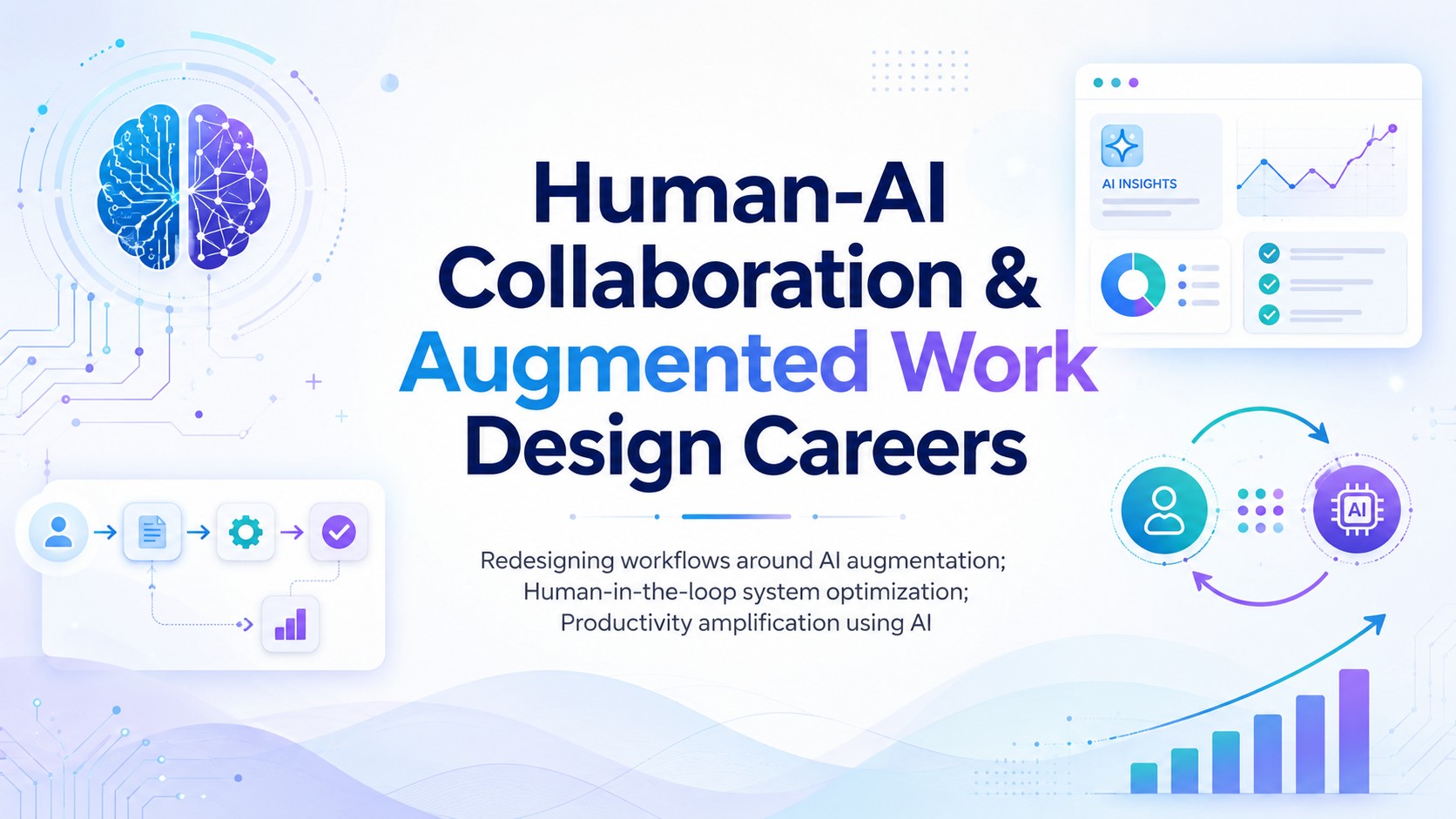
Redesigning workflows around AI augmentation; Human-in-the-loop system optimization; Productivity amplification using AI
Introduction
Artificial Intelligence is no longer only a technology used by data scientists, software engineers, or large technology companies. It is now entering everyday work: writing, research, customer service, marketing, design, operations, finance, teaching, healthcare, law, consulting, project management, and decision support. As AI becomes more capable, the most important question is not simply, “Will AI replace humans?” The better question is: How can humans and AI work together to produce better outcomes than either could produce alone?
This is the core idea behind Human-AI Collaboration. AI can search, summarize, draft, classify, predict, generate, translate, analyze, and automate. Humans can understand context, values, ethics, goals, ambiguity, emotions, accountability, and real-world consequences. When both are combined thoughtfully, the result is not just automation. It is augmentation — the amplification of human ability through intelligent tools.
This creates a new and important career area: Augmented Work Design. These professionals redesign workflows so that AI becomes a productive partner, not a confusing add-on. They decide which tasks should be done by humans, which tasks should be supported by AI, which tasks can be automated, and where human review is essential. They also build human-in-the-loop systems, where people supervise, correct, improve, and guide AI outputs.
The future of work will not be shaped only by people who know how to build AI models. It will also be shaped by people who know how to redesign work around AI. This lecture explores how human-AI collaboration works, why augmented work design matters, what human-in-the-loop systems are, and what career opportunities are emerging in this field. An excellent collection of learning videos awaits you on our Youtube channel.
Let’s dive deep into this.
1. From automation to augmentation
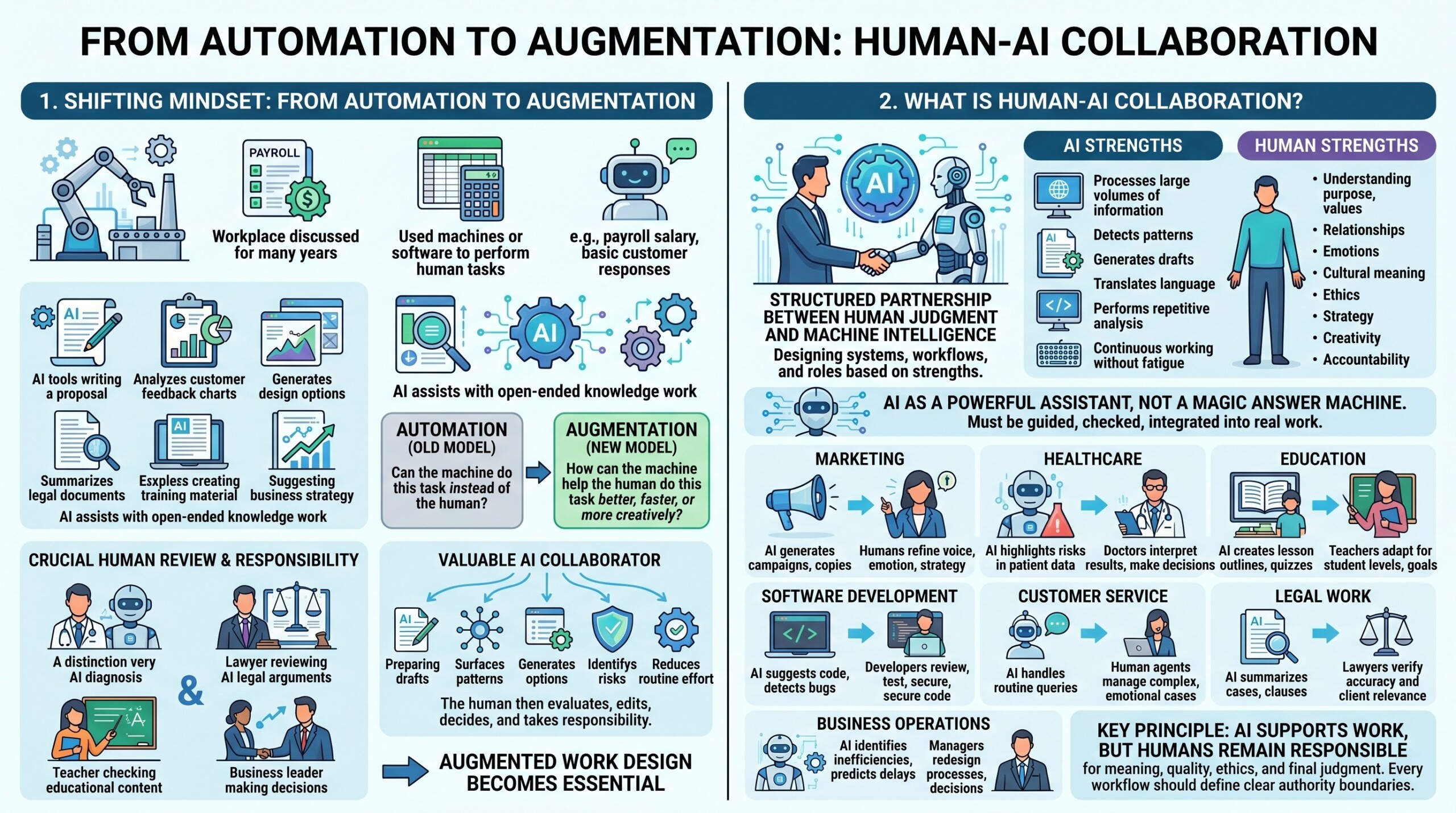
For many years, technology in the workplace was mainly discussed in terms of automation. Automation means using machines or software to perform tasks that humans previously did manually. For example, a payroll system automates salary calculations, a chatbot automates simple customer responses, and a spreadsheet automates numerical calculations.
But AI changes the conversation. AI does not only automate fixed, repetitive tasks. It can also assist with open-ended knowledge work. It can help write a proposal, analyze customer feedback, generate design options, summarize a legal document, explain a technical concept, create training material, or suggest a business strategy.
This moves us from automation to augmentation.
Automation asks:
“Can the machine do this task instead of the human?”
Augmentation asks:
“How can the machine help the human do this task better, faster, or more creatively?”
This distinction is very important. In many workplaces, full automation may not be safe, ethical, or practical. A doctor should not blindly accept an AI diagnosis. A lawyer should not submit an AI-generated legal argument without review. A teacher should not use AI-generated educational content without checking suitability. A business leader should not make major strategic decisions based only on an AI-generated prediction.
In such cases, AI is most valuable as a collaborator. It can prepare drafts, surface patterns, generate options, identify risks, and reduce routine effort. The human then evaluates, edits, decides, and takes responsibility.
This is where augmented work design becomes essential. It helps organizations move beyond the shallow idea of “adding AI tools” and toward the deeper goal of redesigning work intelligently.
2. What is Human-AI Collaboration?
Human-AI Collaboration means designing systems, workflows, and roles where humans and AI contribute according to their strengths. It is not simply about giving employees access to an AI chatbot. It is about creating a structured partnership between human judgment and machine intelligence.
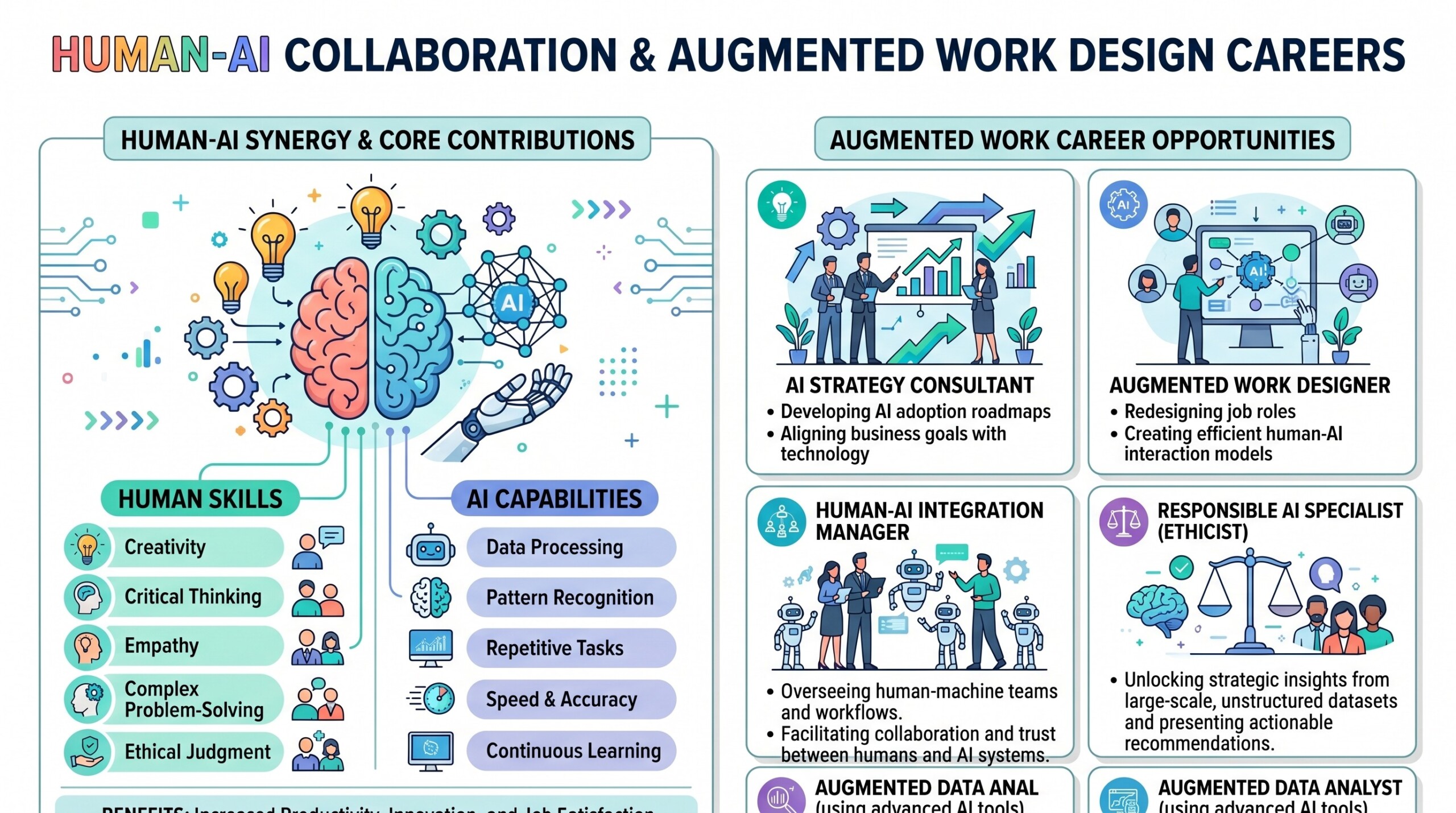
AI is strong at processing large volumes of information, detecting patterns, generating drafts, translating language, performing repetitive analysis, and working continuously without fatigue. Humans are strong at understanding purpose, values, relationships, emotions, cultural meaning, ethics, strategy, creativity, and accountability.
A good Human-AI Collaboration system does not treat AI as a magic answer machine. It treats AI as a powerful assistant that must be guided, checked, and integrated into real work.
Examples of Human-AI Collaboration
- Marketing: AI generates campaign ideas, audience segments, and draft copy. Humans refine the brand voice, emotional tone, and final strategy.
- Healthcare: AI highlights possible risks in patient data. Doctors interpret the results, consider patient history, and make clinical decisions.
- Education: AI creates lesson outlines, quizzes, and explanations. Teachers adapt them to student level, classroom context, and learning goals.
- Software development: AI suggests code, detects bugs, or writes documentation. Developers review, test, secure, and integrate the code.
- Customer service: AI handles routine queries. Human agents manage sensitive, complex, emotional, or high-value cases.
- Legal work: AI summarizes cases and drafts clauses. Lawyers verify accuracy, legal relevance, and client-specific implications.
- Business operations: AI identifies inefficiencies and predicts delays. Managers redesign processes and make final trade-off decisions.
The key principle is: AI supports the work, but humans remain responsible for meaning, quality, ethics, and final judgment.
Human-AI Collaboration works best when the roles are clear. Confusion arises when people do not know whether AI is merely suggesting, recommending, deciding, or acting. Therefore, every AI-enabled workflow should define the boundaries of authority. A constantly updated Whatsapp channel awaits your participation.
3. Redesigning workflows around AI augmentation
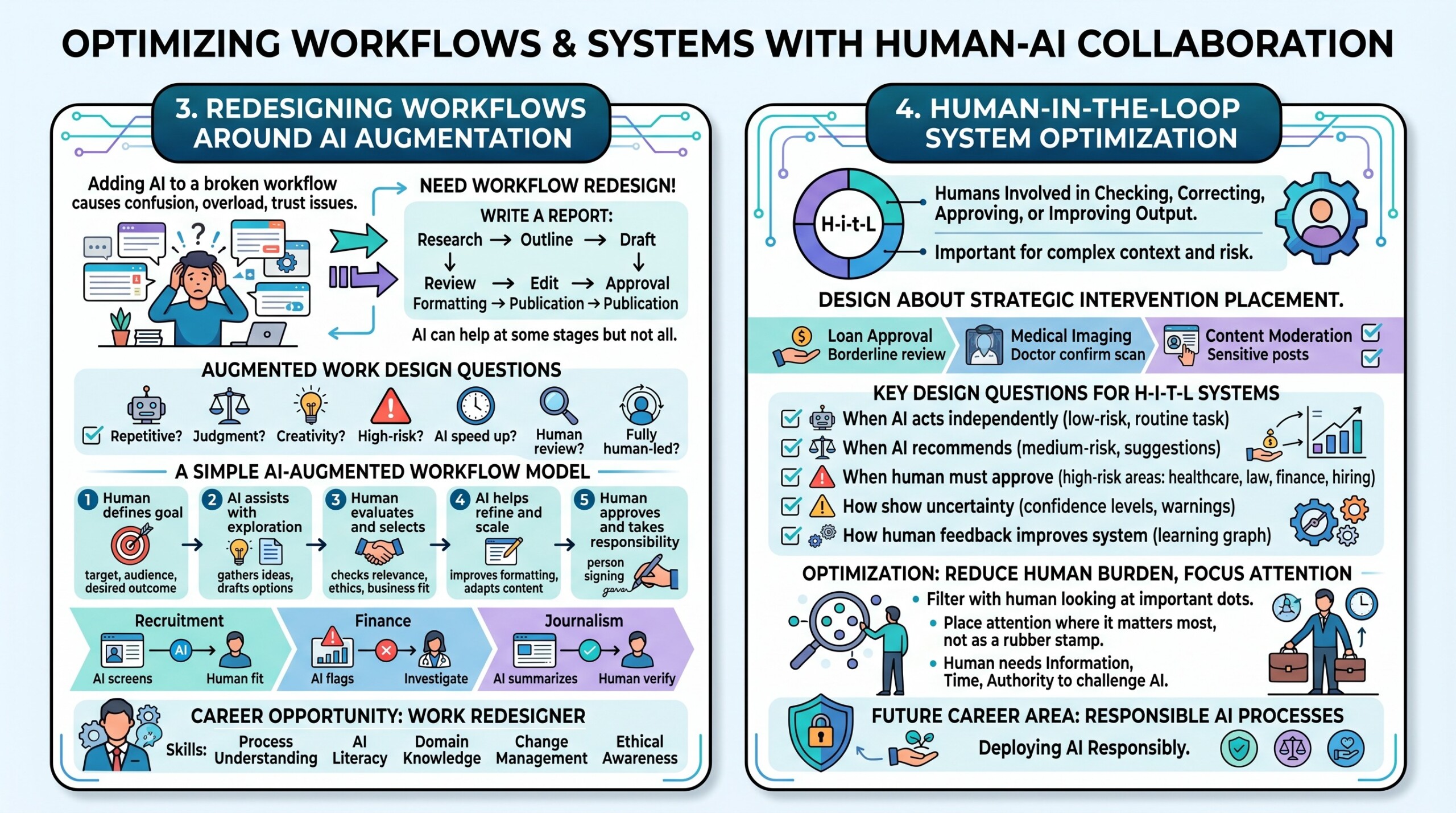
Adding AI to a broken workflow does not automatically make the workflow better. In fact, it can sometimes make work more confusing. Employees may receive too many AI-generated suggestions, spend more time checking low-quality outputs, or feel uncertain about when to trust the system.
That is why organizations need workflow redesign.
A workflow is the sequence of steps through which work gets done. For example, writing a report may involve research, outlining, drafting, review, editing, approval, formatting, and publication. AI can help at several of these stages, but it may not be suitable for all of them.
Augmented work design asks:
- Which parts of this workflow are repetitive?
- Which parts require judgment?
- Which parts involve creativity?
- Which parts are high-risk?
- Which parts can AI speed up?
- Which parts need human review?
- Which parts should remain fully human-led?
A simple AI-augmented workflow model
- Step 1: Human defines the goal
The human clarifies the problem, audience, constraints, and desired outcome. - Step 2: AI assists with exploration
AI gathers ideas, drafts options, summarizes information, or identifies patterns. - Step 3: Human evaluates and selects
The human checks relevance, accuracy, tone, ethics, and business fit. - Step 4: AI helps refine and scale
AI improves formatting, rewrites variations, generates summaries, or adapts content for multiple audiences. - Step 5: Human approves and takes responsibility
The final decision remains with a person, especially in high-stakes contexts.
This model can be applied to many fields. In recruitment, AI may screen resumes, but humans should evaluate fairness and cultural fit. In finance, AI may flag unusual transactions, but humans should investigate and make decisions. In journalism, AI may summarize background material, but humans should verify facts and editorial judgment.
The career opportunity lies in becoming the person who can redesign such workflows. This requires process understanding, AI literacy, domain knowledge, change management, and ethical awareness.
4. Human-in-the-loop system optimization
A human-in-the-loop system is a system where AI performs part of the work, but humans remain involved in checking, correcting, approving, or improving the output. This is especially important when errors can cause harm, when decisions affect people, or when context is complex.
Human-in-the-loop design is not just about placing a human at the end of the process. It is about deciding exactly where, when, and how human intervention should happen.
For example, in an AI-based loan approval system, humans may need to review borderline cases, rejected applications, or cases involving unusual circumstances. In an AI medical imaging system, doctors may review flagged scans and confirm diagnosis. In an AI content moderation system, humans may handle ambiguous or sensitive posts.
Key design questions for human-in-the-loop systems
- When should the AI act independently?
Low-risk, routine, reversible tasks may be suitable for more automation. - When should the AI only recommend?
Medium-risk tasks may allow AI to suggest options while humans decide. - When must a human approve the output?
High-risk areas such as healthcare, law, finance, hiring, and safety usually require human approval. - How should uncertainty be shown?
The system should show confidence levels, reasons, warnings, or alternative interpretations where possible. - How should human feedback improve the system?
Corrections made by humans should be captured and used to improve future performance.
Human-in-the-loop optimization also involves reducing unnecessary human burden. If every AI output requires detailed review, employees may become slower, not faster. The goal is to place human attention where it matters most.
Good design means the human is not used as a rubber stamp. The human should have enough information, time, and authority to challenge the AI.
This is an important future career area because many organizations will not be able to deploy AI responsibly without strong human-in-the-loop processes. Excellent individualised mentoring programmes available.
5. Productivity amplification using AI
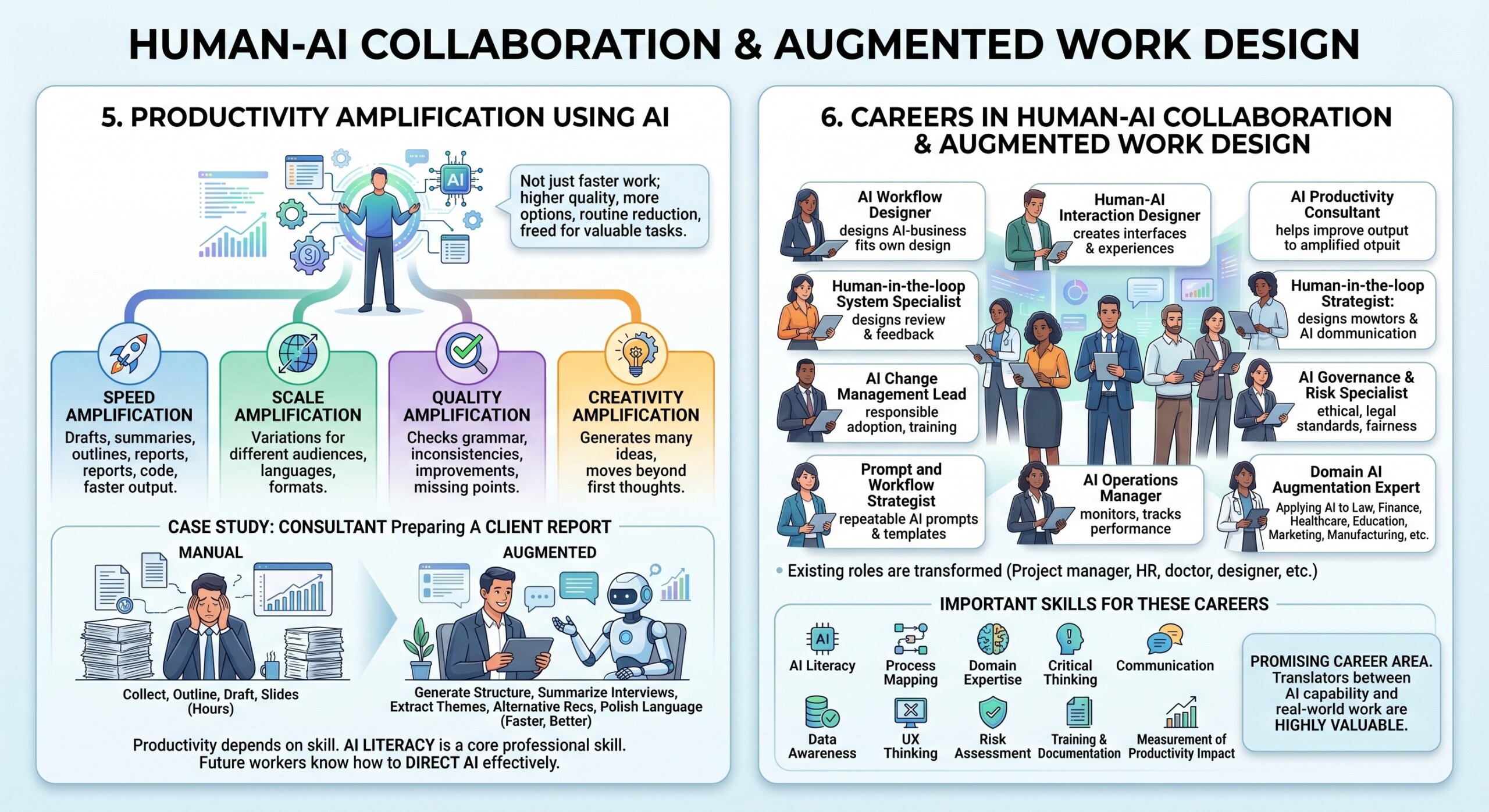
One of the biggest promises of AI is productivity amplification. This does not simply mean doing the same work faster. It also means doing higher-quality work, exploring more options, reducing routine effort, and freeing humans for more valuable tasks.
AI can amplify productivity in at least four ways: speed, scale, quality, and creativity.
How AI amplifies productivity
- Speed amplification
AI can produce first drafts, summaries, outlines, tables, reports, emails, presentations, and code much faster than humans working from scratch. - Scale amplification
A person can use AI to create variations for different audiences, languages, formats, or customer groups. - Quality amplification
AI can check grammar, detect inconsistencies, suggest improvements, compare options, and identify missing points. - Creativity amplification
AI can generate many ideas quickly, helping humans move beyond their first obvious thought.
Consider a consultant preparing a client report. Without AI, the consultant may spend many hours collecting background information, creating an outline, drafting sections, and preparing slides. With AI, the consultant can generate a first structure, summarize interviews, extract themes from notes, create alternative recommendations, and polish the final language. The consultant still needs expertise, but the work becomes faster and potentially better.
However, productivity amplification depends on skill. A poor user may accept weak AI output. A skilled user can guide the AI, question it, improve it, and combine it with human expertise. This is why AI literacy is becoming a core professional skill.
The most productive workers of the future may not be those who simply “use AI.” They will be those who know how to direct AI effectively.
6. Careers in Human-AI Collaboration and Augmented Work Design
As AI enters every sector, new career roles will emerge around designing, managing, improving, and governing human-AI work systems. These roles will sit between technology, business, psychology, operations, design, and ethics.
Some roles may have new job titles. Others may be existing roles transformed by AI. A project manager, HR leader, teacher, consultant, lawyer, doctor, designer, or operations head may all need augmented work design skills.
Possible career roles
- AI Workflow Designer
Designs how AI tools fit into existing business processes. - Human-AI Interaction Designer
Creates interfaces and experiences that help humans understand and control AI systems. - AI Productivity Consultant
Helps individuals and teams use AI to improve speed, quality, and output. - Human-in-the-loop System Specialist
Designs review, approval, escalation, and feedback processes for AI systems. - AI Change Management Lead
Helps organizations adopt AI responsibly while training employees and reducing resistance. - AI Governance and Risk Specialist
Ensures AI-supported workflows follow ethical, legal, privacy, and fairness standards. - Prompt and Workflow Strategist
Builds repeatable AI prompts, templates, and operating procedures for teams. - AI Operations Manager
Monitors AI-enabled processes, tracks performance, identifies failures, and improves workflows. - Domain AI Augmentation Expert
Applies AI to a specific field such as law, finance, healthcare, education, marketing, or manufacturing.
These roles require a combination of hard and soft skills. Technical knowledge helps, but deep coding may not always be necessary. Many careers in this space will reward people who understand work deeply and can redesign it intelligently.
Important skills include:
- AI literacy
- Process mapping
- Domain expertise
- Critical thinking
- Communication
- Ethical reasoning
- Data awareness
- Change management
- User experience thinking
- Risk assessment
- Training and documentation
- Measurement of productivity impact
This is a very promising career area because most organizations will need translators between AI capability and real-world work. The people who can perform this translation will become highly valuable. Subscribe to our free AI newsletter now.
7. Risks, ethics, and responsible design
Human-AI collaboration can create enormous value, but it also brings risks. Poorly designed AI workflows can produce errors, bias, over-dependence, privacy violations, employee anxiety, and loss of accountability.
One common risk is automation bias. This happens when humans trust AI too much simply because the output looks confident or professional. A polished AI answer may still be wrong. Therefore, humans must be trained to question AI outputs, especially in important decisions.
Another risk is deskilling. If AI does too much of the thinking, employees may gradually lose their own ability to analyze, write, calculate, diagnose, or decide. Good augmented work design should strengthen human capability, not weaken it.
There is also the risk of unfairness. AI systems trained on biased data may reproduce or amplify social and organizational biases. In hiring, lending, education, policing, healthcare, and insurance, this can seriously harm people.
Principles for responsible Human-AI Collaboration
- Human accountability
A human or organization must remain responsible for important decisions. - Transparency
Users should know when AI is being used and what role it plays. - Explainability where needed
High-stakes decisions should not depend on unexplained AI outputs. - Fairness
AI workflows should be checked for bias and unequal impact. - Privacy protection
Sensitive data should not be casually entered into AI tools. - Right level of automation
Not every task should be fully automated. - Human skill preservation
AI should support learning and judgment, not replace thinking entirely. - Continuous monitoring
AI systems should be evaluated regularly because performance can change over time.
Responsible design is not an optional add-on. It is central to successful AI adoption. Organizations that ignore these issues may face legal problems, reputational damage, employee resistance, and poor decision quality.
The best Human-AI Collaboration systems are not only efficient. They are trustworthy, understandable, and aligned with human goals. Upgrade your AI-readiness with our masterclass.
Conclusion
Human-AI Collaboration is one of the most important themes in the future of work. AI is becoming powerful enough to support many forms of knowledge work, but it still needs human direction, judgment, supervision, and accountability. The real opportunity is not simply to replace human effort, but to redesign work so that humans and AI can achieve more together.
Augmented Work Design is therefore becoming a major career area. It involves understanding workflows, identifying where AI can help, deciding where humans must remain involved, building human-in-the-loop systems, and measuring productivity improvement. This work requires more than technical skill. It requires business understanding, ethics, communication, process design, and deep awareness of human strengths.
The future workplace will not be divided simply between humans and machines. It will be shaped by partnerships. Some tasks will be automated, some will be AI-assisted, and some will remain deeply human. The most successful professionals will be those who know how to combine human intelligence with artificial intelligence in practical, responsible, and creative ways.
The central message is simple:
AI should not merely replace work. It should redesign work.
It should not only automate tasks. It should augment human potential.
The careers of the future will belong to those who can build better partnerships between people and intelligent machines.