Knowledge Graphs for modern AI systems
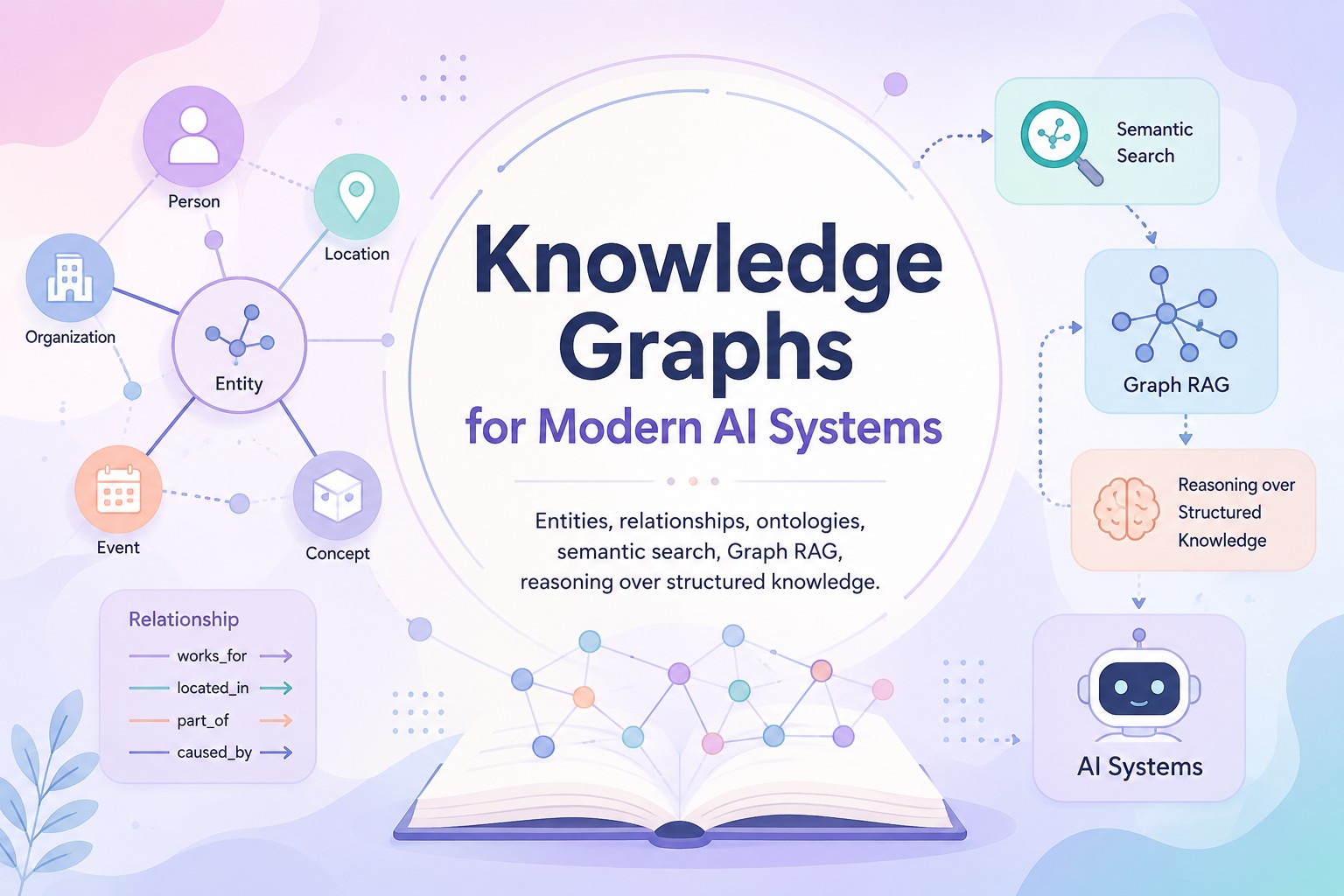
Knowledge Graphs for modern AI systems
Entities, relationships, ontologies, semantic search, Graph RAG, reasoning over structured knowledge.
Introduction
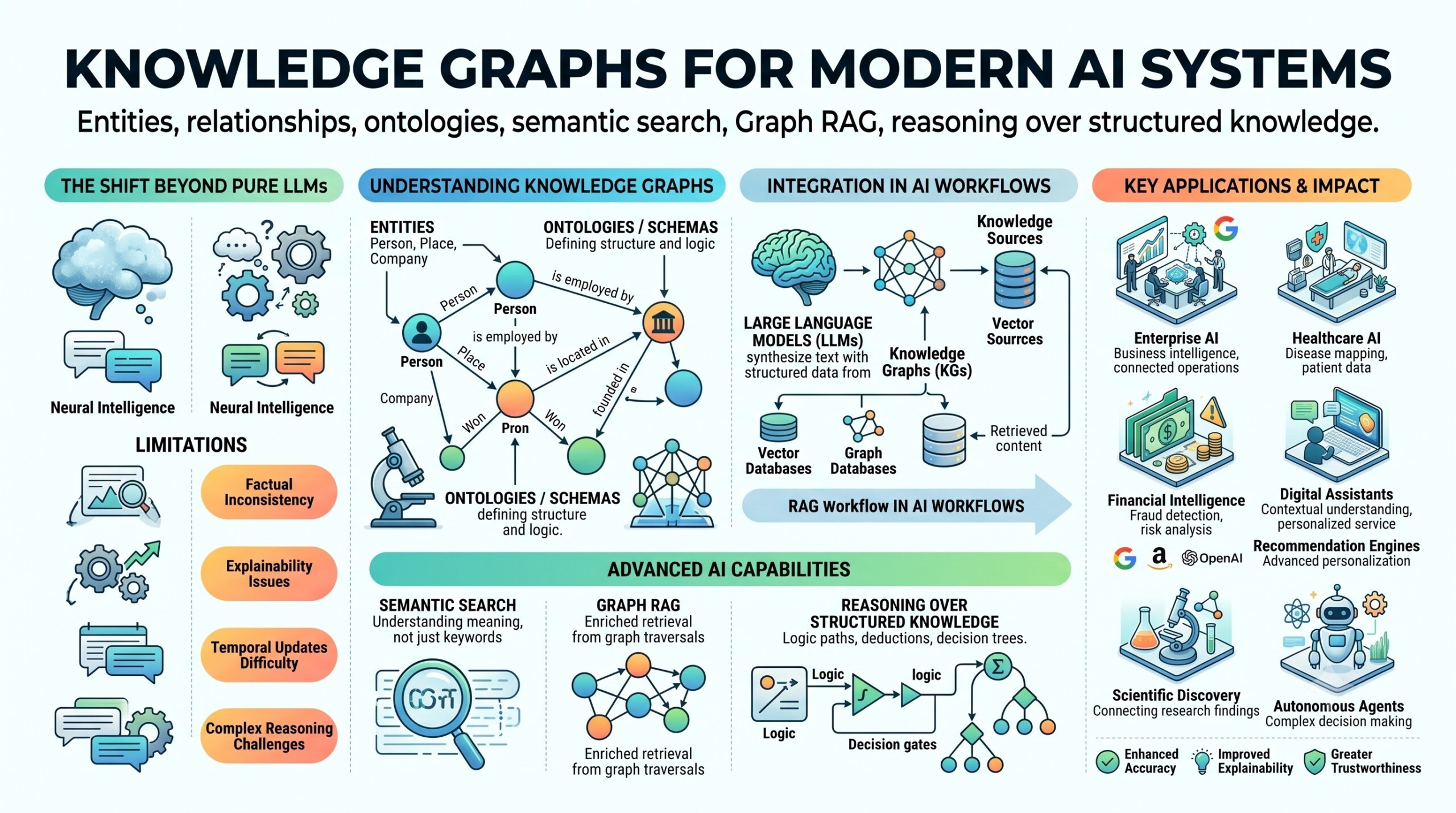
The AI landscape is increasingly moving beyond pure Large Language Models (LLMs) toward systems that combine neural intelligence with structured knowledge. While LLMs are excellent at generating language, they often struggle with factual consistency, explainability, temporal updates, and complex reasoning across interconnected facts.
Knowledge Graphs (KGs) have emerged as one of the most important technologies for addressing these limitations. Modern AI systems now combine vector databases, semantic search, retrieval-augmented generation (RAG), graph databases, and knowledge graphs to create more accurate, explainable, and trustworthy AI applications.
Major technology companies such as Google, Microsoft, Meta, Amazon, and OpenAI increasingly integrate structured knowledge into AI workflows. A knowledge graph acts as a machine-readable representation of the world by organizing entities and their relationships into a network of connected facts. This enables AI systems to understand context, perform reasoning, improve retrieval quality, and support advanced Graph RAG architectures.
Knowledge graphs are now becoming foundational components in enterprise AI, healthcare AI, financial intelligence systems, digital assistants, recommendation engines, scientific discovery platforms, and next-generation autonomous agents.
Let’s dive deep into the topic now.
1. What is a Knowledge Graph?
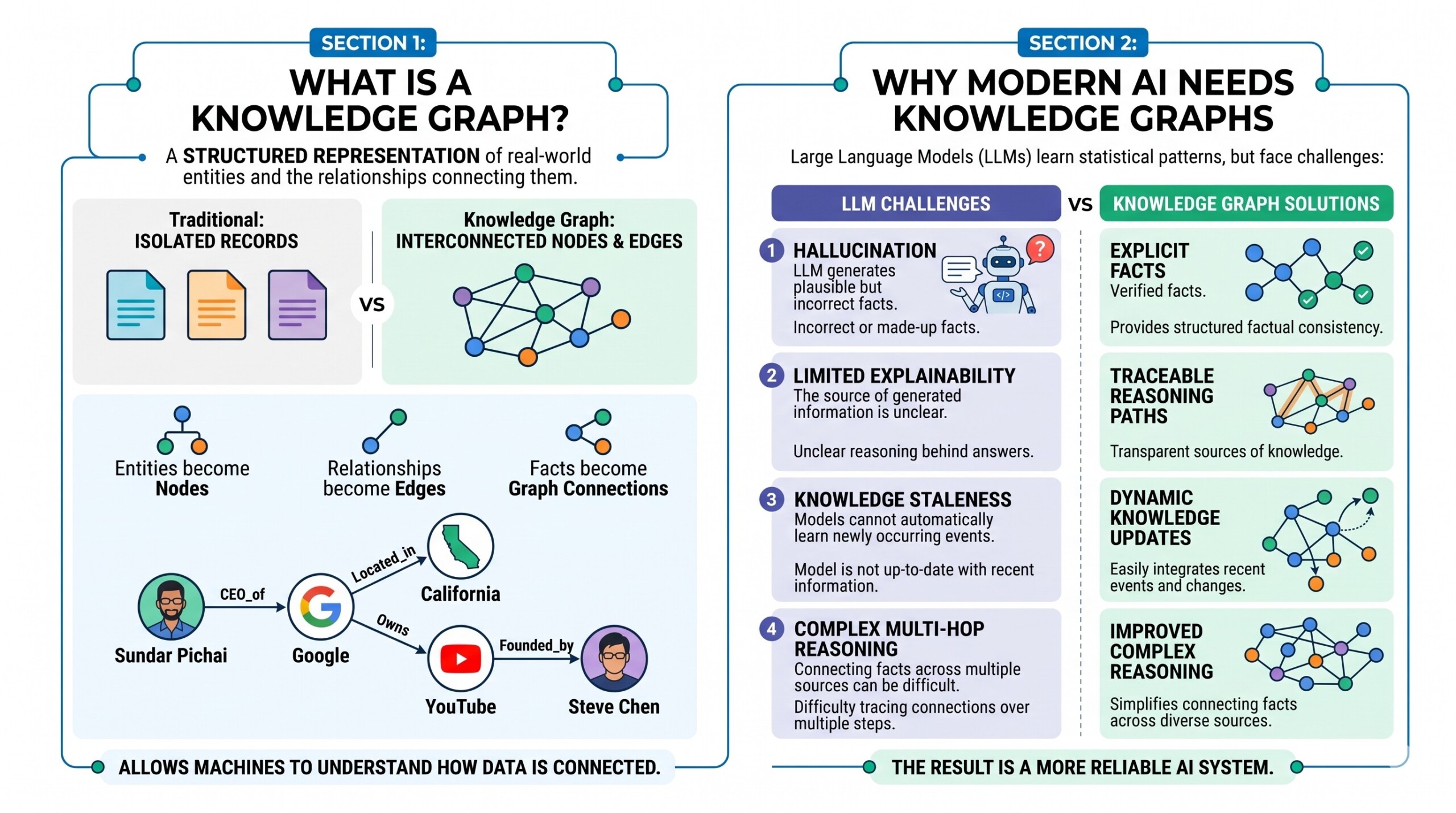
A Knowledge Graph is a structured representation of real-world entities and the relationships connecting them.
Instead of storing information as isolated records, a knowledge graph stores information as interconnected nodes and edges.
Example
Sundar Pichai → CEO_of → Google
Google → Located_in → California
Google → Owns → YouTube
YouTube → Founded_by → Steve Chen
Here:
- Entities become nodes
- Relationships become edges
- Facts become graph connections
This structure allows machines to understand not just data, but how data is connected.
2. Why Modern AI needs Knowledge Graphs
Large Language Models learn statistical patterns from vast amounts of text.
However, they face several challenges:
Challenge 1: Hallucination LLMs may generate plausible but incorrect facts.
Challenge 2: Limited Explainability The source of generated information is often unclear.
Challenge 3: Knowledge Staleness Models cannot automatically learn newly occurring events.
Challenge 4: Complex Multi-Hop Reasoning Connecting facts across multiple sources can be difficult.
Now, Knowledge Graphs address these limitations by providing:
- Explicit facts
- Structured relationships
- Traceable reasoning paths
- Dynamic knowledge updates
The result is a more reliable AI system. An excellent collection of learning videos awaits you on our Youtube channel.
3. Core components of a Knowledge Graph
3.1 Entities
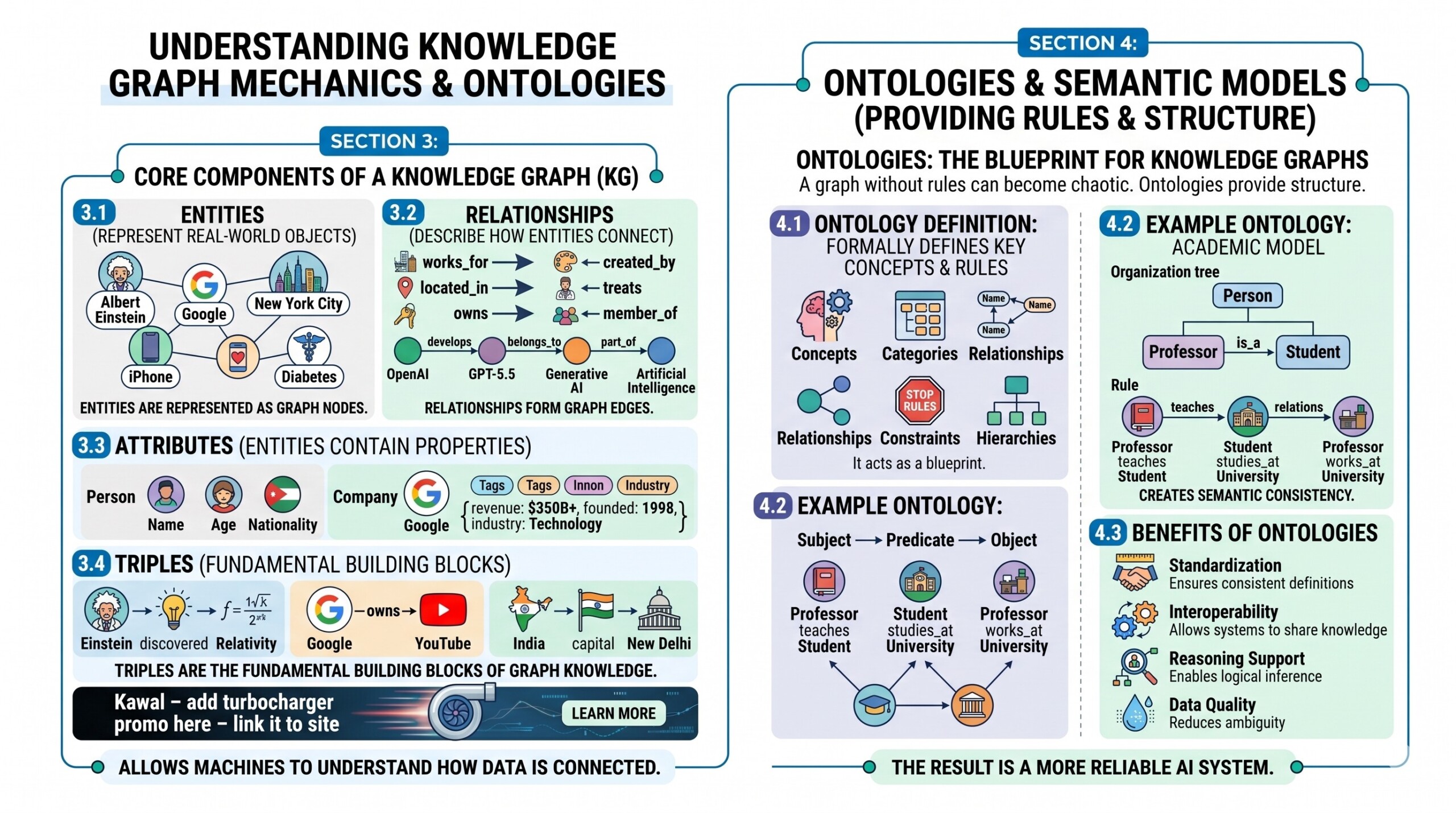
Entities represent real-world objects, concepts, places, organizations, people, or events.
Examples:
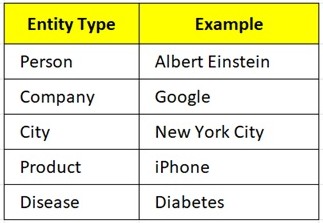
Entities are usually represented as graph nodes.
3.2 Relationships
Relationships describe how entities are connected.
Examples:
works_for
located_in
owns
created_by
treats
member_of
Example:
OpenAI → develops → GPT-5.5
GPT-5.5 → belongs_to → Generative AI
Generative AI → part_of → Artificial Intelligence
Relationships form graph edges.
3.3 Attributes
Entities can contain properties.
Example:
Person:
Name
Age
Nationality
Company:
Revenue
Industry
Headquarters
Example:
Google
{
revenue: $350B+
founded: 1998
industry: Technology
}
3.4 Triples
Most knowledge graphs are built using triples:
Subject → Predicate → Object
Example:
Einstein → discovered → Relativity
Google → owns → YouTube
India → capital → New Delhi
Triples are the fundamental building blocks of graph knowledge.

4. Ontologies and Semantic Models
A graph without rules can become chaotic.
Ontologies provide structure.
Definition
An ontology formally defines:
- Concepts
- Categories
- Relationships
- Constraints
- Hierarchies
It acts as a blueprint for the knowledge graph.
Example Ontology
Person
Professor
└── is_a Person
Student
└── is_a Person
University
Rules:
Professor teaches Student
Student studies_at University
Professor works_at University
This creates semantic consistency.
Benefits of Ontologies
Standardization
Ensures consistent definitions.
Interoperability
Allows systems to share knowledge.
Reasoning Support
Enables logical inference.
Data Quality
Reduces ambiguity. A constantly updated Whatsapp channel awaits your participation.
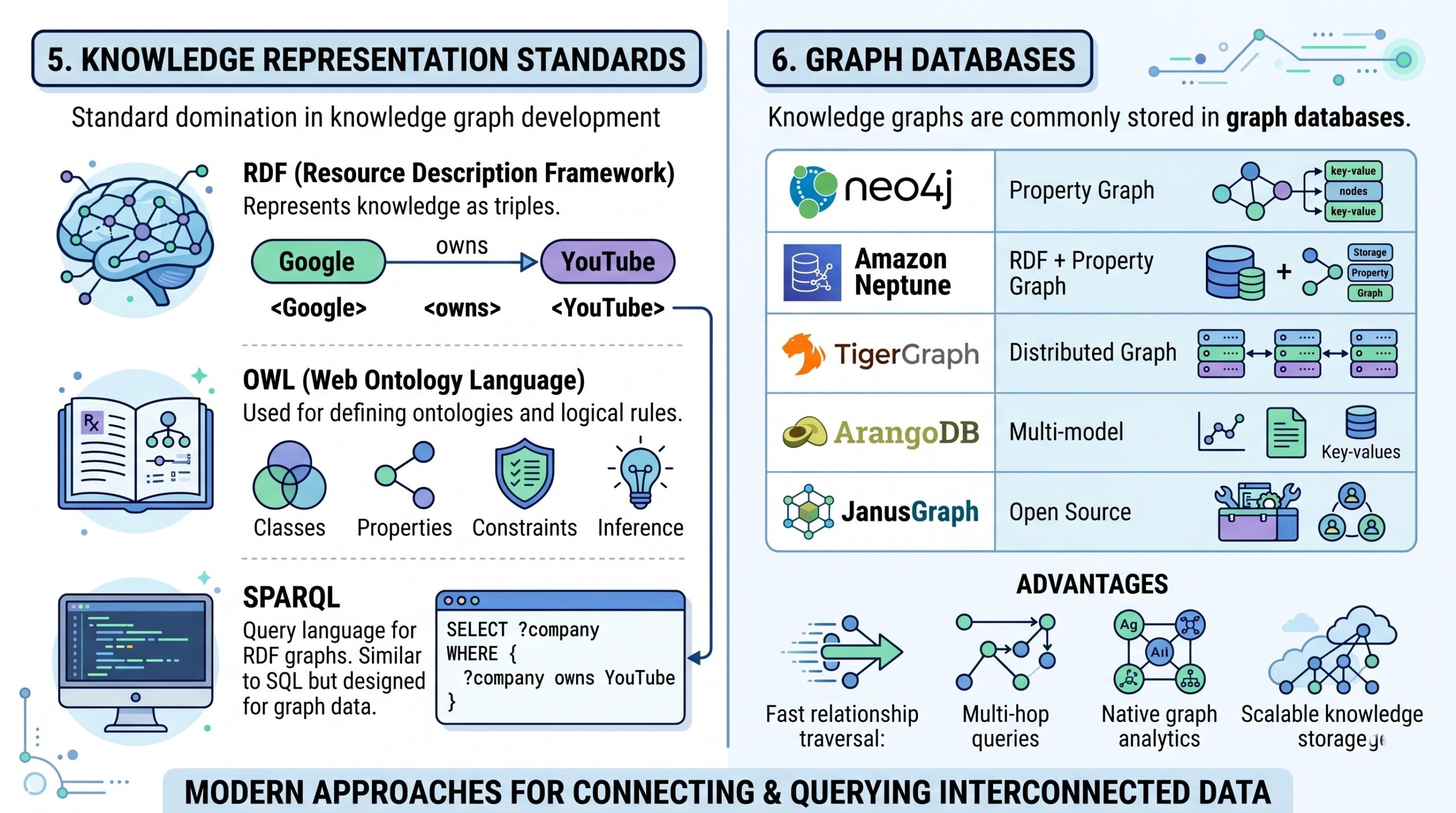
5. Knowledge Representation Standards
Several standards dominate knowledge graph development.
RDF
Resource Description Framework
Represents knowledge as triples.
Example:
<Google> <owns> <YouTube>
OWL
Web Ontology Language
Used for defining ontologies and logical rules.
Supports:
- Classes
- Properties
- Constraints
- Inference
SPARQL
Query language for RDF graphs.
Example:
SELECT ?company
WHERE {
?company owns YouTube
}
Similar to SQL but designed for graph data.
6. Graph databases
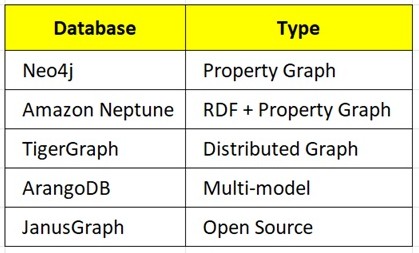
Knowledge graphs are commonly stored in graph databases.
Popular systems include:
Advantages:
- Fast relationship traversal
- Multi-hop queries
- Native graph analytics
- Scalable knowledge storage Excellent individualised mentoring programmes available.
7. Semantic Search and Knowledge Graphs
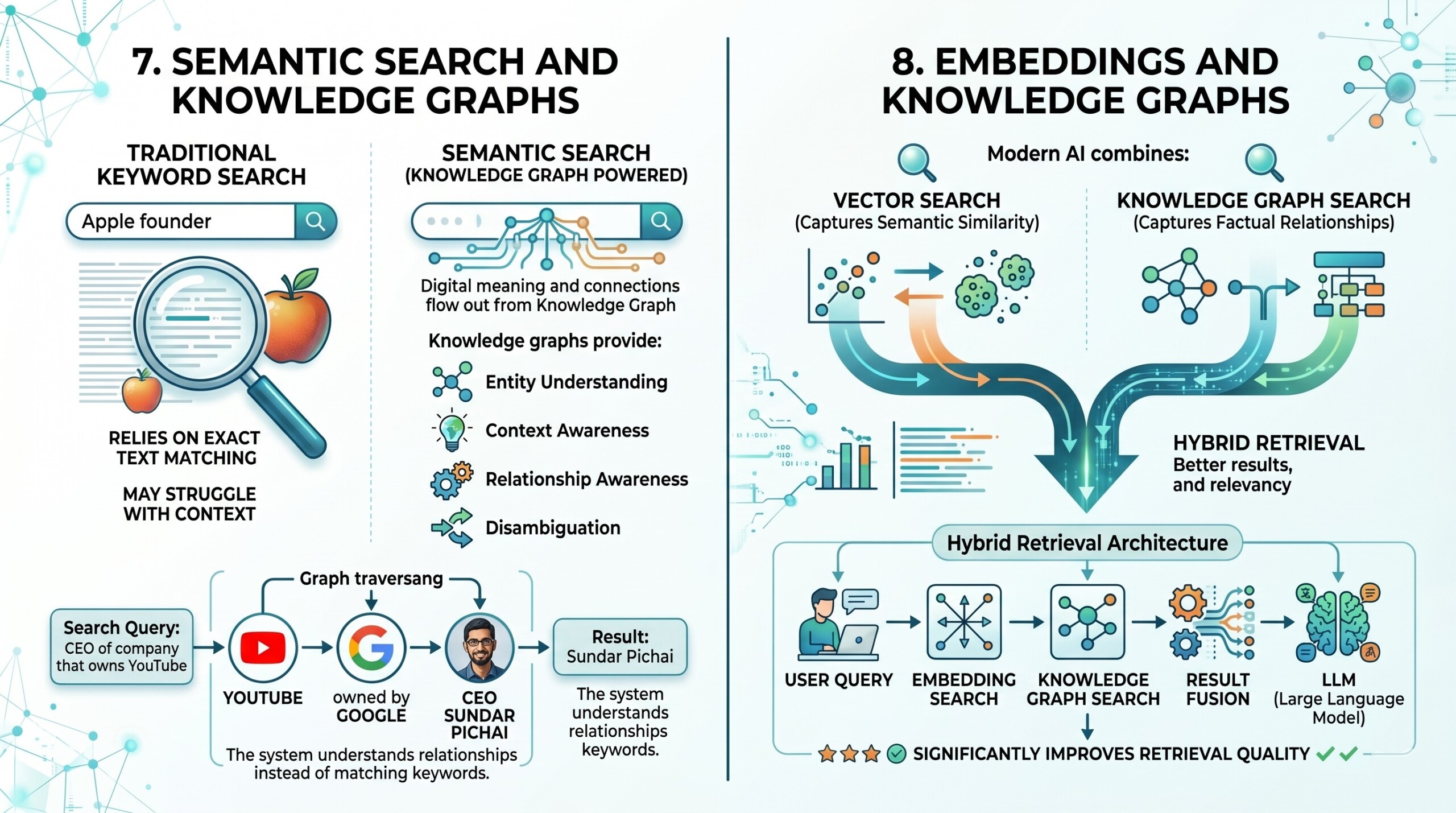
Traditional keyword search relies on exact text matching.
Example:
Search:
Apple founder
Keyword systems may struggle with context.
Semantic search understands meaning.
Knowledge graphs provide:
- Entity understanding
- Context awareness
- Relationship awareness
- Disambiguation
Example
Query:
CEO of company that owns YouTube
Graph traversal:
YouTube
→ owned by Google
→ CEO Sundar Pichai
Result:
Sundar Pichai
The system understands relationships instead of matching keywords.
8. Embeddings and Knowledge Graphs
Modern AI combines:
Vector Search
Captures semantic similarity.
Knowledge Graph Search
Captures factual relationships.
Together they create:
Hybrid Retrieval
Architecture:
User Query
↓
Embedding Search
↓
Knowledge Graph Search
↓
Result Fusion
↓
LLM
This significantly improves retrieval quality. Subscribe to our free AI newsletter now.
9. Reasoning over Structured Knowledge
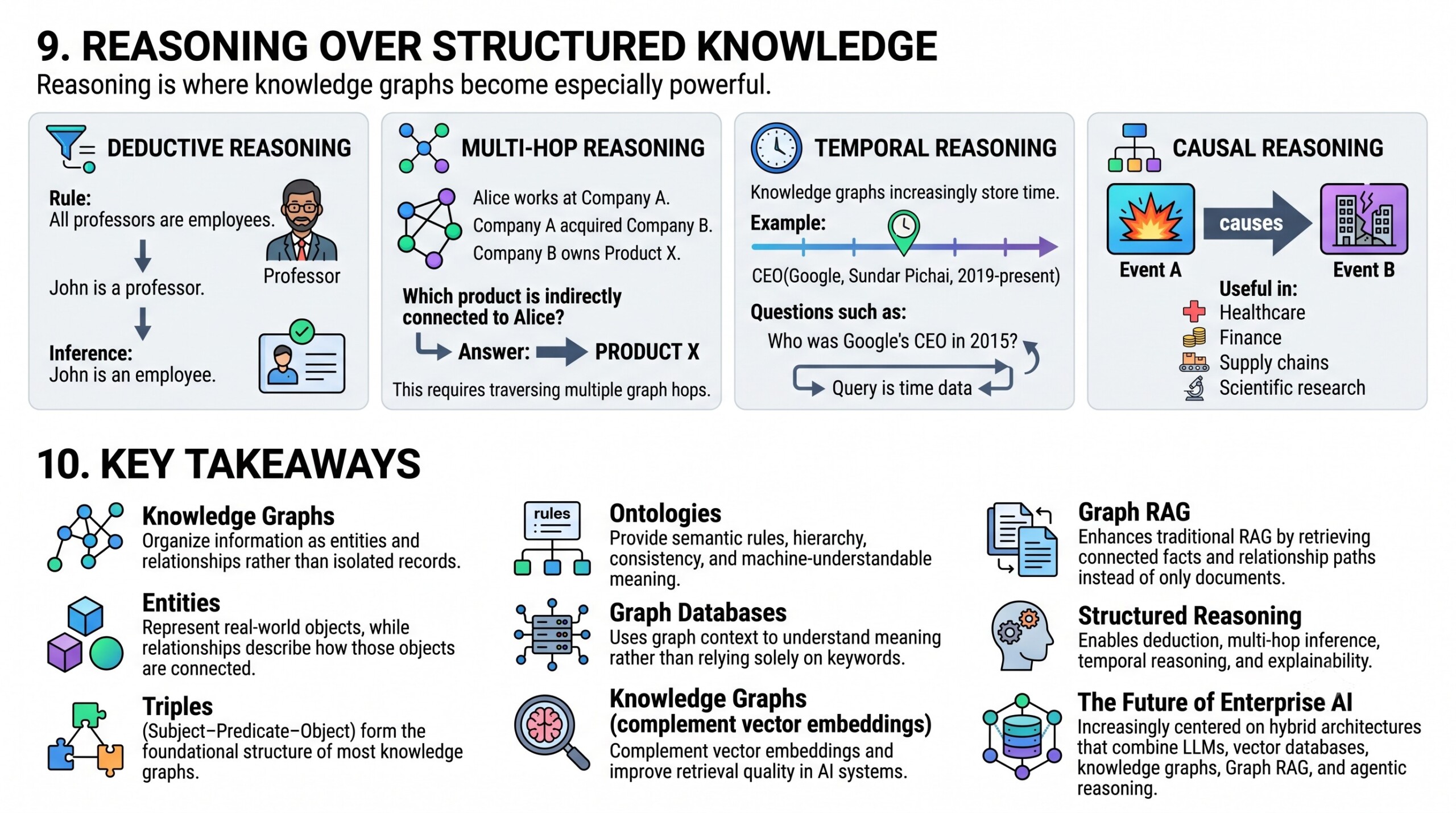
Reasoning is where knowledge graphs become especially powerful.
Deductive Reasoning
Rule:
All professors are employees.
John is a professor.
Inference:
John is an employee.
Multi-Hop Reasoning
Example:
Alice works at Company A.
Company A acquired Company B.
Company B owns Product X.
Question:
Which product is indirectly connected to Alice?
Answer:
Product X
This requires traversing multiple graph hops.
Temporal Reasoning
Knowledge graphs increasingly store time.
Example:
CEO(Google, Sundar Pichai, 2019-present)
Allows questions such as:
Who was Google’s CEO in 2015?
Causal Reasoning
Emerging graph AI systems can model:
Event A
causes
Event B
Useful in:
- Healthcare
- Finance
- Supply chains
- Scientific research
10. Key takeaways
- Knowledge Graphs organize information as entities and relationships rather than isolated records.
- Entities represent real-world objects, while relationships describe how those objects are connected.
- Triples (Subject–Predicate–Object) form the foundational structure of most knowledge graphs.
- Ontologies provide semantic rules, hierarchy, consistency, and machine-understandable meaning.
- Graph databases enable efficient storage and traversal of highly connected information.
- Semantic search uses graph context to understand meaning rather than relying solely on keywords.
- Knowledge graphs complement vector embeddings and improve retrieval quality in AI systems.
- Graph RAG enhances traditional RAG by retrieving connected facts and relationship paths instead of only documents.
- Structured reasoning over graphs enables deduction, multi-hop inference, temporal reasoning, and explainability.
- The future of enterprise AI is increasingly centred on hybrid architectures that combine LLMs, vector databases, knowledge graphs, Graph RAG, and agentic reasoning. Upgrade your AI-readiness with our masterclass.
Conclusion
Knowledge Graphs have evolved from being primarily a semantic web technology into a core component of modern AI architectures. As AI systems move toward greater accuracy, explainability, autonomy, and enterprise deployment, structured knowledge is becoming as important as neural computation. Knowledge graphs provide a mechanism for representing real-world entities, capturing relationships, enforcing semantic consistency through ontologies, enabling advanced semantic search, and supporting sophisticated reasoning across interconnected facts. The emergence of Graph RAG, agentic AI, and neuro-symbolic architectures demonstrates that the future of AI is not purely neural nor purely symbolic, but a fusion of both. In 2026, organizations seeking trustworthy, explainable, and scalable AI increasingly view knowledge graphs as a strategic layer that connects data, reasoning, retrieval, and intelligence into a unified system.