Prompt Engineering & Context Design Roles – From prompt writing to system orchestration

Artificial intelligence has moved beyond static models and one-off interactions into interactive, context-aware systems embedded in products, workflows, and decision processes. As a result, a new class of roles has emerged around prompt engineering and context design. These roles are not about clever phrasing alone, but about shaping how AI systems perceive tasks, constraints, goals, and environments.
Prompt and context design sit at the boundary between human intent and machine behaviour. Large language models do not operate in a vacuum; they respond to the structure, framing, memory, and signals provided to them. Designing these inputs has become a critical function for building reliable, scalable, and trustworthy AI systems. Understanding these roles is essential for anyone involved in deploying AI beyond experimentation.
1. The expanding prompt and context design landscape
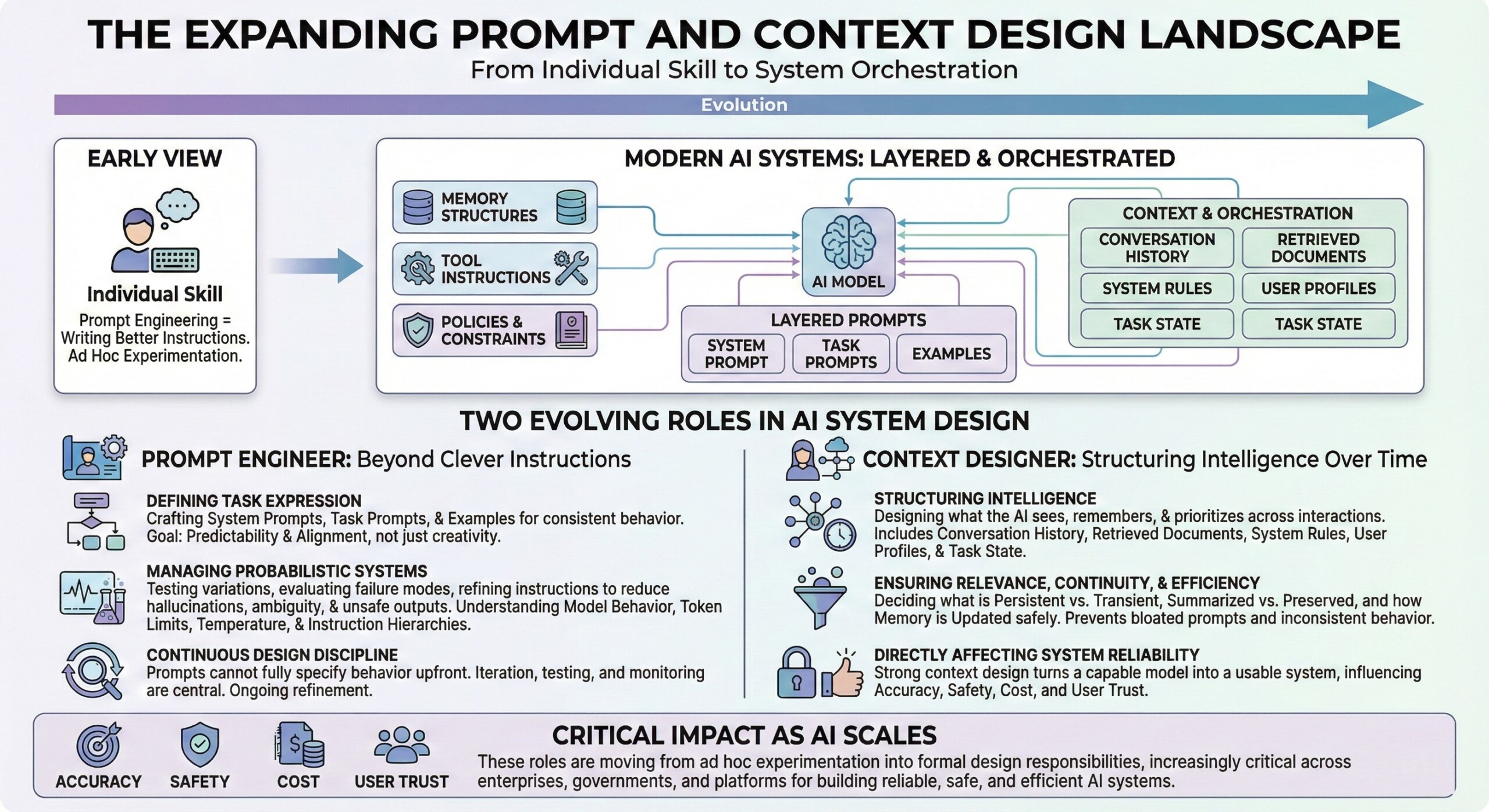
Early discussions around prompt engineering framed it as an individual skill—writing better instructions to get better answers. In production systems, however, prompt engineering has evolved into context engineering and system orchestration.
Modern AI systems rely on layered prompts, memory structures, tool instructions, policies, and constraints. Prompt and context designers now shape how models reason across multi-step tasks, how they handle ambiguity, and how they interact with external systems. This work directly influences accuracy, safety, cost, and user trust.
As AI systems scale, these roles move from ad hoc experimentation into formal design responsibilities, increasingly critical across enterprises, governments, and platforms.
2. Prompt Engineer: Beyond clever instructions
Prompt Engineers focus on defining how tasks are expressed to AI systems. This includes crafting system prompts, task prompts, and examples that guide model behavior consistently across scenarios. The goal is not creativity, but predictability and alignment.
In practice, Prompt Engineers manage probabilistic systems. They test variations, evaluate failure modes, and refine instructions to reduce hallucinations, ambiguity, and unsafe outputs. They must understand model behavior, token limits, temperature effects, and instruction hierarchies.
Unlike traditional interfaces, prompts cannot fully specify behavior upfront. Iteration, testing, and monitoring are central to the role, making prompt engineering a continuous design discipline rather than a one-time activity. An excellent collection of learning videos awaits you on our Youtube channel.
3. Context Designer: Structuring intelligence over time
Context Designers operate at a higher system level. Their responsibility is to design what information the AI sees, remembers, and prioritizes across interactions. This includes conversation history, retrieved documents, system rules, user profiles, and task state.
Poor context design leads to bloated prompts, inconsistent behavior, and rising inference costs. Strong context design ensures relevance, continuity, and efficiency. Context Designers decide what is persistent versus transient, what is summarized versus preserved, and how memory is updated safely.
These decisions directly affect system reliability. Context design turns a capable model into a usable system.
4. From prompt writing to system orchestration
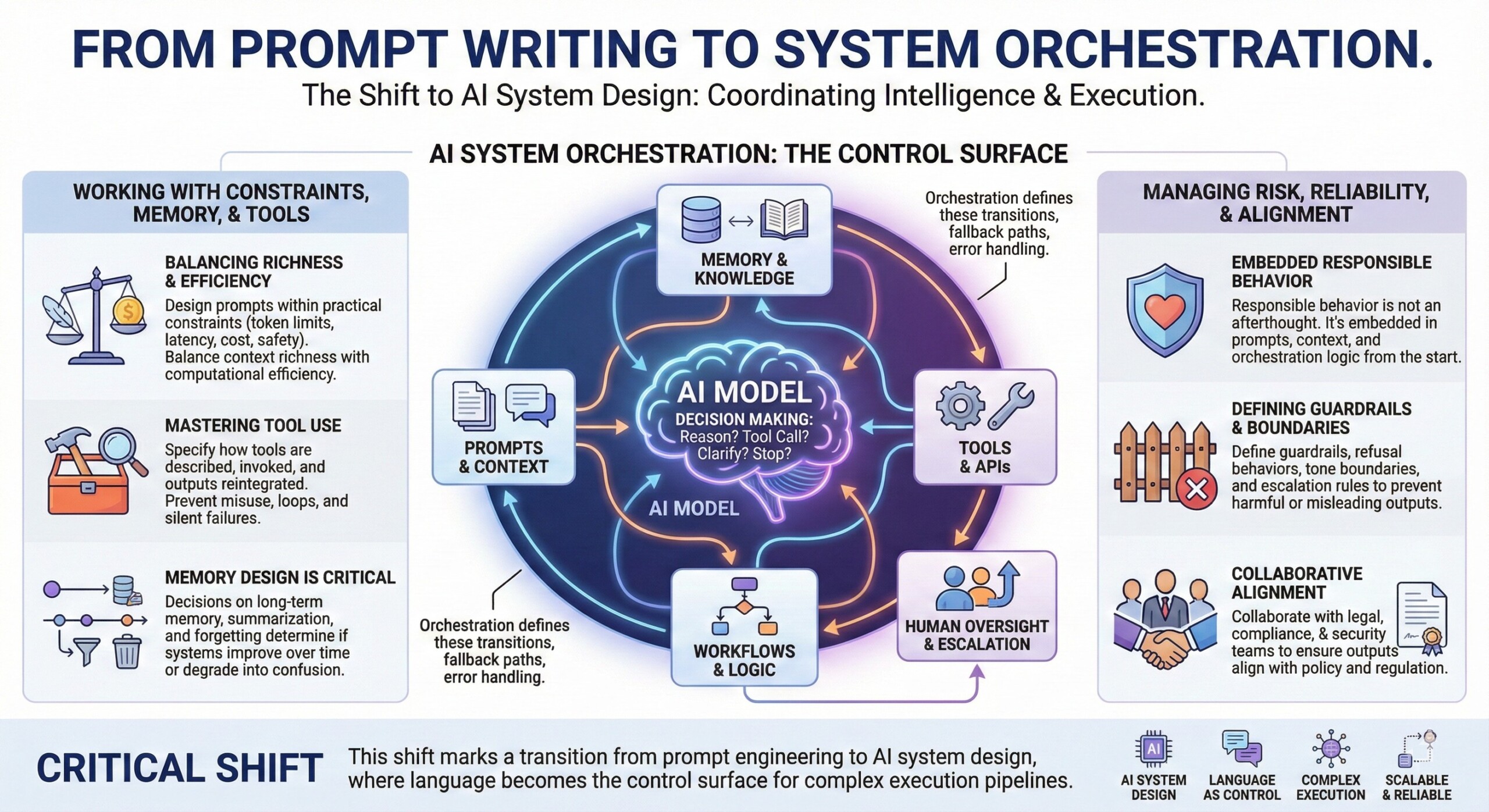
As AI systems grow more agentic, prompt and context roles expand into orchestration. Orchestration involves coordinating prompts, tools, workflows, memory, and human oversight into a coherent system.
In multi-step tasks, the model must know when to reason, when to call tools, when to ask for clarification, and when to stop. Orchestration defines these transitions. It also includes fallback paths, error handling, and escalation to humans.
This shift marks a transition from prompt engineering to AI system design, where language becomes the control surface for complex execution pipelines. A constantly updated Whatsapp channel awaits your participation.
5. Working with constraints, memory, and tools
Prompt and context designers must work within practical constraints: token limits, latency, cost, and safety requirements. They design prompts that balance richness with efficiency and context with control. Tool use adds another layer. Designers specify how tools are described, when they can be invoked, and how outputs are reintegrated into context. Poorly designed tool prompts lead to misuse, loops, or silent failures.
Memory design is equally critical. Decisions about long-term memory, summarization, and forgetting determine whether systems improve over time or degrade into confusion.
6. Managing risk, reliability, and alignment
Prompt and context design directly shape AI risk profiles. Ambiguous instructions, missing constraints, or excessive autonomy can produce harmful or misleading outputs.
These roles therefore sit at the heart of responsible AI execution. Designers define guardrails, refusal behaviors, tone boundaries, and escalation rules. They collaborate with legal, compliance, and security teams to ensure outputs align with policy and regulation.
Responsible behavior is not added later. It is embedded in prompts, context, and orchestration logic from the start. Excellent individualised mentoring programmes available.
7. Cross-functional collaboration and communication
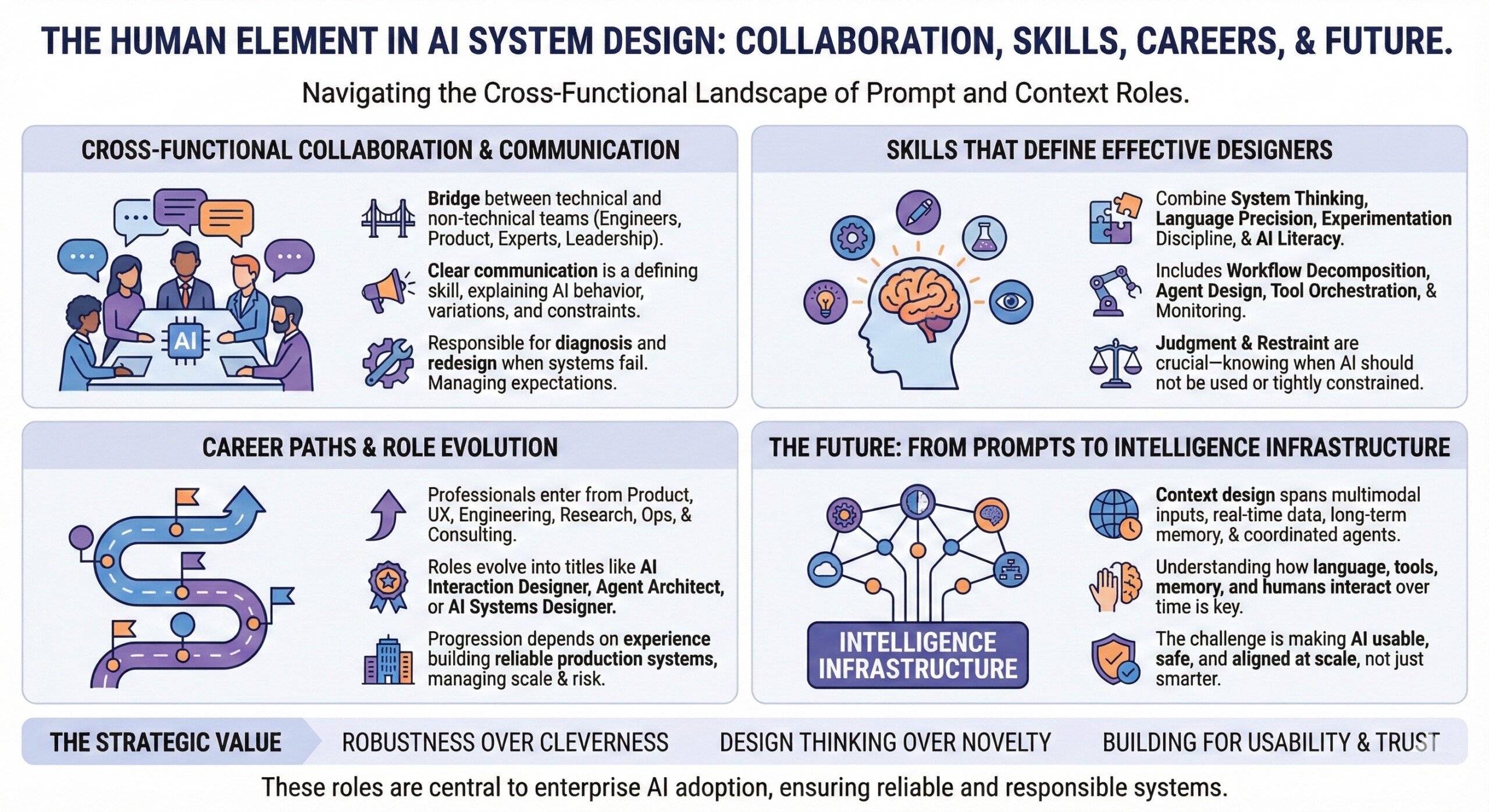
Prompt and context roles are inherently cross-functional. Designers work with engineers to integrate systems, with product teams to align user intent, with domain experts to ground outputs, and with leadership to manage expectations.
They must explain why AI behaves a certain way, why outputs vary, and why some requests must be constrained or refused. When systems fail, prompt and context designers are often responsible for diagnosis and redesign.
Clear communication across technical and non-technical stakeholders is a defining skill in these roles.
8. Skills that define effective prompt and context designers
Successful professionals in these roles combine multiple competencies: system thinking, language precision, experimentation discipline, and AI literacy. They understand model limitations, hallucination patterns, and evaluation techniques.
Increasingly important skills include workflow decomposition, agent design, tool orchestration, and monitoring. Equally important are judgment and restraint—knowing when AI should not be used or should be tightly constrained.
These roles reward design thinking over novelty, and robustness over cleverness. Subscribe to our free AI newsletter now.
9. Career paths and role evolution
Professionals enter prompt and context roles from product management, UX, engineering, research, operations, and consulting backgrounds. Over time, roles evolve into titles such as AI Interaction Designer, Agent Architect, Context Engineering Lead, or AI Systems Designer.
Career progression depends less on certifications and more on experience building systems that perform reliably in production. Those who can manage scale, risk, and ambiguity become central to enterprise AI adoption.
10. The future: From prompts to intelligence infrastructure
The future of prompt engineering lies beyond text. Context design will span multimodal inputs, real-time data, long-term memory, and coordinated agent systems. Prompts will become part of intelligence infrastructure, not user tricks.
The most valuable professionals will be those who understand how language, tools, memory, and humans interact over time. The challenge is not making AI smarter, but making it usable, safe, and aligned at scale. Upgrade your AI-readiness with our masterclass.
Billion Hopes summary
Prompt Engineering and Context Design roles are about shaping intelligence, not scripting responses. They translate human intent into structured signals that AI systems can act on reliably. As AI becomes embedded across organizations, these roles will determine whether systems are brittle or robust, helpful or harmful. The future belongs to professionals who can orchestrate intelligence responsibly – balancing creativity with control, autonomy with oversight, and capability with judgment.
Share this with the world
Related Articles