Robotics, Embodied AI & Physical Automation Careers
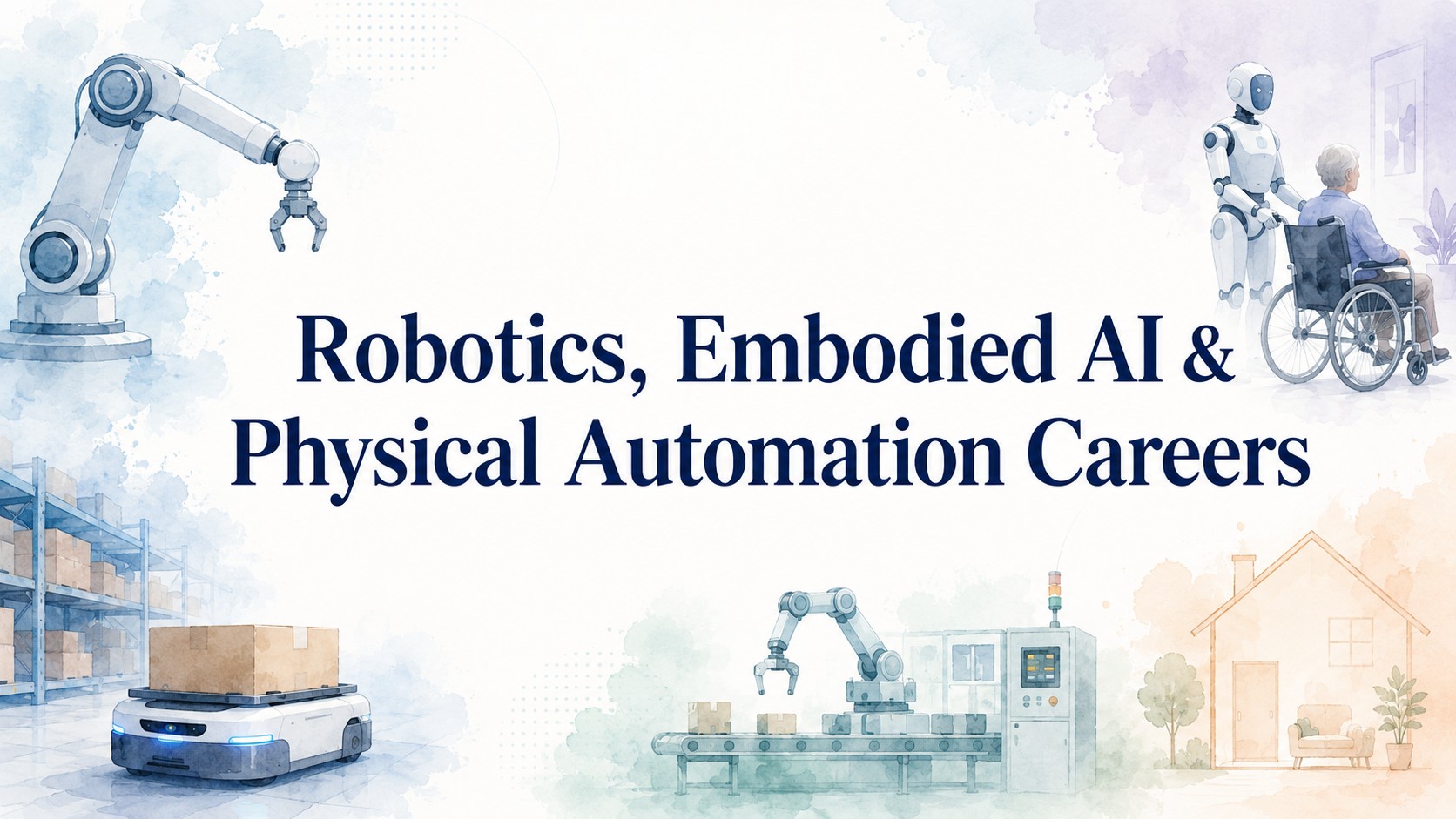
Robotics, Embodied AI & Physical Automation Careers
AI systems that operate in the physical world; Robotics for warehouses, hospitals, factories, and homes; Combining perception, movement, control, and safety
Introduction
Artificial Intelligence is no longer limited to screens, software, chatbots, and data dashboards. A major frontier is Embodied AI — AI that can sense, move, act, and make decisions in the physical world. This is where robotics, automation, computer vision, sensors, control systems, and machine learning come together.
Robotics and physical automation are already being used in warehouses, hospitals, factories, farms, airports, homes, and service environments. Robots can sort packages, assist in surgery, clean floors, move goods, inspect machines, support rehabilitation, and work alongside humans in industrial settings.
This creates a growing career path for students, engineers, designers, AI professionals, and business leaders. Robotics careers are not only about building humanoid robots. They include software, hardware, safety, simulation, data, design, maintenance, operations, and human-robot interaction. An excellent collection of learning videos awaits you on our Youtube channel.
Let’s dive deep into this.
1. What makes Robotics and Embodied AI different?
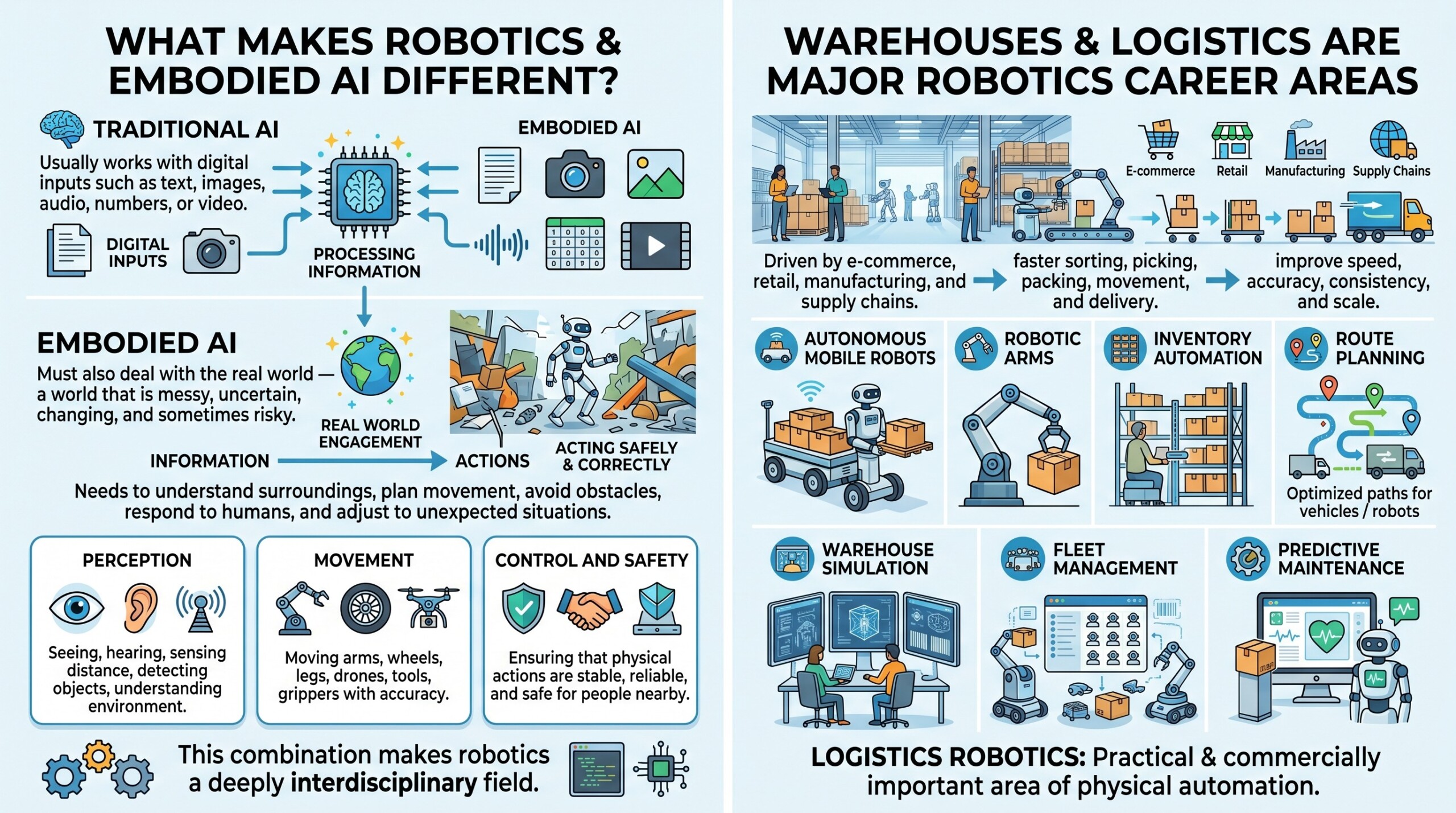
Traditional AI usually works with digital inputs such as text, images, audio, numbers, or video. Embodied AI must also deal with the real world — a world that is messy, uncertain, changing, and sometimes risky.
A robot must not only process information; it must also act safely and correctly. It needs to understand its surroundings, plan movement, avoid obstacles, respond to humans, and adjust to unexpected situations.
Key capabilities include:
- Perception: Seeing, hearing, sensing distance, detecting objects, and understanding the environment.
- Movement: Moving arms, wheels, legs, drones, tools, or grippers with accuracy.
- Control and safety: Ensuring that physical actions are stable, reliable, and safe for people nearby.
This combination makes robotics a deeply interdisciplinary field.
2. Warehouses and Logistics are major robotics career areas
Warehouses are among the most visible users of robotics today. E-commerce, retail, manufacturing, and supply chains need faster sorting, picking, packing, movement, and delivery. Robots can help improve speed, accuracy, consistency, and scale.
Career opportunities in this area include autonomous mobile robots, robotic arms, inventory automation, route planning, warehouse simulation, fleet management, and predictive maintenance. Professionals may work on robots that move packages or pallets, vision systems that identify products and barcodes, or software that coordinates many robots inside one facility.
This makes logistics robotics one of the most practical and commercially important areas of physical automation. A constantly updated Whatsapp channel awaits your participation.
3. Healthcare Robotics needs precision and trust
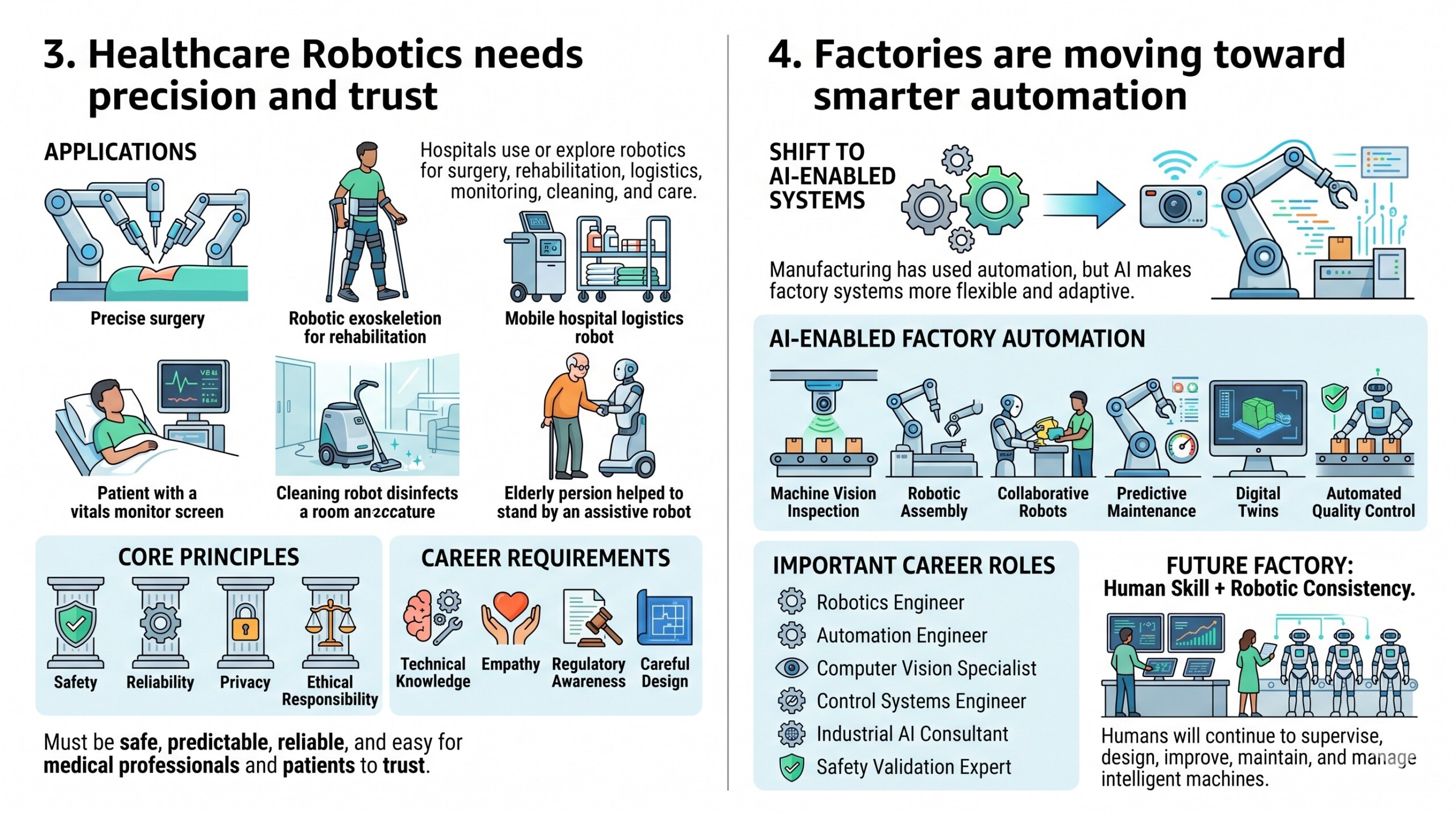
Hospitals and healthcare systems use or explore robotics for surgery, rehabilitation, hospital logistics, patient monitoring, cleaning, and assistive care. These applications require high standards of safety, reliability, privacy, and ethical responsibility.
Healthcare robots may assist doctors, support nurses, transport medicines, disinfect rooms, or help patients recover movement after injury. In future, assistive robots may also support elderly people and people with disabilities in daily activities.
Careers in healthcare robotics require technical knowledge, empathy, regulatory awareness, and careful design. A robot in a hospital cannot behave like a robot in a factory. It must be safe, predictable, reliable, and easy for medical professionals and patients to trust.
4. Factories are moving toward smarter automation
Manufacturing has used automation for decades, but AI is making some factory systems more flexible and adaptive. Earlier industrial robots were often programmed for fixed, repetitive tasks. Newer systems can use sensors, vision, data, and software to handle more variation.
AI-enabled factory automation includes machine vision inspection, robotic assembly, collaborative robots, predictive maintenance, digital twins, and automated quality control.
Important career roles include robotics engineer, automation engineer, computer vision specialist, control systems engineer, industrial AI consultant, and safety validation expert. The future factory will combine human skill with robotic consistency. Humans will continue to supervise, design, improve, maintain, and manage intelligent machines. Excellent individualised mentoring programmes available.
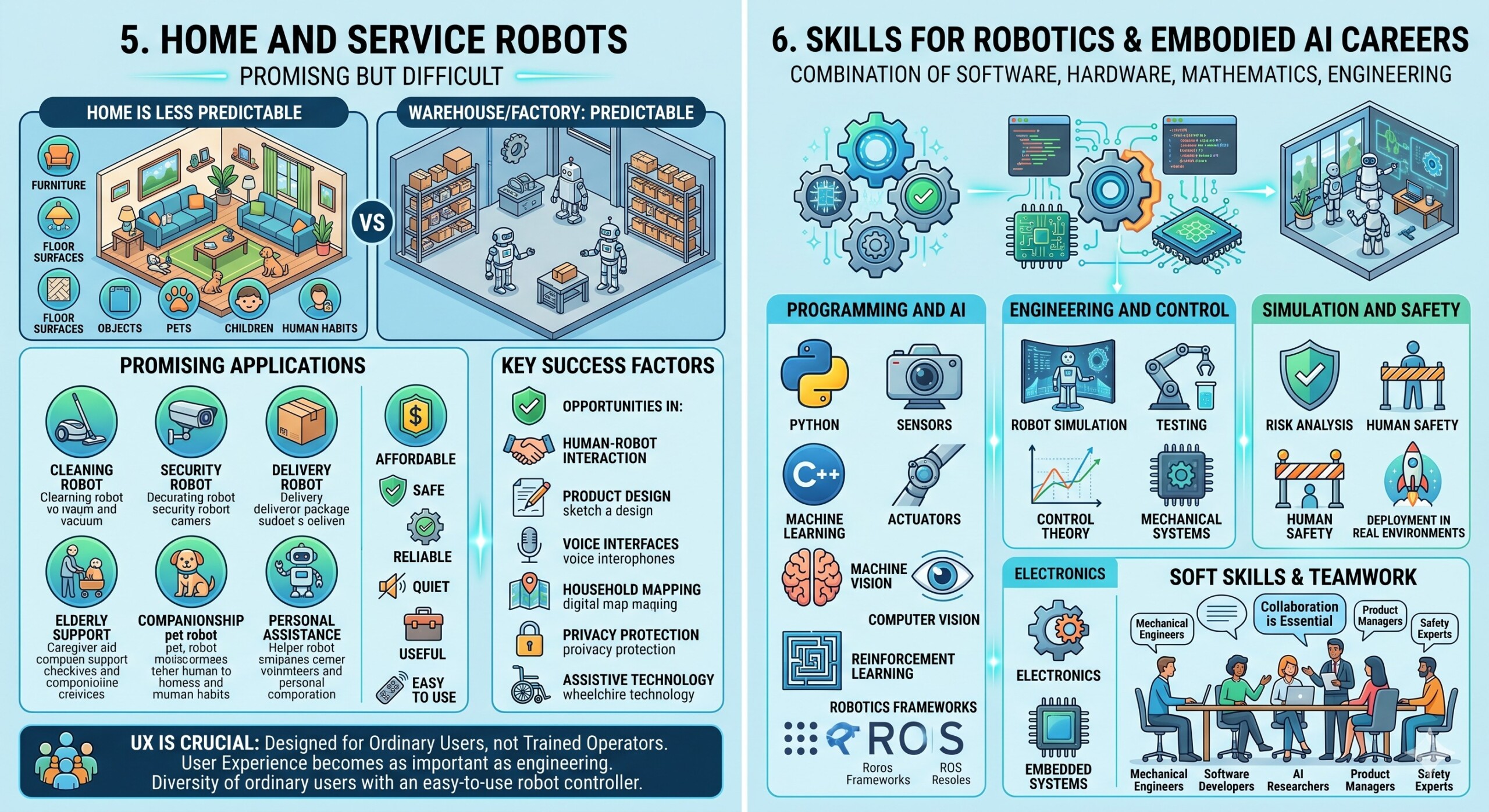
5. Home and Service Robots are promising but difficult
Home robotics is attractive, but technically difficult. A home is less predictable than a warehouse or factory. Every home has different furniture, lighting, floor surfaces, objects, pets, children, and human habits.
Service robots may help with cleaning, security, delivery, elderly support, companionship, and personal assistance. To succeed, they must be affordable, safe, reliable, quiet, useful, and easy to use.
This field creates opportunities in human-robot interaction, product design, voice interfaces, household mapping, privacy protection, and assistive technology.
Unlike industrial robotics, home robotics must be designed for ordinary users, not trained operators. So user experience becomes as important as engineering.

6. Skills needed for robotics and embodied AI careers
Robotics careers require a combination of software, hardware, mathematics, engineering, and real-world problem-solving. A professional does not need to master everything at once, but must understand how different systems connect.
Useful skills include:
- Programming and AI: Python, C++, machine learning, computer vision, reinforcement learning, and robotics frameworks.
- Engineering and control: Sensors, actuators, control theory, electronics, mechanical systems, and embedded systems.
- Simulation and safety: Robot simulation, testing, risk analysis, human safety, and deployment in real environments.
Soft skills also matter. Robotics projects require teamwork between mechanical engineers, software developers, AI researchers, product managers, safety experts, and domain specialists. Subscribe to our free AI newsletter now.
7. Future career opportunities in Physical AI
The future of robotics will not be limited to one industry. As AI and automation improve, robots may become more common in agriculture, construction, mining, education, eldercare, retail, hospitality, public infrastructure, and disaster response.
Promising career paths include:
- Robotics Software Engineer
- Computer Vision Engineer
- Autonomous Systems Engineer
- Human-Robot Interaction Designer
- Industrial Automation Consultant
- Robotics Safety Engineer
- Simulation and Digital Twin Specialist
- Drone Systems Engineer
- Healthcare Robotics Specialist
- AI Product Manager for Physical Automation
The most valuable professionals will be those who can connect AI intelligence with physical-world usefulness. They will understand not only algorithms, but also machines, people, safety, and business needs.
Conclusion
Robotics, Embodied AI, and Physical Automation represent an important career frontier. These fields bring AI out of the computer and into the real world, where machines can move, assist, inspect, transport, clean, build, heal, and collaborate.
For students and professionals, this is a powerful opportunity because it combines AI, engineering, design, safety, ethics, and business transformation. The goal is not only to build robots, but to create intelligent physical systems that make work safer, faster, more precise, and more humane.
As warehouses become more automated, hospitals use smarter tools, factories become more adaptive, and homes become more assistive, demand for skilled robotics professionals is likely to grow. Those who learn to combine perception, movement, control, and safety will be well-positioned for the next wave of AI careers. Upgrade your AI-readiness with our masterclass.