Skills Required for AI Careers (2026)
Skills Required for AI Careers (2026)
Technical, human, and business skills
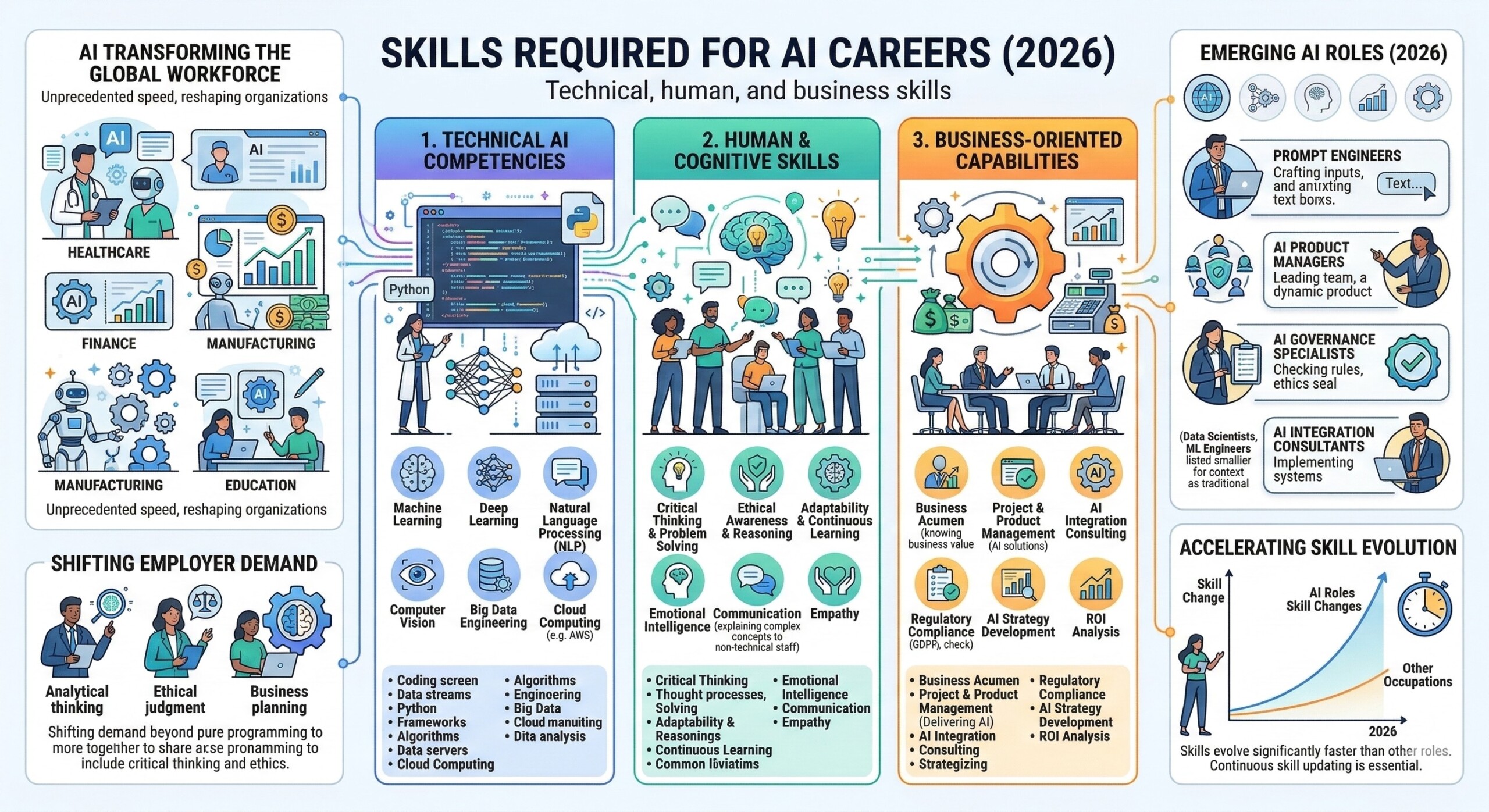
Artificial intelligence is transforming the global workforce at an unprecedented speed. From healthcare and finance to manufacturing and education, AI-driven systems are reshaping how organizations operate and compete. As a result, the demand for professionals who can build, manage, and work alongside AI technologies has increased dramatically across industries. Employers now expect candidates to possess not just programming knowledge but also a combination of analytical thinking, ethical awareness, and business understanding.
In 2026, the AI job market is no longer limited to traditional roles like data scientists or machine learning engineers. New roles such as AI product managers, prompt engineers, AI governance specialists, and AI integration consultants are emerging rapidly. These roles require a mix of technical expertise, human-centered abilities, and business acumen to successfully deploy and manage AI systems.
Another major trend is that AI skills are evolving faster than traditional job skills. Studies indicate that skill requirements in AI-exposed roles are changing significantly faster than in other occupations, meaning professionals must continuously update their capabilities to remain relevant in the workforce.
In this environment, building a successful AI career requires mastering three broad skill categories: technical AI competencies, human or cognitive skills, and business-oriented capabilities. The following sections explore the most important skills required for AI careers in 2026.
1. Programming and Software Development skills
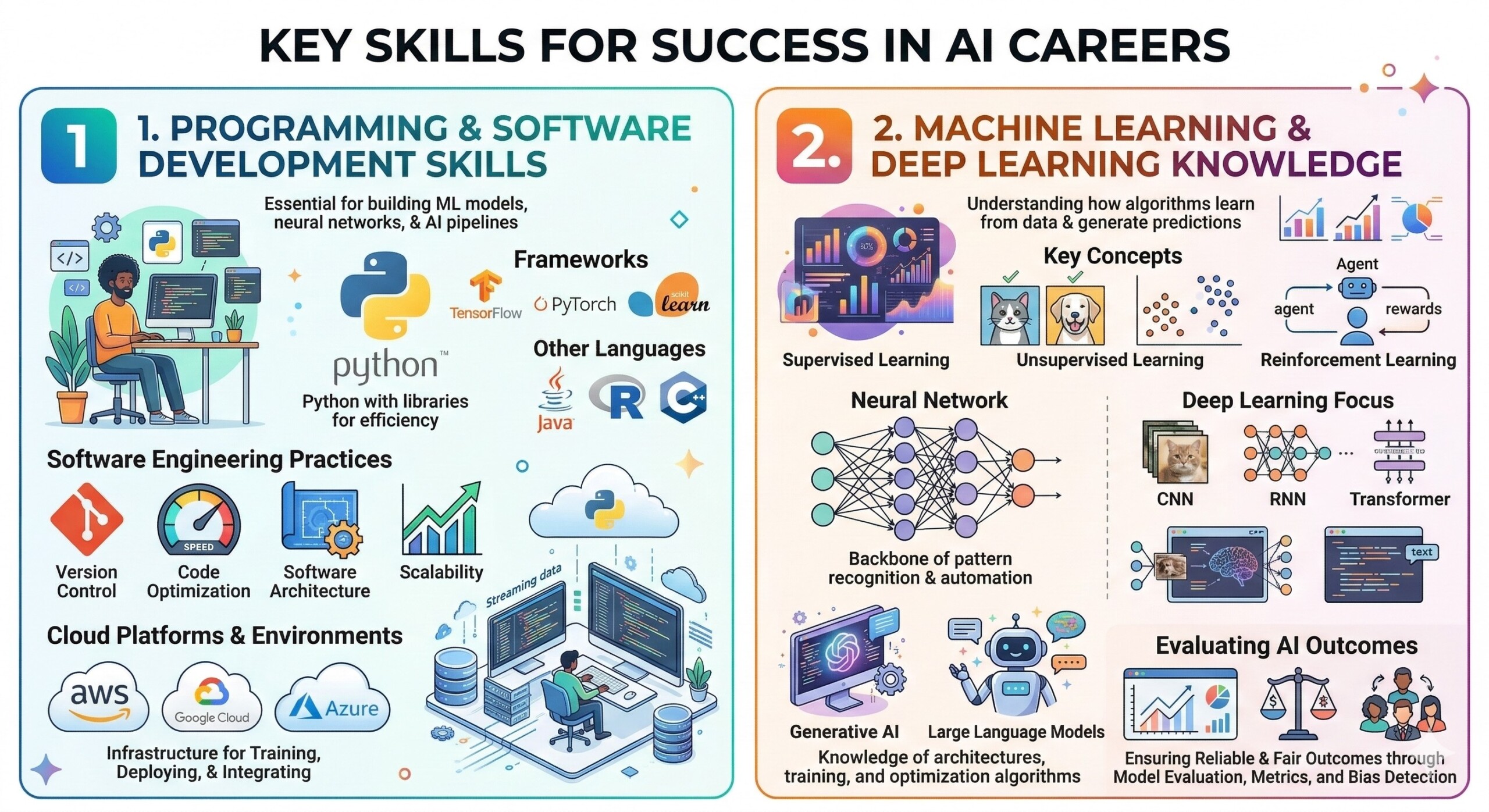
A strong foundation in programming remains one of the most essential skills for AI professionals. Machine learning models, neural networks, and AI pipelines are built through programming languages and development frameworks that allow developers to process large datasets and implement algorithms.
Python continues to dominate the AI ecosystem because of its extensive libraries and frameworks such as TensorFlow, PyTorch, and scikit-learn. These tools help developers build and train machine learning models efficiently. In addition to Python, languages like Java, R, and C++ are also used in AI applications, especially in high-performance computing environments.
Software engineering practices are also becoming important in AI roles. AI engineers must understand version control, code optimization, and software architecture to ensure that AI systems can scale in real-world environments.
Modern AI careers also require knowledge of AI development environments and cloud platforms, including AWS, Google Cloud, and Azure. These platforms provide infrastructure for training large models, deploying AI systems, and integrating them into enterprise applications.
2. Machine Learning and Deep Learning Knowledge
Understanding machine learning concepts is central to any AI-related role. Professionals working in AI need to understand how algorithms learn from data, how models are trained, and how predictions are generated.
Key concepts include supervised learning, unsupervised learning, reinforcement learning, and neural networks. These approaches form the backbone of modern AI applications, enabling systems to recognize patterns, generate predictions, and automate decision-making processes.
Deep learning has become particularly important with the rise of generative AI and large language models. Knowledge of neural network architectures, model training techniques, and optimization algorithms is essential for building advanced AI systems.
Professionals must also understand model evaluation, performance metrics, and bias detection to ensure AI systems produce reliable and fair outcomes. An excellent collection of learning videos awaits you on our Youtube channel.
3. Data Literacy and Analytics skills
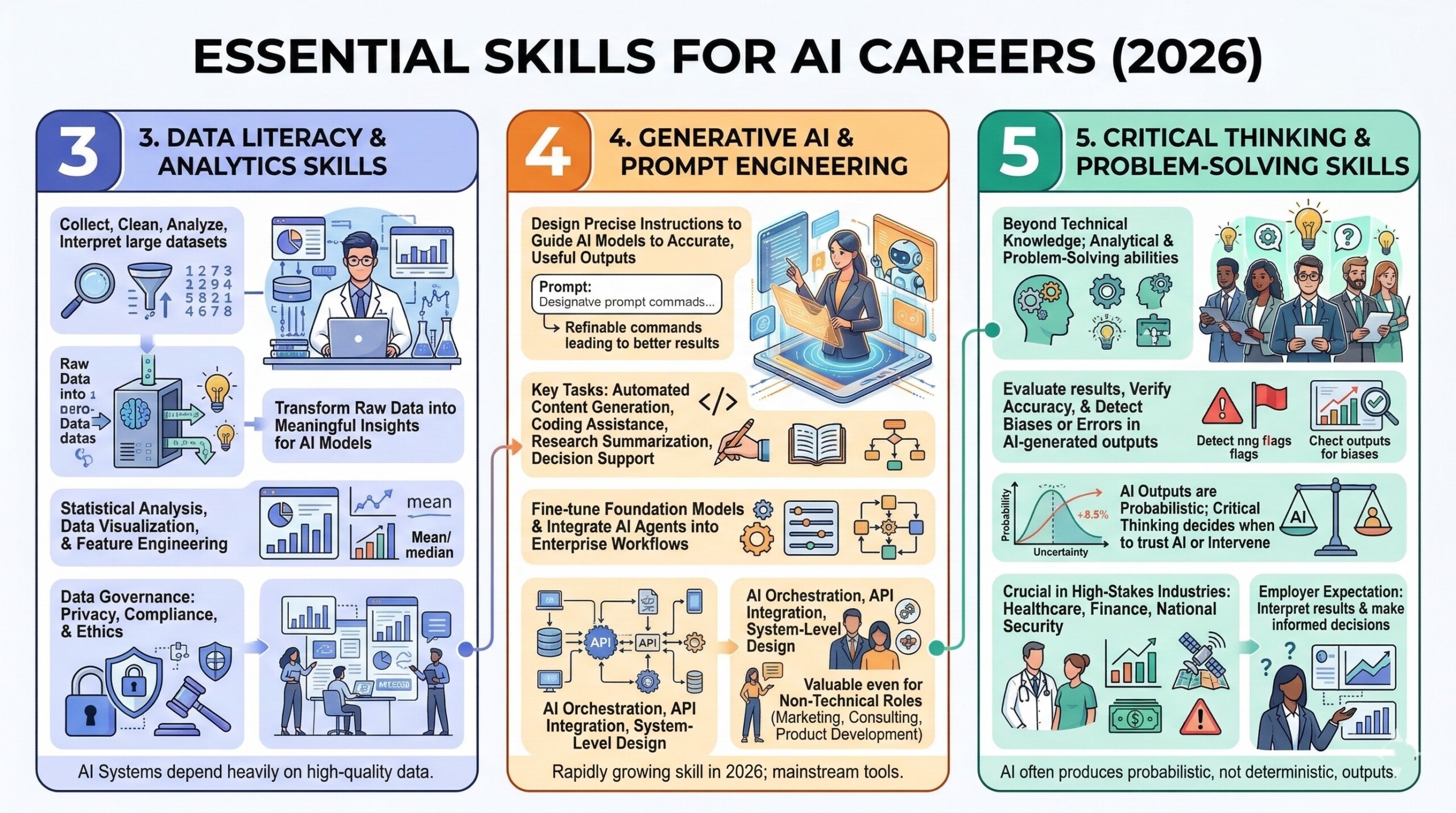
AI systems depend heavily on high-quality data. Therefore, data literacy is a critical skill for anyone working in AI. Professionals must be able to collect, clean, analyze, and interpret large datasets.
Key data-related competencies include statistical analysis, data visualization, and feature engineering. These skills allow professionals to transform raw data into meaningful insights that can power AI models.
Organizations adopting AI-first strategies increasingly require strong data science and analytical capabilities because data-driven decision-making is at the core of modern AI systems.
Another important aspect is data governance. AI professionals must understand how to manage data privacy, compliance requirements, and ethical use of data.
4. Generative AI and Prompt engineering
One of the most rapidly growing skill areas in 2026 is generative AI and prompt engineering. As large language models and AI assistants become mainstream tools in businesses, professionals must learn how to interact effectively with these systems.
Prompt engineering involves designing precise instructions that guide AI models to produce accurate, useful outputs. This skill is especially important for tasks such as automated content generation, coding assistance, research summarization, and AI-powered decision support.
Professionals working with AI systems must also understand how to fine-tune foundation models and integrate AI agents into enterprise workflows. This requires knowledge of AI orchestration, API integration, and system-level design.
Generative AI skills are now becoming valuable even for non-technical roles such as marketing, consulting, and product development.
A constantly updated Whatsapp channel awaits your participation.
5. Critical Thinking and Problem-Solving skills
Technical knowledge alone is not enough to succeed in AI careers. Professionals must also develop strong analytical and problem-solving abilities.
AI systems often produce probabilistic outputs rather than deterministic answers. Therefore, professionals must evaluate results carefully, verify accuracy, and detect potential biases or errors in AI-generated outputs.
Critical thinking helps professionals decide when to trust AI outputs and when human intervention is necessary. This skill becomes especially important in high-stakes industries such as healthcare, finance, and national security.
Employers increasingly expect professionals to demonstrate the ability to interpret AI results and make informed decisions, rather than simply relying on automated outputs.
6. Communication, Collaboration, and Human skills
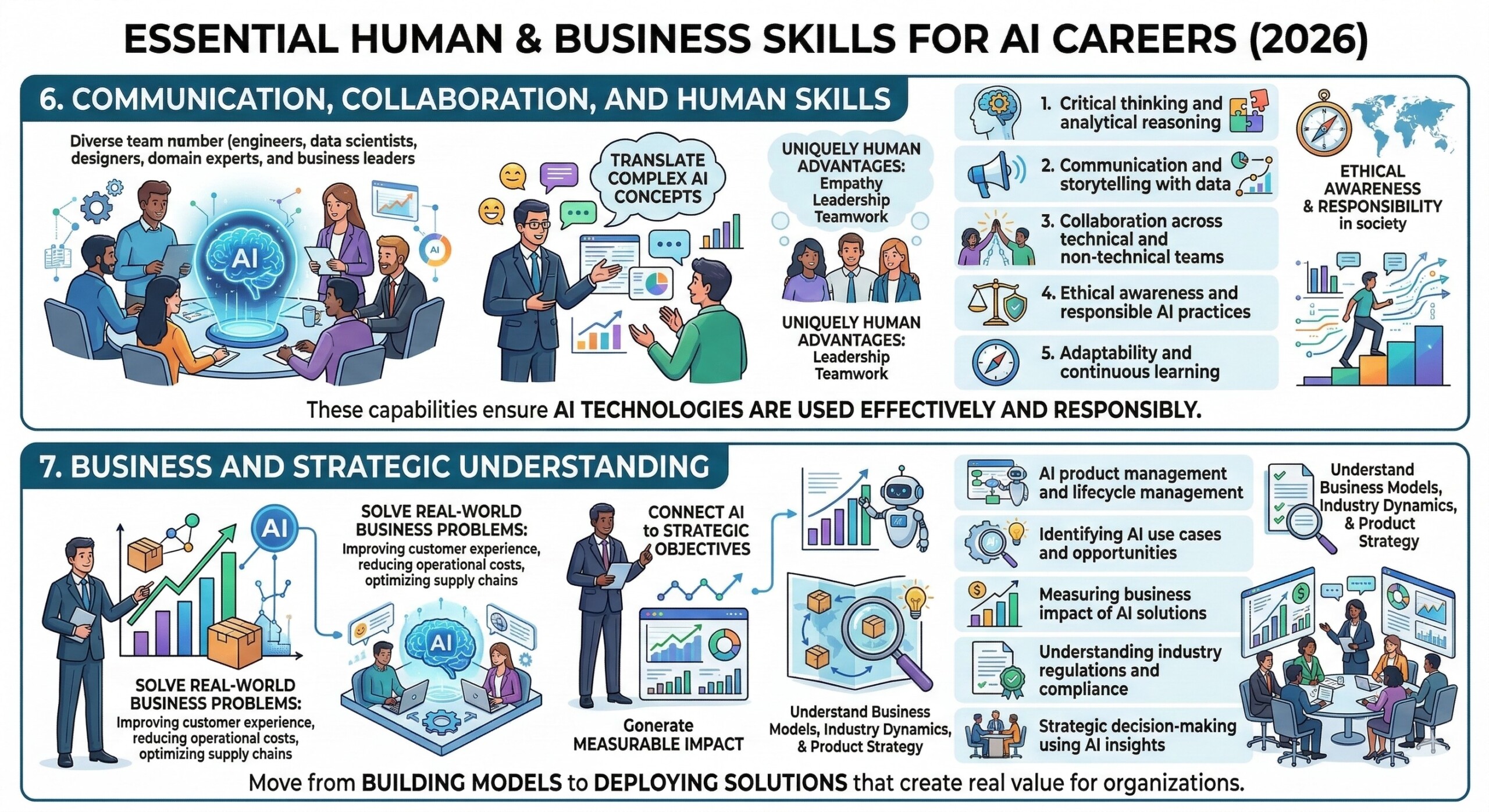
AI projects are rarely built by isolated individuals. They typically involve teams of engineers, data scientists, designers, domain experts, and business leaders. Therefore, strong communication and collaboration skills are essential.
Professionals must be able to translate complex AI concepts into language that non-technical stakeholders can understand. This is particularly important when explaining model predictions, risks, and limitations. Human-centered skills such as empathy, leadership, and teamwork are becoming increasingly valuable in AI-driven workplaces. Many industry leaders emphasize that these skills will remain uniquely human advantages in the age of automation.
As AI systems become more integrated into society, professionals must also demonstrate ethical awareness and responsibility when designing and deploying AI technologies.
Important Human Skills for AI Careers
- Critical thinking and analytical reasoning
- Communication and storytelling with data
- Collaboration across technical and non-technical teams
- Ethical awareness and responsible AI practices
- Adaptability and continuous learning
These human capabilities ensure that AI technologies are used effectively and responsibly. Excellent individualised mentoring programmes available.
7. Business and Strategic understanding
The most successful AI professionals in 2026 are not just technical experts—they also understand how AI creates value for organizations.
AI solutions must solve real-world business problems such as improving customer experience, reducing operational costs, or optimizing supply chains. Professionals who can connect AI technologies with strategic objectives are highly valued.
Understanding business models, industry dynamics, and product strategy allows AI professionals to design systems that generate measurable impact.
Key Business Skills for AI Careers
- AI product management and lifecycle management
- Identifying AI use cases and opportunities
- Measuring business impact of AI solutions
- Understanding industry regulations and compliance
- Strategic decision-making using AI insights
These skills enable professionals to move from building AI models to deploying AI solutions that create real value for organizations. Subscribe to our free AI newsletter now.
Summary
The AI job market in 2026 demands a powerful combination of technical expertise, human intelligence, and business awareness. Programming, machine learning, and data analytics remain foundational skills, while emerging areas such as generative AI and prompt engineering are becoming essential for modern AI roles.
At the same time, human-centered abilities such as communication, ethical reasoning, and critical thinking are becoming increasingly important as AI systems become more integrated into society. Organizations are not just looking for engineers who can build algorithms—they need professionals who can responsibly deploy AI technologies and align them with business goals.
Ultimately, the most successful AI professionals will be those who combine deep technical knowledge with strong human judgment and strategic thinking. In a world where AI continues to evolve rapidly, the ability to continuously learn and adapt may be the most valuable skill of all. Upgrade your AI-readiness with our masterclass.
Share this with the world
Related Articles