AI in Agriculture, Food Systems & Climate Resilience Careers
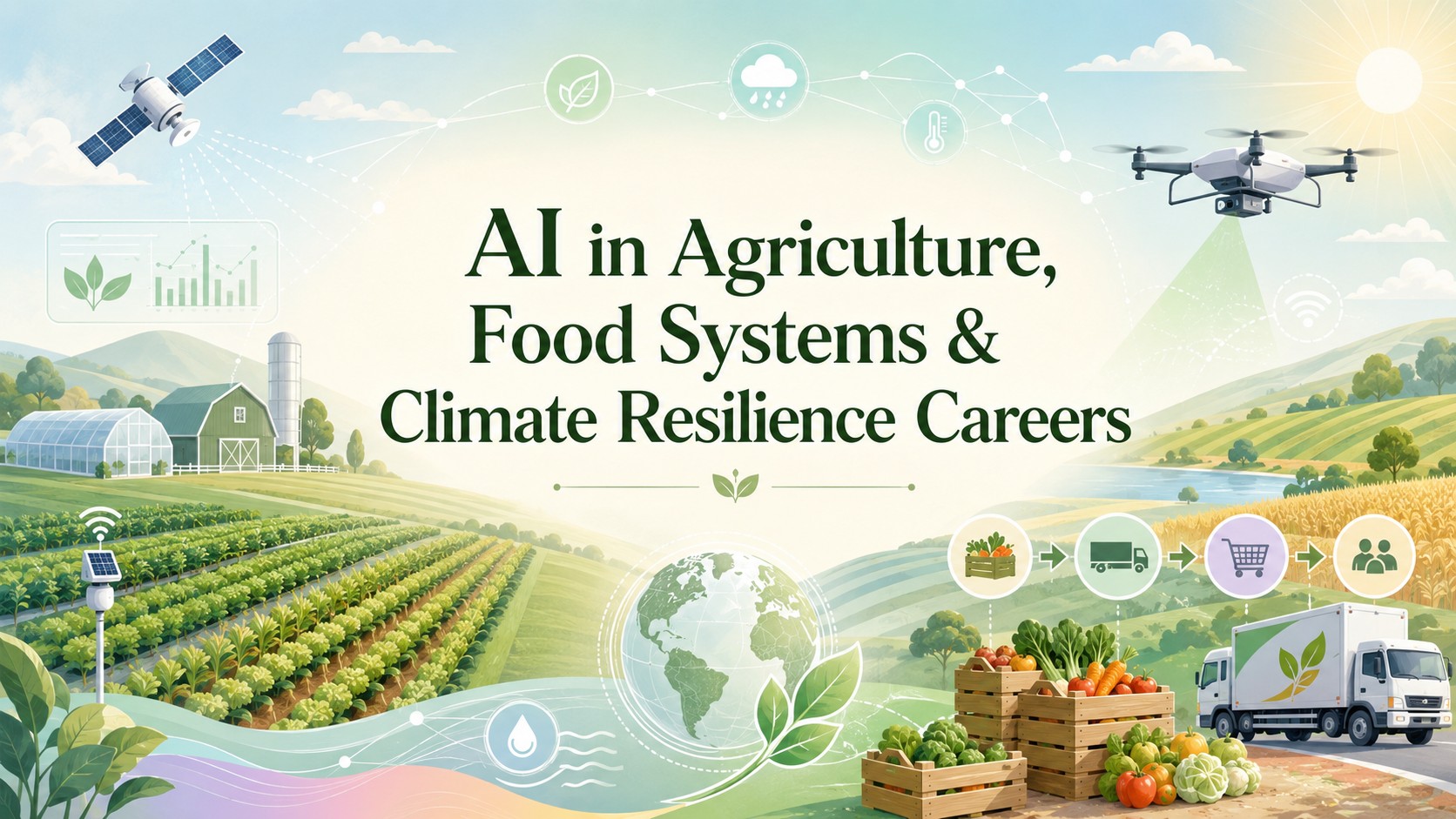
AI in Agriculture, Food Systems & Climate Resilience Careers
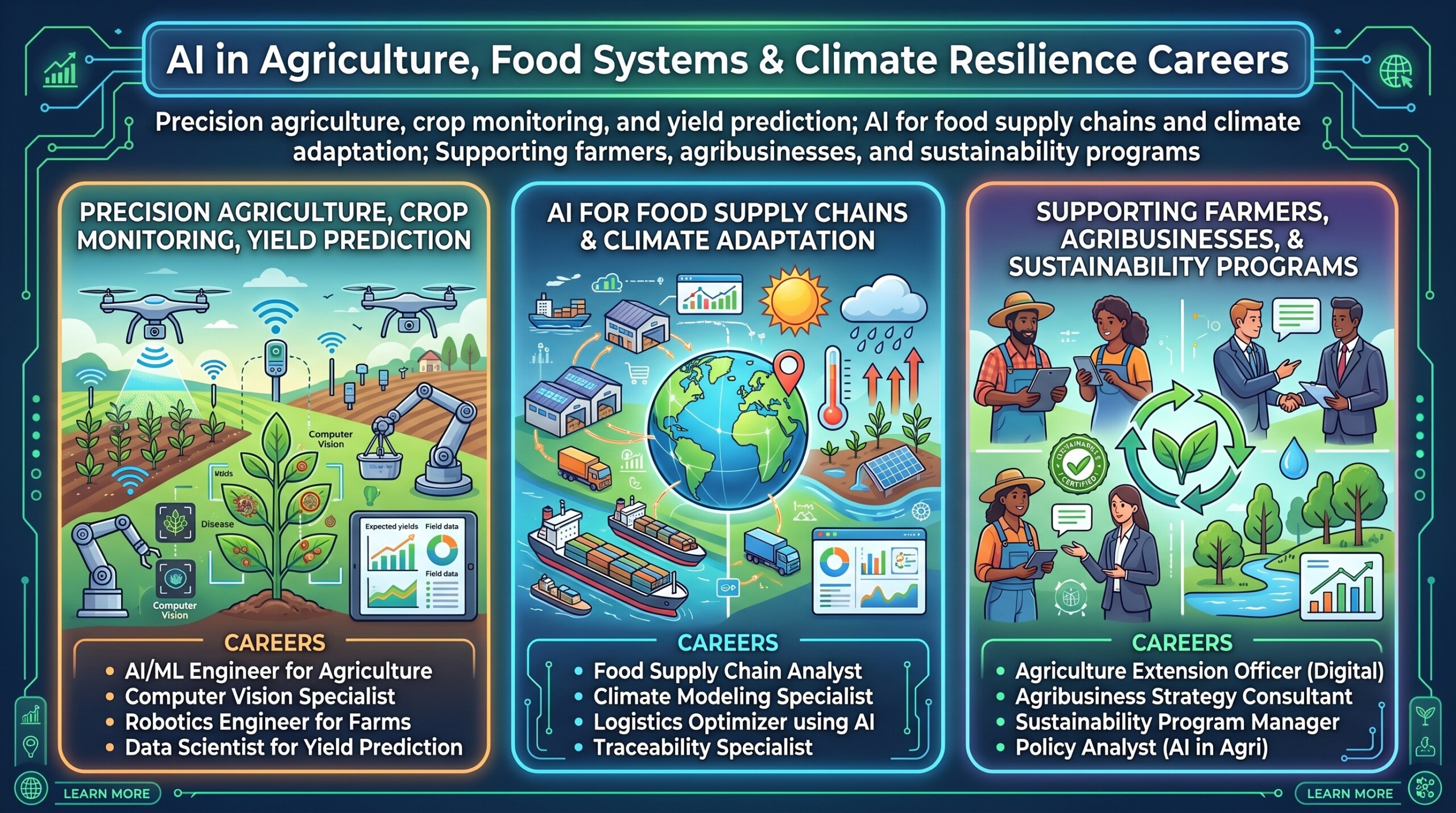
Precision agriculture, crop monitoring, and yield prediction; AI for food supply chains and climate adaptation; Supporting farmers, agribusinesses, and sustainability programs
Introduction
Agriculture is no longer only about land, seeds, water, weather, and labour. It is increasingly becoming a data-driven system where satellites, drones, soil sensors, smartphones, weather stations, farm machinery, supply chain platforms, and artificial intelligence work together. Farmers still remain at the centre of agriculture, but their decisions are now being supported by digital tools that can observe fields, predict risks, improve productivity, reduce waste, and help communities adapt to climate change.
AI in agriculture is especially important because the world faces several connected challenges. Food demand is rising. Climate change is making rainfall, heat, pests, and diseases less predictable. Soil health is under pressure. Water resources are stressed. Farmers face volatile prices, uncertain markets, and rising input costs. At the same time, governments, companies, NGOs, and sustainability programs need better data to support farmers and protect food systems.
This is why AI careers in agriculture, food systems, and climate resilience are becoming highly relevant. These careers are not limited to coding or data science. They include precision agriculture specialists, crop monitoring analysts, remote sensing experts, agronomists using AI tools, food supply chain analysts, climate risk modellers, sustainability program managers, digital extension workers, agri-fintech professionals, and policy researchers. An excellent collection of learning videos awaits you on our Youtube channel.
Let’s dive deep into this.
1. Precision agriculture careers: using data to farm more intelligently
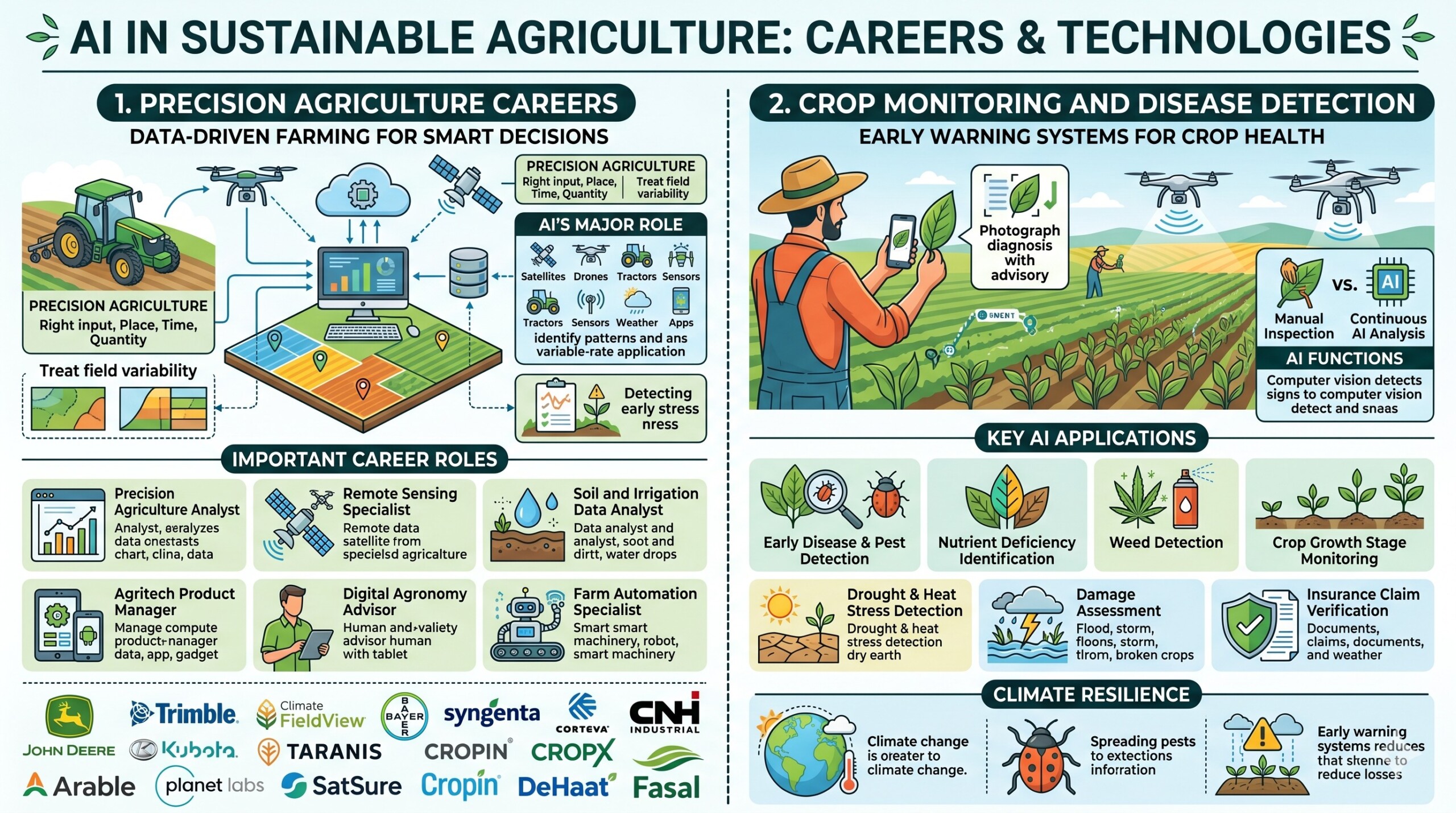
Precision agriculture means applying the right input, at the right place, at the right time, in the right quantity. Instead of treating an entire farm as one uniform field, precision agriculture recognizes that different parts of a field may have different soil conditions, moisture levels, nutrient needs, pest risks, and yield potential.
AI plays a major role here because farms generate large amounts of data. Satellite images, drone images, tractor data, soil sensors, weather forecasts, irrigation systems, and mobile apps can all feed into AI models. These models can identify patterns that are difficult for humans to see manually. For example, AI can detect early signs of crop stress from images before the damage is visible to the naked eye. It can recommend where fertilizer should be applied, where water is needed, or where pest control should be targeted.
Careers in precision agriculture are growing because farmers, agribusinesses, cooperatives, governments, and sustainability programs need people who can convert data into practical field decisions.
Important career roles in this area include:
- Precision agriculture analyst who uses farm data to improve input use, crop health, and productivity.
- Remote sensing specialist who interprets satellite and drone imagery for crop monitoring.
- Soil and irrigation data analyst who helps optimize water and nutrient management.
- Agritech product manager who designs farmer-friendly AI tools.
- Digital agronomy advisor who combines agronomy knowledge with AI recommendations.
- Farm automation specialist who works with smart tractors, sprayers, sensors, and irrigation systems.
Companies and platforms working in this space include John Deere, Trimble, Climate FieldView, Bayer Crop Science, Syngenta, Corteva, CNH Industrial, Kubota, Taranis, CropX, Arable, Planet Labs, SatSure, Cropin, DeHaat, Fasal, and several drone and remote sensing startups.
2. Crop monitoring and disease detection: seeing problems before they become disasters
Crop monitoring is one of the most practical uses of AI in agriculture. Traditionally, farmers and agronomists inspect fields manually. This remains important, but manual inspection can miss early warning signs, especially across large farms or remote areas. AI can help by continuously analysing images, weather data, soil data, and historical crop patterns.
Computer vision models can detect signs of plant disease, pest attack, nutrient deficiency, water stress, weed growth, and crop damage. These models can use images from mobile phones, drones, satellites, or fixed field cameras. In smallholder farming systems, a farmer may take a photo of a diseased leaf and receive a likely diagnosis with advisory support. In large farms, drones and satellite images can scan hundreds or thousands of acres and identify zones that need attention. This creates career opportunities for people who can build, manage, validate, and explain crop monitoring systems.
Key applications of AI crop monitoring include:
- Early detection of plant disease and pest attack.
- Identification of nutrient deficiency through leaf colour, canopy structure, and field patterns.
- Weed detection for targeted spraying and reduced chemical use.
- Crop growth stage monitoring.
- Drought stress and heat stress detection.
- Damage assessment after floods, storms, hail, or extreme weather events.
- Insurance claim verification and disaster response planning.
This field is especially important for climate resilience because climate change can increase the spread of pests and diseases. AI-enabled early warning systems can help farmers act faster and reduce losses. A constantly updated Whatsapp channel awaits your participation.
3. Yield prediction and climate risk modelling: helping farmers and planners prepare better
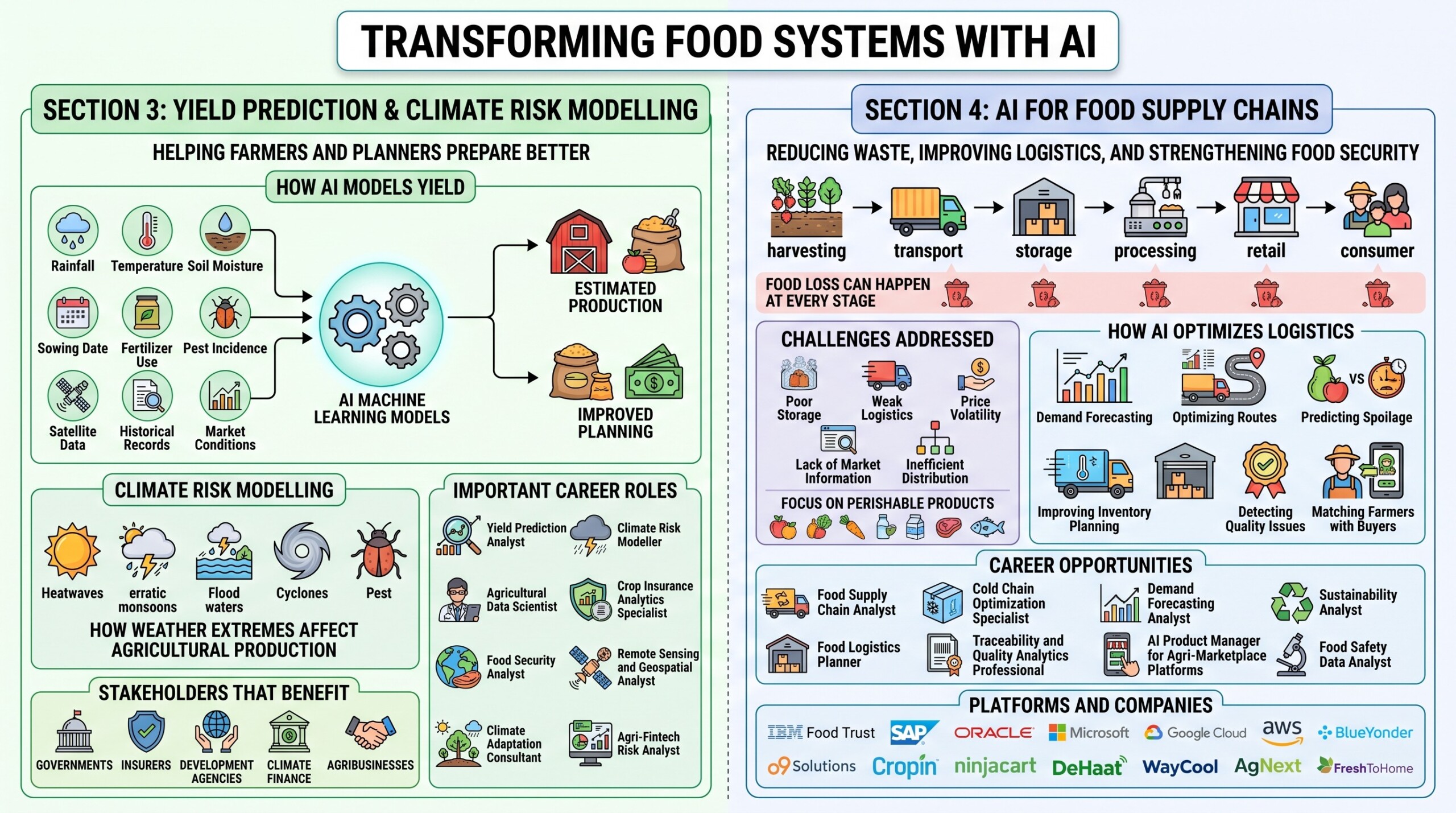
Yield prediction is the process of estimating how much crop will be produced before harvest. This is valuable for farmers, traders, food companies, insurers, banks, governments, and humanitarian agencies. Accurate yield prediction helps in planning storage, procurement, transport, pricing, credit, insurance, food security programs, and import or export decisions.
AI models can predict yield by combining many types of data. These may include rainfall, temperature, soil moisture, crop variety, sowing date, fertilizer use, pest incidence, satellite vegetation indices, historical yield records, and market conditions. Machine learning can detect relationships between these variables and estimate likely production outcomes.
Climate risk modelling goes a step further. It asks how drought, heatwaves, floods, cyclones, erratic monsoons, pest outbreaks, or water shortages may affect agricultural production. As extreme weather becomes more frequent, these skills are becoming essential for governments, insurers, development agencies, climate finance institutions, and agribusinesses.
Important career roles include:
- Yield prediction analyst.
- Climate risk modeller.
- Agricultural data scientist.
- Crop insurance analytics specialist.
- Food security analyst.
- Remote sensing and geospatial analyst.
- Climate adaptation consultant.
- Agri-fintech risk analyst.
4. AI for food supply chains: reducing waste, improving logistics, and strengthening food security
Food systems do not end at the farm gate. After production, food must move through harvesting, grading, storage, cold chains, transport, processing, wholesale markets, retail, restaurants, and consumers. Losses can happen at every stage. In many countries, poor storage, weak logistics, price volatility, lack of market information, and inefficient distribution contribute to food loss and farmer income stress.
AI can improve food supply chains by forecasting demand, optimizing routes, predicting spoilage, monitoring cold chain conditions, improving inventory planning, detecting quality issues, and matching farmers with buyers. For perishable products such as fruits, vegetables, milk, meat, fish, and flowers, better prediction and logistics can make a major difference.
Career opportunities in AI-enabled food supply chains include:
- Food supply chain analyst
- Cold chain optimization specialist
- Demand forecasting analyst
- Food logistics planner
- Traceability and quality analytics professional
- AI product manager for agri-marketplace platforms
- Sustainability analyst focused on food loss and waste
- Food safety data analyst
Platforms and companies connected to this area include IBM Food Trust, SAP, Oracle, Microsoft, Google Cloud, AWS, Blue Yonder, o9 Solutions, Cropin, Ninjacart, DeHaat, WayCool, AgNext, FreshToHome, and many retail and food processing technology providers. Excellent individualised mentoring programmes available.
5. Climate adaptation and resilience careers: helping agriculture survive a changing climate
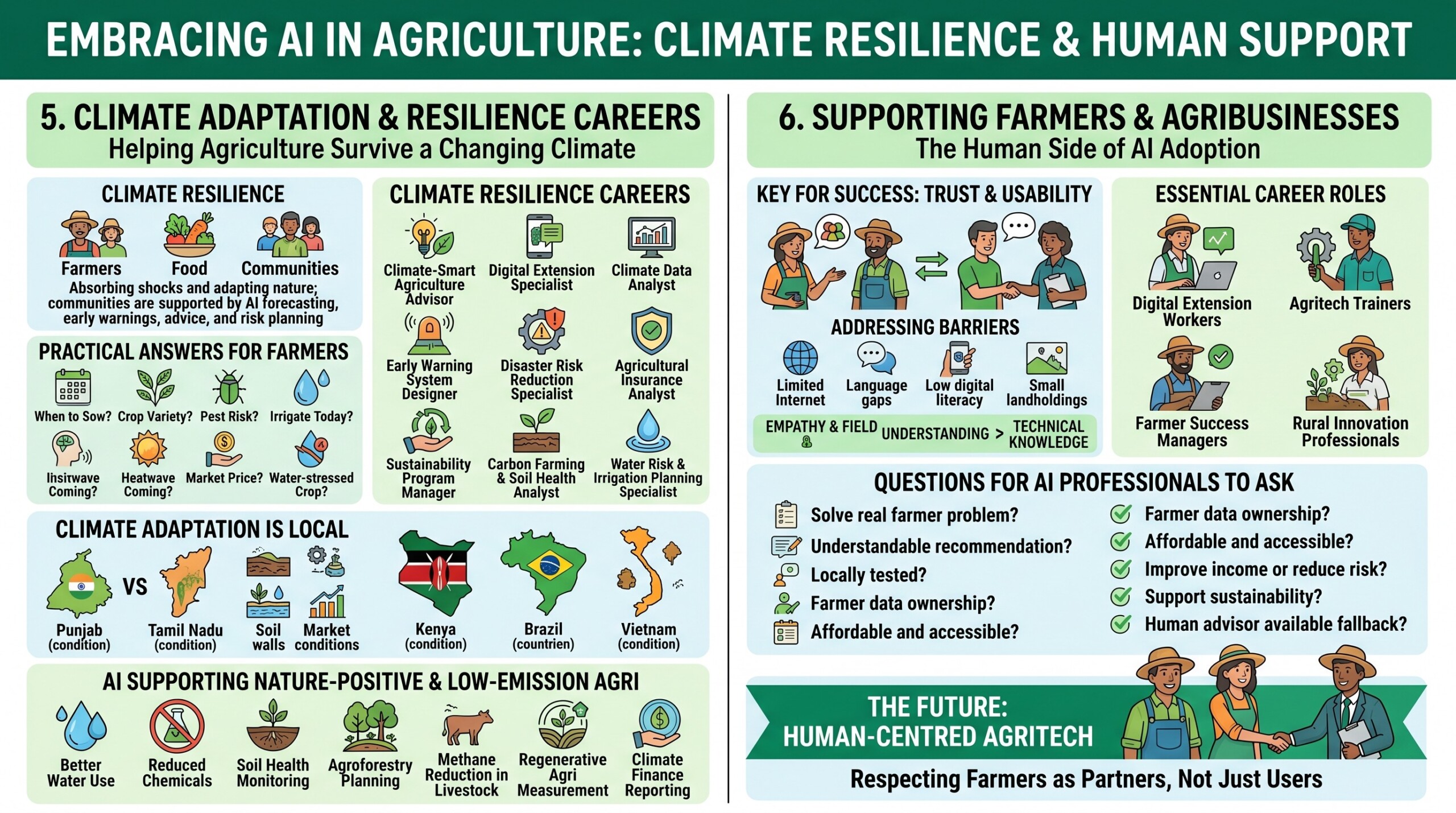
Climate resilience means the ability of farmers, food systems, and rural communities to absorb shocks, adapt to changing conditions, and continue producing food. AI can support this by providing better forecasts, early warnings, adaptation advice, and risk planning.
Farmers need practical answers to questions such as: When should I sow? Which crop variety is better for this season? Is there a pest risk after unusual rain? Should I irrigate today? Is a heatwave coming? Is the market price likely to fall? Which crop is suitable for a water-stressed area?
Climate resilience careers may include:
- Climate-smart agriculture advisor.
- Digital extension specialist.
- Climate data analyst.
- Early warning system designer.
- Disaster risk reduction specialist.
- Agricultural insurance analyst.
- Sustainability program manager.
- Carbon farming and soil health analyst.
- Water risk and irrigation planning specialist.
The most important point is that climate adaptation is local. A recommendation that works in Punjab may not work in Tamil Nadu, Kenya, Brazil, or Vietnam. Even within one district, soil, water, crop choice, market access, and farmer capacity may differ.
AI should also support nature-positive and low-emission agriculture. This includes better water use, reduced chemical overuse, soil health monitoring, agroforestry planning, methane reduction in livestock systems, regenerative agriculture measurement, and climate finance reporting.

6. Supporting farmers and agribusinesses: the human side of AI adoption
AI in agriculture will succeed only if farmers trust it and can use it easily. Many farmers face barriers such as limited internet access, language gaps, low digital literacy, small landholdings, lack of reliable data, and uncertainty about the value of digital tools. Therefore, careers in this field require empathy and field understanding, not only technical knowledge.
Digital extension workers, agritech trainers, farmer success managers, and rural innovation professionals will be essential. They help farmers understand advisory tools, interpret AI recommendations, collect data, adopt best practices, and provide feedback to improve the system.
AI agriculture professionals need to ask:
- Does this tool solve a real farmer problem?
- Is the recommendation understandable?
- Is the advice locally tested?
- Who owns the farmer’s data?
- Is the tool affordable and accessible?
- Does it improve farmer income or reduce risk?
- Does it support sustainability?
- Is there a human advisor available when the AI is wrong or unclear?
The future belongs to human-centred agritech. The best professionals will be those who respect farmers as partners, not just users. Subscribe to our free AI newsletter now.
7. Skills, education, and career pathways for AI in agriculture and food systems
AI agriculture careers require a mix of domain knowledge, data skills, technology awareness, and social understanding. A student or professional entering this field does not need to master everything at once. Different roles require different combinations of skills.
A technical AI agriculture career may require Python, machine learning, data engineering, GIS, remote sensing, computer vision, statistics, cloud platforms, APIs, and model evaluation. A product or program career may require agronomy basics, farmer research, business model design, supply chain understanding, sustainability reporting, and field implementation. A policy or development career may require climate adaptation, rural livelihoods, food security, public systems, impact evaluation, and ethical AI governance.
Important skill areas include:
- Agriculture basics: crops, soil, irrigation, pests, diseases, farm economics, livestock, fisheries, and post-harvest systems.
- AI and data: machine learning, computer vision, forecasting, geospatial analytics, natural language processing, and responsible AI.
- Tools and platforms: QGIS, Google Earth Engine, Python, R, Power BI, Tableau, cloud services, drone mapping tools, satellite imagery platforms, and farm management systems.
- Climate knowledge: drought, heat stress, flood risk, water stress, climate-smart agriculture, carbon farming, and adaptation planning.
- Communication: farmer training, local language support, extension design, stakeholder management, and policy writing.
- Ethics and governance: data privacy, model transparency, fairness, inclusion, and accountability.
In India and globally, career opportunities may emerge in agritech startups, agricultural universities, food companies, climate tech firms, remote sensing companies, development organizations, ESG and sustainability teams, crop insurance firms, agri-fintech companies, government missions, and international organizations.
Conclusion
AI in agriculture, food systems, and climate resilience is one of the most meaningful career areas of the coming decade. It connects technology with food security, farmer livelihoods, sustainability, climate adaptation, and rural development. AI can help monitor crops, predict yield, detect disease, optimize irrigation, reduce food loss, improve supply chains, support climate-smart agriculture, and strengthen decision-making for farmers and institutions.
But the purpose of AI in agriculture should not be technology for its own sake. The purpose should be better farming, better incomes, better nutrition, better resilience, and better stewardship of land, water, and biodiversity. AI must be grounded in real farm conditions, local languages, trusted data, human judgement, and ethical governance. Upgrade your AI-readiness with our masterclass.