AI in Energy, Utilities & Grid Intelligence Careers
AI in Energy, Utilities & Grid Intelligence Careers
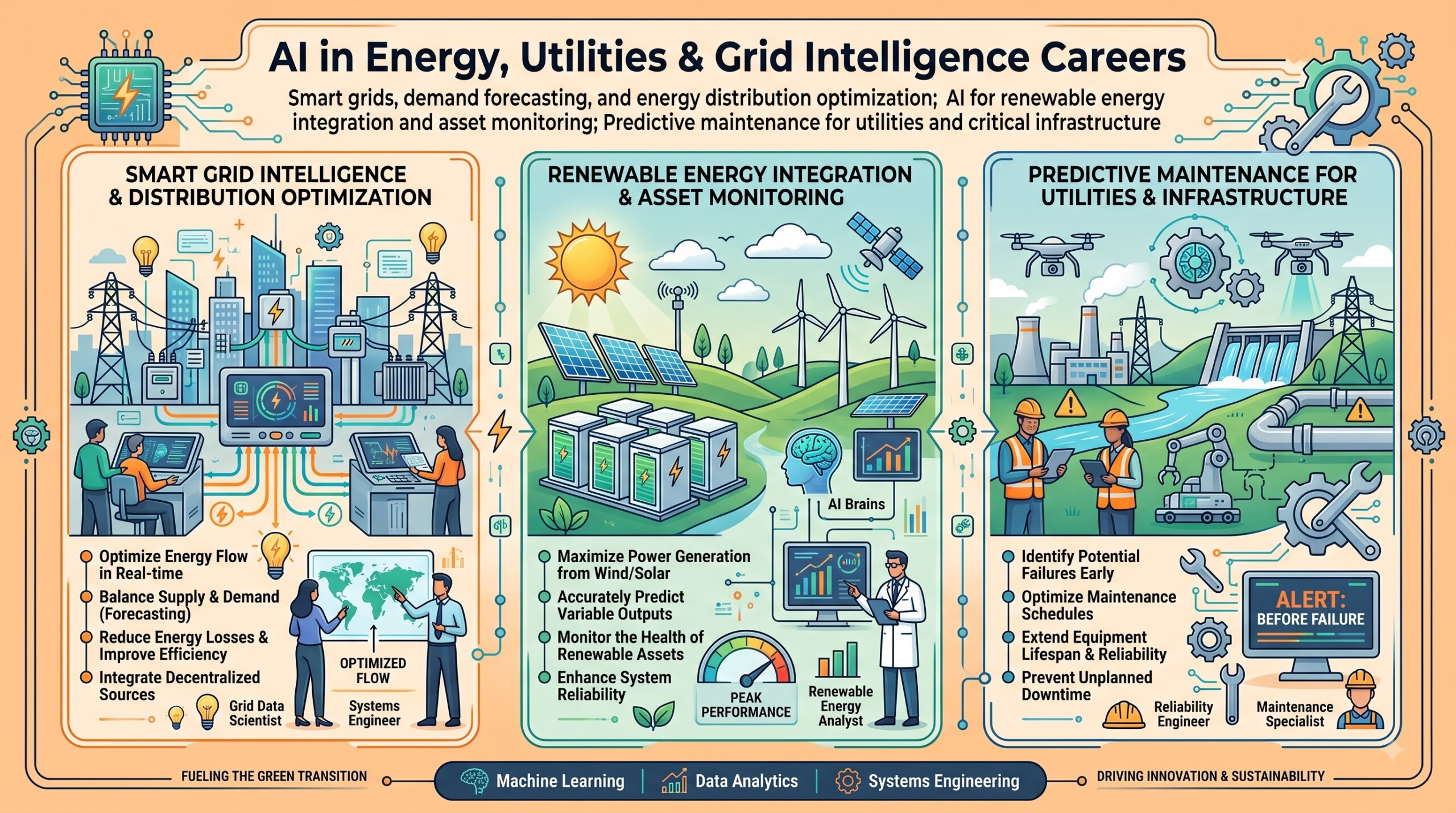
Smart grids, demand forecasting, and energy distribution optimization; AI for renewable energy integration and asset monitoring; Predictive maintenance for utilities and critical infrastructure
Introduction
Electricity networks are becoming far more complex than the traditional model of large power stations sending electricity in one direction to consumers. Solar rooftops, wind farms, battery storage, electric vehicles, smart meters, microgrids, data centres and flexible industrial loads are creating a grid in which supply and demand can change rapidly across thousands or millions of connected points.
The pressure is increasing. The International Energy Agency reported that electricity demand from data centres increased by about 17% in 2025, with AI-focused data centres growing even faster. At the same time, electricity systems are integrating larger amounts of weather-dependent renewable generation.
This is making grid intelligence one of the most important industrial applications of artificial intelligence. Machine learning, forecasting, optimization, computer vision, digital twins and increasingly AI-assisted decision systems are being embedded into utility operations.
For professionals, this creates an unusual career opportunity: the industry needs people who understand not only AI, but also how electricity systems, physical assets and safety-critical infrastructure actually work. An excellent collection of learning videos awaits you on our Youtube channel.
Let’s dive deep into this.
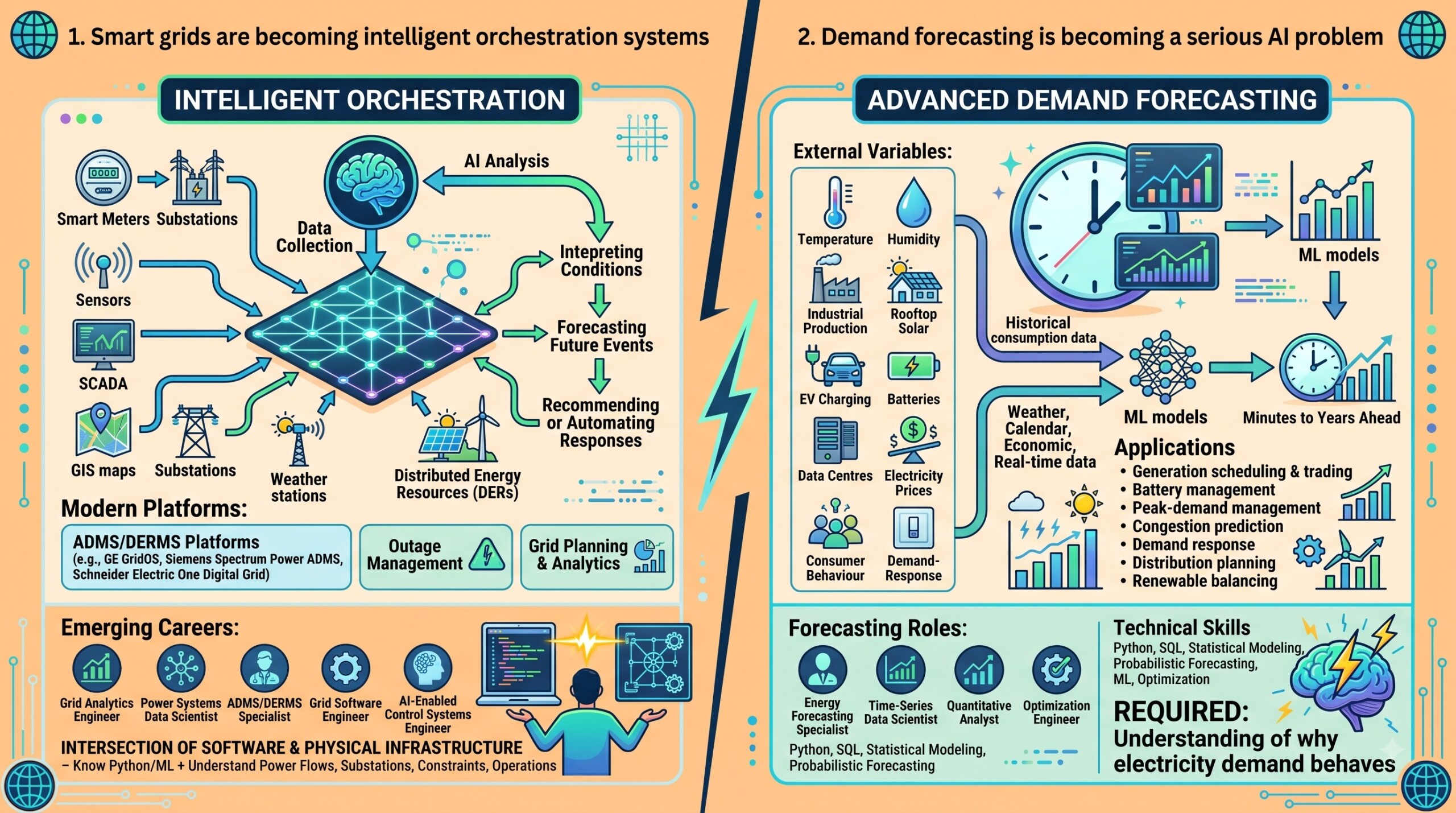
1. Smart grids are becoming intelligent orchestration systems
A smart grid produces enormous amounts of operational data from smart meters, substations, sensors, supervisory control and data acquisition systems (SCADA), geographic information systems (GIS), weather feeds and distributed energy resources.
The next step is not simply collecting this data. AI systems are being used to interpret conditions, forecast what may happen and recommend or automate operational responses.
Modern platforms combine technologies such as Advanced Distribution Management Systems (ADMS), Distributed Energy Resource Management Systems (DERMS), outage management, grid planning and analytics. GE Vernova’s GridOS for Distribution, for example, integrates ADMS, DERMS, GIS, field operations and grid data, while Siemens’ Spectrum Power ADMS is designed to manage distribution systems and renewable integration. Schneider Electric’s One Digital Grid Platform similarly connects planning, operations and asset management.
This is creating roles such as grid analytics engineer, power systems data scientist, ADMS/DERMS specialist, grid software engineer and AI-enabled control systems engineer.
The important career distinction is that these jobs sit at the intersection of software and physical infrastructure. Knowing Python or machine learning alone is rarely enough; understanding power flows, substations, grid constraints and utility operations can become a major advantage.
2. Demand forecasting is becoming a serious AI problem
Utilities have always forecast electricity demand. What is changing is the number of variables affecting that demand.
Temperature, humidity, industrial production, rooftop solar, EV charging, batteries, data centres, electricity prices, consumer behaviour and demand-response programmes can all influence load patterns. Machine-learning models can combine historical consumption with weather, calendar, economic and real-time operational data to generate forecasts ranging from the next few minutes to several years ahead.
The applications go well beyond predicting tomorrow’s electricity consumption. Forecasts increasingly support:
- generation scheduling and energy trading;
- battery charging and discharging;
- peak-demand management;
- congestion prediction;
- demand response;
- distribution planning;
- renewable balancing.
GE Vernova, for example, describes GridOS Forecasting as predicting both electrical load and renewable generation and connecting those forecasts with DERMS, ADMS and energy-management applications.
For careers, this creates demand for energy forecasting specialists, time-series data scientists, quantitative analysts and optimization engineers. Useful technical skills include Python, SQL, statistical modelling, probabilistic forecasting, machine learning and optimization – but the ability to understand why electricity demand behaves as it does remains equally important. A constantly updated Whatsapp channel awaits your participation.

3. AI is becoming essential for renewable energy integration
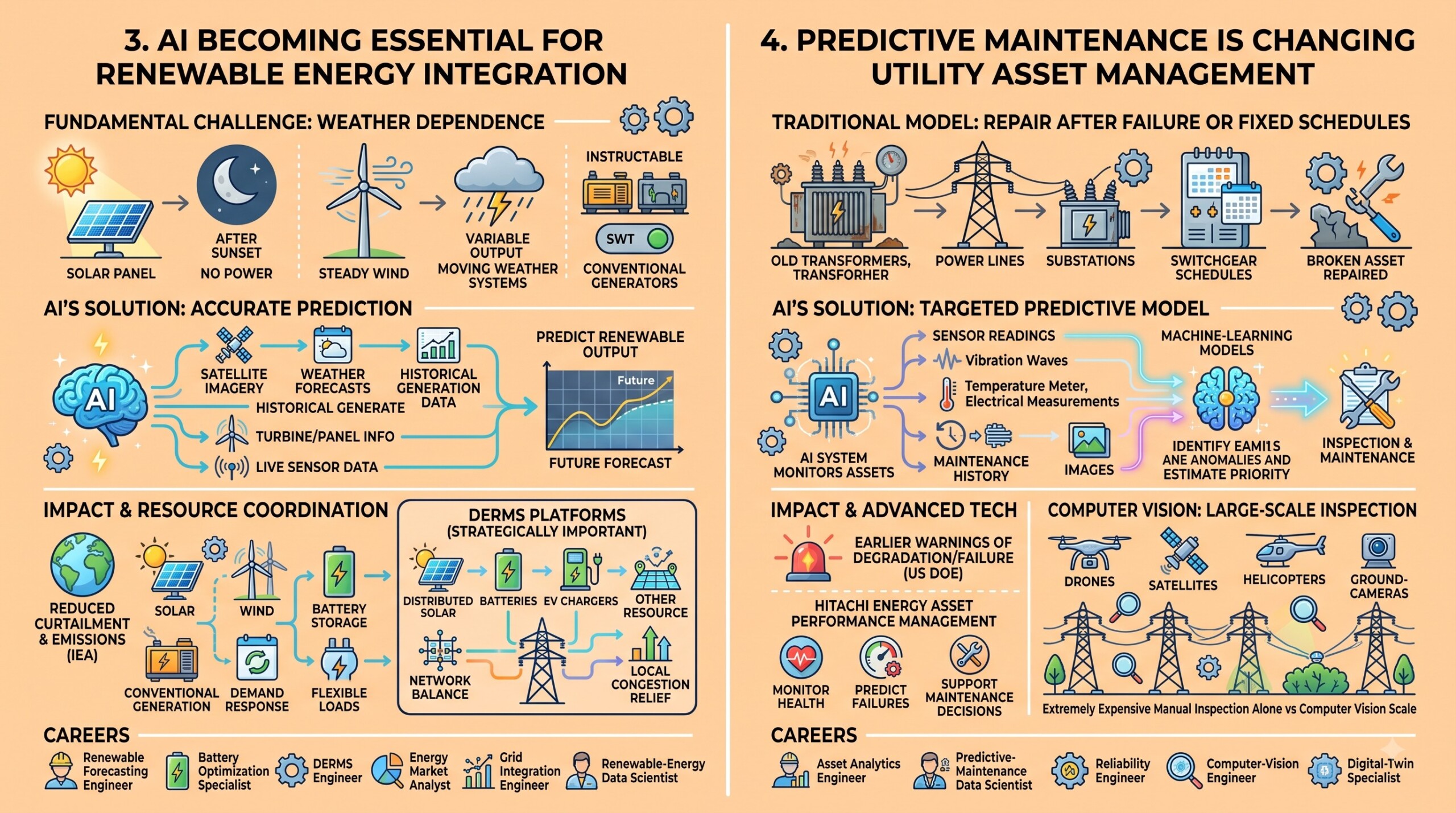
Solar and wind introduce a fundamental challenge: their output depends heavily on weather.
A conventional generator can generally be instructed to produce a certain amount of electricity. A solar farm cannot be instructed to produce full output after sunset, while wind generation may change substantially as weather systems move.
AI can combine satellite imagery, weather forecasts, historical generation data, turbine or panel information and live sensor data to predict renewable output more accurately.
The IEA identifies improved forecasting and integration of variable renewable generation as an important application of AI, with the potential to reduce renewable curtailment and associated emissions.
Forecasting is only part of the problem. Increasingly sophisticated systems must decide how solar, wind, batteries, conventional generation, demand response and flexible loads should work together.
DERMS platforms are therefore becoming strategically important. They can monitor distributed solar, batteries, EV chargers and other resources and adjust their behaviour to help balance the network or relieve local congestion.
Career opportunities include renewable forecasting engineer, battery optimization specialist, DERMS engineer, energy market analyst, grid integration engineer and renewable-energy data scientist.
4. Predictive maintenance is changing utility asset management
Utilities manage some of the world’s largest collections of long-lived physical infrastructure: transformers, transmission lines, substations, switchgear, turbines, generators, pumps, cables and millions of field devices.
Traditionally, equipment may be maintained according to fixed schedules or repaired after something fails. AI makes a more targeted model possible.
Sensor readings, vibration, temperature, electrical measurements, maintenance history, images and operating conditions can be analysed for early signs of deterioration. Machine-learning systems can identify anomalies and estimate which assets require inspection or maintenance first.
The US Department of Energy has specifically identified predictive maintenance as an AI opportunity that can provide earlier warning of equipment degradation or failure. Hitachi Energy’s Asset Performance Management products similarly use analytics and AI models to monitor asset health, predict failures and support maintenance decisions.
Computer vision adds another layer. Drone, satellite, helicopter and ground-camera imagery can help inspect transmission lines, towers and vegetation at a scale that would be extremely expensive using manual inspection alone.
Relevant careers include asset analytics engineer, predictive-maintenance data scientist, reliability engineer, computer-vision engineer and digital-twin specialist. Excellent individualised mentoring programmes available.
5. AI can make outage and infrastructure-risk management more proactive
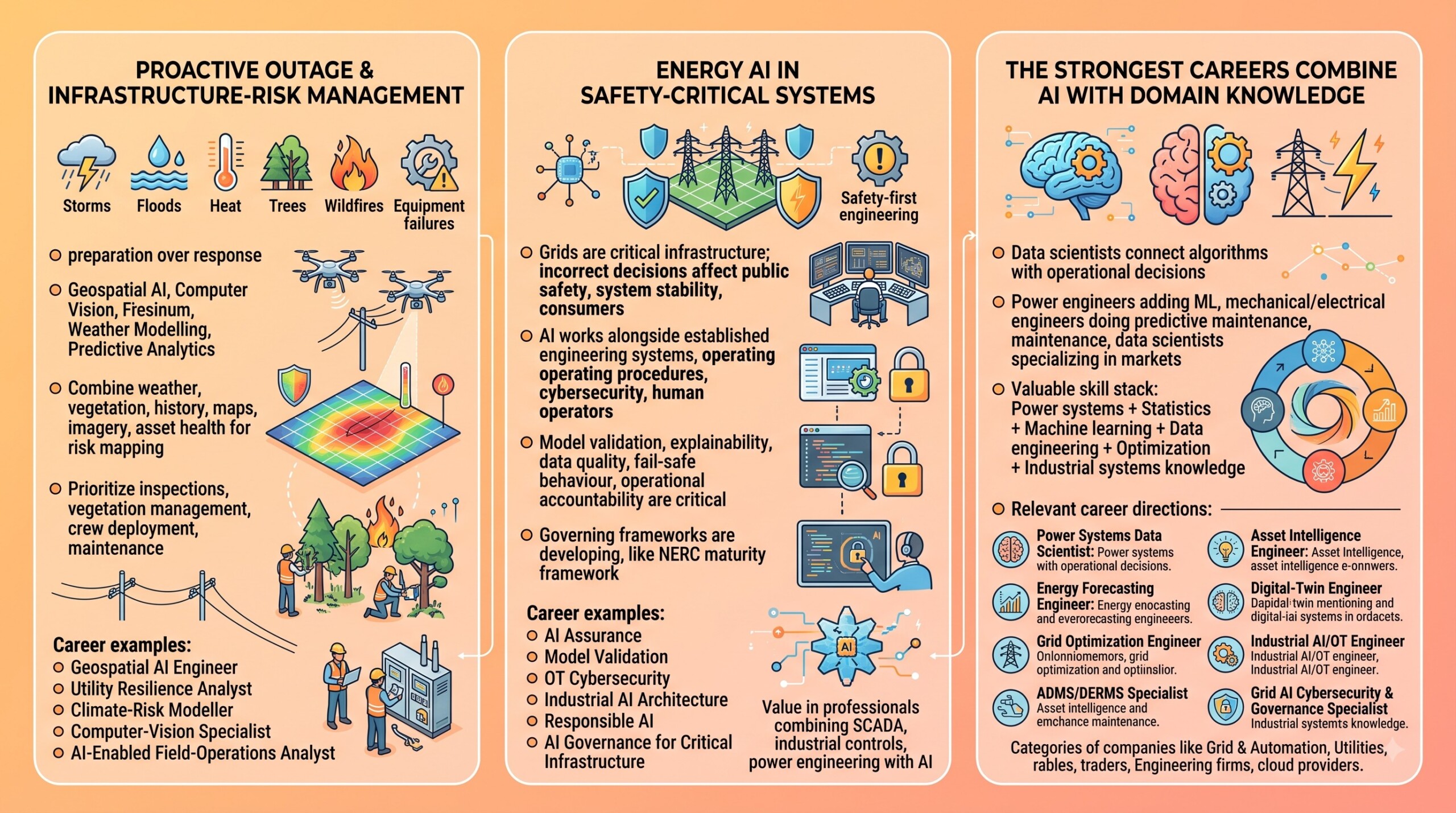
Utilities increasingly need to prepare for storms, floods, heat, vegetation problems, wildfires and equipment failures rather than simply responding after outages occur.
This is where geospatial AI, computer vision, weather modelling and predictive analytics become particularly useful.
AI systems can combine weather forecasts, vegetation information, historical outages, infrastructure maps, inspection imagery and asset-health data to identify areas where failures are becoming more likely.
Utilities can then prioritize inspections, vegetation management, crew deployment and maintenance.
The technology is already moving into commercial grid platforms. Schneider Electric’s 2026 grid offerings, for example, incorporate technologies from companies including AiDASH, Technosylva and Neara for areas such as risk modelling, vegetation, wildfire and network intelligence. GE Vernova is also applying AI-enabled visual intelligence to utility infrastructure monitoring.
This opens careers beyond conventional data science, including geospatial AI engineer, utility resilience analyst, climate-risk modeller, computer-vision specialist and AI-enabled field-operations analyst.
6. Energy AI must work inside safety-critical operational systems
Building an AI model for a utility is fundamentally different from building a movie recommender or marketing chatbot.
Electricity grids are critical infrastructure. Incorrect decisions can affect equipment, public safety, system stability and potentially millions of consumers.
This means utilities cannot simply hand operational control to an opaque AI model.
AI systems must work alongside established engineering systems, operating procedures, cybersecurity controls and human operators. Model validation, explainability, data quality, fail-safe behaviour and operational accountability become critical.
The North American Electric Reliability Corporation has been developing an AI/ML maturity framework specifically to help electric utilities evaluate and govern AI adoption while preserving operational accountability. Its work covers AI use in planning, operations and engineering as well as reliability and security implications.
As a result, an important group of careers will emerge around AI assurance, model validation, OT cybersecurity, industrial AI architecture, responsible AI and AI governance for critical infrastructure.
Professionals familiar with SCADA, EMS/DMS, industrial control systems, IEC standards, cybersecurity and power engineering may therefore become extremely valuable when they add AI capabilities. Subscribe to our free AI newsletter now.
7. The strongest careers will combine AI with energy-domain knowledge
Energy companies do need data scientists—but the most valuable professionals are increasingly likely to be those who can connect algorithms with operational decisions.
A power systems engineer who understands machine learning can work on load forecasting, state estimation or grid optimization. A mechanical or electrical engineer who learns anomaly detection can move into predictive maintenance. A data scientist who understands power markets can specialize in renewable forecasting, battery dispatch or electricity trading.
Some of the most relevant career directions include:
Power systems data scientist — applies ML and analytics to grid data.
Energy forecasting engineer — predicts electricity demand, renewable production and market conditions.
Grid optimization engineer — develops algorithms for dispatch, power flows, storage and network constraints.
ADMS/DERMS specialist — works on intelligent distribution and distributed-energy management systems.
Asset intelligence engineer — develops predictive-maintenance and equipment-health systems.
Digital-twin engineer — creates computational representations of grids, plants and equipment for simulation and optimization.
Industrial AI/OT engineer — integrates AI with SCADA, sensors, control systems and operational technology.
Grid AI cybersecurity and governance specialist — ensures AI is deployed securely and responsibly in critical infrastructure.
Companies to watch extend well beyond conventional AI firms. They include grid and automation companies such as Hitachi Energy, Siemens, Schneider Electric and GE Vernova, alongside utilities, renewable developers, grid operators, energy traders, battery companies, engineering firms, cloud providers and specialist energy-software companies.
The underlying skill stack is similarly hybrid: power systems + statistics + machine learning + data engineering + optimization + industrial systems knowledge.
Conclusion
AI in energy is moving away from experimental dashboards and isolated prediction models toward systems that influence how real electricity networks are planned, monitored, maintained and operated.
Smart-grid analytics can forecast demand. Renewable models can predict wind and solar output. DERMS can coordinate batteries, rooftop solar and EVs. Computer vision can inspect infrastructure. Predictive models can identify equipment likely to fail. Optimization systems can help operators balance increasingly complex networks.
Yet this will remain a domain where engineering knowledge matters enormously. Electricity grids are physical, regulated and safety-critical systems; sophisticated AI does not remove those constraints.
That makes AI in Energy, Utilities & Grid Intelligence an especially promising career field for people willing to become genuinely interdisciplinary.
The professional advantage will not come from knowing how to use an AI tool. It will come from understanding the grid, the data, the algorithms and the operational consequences of the decisions those algorithms support. Upgrade your AI-readiness with our masterclass.