AI Training, Enablement & Corporate Learning Careers
AI Training, Enablement & Corporate Learning Careers
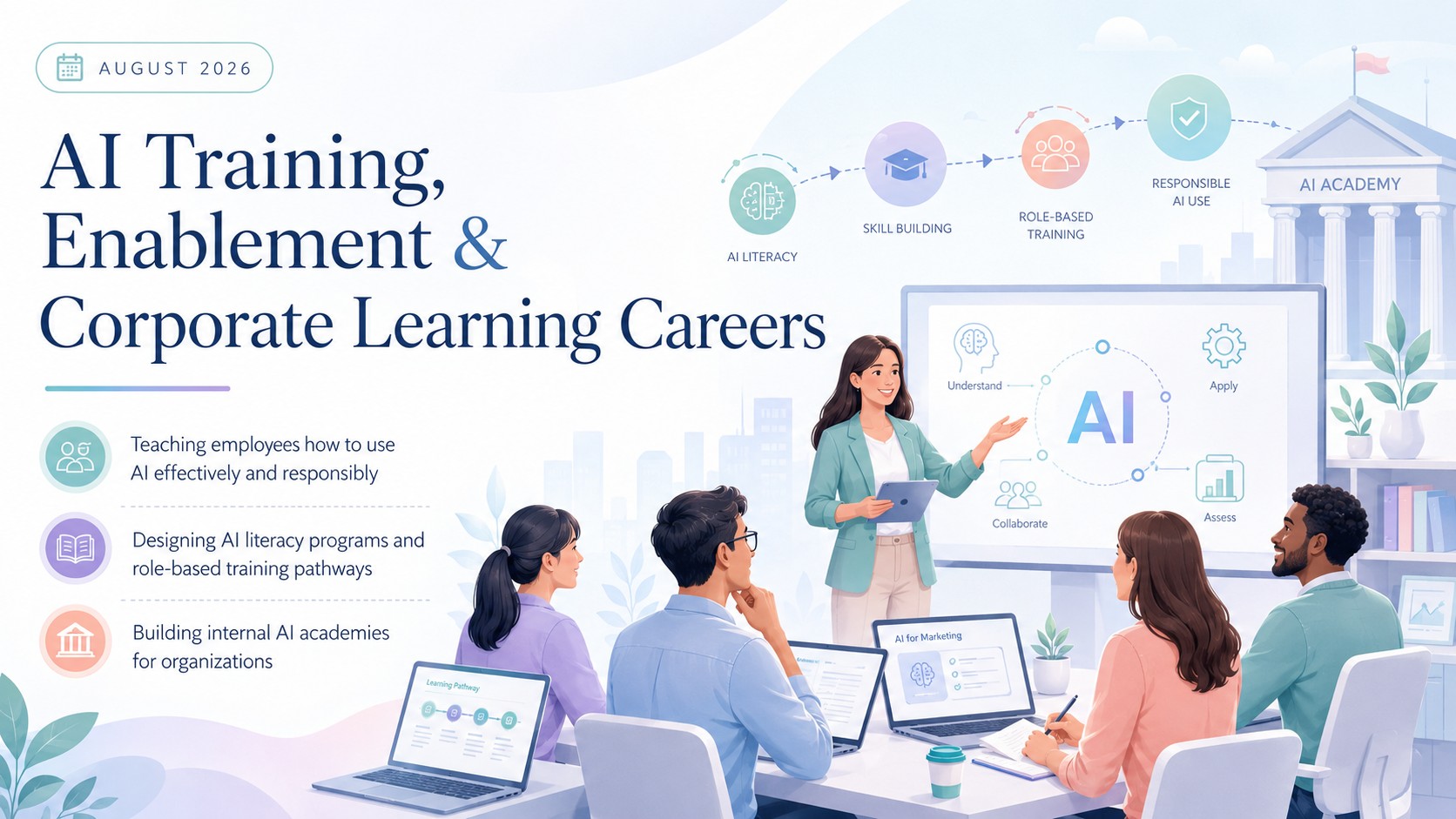
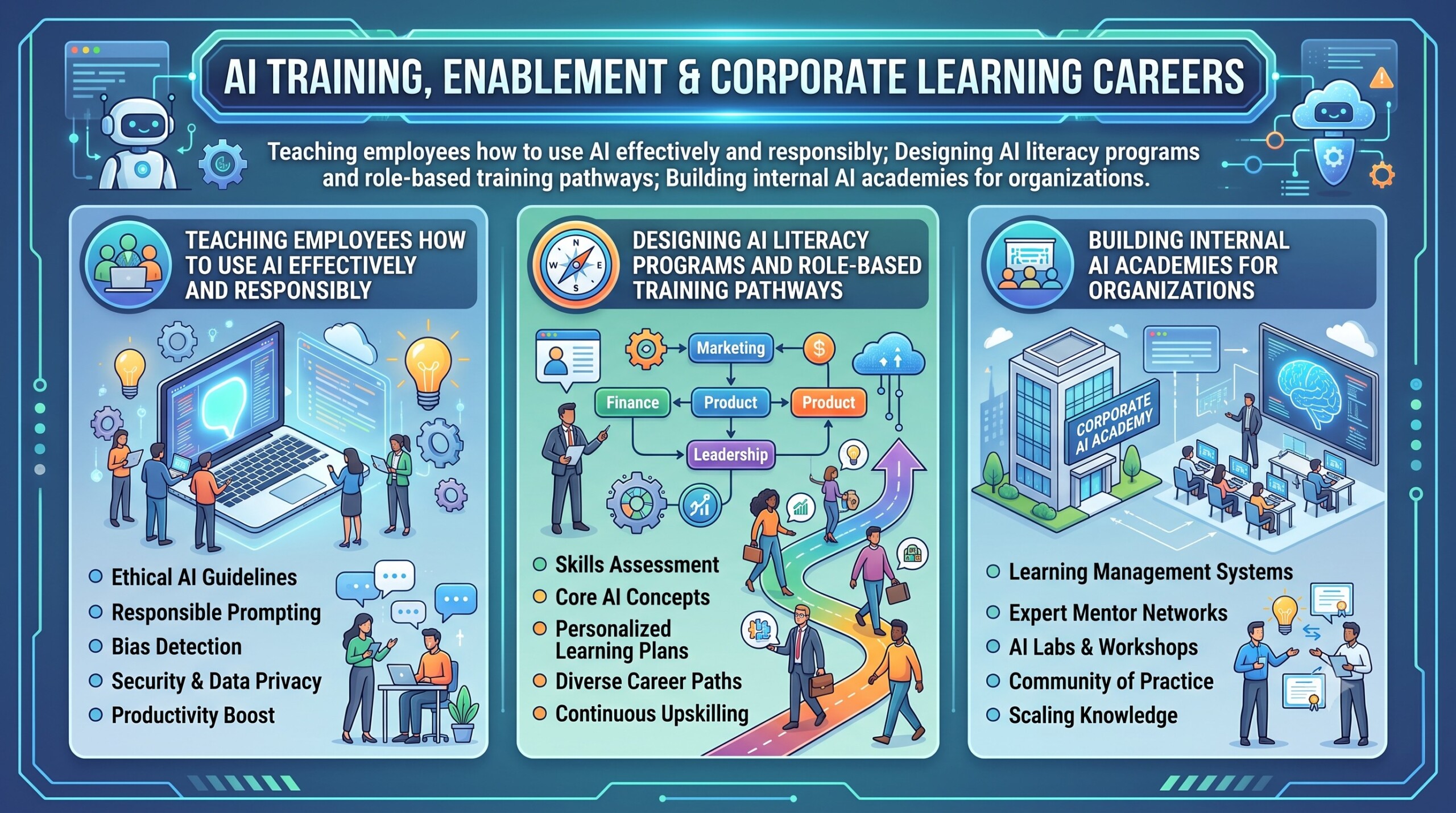
Teaching employees how to use AI effectively and responsibly; Designing AI literacy programs and role-based training pathways; Building internal AI academies for organizations
Introduction
As organizations move from experimenting with artificial intelligence to embedding it into everyday work, one challenge is becoming increasingly clear: buying AI tools does not automatically create an AI-capable workforce. Employees need to understand what AI can do, where it can fail, which tools they are permitted to use, how to work with AI productively, and when human judgment must take priority. This is creating an important career space around AI training, workforce enablement and corporate learning, bringing together AI knowledge, instructional design, business understanding and organizational change.
By August 2026, AI literacy is also becoming part of responsible AI governance. The current EU AI Act requires providers and deployers of AI systems to take measures supporting the development of AI literacy among staff and others using AI systems on their behalf. NIST’s AI Risk Management Framework similarly includes training personnel and partners in AI risk management according to their responsibilities. At the same time, Microsoft, Google Cloud and AWS are expanding role-based AI learning, agentic AI training, hands-on labs and organizational skilling programs. Corporate AI education is therefore developing into a sustained organizational capability rather than a series of introductory workshops. An excellent collection of learning videos awaits you on our Youtube channel.
Let’s dive deep into this.
1. AI literacy trainers and facilitators
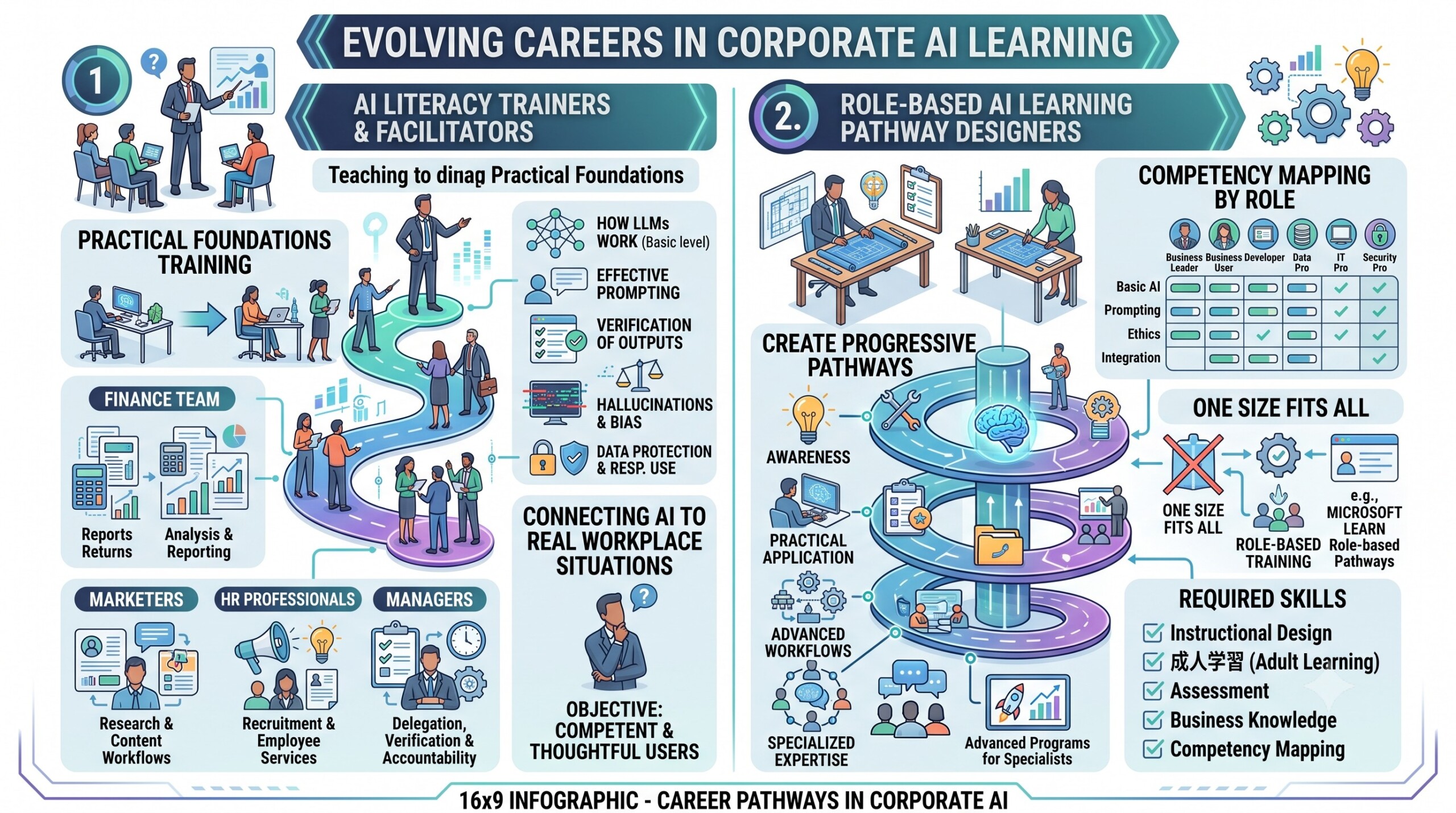
One of the most visible career opportunities is the AI literacy trainer or corporate AI facilitator. This person teaches employees the practical foundations of AI, generative AI and increasingly AI agents. Training may cover how large language models work at a basic level, effective prompting, verification of outputs, hallucinations, confidentiality, copyright, bias, data protection and responsible use. The objective is not to turn every employee into an AI engineer. It is to make employees competent and thoughtful users of AI.
Good trainers will increasingly need to connect AI concepts with real workplace situations. A finance team may need training on analysis and reporting, marketers may focus on research and content workflows, HR professionals may explore recruitment and employee services, while managers need to understand delegation, verification and accountability. This makes corporate AI training an attractive area for people who combine communication and teaching abilities with practical understanding of AI tools and organizational work.
2. Role-based AI learning pathway designers
Organizations are discovering that a single “AI for everyone” course is not enough. Employees have different responsibilities, risks and opportunities, so training needs to become role-based. Microsoft Learn, for example, currently organizes AI learning around roles including business leaders, business users, developers, data professionals, IT professionals and security professionals. This reflects a broader movement toward training people according to what they are expected to do with AI rather than giving everyone identical content.
This creates opportunities for AI learning designers, curriculum architects and learning experience designers. Their job is to map job roles to required AI competencies and then create progressive learning pathways. A pathway could move from awareness to practical application, advanced workflows and eventually specialized expertise. These professionals need skills in instructional design, competency mapping, adult learning, assessment and AI applications, together with enough business knowledge to understand what different functions actually need. A constantly updated Whatsapp channel awaits your participation.


3. AI enablement and adoption specialists
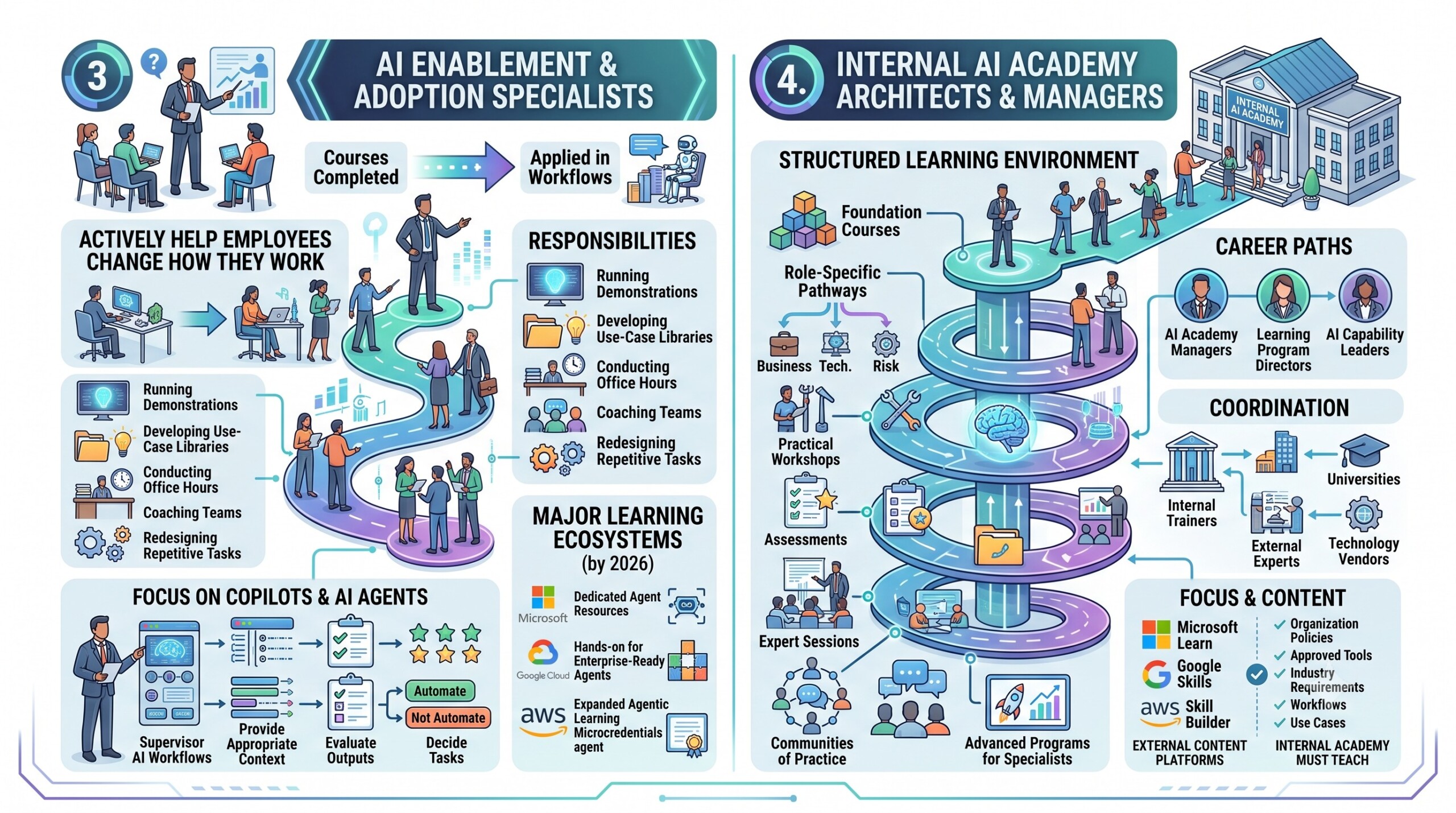
Teaching people what AI is represents only one part of the challenge. Organizations also need employees to change the way they work. This is creating roles around AI enablement, adoption and change management, where the focus moves from completing courses to actually applying AI inside business workflows. An enablement specialist may run demonstrations, develop use-case libraries, conduct office hours, coach teams and help employees redesign repetitive or information-intensive tasks.
This work becomes especially important as organizations introduce copilots and AI agents. Employees need to learn not only how to generate text or images but how to supervise AI-assisted workflows, provide appropriate context, evaluate outputs and decide which tasks should or should not be automated. By 2026, major learning ecosystems are already reflecting this shift. Microsoft has dedicated resources around agents, Google Cloud’s GEAR program includes hands-on training for building enterprise-ready agents, and AWS has expanded agentic AI learning and practical microcredentials.
4. Internal AI academy architects and managers
Larger organizations are increasingly better served by an internal AI academy than by disconnected training sessions. An AI academy can provide a structured learning environment containing foundation courses, role-specific pathways, practical workshops, assessments, internal case studies, expert sessions, communities of practice and advanced programs for specialists. It can also create a common language around AI across business, technology, risk and leadership teams.
This creates a career path for AI academy managers, learning program directors and AI capability leaders. They may coordinate internal trainers, external experts, universities and technology vendors while deciding which capabilities should be developed internally. Platforms such as Microsoft Learn, Google Skills and AWS Skill Builder can provide useful external content, but an effective corporate academy must also teach the organization’s own policies, approved tools, industry requirements, workflows and use cases. Excellent individualised mentoring programmes available.
5. Responsible AI and governance learning specialists
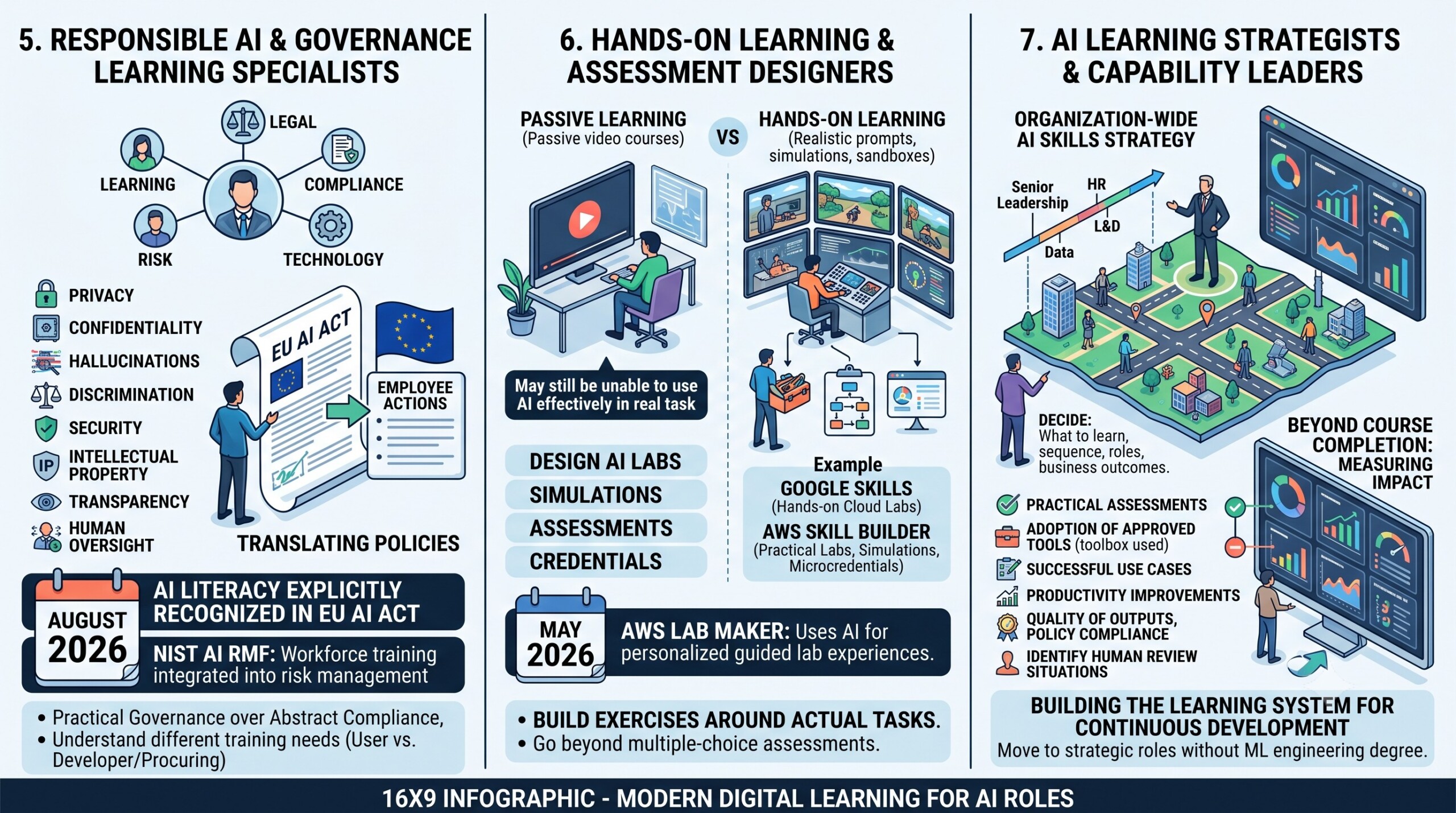
Responsible AI is becoming a significant component of corporate learning. Employees need to understand issues such as privacy, confidentiality, hallucinations, discrimination, security, intellectual property, transparency and human oversight. Training requirements will differ depending on whether someone is simply using an AI assistant or developing, approving, procuring or operating a higher-risk AI system.
This opens opportunities for responsible AI trainers and governance learning specialists who sit between learning, legal, compliance, risk and technology teams. They translate policies and regulatory requirements into understandable employee behaviour. The role is particularly relevant in August 2026 because AI literacy is now explicitly recognized in the EU AI Act, while frameworks such as the NIST AI RMF integrate workforce training into organizational AI risk management. Professionals in this area need to make governance practical rather than turning it into abstract compliance training.
6. Hands-on learning and assessment designers
Corporate AI learning is also shifting from passive video courses toward learning by doing. Employees benefit from working through realistic prompts, simulations, sandbox exercises, business cases and supervised challenges. A learner who has watched several hours of AI videos may still be unable to use AI effectively in a real task, while practical exercises can reveal whether the person can select an appropriate tool, construct a useful workflow and critically evaluate the result.
This creates opportunities for people who design AI labs, simulations, assessments, credentials and experiential learning programs. Current vendor programs illustrate the direction. Google Skills provides hands-on cloud labs, while AWS Skill Builder includes practical labs, simulations and microcredentials. In May 2026, AWS also introduced Lab Maker, which uses AI to generate personalized guided lab experiences for AWS services. Corporate learning teams can adapt the same philosophy by building exercises around actual organizational tasks rather than relying only on multiple-choice assessments. Subscribe to our free AI newsletter now.
7. AI learning strategists and capability leaders
At a more senior level, organizations need people who can decide what the workforce should learn, in what sequence, for which roles and with what business outcome. An AI learning strategist may work with senior leadership, HR, learning and development, IT, data teams and business units to identify capability gaps and create an organization-wide AI skills strategy. This role is less about personally teaching every course and more about building the system through which thousands of employees can continuously develop relevant AI capabilities.
The strongest professionals in this field will also measure whether training changes behaviour and performance. Course completion alone is a weak indicator of AI readiness. Organizations can look at practical assessments, adoption of approved tools, successful use cases, productivity improvements, quality of outputs, policy compliance and the ability of employees to identify situations requiring human review. This gives experienced L&D professionals, trainers, HR leaders, consultants and change-management specialists an opportunity to move into strategic AI capability roles without necessarily becoming machine-learning engineers.
Conclusion
AI training and corporate learning careers are becoming increasingly important because the AI transformation of organizations is ultimately also a workforce transformation. Companies need people who can teach AI literacy, design role-based learning pathways, drive adoption, build internal AI academies, explain responsible AI, create hands-on learning experiences and develop long-term capability strategies. By August 2026, the opportunity is moving beyond the generic title of “AI trainer.” A broader professional ecosystem is emerging at the intersection of AI, learning and development, workforce transformation, governance and organizational change. For professionals who can understand technology while also understanding how adults learn and how organizations operate, this is likely to remain an important field as AI becomes embedded more deeply into everyday work. Upgrade your AI-readiness with our masterclass.