How can professionals start learning AI from zero?
How can professionals start learning AI from zero?
There is always a time to start afresh, and it is now
Introduction
Starting AI in late 2026 can feel intimidating because the vocabulary has expanded rapidly. Conversations now include LLMs, multimodal AI, agents, context windows, reasoning models, APIs, retrieval systems and dozens of changing product names, which can create the false impression that newcomers need to understand the whole technical field before they can use any of it.
The employment picture suggests a more practical approach. LinkedIn continues to track rapid changes in workplace skills, while the World Economic Forum expects AI and big data, cybersecurity and technological literacy to grow strongly through 2030 alongside analytical thinking, creativity, resilience and lifelong learning. Professionals preparing for 2027 should therefore treat AI as a new layer of professional capability rather than a subject reserved for programmers. An excellent collection of learning videos awaits you on our Youtube channel.
Let’s dive deep into it now.
1. Begin with AI literacy, not AI engineering
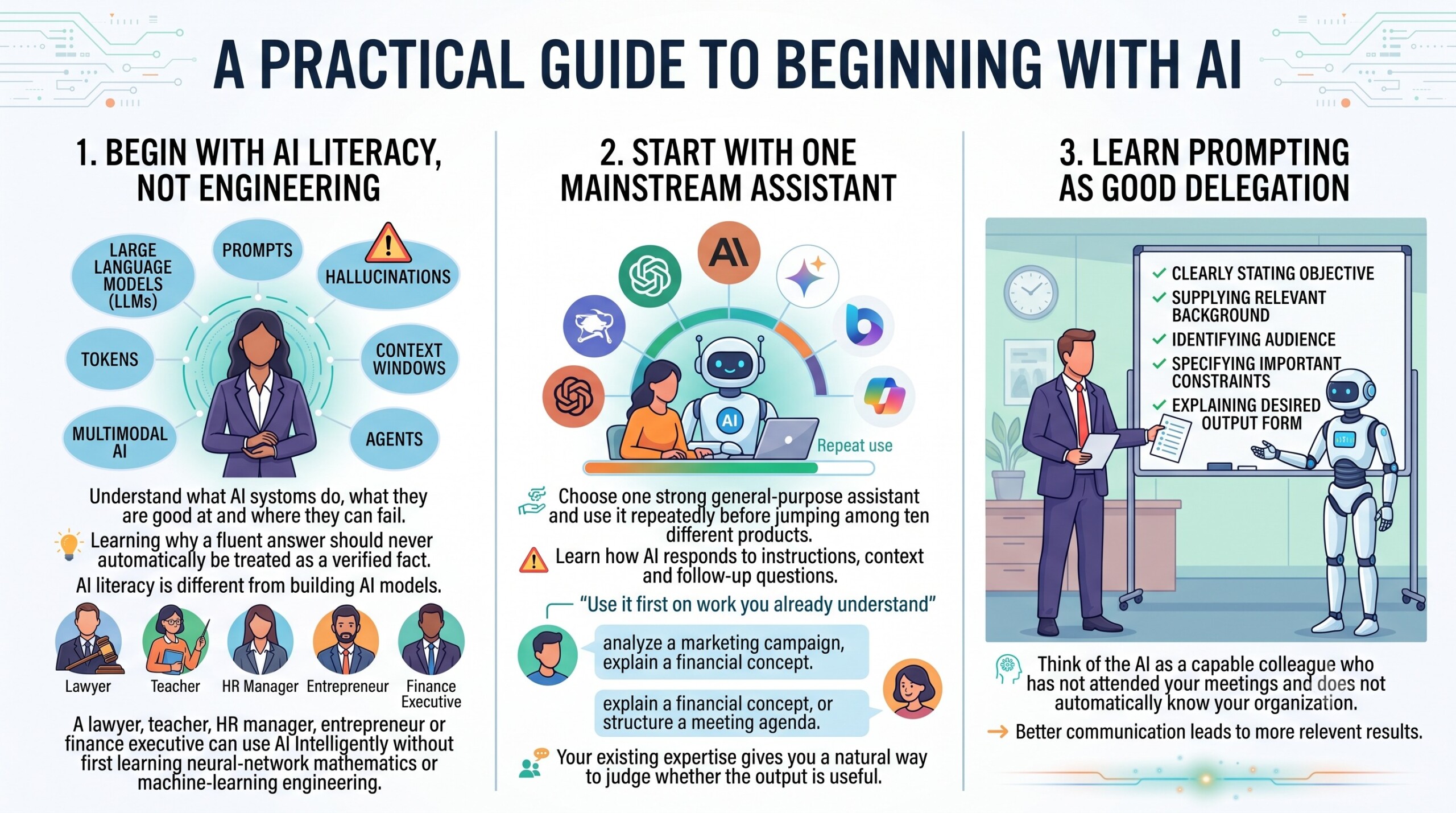
AI literacy means understanding what current AI systems broadly do, what they are good at and where they can fail. Begin with concepts such as large language models, prompts, hallucinations, tokens, context windows, multimodal AI and agents, while learning why a fluent answer should never automatically be treated as a verified fact.
This level of understanding is useful across professions because AI literacy is different from building AI models. A lawyer, teacher, HR manager, entrepreneur or finance executive can use AI intelligently without first learning neural-network mathematics or machine-learning engineering.
2. Start with one mainstream assistant
Choose one strong general-purpose assistant and use it repeatedly before jumping among ten different products. ChatGPT, Claude, Gemini, Microsoft Copilot and other established systems can all provide an environment in which a beginner learns how AI responds to instructions, context and follow-up questions.
Use it first on work you already understand. If you know marketing, ask it to analyse a campaign; if you work in finance, use it to explain a familiar financial concept; if you manage people, ask it to structure a meeting agenda, because your existing expertise gives you a natural way to judge whether the output is useful. A constantly updated Whatsapp channel awaits your participation.


3. Learn prompting as good delegation
Prompting does not require memorizing magical formulas. Good results usually come from clearly stating the objective, supplying relevant background, identifying the audience, specifying important constraints and explaining the desired form of the output.
Think of the AI as a capable colleague who has not attended your meetings and does not automatically know your organization. The better you communicate the situation and provide useful material, the easier it becomes for the system to give you something relevant.
4. Develop a verification habit early
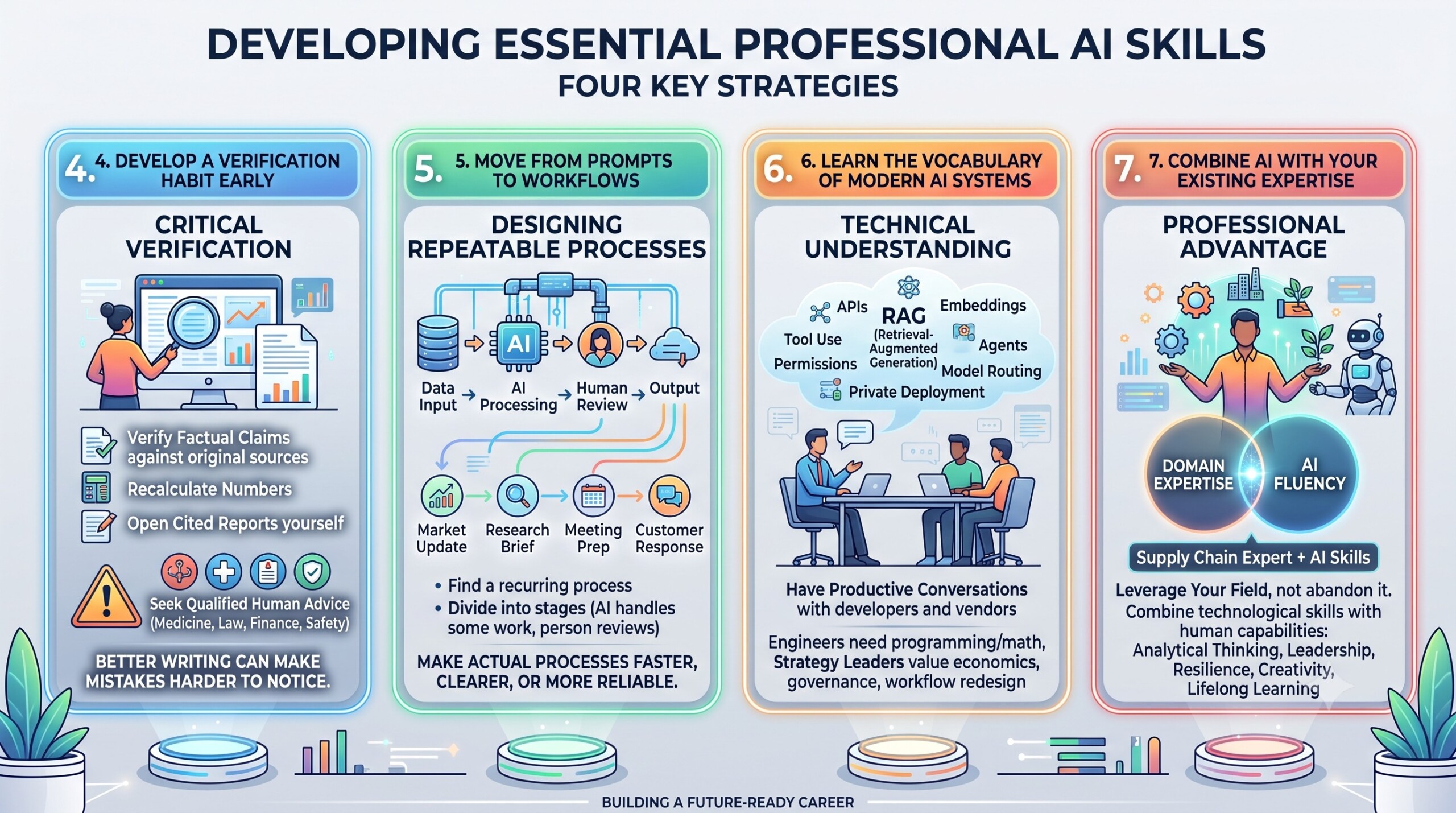
One of the most valuable AI skills is knowing when to check the machine. Verify factual claims against original sources, recalculate important numbers, open cited reports yourself and use qualified human advice where decisions involve areas such as medicine, law, finance, safety or regulation.
This habit will become more important as models improve because better writing can make mistakes harder to notice. A polished answer creates psychological confidence, but confidence in the presentation is not evidence that every underlying fact is correct. Excellent individualised mentoring programmes available.
5. Move from prompts to workflows
After learning individual prompts, find one recurring process in your working life. A market update, research brief, meeting preparation routine, customer-response process, competitive scan or monthly report can often be divided into several stages where AI handles some work and a person reviews the important decisions.
This changes the learning experience because you stop asking random questions and start designing repeatable ways of working. The objective is not simply to produce more AI output, but to make an actual process faster, clearer or more reliable.
6. Learn the vocabulary of modern AI systems
Professionals who want to work intelligently with technical teams should eventually understand concepts such as APIs, retrieval-augmented generation, embeddings, tool use, agents, permissions, model routing and private deployment. You do not initially need to implement these technologies yourself, but understanding what they mean will make conversations with developers and vendors much more productive.
Only then should you decide how technical your personal pathway needs to become. A future AI engineer will need programming and mathematics, while a strategy leader may gain greater value from understanding economics, governance, workflow redesign and how different AI systems fit into an organization. Subscribe to our free AI newsletter now.
7. Combine AI with the expertise you already have
The most powerful professional advantage often comes from combining AI fluency with existing domain knowledge. A person who deeply understands supply chains and can use AI effectively may create more value in supply-chain work than someone who knows generic prompting but lacks operational experience.
That is why professionals should not abandon their field merely because AI is growing. The World Economic Forum’s skills outlook combines technological skills with analytical thinking, leadership, resilience, creativity and lifelong learning, suggesting that the future of work will require combinations of human and technological capabilities rather than one narrow skill alone.
Conclusion
Preparing for an AI-first 2027 is much easier when the journey is broken into layers. Understand the basic concepts, use one capable assistant on familiar work, learn to give better context, verify important outputs, turn useful experiments into repeatable workflows, acquire enough technical vocabulary to collaborate intelligently and combine AI with the professional expertise you already possess. Continuous learning matters far more than memorizing today’s model names because the tools will keep changing while the ability to learn, judge and apply them will remain valuable. Upgrade your AI-readiness with our masterclass.