A monkey may define AI creativity’s legal bounds
A monkey may define AI creativity’s legal bounds
‘Naruto’ will end up making history
Introduction
In a world debating billion-dollar AI models, global copyright conflicts, and the future of human creativity, it is both amusing and profound that one of the most important legal reference points comes from a monkey with a camera. Not a metaphorical monkey, but a real one. In a quiet forest, curiosity met technology, a shutter clicked, and an unexpected legal journey began.
The story of Naruto, who took a photograph using a camera set up by David Slater in Tangkoko Nature Reserve, has now become central to defining authorship in the modern age. As artificial intelligence generates music, films, and literature, courts are asking a deeper question. If a monkey cannot own a photograph, can a machine own creative work?
A deep dive follows.
Why AI copyrights is a tangled mess
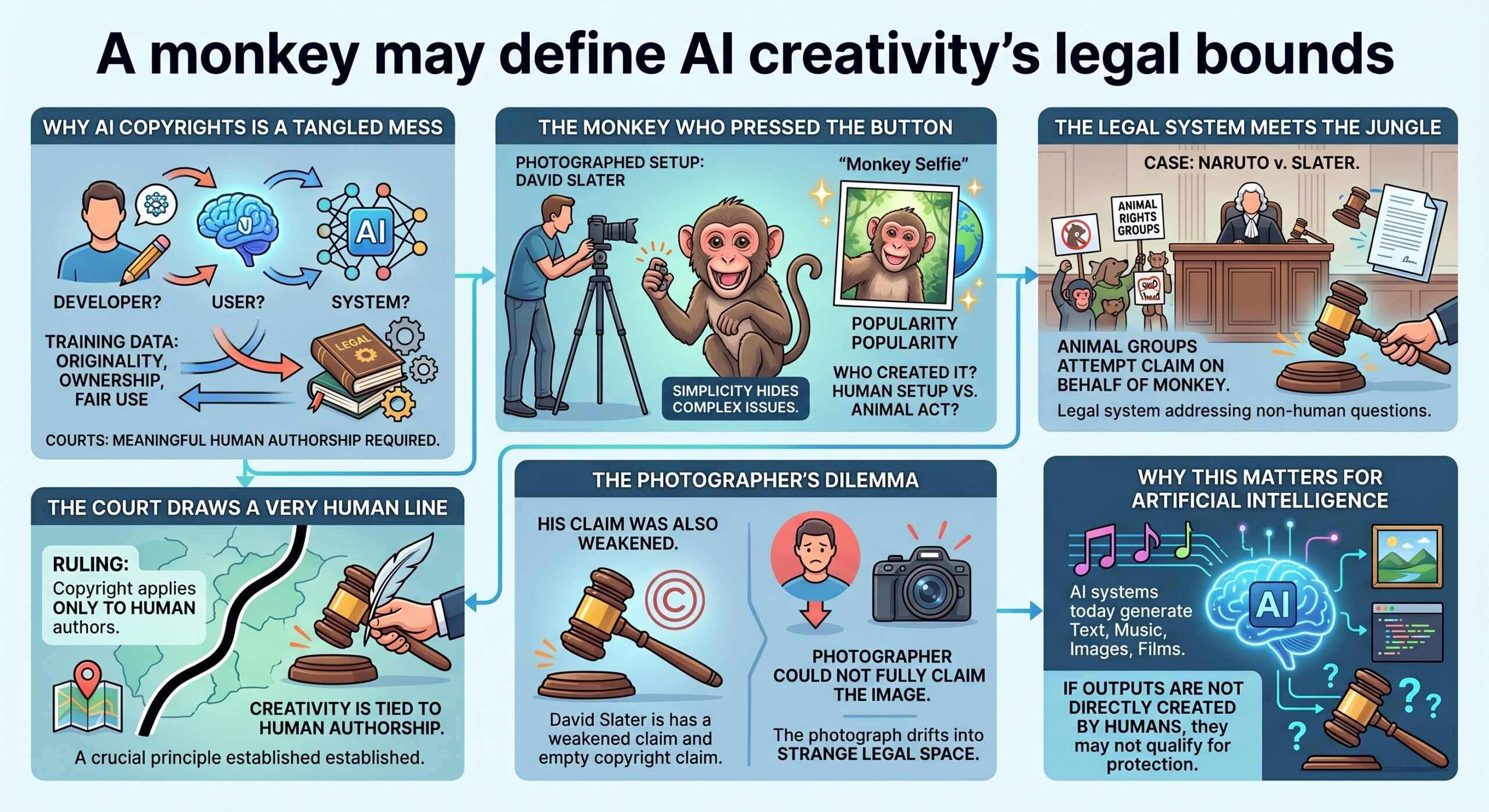
AI copyright is a tangled mess because it sits at the intersection of human creativity, machine generation, and outdated legal frameworks that were never designed for non-human authors. When an AI produces a song, image, or article, it is unclear who the true creator is. Is it the developer who built the model, the user who gave the prompt, or the system that generated the output. At the same time, AI models are trained on vast amounts of existing human-created content, raising questions about originality, ownership, and fair use. Different countries are also taking different legal positions, which adds further confusion. As a result, AI challenges the very definition of authorship, making copyright law one of the most complex and unresolved issues in the digital age. Courts are consistently holding that copyright protection requires meaningful human authorship, and works generated without direct human creative input do not qualify for protection.
The monkey who pressed the button
The entire episode began with a simple act. A photographer set up his camera, and a curious macaque interacted with it and triggered the shutter. The resulting image became globally famous. The simplicity of the act hides a complex legal issue. Who created the photograph. The person who set up the camera or the animal who actually triggered it. An excellent collection of learning videos awaits you on our Youtube channel.
The legal system meets the jungle
The case evolved into the well-known Naruto v. Slater. Animal rights groups attempted to claim copyright on behalf of the monkey. Courts were forced to consider whether a non-human entity could hold copyright under existing law. The legal system, built for human society, suddenly had to address a question it had never imagined.
The court draws a very human line
The courts ultimately ruled that copyright protection applies only to human authors. Since the monkey was not human, it could not hold copyright. This decision may sound obvious, but it established a crucial principle. Creativity, in the legal sense, is tied to human authorship.
The photographer’s dilemma
The photographer did not escape unscathed. Since he did not physically take the photograph, his claim to copyright was also weakened. The result was almost poetic. The monkey could not own the image, and the human could not fully claim it either. The photograph drifted into a strange legal space where ownership itself became unclear. A constantly updated Whatsapp channel awaits your participation.
Why this matters for artificial intelligence
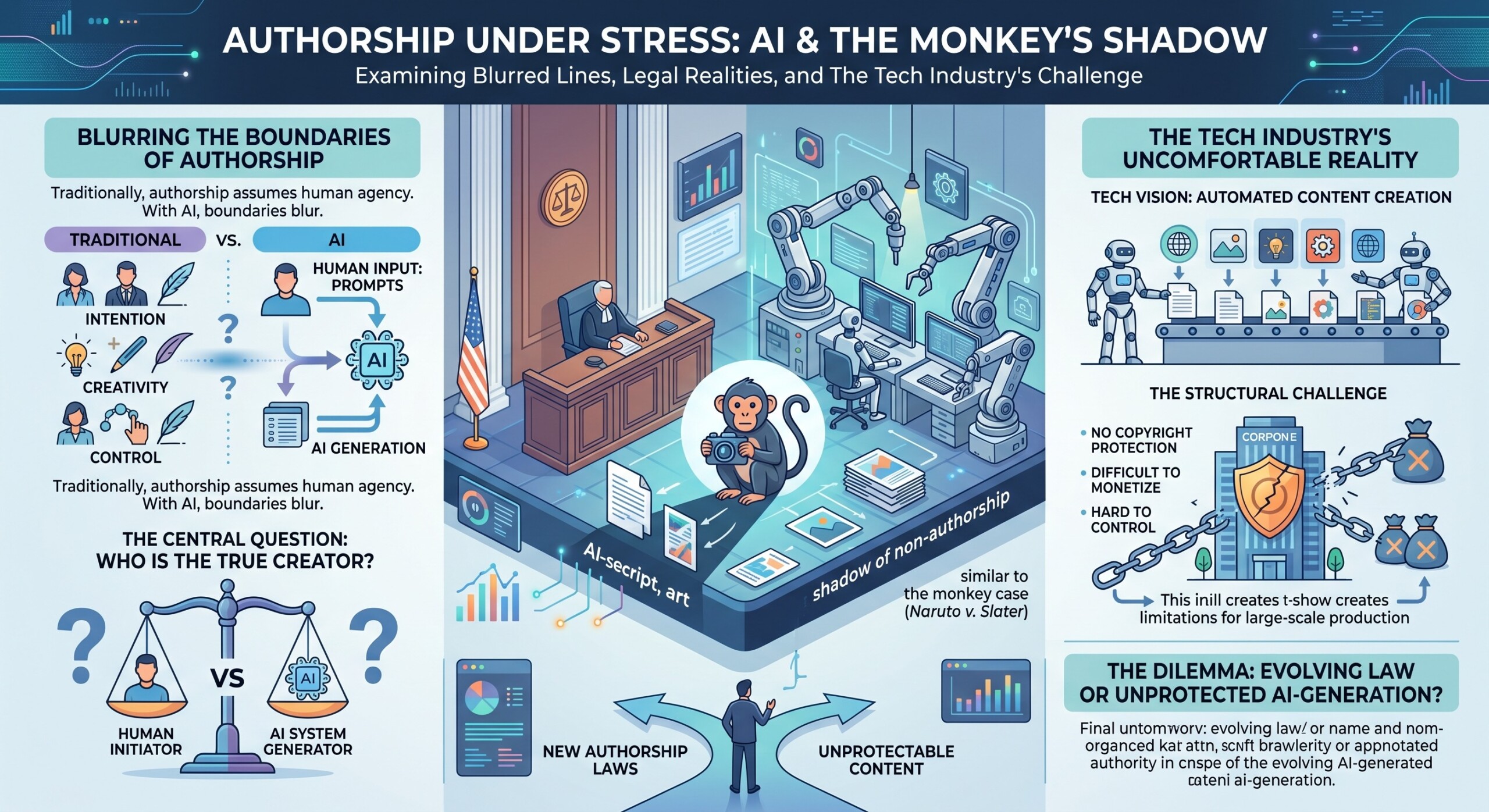
This is where things become serious. AI systems today generate text, music, images, and even films. If these outputs are not directly created by humans, they may fall into the same category as the monkey’s photograph. That means they may not qualify for copyright protection.
The idea of authorship is under stress
Traditionally, authorship assumes intention, creativity, and control. With AI, these boundaries blur. A human may provide prompts, but the system produces the output. Courts now face a question similar to the monkey case. Who is the true creator. The human who initiated the process or the system that generated the result.
The tech industry’s uncomfortable reality
Many technology companies envision a future filled with automated content creation. However, if AI-generated work cannot be protected by copyright, it becomes difficult to monetize and control. The legal limitation exposed by the monkey case creates a structural challenge for large-scale AI content production. Excellent individualised mentoring programmes available.
Courts are becoming the new creative gatekeepers
As disputes increase, courts are emerging as the key decision-makers shaping the future of creativity. Each ruling adds clarity but also raises new questions. The legal system is now actively defining the boundaries of what counts as creative work in the age of machines.
The irony at the heart of it all
There is a deep irony in this situation. A random act by a curious animal has become one of the most important precedents in modern intellectual property law. While engineers build increasingly complex systems, the legal framework keeps returning to a simple principle. Creativity must originate from a human mind. Subscribe to our free AI newsletter now.
The future may still surprise us
The story is far from over. Laws evolve, and new interpretations may emerge as AI becomes more integrated into creative processes. Hybrid models of authorship, where humans and machines collaborate, may lead to new legal definitions. The monkey may not have the final word, but it has certainly started the conversation.
Conclusion
The case of the monkey selfie has moved far beyond its unusual origins. It now sits at the centre of a global debate about creativity, ownership, and the role of artificial intelligence. By reinforcing the idea that copyright belongs to humans, it places a boundary on how far automated creativity can go.
As AI continues to advance, this boundary will be tested again and again. The future of creative industries may depend not only on technological innovation but also on how legal systems interpret authorship. In an unexpected twist, a single moment in a forest has become a guiding reference for one of the most important questions of our time. Upgrade your AI-readiness with our masterclass.
Share this with the world
Related Articles