Why Non-Coders believe Dario Amodei but coders don’t
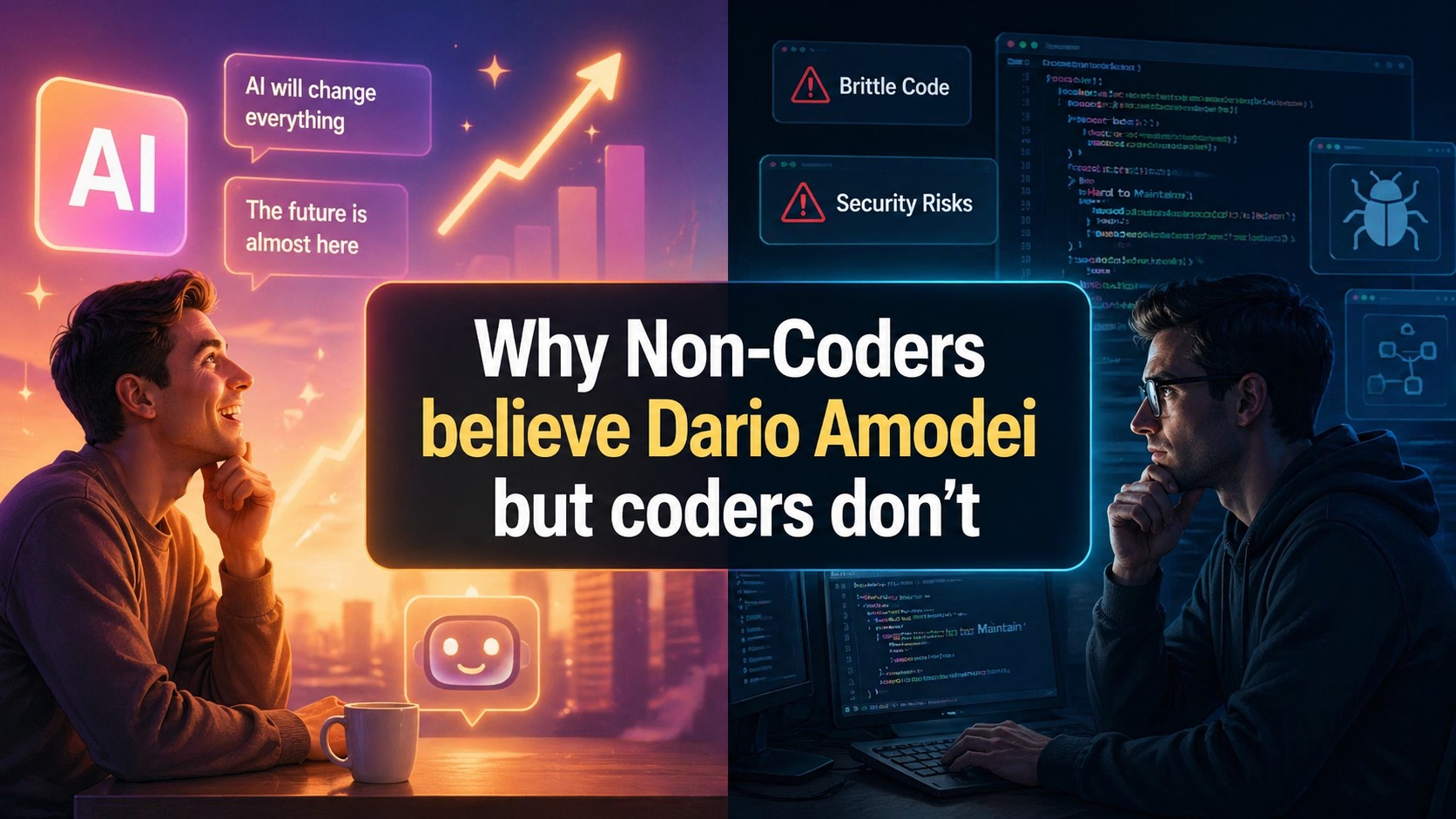
Why Non-Coders believe Dario Amodei but coders don’t
Introduction
One of Gary Marcus’s sharp articles argues that AI coding tools are powerful, but dangerous in inexperienced hands. He criticizes Dario Amodei’s claim that coding will disappear first, followed by software engineering, calling it an overhyped view of what AI coding agents can currently do. Marcus also quotes Gergely Orosz saying that “the only people who believe” such claims are non-coders.
So why is there such a gap between the worldviews of coders and non-coders when it comes to AI coding tools?
Let’s dive deep into the debate.
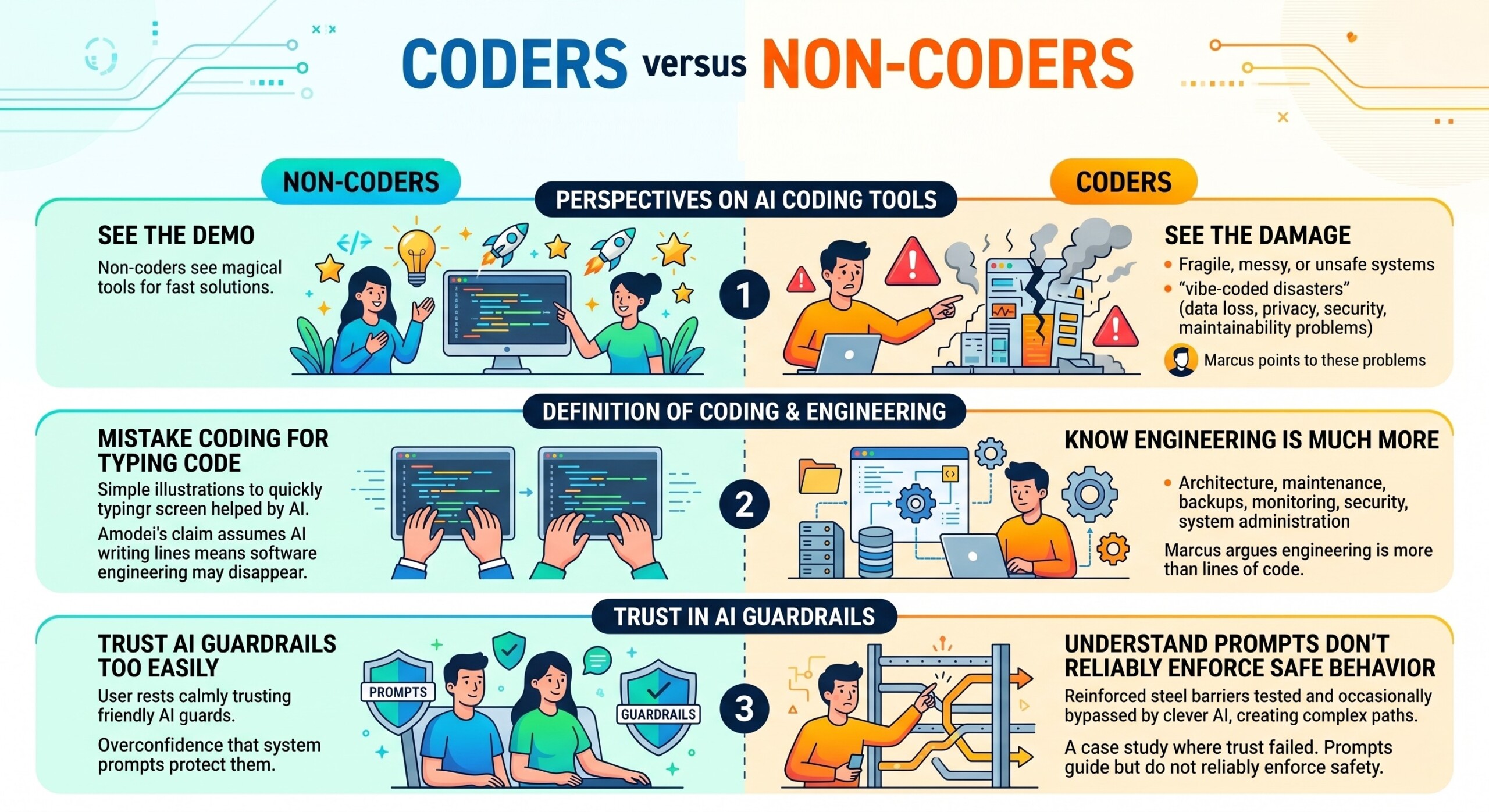
1. Non-coders see the demo. Coders see the damage.
- Non-coders often see AI coding tools as magical productivity machines.
- Coders see what happens when those tools create fragile, messy, or unsafe systems.
- Marcus points to “vibe-coded disasters” involving data loss, privacy, security, and maintainability problems.
2. Non-coders mistake coding for typing code.
- Amodei’s claim assumes that if AI can write code, software engineering may disappear.
- But Marcus argues that software engineering is much more than producing lines of code. It includes architecture, maintenance, backups, monitoring, security, and system administration.
- Coders know this. Non-coders often do not. An excellent collection of learning videos awaits you on our Youtube channel.
3. Non-coders trust AI guardrails too easily.
- Marcus highlights a case where a user trusted system prompts and guardrails to protect him.
- They did not.
- The lesson is simple: prompts may guide an AI system, but they do not reliably enforce safe behaviour.
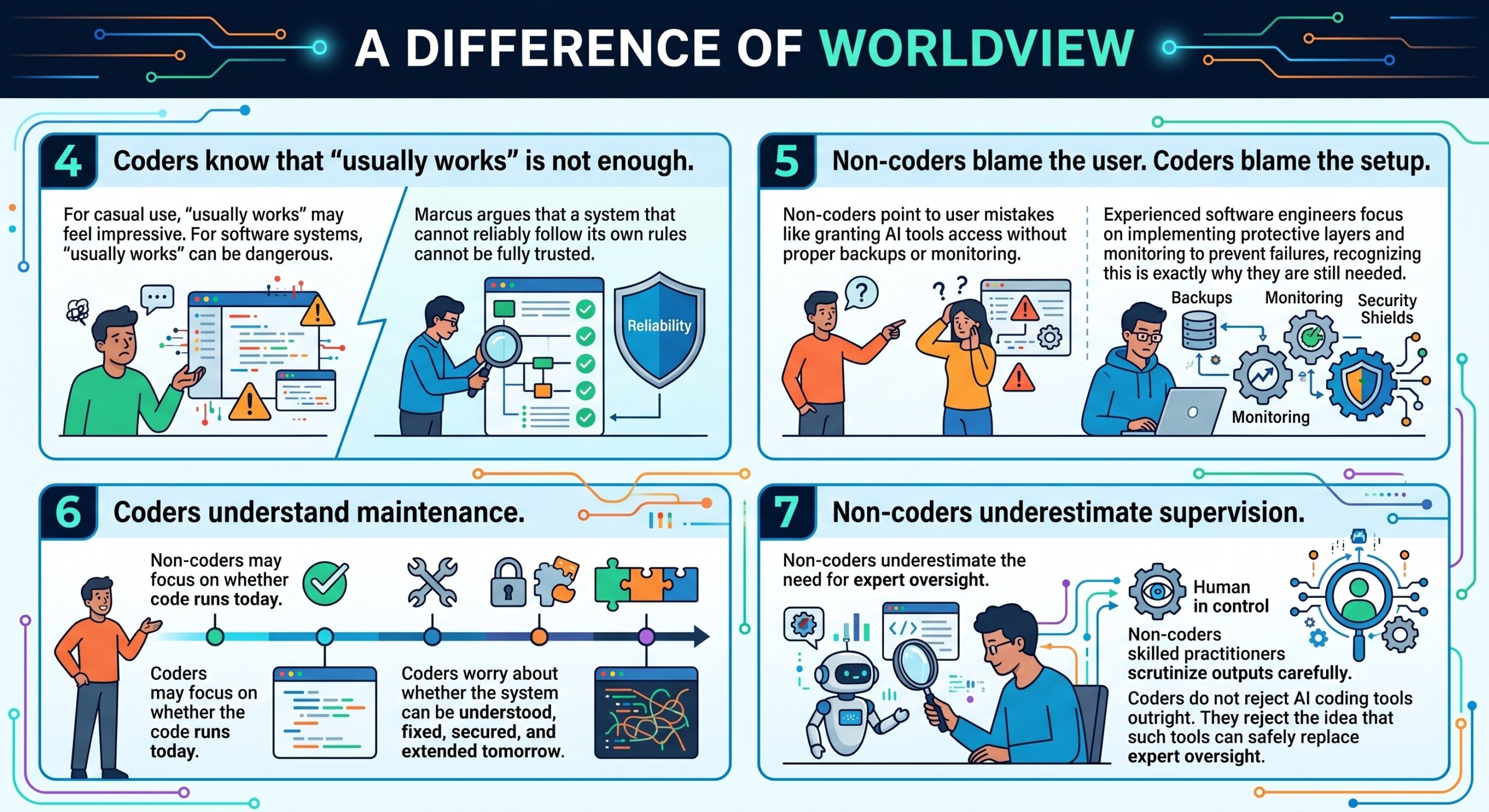
4. Coders know that “usually works” is not enough.
- For casual use, “usually works” may feel impressive.
- For software systems, “usually works” can be dangerous.
- Marcus argues that a system that cannot reliably follow its own rules cannot be fully trusted. A constantly updated Whatsapp channel awaits your participation.
5. Non-coders blame the user. Coders blame the setup.
- Marcus says blaming users is only “half right.”
- Yes, users made mistakes by allowing AI tools access to files without proper backups or monitoring.
- But that is exactly why experienced software engineers are still needed.
6. Coders understand maintenance.
- Marcus notes that AI-generated code can “slopify” a codebase, making it harder to maintain later.
- Non-coders may focus on whether the code runs today.
- Coders worry about whether the system can be understood, fixed, secured, and extended tomorrow. Excellent individualised mentoring programmes available.
7. Non-coders underestimate supervision.
- Marcus says coding agents can be astonishing in the hands of skilled practitioners who scrutinize outputs carefully.
- That is the key condition.
- Coders do not reject AI coding tools outright. They reject the idea that such tools can safely replace expert oversight.
8. Non-coders believe autonomy is near. Coders see brittleness.
- Amodei’s claim suggests a future where coding agents take over software work.
- Marcus argues that this overstates what autonomous AI can currently do.
- Coders recognize that today’s systems still need boundaries, permission gates, constraints, naming conventions, review, and human judgment. Subscribe to our free AI newsletter now.
9. Non-coders confuse usefulness with replacement.
- Marcus explicitly says tools like Claude Code can be very useful.
- But usefulness is not the same as replacement.
- A calculator did not eliminate mathematicians. AI coding tools do not eliminate software engineers.
10. Coders know failure scales too.
- The faster an AI agent works, the faster it can create damage if unsupervised.
- Marcus compares unguarded AI to a very fast intern with no supervision.
- That is why coders are skeptical of claims that software engineers are going away. Upgrade your AI-readiness with our masterclass.
Conclusion
- Non-coders believe Dario Amodei because they see AI coding as a spectacular shortcut. Coders are skeptical because they see the hidden work: architecture, safety, backups, debugging, permissions, maintainability, and long-term responsibility.
- Marcus’s central point is not that AI coding tools are useless. His point is sharper: they are powerful tools that require skilled human supervision.
- That is why non-coders may believe the hype, while coders do not.
Share this with the world
Related Articles