Latest LLMs from leading vendors: September 2026 beginner’s guide

Latest LLMs from leading vendors: September 2026 beginner’s guide
How LLM landscape is changing rapidly
Introduction
Following large language models has become confusing because the market no longer consists of a few famous chatbots. Vendors now offer premium reasoning systems, fast low-cost models, specialist cybersecurity versions, open-weight models, multimodal systems and agents designed to keep working across long sequences of actions, while releases can change within weeks.
For beginners, the useful question is not which model wins the internet’s latest benchmark argument. The better question is what each model is designed to do, what it costs, how much information it can handle, where it can be accessed and what limitations matter before using it for real work.
Let’s dive deep into it now.
1. OpenAI GPT-6 Astra
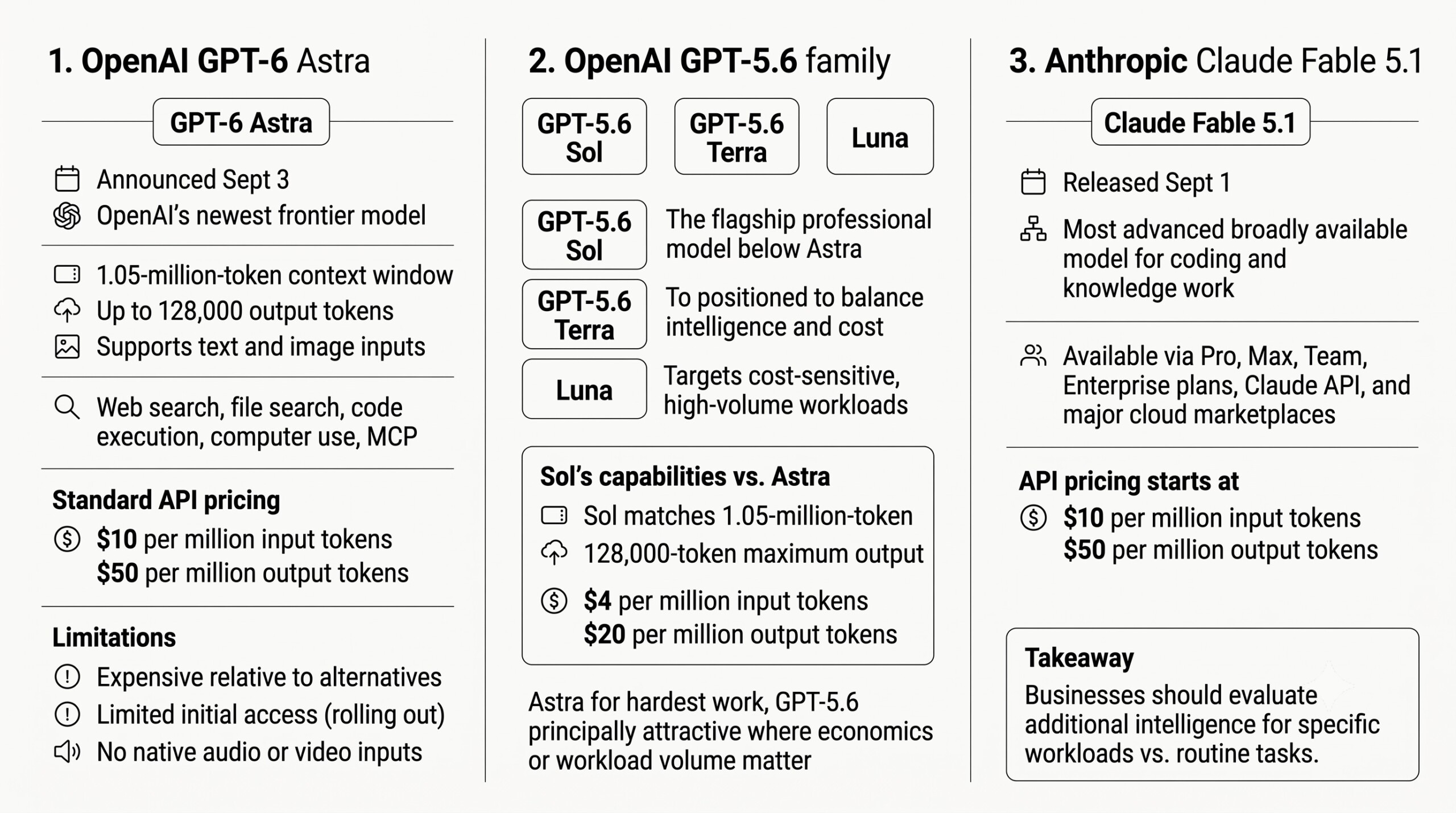
GPT-6 Astra was announced on September 3 and is OpenAI’s newest frontier model. It supports a 1.05-million-token context window, up to 128,000 output tokens, text and image inputs, and tools including web search, file search, code execution, computer use and MCP.
Astra is also expensive relative to many alternatives, at $10 per million input tokens and $50 per million output tokens under standard API pricing. Access is initially limited while broader API and ChatGPT availability rolls out, and the model does not natively support audio or video inputs.
2. OpenAI GPT-5.6 family
OpenAI’s GPT-5.6 family remains relevant after Astra because it provides different cost and capability levels. GPT-5.6 Sol is the flagship professional model below Astra, while GPT-5.6 Terra is positioned to balance intelligence and cost and Luna targets more cost-sensitive, high-volume workloads.
Sol has the same 1.05-million-token context window and 128,000-token maximum output as Astra but is priced at $4 per million input tokens and $20 per million output tokens. The limitation is straightforward: Astra is now OpenAI’s most capable option for the hardest work, so GPT-5.6 is principally attractive where economics or workload volume matter more. An excellent collection of learning videos awaits you on our Youtube channel.
3. Anthropic Claude Fable 5.1
Anthropic released Claude Fable 5.1 on September 1 as its most advanced broadly available model for difficult coding and knowledge work. It is available through Anthropic’s Pro, Max, Team and Enterprise plans, through the Claude API and through major cloud marketplaces.
Its API price starts at $10 per million input tokens and $50 per million output tokens, placing it firmly in the premium category. Businesses should therefore evaluate whether the additional intelligence is useful for the specific workload rather than assuming that the newest premium model is economical for every routine task.
4. Anthropic Claude Mythos 5.1
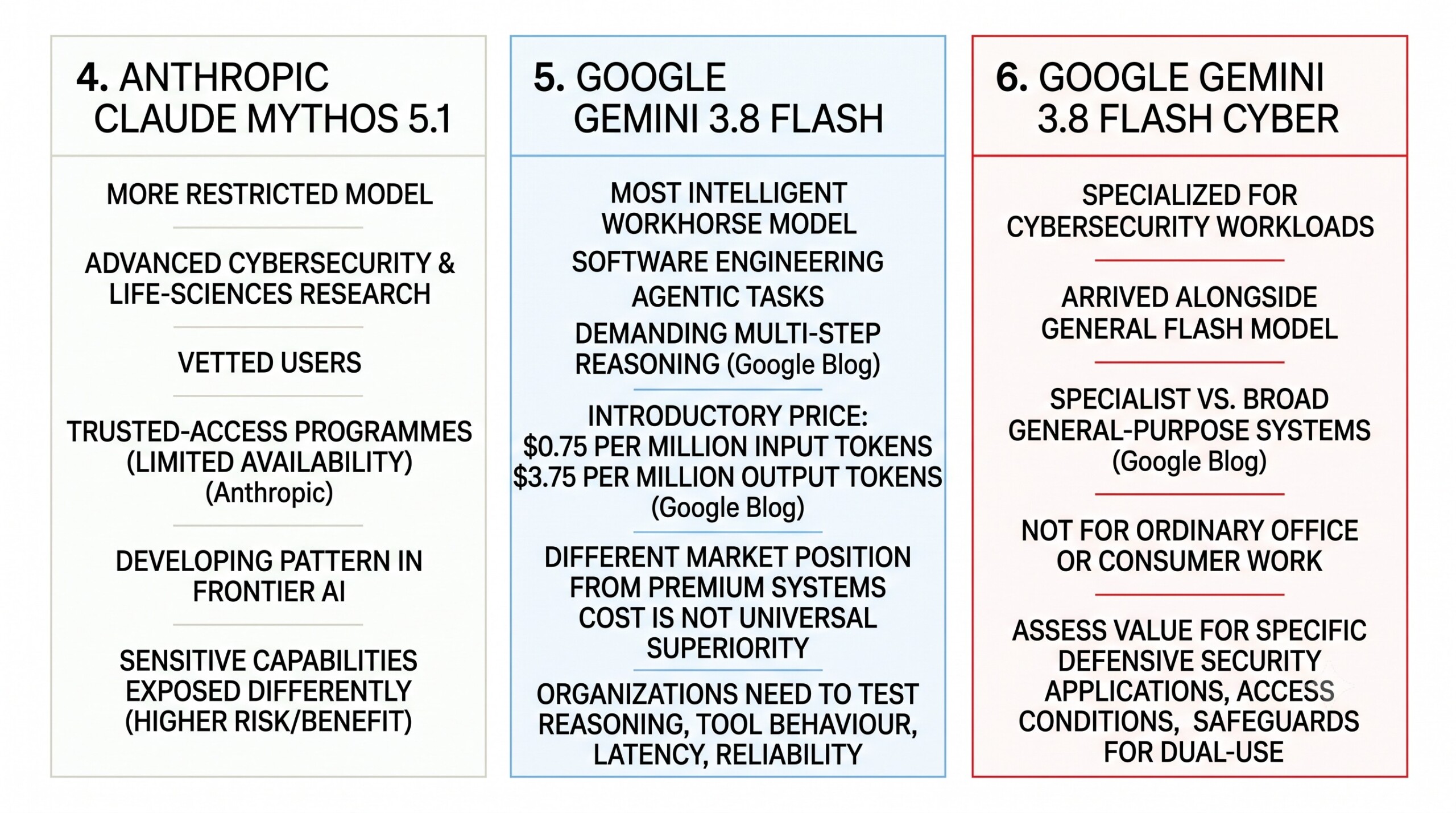
Claude Mythos 5.1 is a more restricted model aimed at advanced cybersecurity and life-sciences research. Anthropic says access is being provided to vetted users through trusted-access programmes, with availability currently limited rather than offered as a normal general-purpose consumer model.
That limited access is itself one of the model’s defining characteristics. Mythos demonstrates a developing pattern in frontier AI where vendors may expose particularly sensitive capabilities differently from ordinary language-model functions because the potential benefits and misuse risks are both unusually high. A constantly updated Whatsapp channel awaits your participation.


5. Google Gemini 3.8 Flash
Google introduced Gemini 3.8 Flash on September 2 and describes it as its most intelligent workhorse model. The company highlights improvements in software engineering, agentic tasks and demanding multi-step reasoning while keeping the introductory price at $0.75 per million input tokens and $3.75 per million output tokens.
That pricing gives Gemini 3.8 Flash a different market position from premium systems charging $10 and $50 per million tokens. Cost, however, should not be confused with universal superiority, because organizations still need to test reasoning quality, tool behaviour, latency and reliability on the actual tasks they want to automate.
6. Google Gemini 3.8 Flash Cyber
Gemini 3.8 Flash Cyber arrived alongside the general Flash model and is built specifically for cybersecurity workloads. Its existence reflects an important development across the market as specialist models begin to sit alongside broad general-purpose systems.
A specialist cyber model should not automatically be treated as the right model for ordinary office or consumer work. Its value needs to be assessed against specific defensive security applications, access conditions and the safeguards surrounding potentially dual-use capabilities. Excellent individualised mentoring programmes available.
7. xAI Grok 4.6
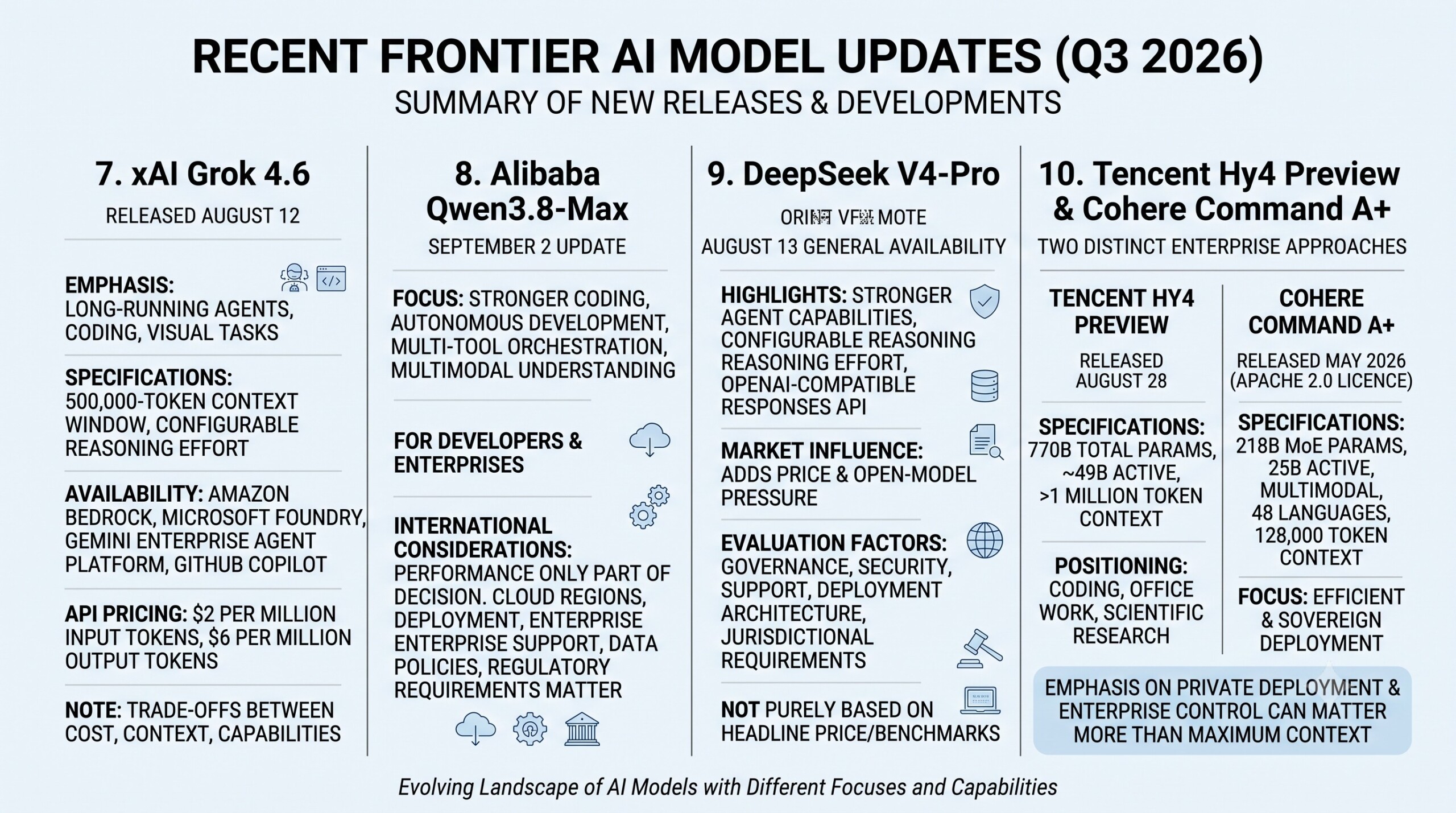
SpaceXAI released Grok 4.6 on August 12 with an emphasis on long-running agents, coding and ambitious interactive or visual tasks. It supports a 500,000-token context window and configurable reasoning effort, and has since become available through services including Amazon Bedrock, Microsoft Foundry, Gemini Enterprise Agent Platform and GitHub Copilot.
API pricing starts at $2 per million input tokens and $6 per million output tokens. Its 500,000-token context window is large but smaller than the million-token class now offered by some competitors, reminding users that leading models increasingly make different trade-offs between cost, context and capabilities.
8. Alibaba Qwen3.8-Max
Alibaba Cloud’s Qwen3.8-Max family represents one of China’s major frontier-model efforts. The September 2 update focuses on stronger coding, longer autonomous-development tasks, multi-tool orchestration and multimodal understanding, making it relevant to developers as well as ordinary enterprise AI applications.
The important limitation for international buyers is that model performance is only part of the decision. Availability by cloud region, deployment options, enterprise support, data policies and regulatory requirements can matter just as much as benchmark results when a model moves from experimentation into production. Subscribe to our free AI newsletter now.
9. DeepSeek V4-Pro
DeepSeek released V4-Pro into general availability on August 13. The company highlights stronger agent capabilities, configurable reasoning effort and support for OpenAI-compatible Responses API interfaces, while V4-Pro is available through DeepSeek’s web product and API.
DeepSeek remains important because it contributes to the price and open-model pressure on the wider frontier market. Organizations should nevertheless evaluate data governance, security, support, deployment architecture and jurisdictional requirements rather than choosing any model purely because its headline price or benchmark result appears attractive.
10. Tencent Hy4 preview and Cohere Command A+
Tencent’s Hy4 preview shows how ambitious open models have become. Released on August 28, it has 770 billion total parameters, approximately 49 billion active parameters and a context window exceeding one million tokens, while Tencent positions it for coding, office work and scientific research.
Cohere Command A+ represents a different enterprise-oriented approach. Released in May 2026 under the Apache 2.0 licence, it is a 218-billion-parameter mixture-of-experts model with 25 billion active parameters, multimodal input, support for 48 languages and a 128,000-token context window; Cohere emphasizes efficient private and sovereign deployment. Its context is shorter than newer million-token systems, but private deployment and enterprise control may matter more than maximum context for many organizations. Upgrade your AI-readiness with our masterclass.
Conclusion
The September 2026 LLM market is no longer a simple race for one universally superior model. OpenAI is pushing high-end reasoning and computer use, Anthropic is separating general frontier capability from sensitive specialist access, Google is competing aggressively on intelligence and price, xAI is emphasizing long-running agents, Alibaba, DeepSeek and Tencent are expanding the Chinese frontier ecosystem, and Cohere continues to focus strongly on controllable enterprise deployment. Beginners do not need to master every model name; they need to understand the trade-offs, experiment with a few strong systems and develop the durable skills of providing good context, asking clear questions, checking important outputs and choosing tools according to the job.