Making SLMs work for you

Making SLMs work for you
Introduction
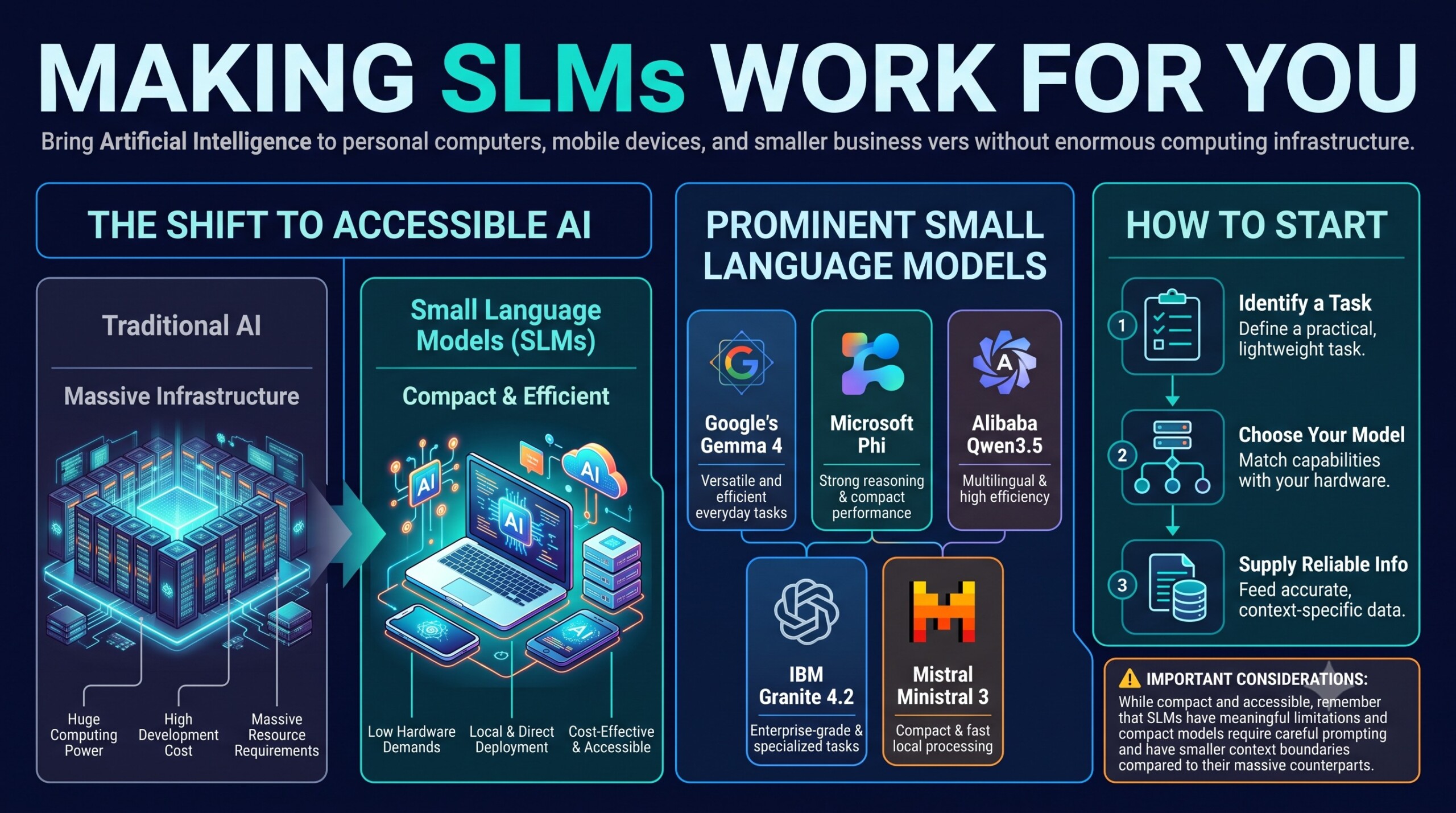
Artificial intelligence has traditionally been associated with enormous computing infrastructure, sophisticated research laboratories and substantial development expenditure. The largest AI models require powerful processors and considerable resources, making direct ownership or local deployment impractical for many individuals and smaller organisations. Yet a different part of the AI industry is developing models capable of performing useful work with much more modest computing requirements. These small language models, commonly called SLMs, are opening opportunities to experiment with AI on personal computers, mobile devices and smaller business servers.
By September 2026, the selection of available models had expanded significantly. Google’s Gemma 4, Microsoft’s Phi models, Alibaba’s Qwen3.5, IBM’s Granite 4.2 and Mistral’s Ministral 3 provide different combinations of efficiency, language understanding, reasoning and specialised capabilities. Some are suitable for lightweight everyday activities, while larger variants require considerably more powerful hardware. Learning to use SLMs begins with identifying a practical task, choosing a compatible model and understanding how to supply reliable information. The process is increasingly approachable for beginners, provided they recognise that compact models still have meaningful limitations.
Let’s dive deep now.
1. Understand what makes a language model small
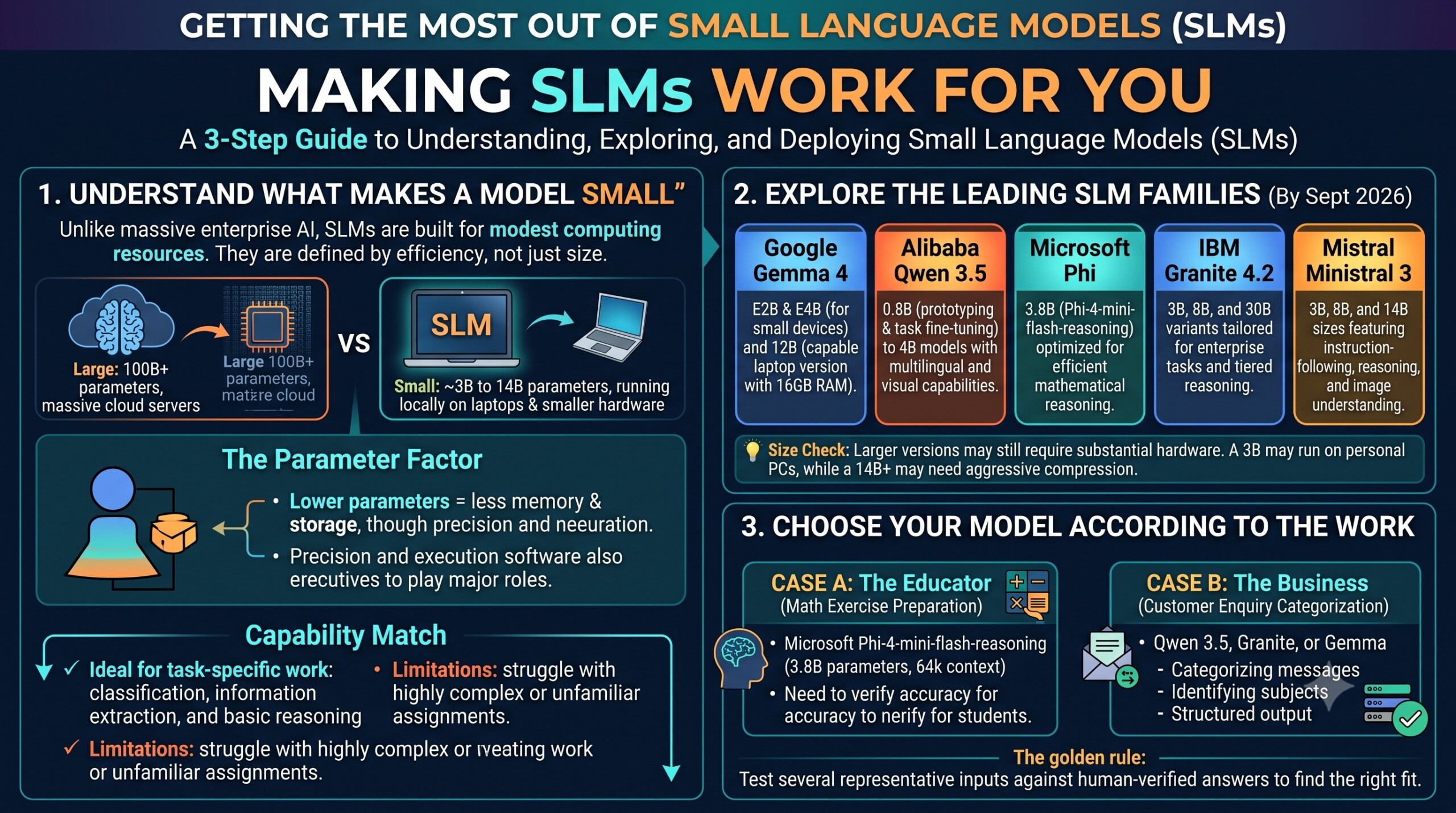
A small language model is designed to perform language-related activities using comparatively modest computing resources. Much of a model’s learned behaviour is represented by numerical values called parameters, which influence how it processes information and generates responses. A model with a few billion parameters generally requires less memory to store its weights than a model with tens or hundreds of billions of comparable parameters. However, architecture, numerical precision, input length and the software used for execution also influence the resources needed.
There is no universally accepted size that separates an SLM from a larger language model. A 3B model may run comfortably on some personal computers, while a 14B model may require considerably more memory or aggressive compression. Smaller models can perform well on clearly defined activities such as classification, information extraction and selected reasoning tasks, although difficult or unfamiliar assignments may expose their limitations. Model selection should therefore begin with what the user wants to accomplish and which hardware resources are available.
2. Explore the leading SLM families available by September 2026
Google’s Gemma 4 family includes efficient E2B and E4B variants intended for smaller devices, alongside a more capable 12B model introduced in June 2026. Google says the 12B version can run on suitable laptops with 16GB of memory, although the result depends on the configuration and the work being performed. Alibaba’s Qwen3.5 family includes compact 0.8B, 2B and 4B models with multilingual and visual capabilities. The Qwen team specifically identifies the 0.8B version as suitable for prototyping, research and task-specific fine-tuning, with its small scale limiting more demanding applications.
Microsoft’s Phi-4-mini-flash-reasoning is a 3.8B model optimised for efficient mathematical reasoning, while IBM’s Granite 4.2 family offers 3B, 8B and 30B versions intended for different levels of reasoning and enterprise work. Mistral’s Ministral 3 models are available in 3B, 8B and 14B sizes, with separate instruction-following and reasoning variants that support image understanding. These models have different strengths, and their larger versions should not automatically be considered suitable for ordinary laptops. A reliable comparison must include the intended task, supported languages, memory requirements, software compatibility and limitations documented by the developer.
3. Choose your model according to the work you need done
Imagine a teacher who wants to prepare mathematics exercises for students. Microsoft’s Phi-4-mini-flash-reasoning may be worth evaluating because it was developed specifically for efficient mathematical reasoning. Its 3.8 billion parameters and 64,000-token context capacity make it an interesting option for certain educational applications. However, Microsoft acknowledges that smaller models have limitations, and generated calculations or explanations should still be checked before they are given to learners.
Now consider a business that wants to categorise customer enquiries. The requirements are different because the model must identify subjects, follow instructions consistently and produce information in a predictable format. A compact Qwen3.5, Granite or Gemma variant may be sufficient, depending on the languages and complexity involved. The best way to choose is to test several representative messages and compare the results against answers prepared by people who understand the task.
4. Learn to run an SLM on a personal computer
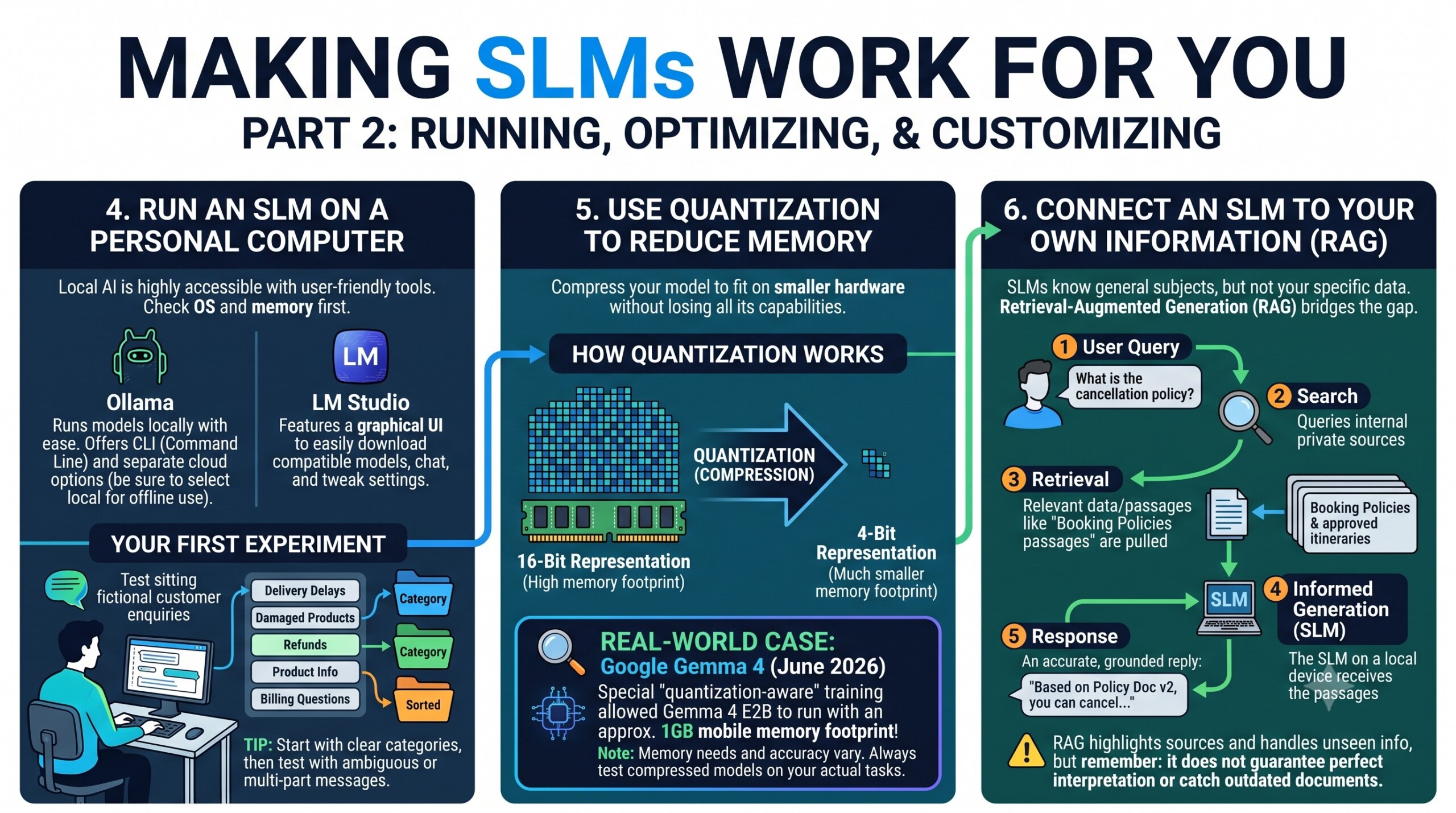
Tools such as Ollama and LM Studio provide accessible starting points for experimenting with supported language models. Ollama allows models to run locally and also offers separate cloud execution options, so users must select a local model when local processing is their objective. LM Studio provides a graphical environment for downloading compatible models, chatting with them and testing different settings. Before choosing either option, users should check operating system compatibility, available memory and the requirements of the specific model.
A useful first experiment involves creating five fictional customer enquiries and asking a compact model to assign each one to a category. The messages might concern delivery delays, damaged products, refunds, product information and billing questions. After reviewing the results, users can introduce more difficult examples containing ambiguous language or several problems in the same message. This process demonstrates how an SLM interprets instructions, where it makes mistakes and why clearly specified output categories improve consistency.
5. Use quantization to reduce memory requirements
Models normally store their parameters using numerical formats that preserve a particular level of precision. Quantization allows many of those numbers to be represented using fewer bits, reducing the amount of memory needed to store the model’s weights. A commonly used comparison involves 16-bit and 4-bit representations, although actual compression and running costs depend on additional technical details. Smaller memory requirements can make a model more practical on personal computers and mobile devices.
Google’s June 2026 release of quantization-aware training versions of Gemma 4 illustrates the technique’s importance. The company reported that a specialised mobile format reduced the model memory footprint of Gemma 4 E2B to approximately 1GB, with an even smaller footprint possible for a particular text-only configuration. However, this is a model-specific result and does not mean that every application using Gemma 4 requires only 1GB of total system memory. Quantization may also affect accuracy, so compressed models should be tested on the actual work they are intended to perform.
6. Connect an SLM to your own information
A language model may understand a great deal about general subjects while knowing very little about a particular organisation’s policies or current operations. A business assistant answering questions about employee benefits, supplier arrangements or customer procedures needs access to the correct internal information. Retrieval-augmented generation, usually called RAG, helps address this challenge by searching approved documents and supplying relevant passages to the model. This allows an application to use information that was never included in the model’s original training data.
Consider a travel agency with a collection of booking policies, approved itineraries and customer guidance documents. An application can retrieve the relevant passages when a customer asks about a cancellation and provide those passages to an SLM for preparing a response. The assistant can also identify the document used and state when the available information does not answer the question. RAG improves the relevance of the information supplied, although it does not guarantee that the model will interpret every document correctly or recognise outdated material.
7. Automate small, repetitive office activities
Many organisations perform large volumes of routine work involving documents, messages and unstructured information. Employees may spend hours sorting emails, extracting details from forms, classifying feedback or preparing preliminary summaries. Small language models can be useful for these activities when the requirements are clear and the consequences of mistakes are manageable. An organisation can begin with a limited trial to see whether automated assistance meaningfully reduces manual effort.
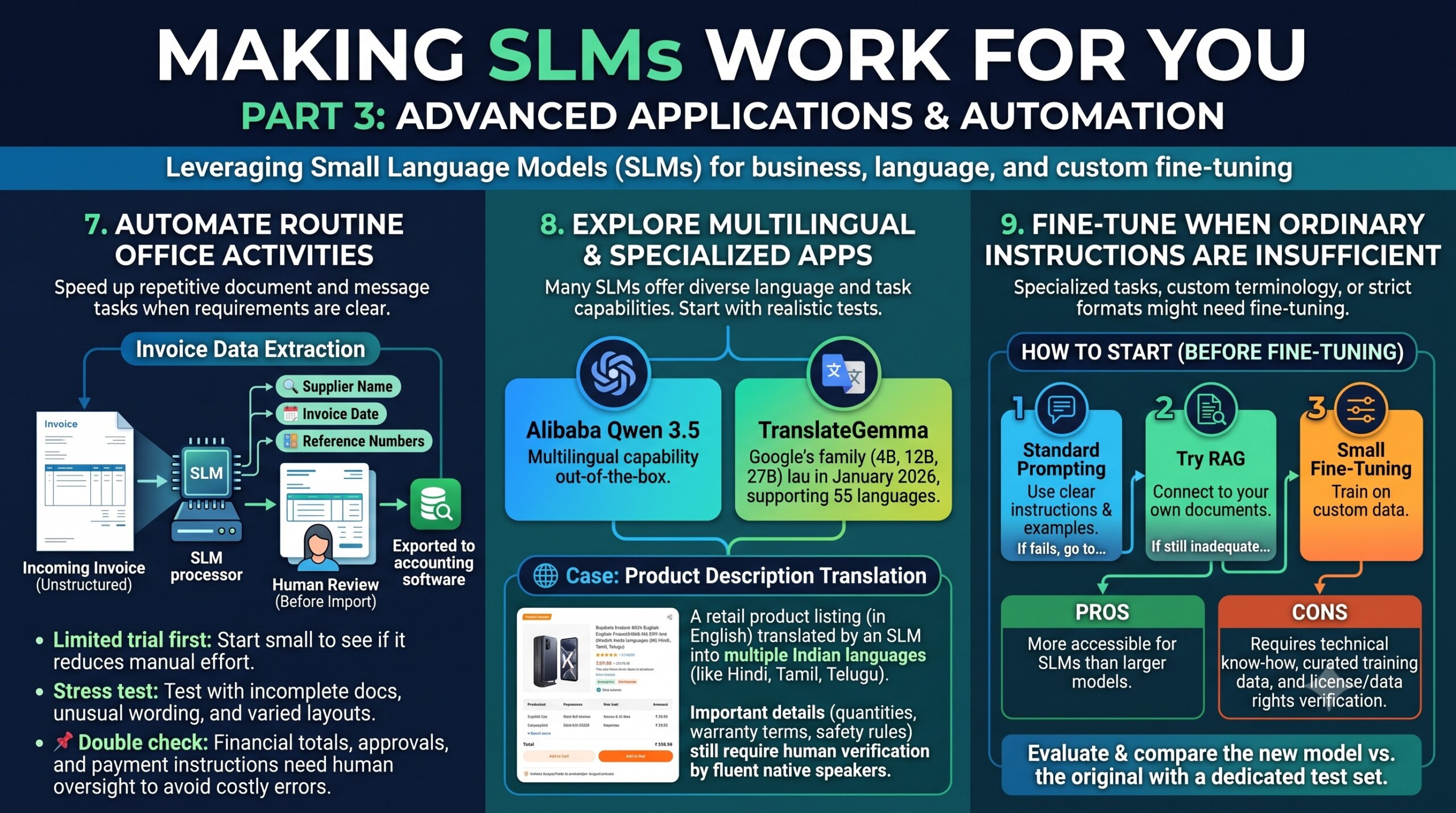
An accounts department, for example, might use an SLM-based application to identify supplier names, invoice dates and reference numbers from incoming documents. The extracted fields can be placed in a structured format for an employee to review before importing them into accounting software. Testing should include different layouts, incomplete documents, unusual wording and incorrect source information. Financial totals, payment instructions and approvals require additional checks because even a small extraction error can create costly consequences.
8. Explore multilingual and industry-specific applications
Small models are increasingly capable of working across multiple languages, although quality varies according to the language and the task. Alibaba’s Qwen3.5 models include multilingual capabilities, while Google’s TranslateGemma family provides specialised translation models in 4B, 12B and 27B sizes. Introduced in January 2026, TranslateGemma was designed to support translation across 55 languages. These options are particularly interesting for schools, regional businesses and organisations that need to communicate with audiences using different languages.
Imagine a retailer preparing product descriptions in English and several Indian languages. An appropriate model could generate first drafts of translations, potentially reducing the time required for routine content preparation. However, important details such as product quantities, warranty terms and safety instructions still require careful verification by people familiar with the language and subject. Multilingual support should be evaluated using realistic examples, since a model may perform well in one language while struggling with another.
9. Consider fine-tuning when ordinary instructions are insufficient
Fine-tuning involves further training an existing model on examples selected for a particular task. It can be useful when an organisation needs specialised terminology, consistent formatting or better performance on a repetitive activity. Smaller models are often attractive candidates because some fine-tuning techniques require fewer computing resources than those needed for very large models. Nevertheless, effective fine-tuning still demands carefully prepared examples, technical knowledge and a dependable method for evaluating improvements.
A sensible starting point is to try the existing model with clear instructions and examples before investing in additional training. Connecting the model to reliable documents through RAG may solve knowledge-related problems without changing its parameters. If performance remains inadequate, a small fine-tuning experiment can compare the modified model with the original using a separate evaluation set. Businesses should also review model licensing terms and ensure that any information used for training is appropriately authorised.
10. Combine small and large models intelligently
Organisations do not have to rely on a single model for every activity. A smaller local model may be suitable for sorting messages, extracting routine information and preparing straightforward drafts, while a more capable cloud model can handle complex reasoning or unusual cases. This arrangement, sometimes called model routing, helps match computing resources to the difficulty of an assignment. It can improve operating efficiency, although the integration itself introduces additional engineering and testing requirements.
Consider a customer service department receiving hundreds of enquiries daily. A compact SLM could identify the issue and suggest a response based on approved policies, while complicated complaints would be passed to a larger model or a human specialist. The business could then measure response accuracy, cost, processing time and the number of cases requiring correction. Successful use of this approach depends on clear escalation rules and trustworthy evaluation, particularly because smaller models may sometimes appear confident even when they have misunderstood a request.
Conclusion
Small language models offer a practical route into AI for people and organisations that want useful applications without depending entirely on the most resource-intensive systems. By September 2026, compact models from Google, Microsoft, Alibaba, IBM and Mistral had created a wide range of options for local experimentation, document processing, translation, classification and selected reasoning tasks. Their real value emerges when users match the model to a specific job, understand its hardware requirements, supply reliable information and test the results carefully. For beginners, a modest project that solves one recurring problem can provide a more rewarding introduction to applied AI than attempting to master every model and feature available.