Privacy-Preserving AI and Federated Learning
Privacy-Preserving AI and Federated Learning
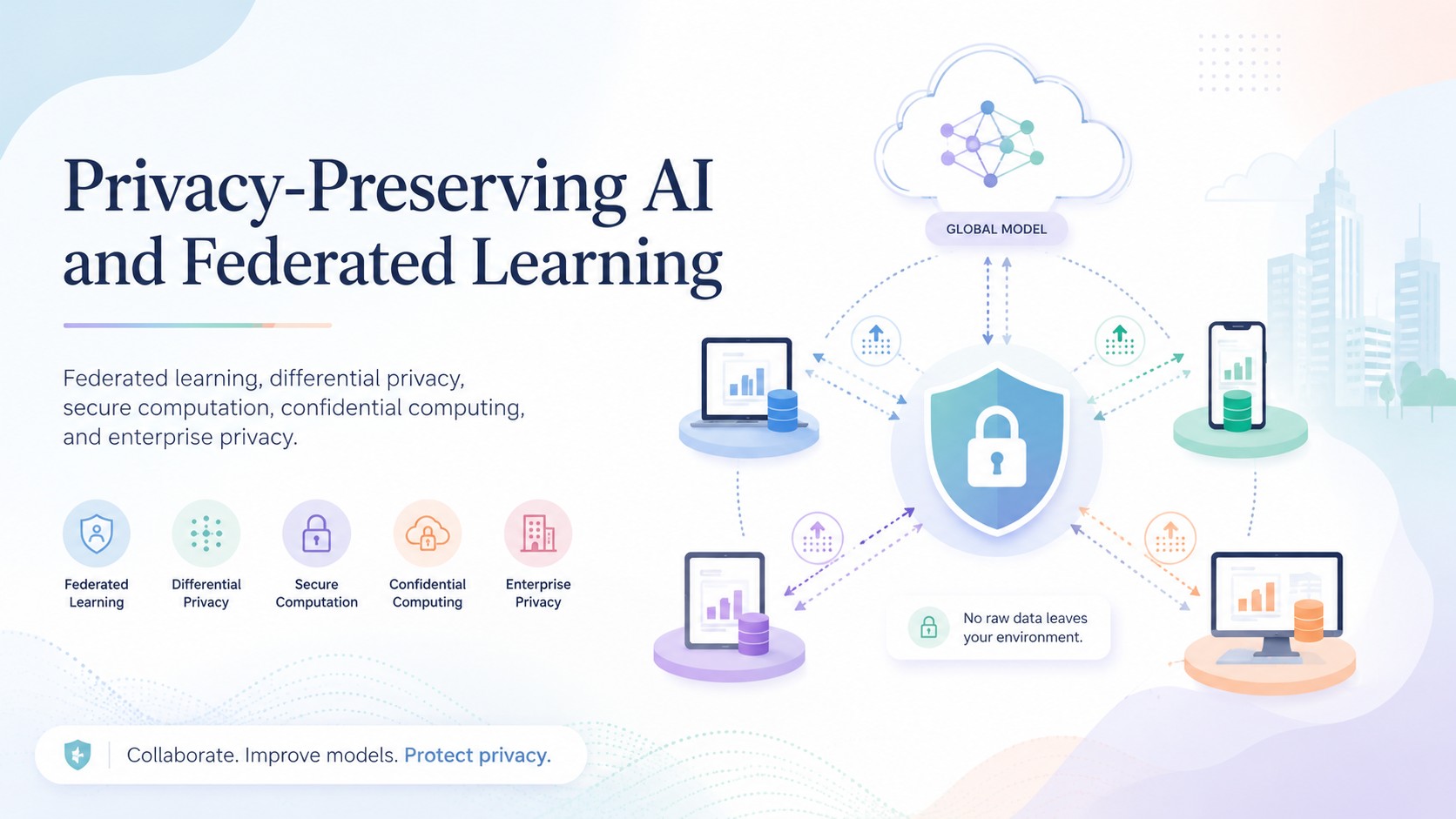
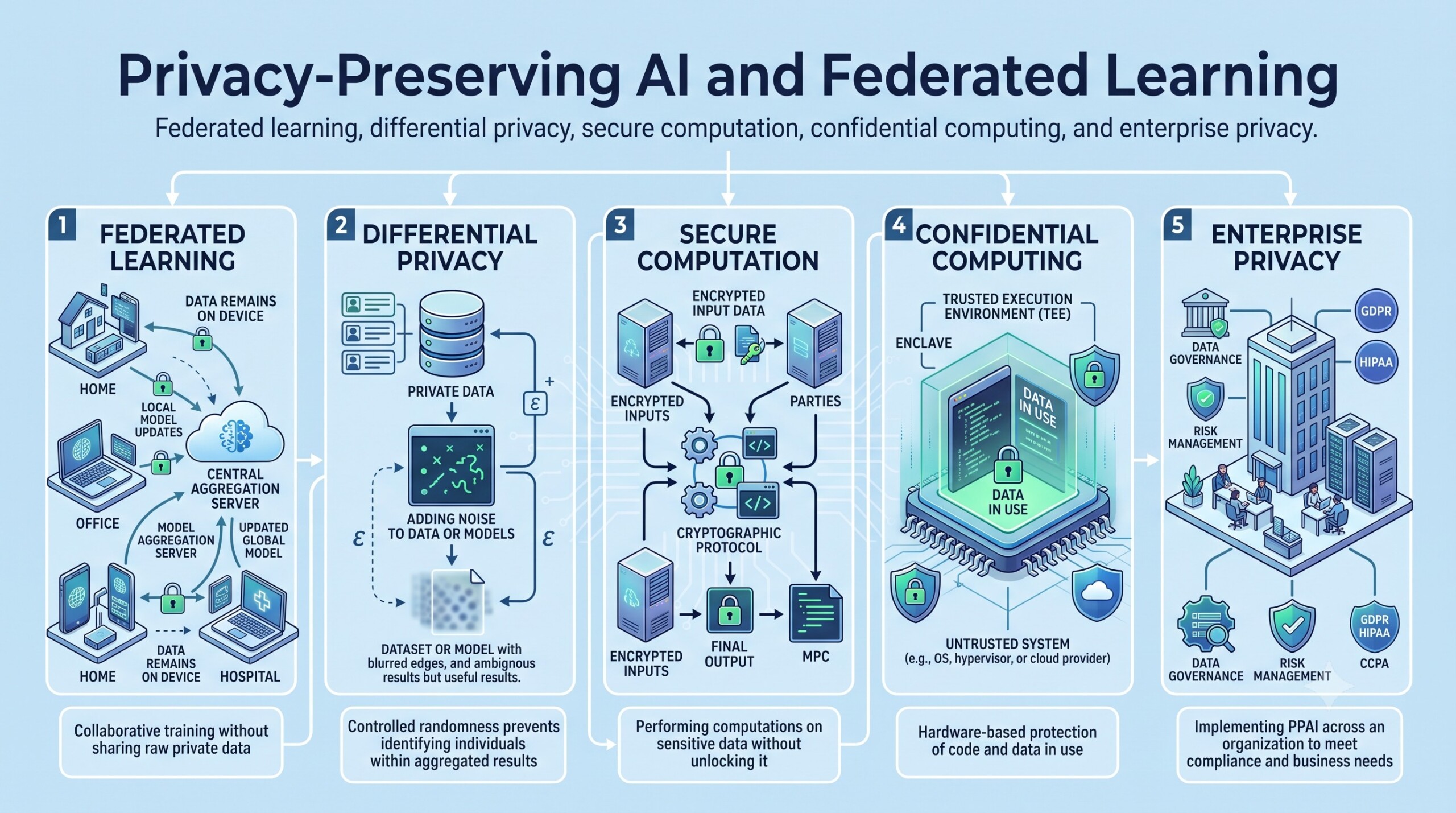
Federated learning, differential privacy, secure computation, confidential computing, and enterprise privacy.
Introduction
Artificial intelligence has historically been built around a simple assumption: collect as much data as possible in one place, train increasingly capable models on it, and protect the central repository through conventional cybersecurity. That model is becoming harder to sustain. Enterprises now hold enormous quantities of customer, employee, financial, health, operational, research and intellectual-property data that may be highly valuable for AI, yet too sensitive, regulated or strategically important to place in a common training environment.
Privacy-preserving AI offers a different architecture. Instead of asking only how an organisation can secure a large central data lake, it asks whether useful computation can occur while revealing less data in the first place. This has led to increasing enterprise interest in a family of technologies collectively known as privacy-enhancing technologies, or PETs, including federated learning, differential privacy, secure multiparty computation, homomorphic encryption and trusted execution environments. The OECD describes these technologies as increasingly important for collaborative AI, while also warning that they are not silver bullets and often work best when combined.
This field has moved considerably beyond academic experimentation. NVIDIA, Microsoft, Google Cloud, AWS, Flower Labs, OpenMined, OpenDP, OPAQUE, Zama and other organisations now provide frameworks, libraries or infrastructure for different parts of the privacy-preserving AI stack.
Let’s dive deep into the topic now.
1. Privacy-preserving AI changes where trust is placed
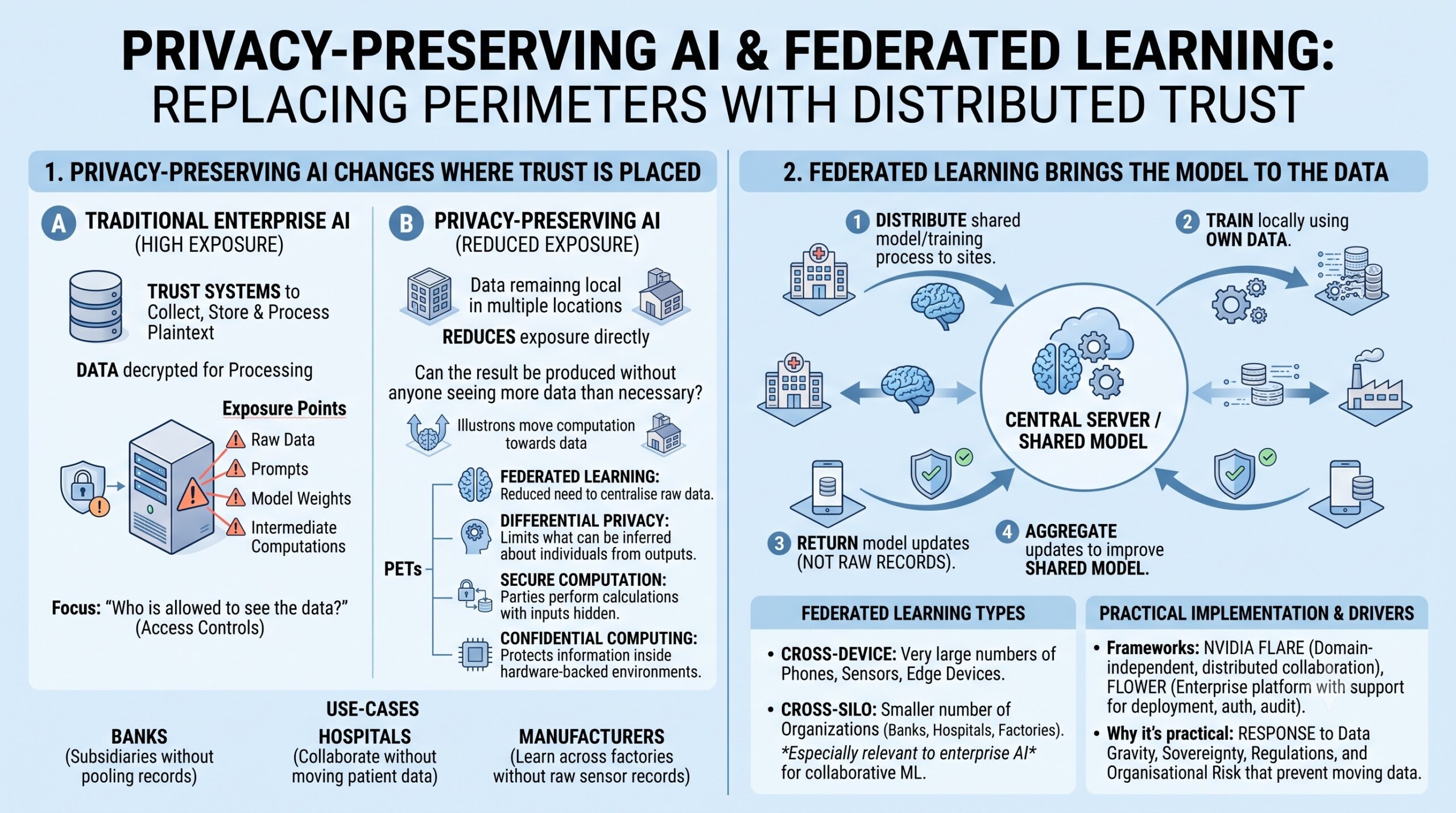
Traditional enterprise AI usually requires organisations to trust the systems that collect, store and process plaintext data. Encryption protects information while it is stored and while it travels across networks, but conventional architectures normally decrypt that information when applications need to process it. For highly sensitive AI workloads, this creates an important exposure point because the data, prompts, model weights or intermediate computations may become accessible somewhere inside the processing environment.
Privacy-preserving AI tries to reduce that exposure rather than merely surrounding it with additional access controls. Different PETs solve different parts of the problem. Federated learning reduces the need to centralise raw data. Differential privacy limits what can be inferred about individuals from outputs. Secure computation allows parties to perform certain calculations while keeping inputs hidden. Confidential computing protects information while it is being processed inside hardware-backed trusted environments. The important architectural shift is from asking, “Who is allowed to see the data?” towards also asking, “Can the required result be produced without anyone seeing more data than necessary?”
This distinction matters enormously for enterprise AI. A bank may want information from several subsidiaries without pooling customer records, hospitals may want to collaborate without moving patient data, and manufacturers may want to learn from equipment operating across factories without transferring every raw sensor record to headquarters. Privacy-preserving AI provides mechanisms through which the computation can increasingly move towards the data rather than forcing every dataset to move towards the computation.
2. Federated learning brings the model to the data
Federated learning is one of the most intuitive examples of this new approach. Instead of collecting all training data on one central server, a central model or training process is distributed to participating devices, organisations or locations. Each participant trains locally using its own data and returns model updates rather than the underlying records. Those updates are then aggregated to improve a shared model.
There are several forms of federated learning. Cross-device federated learning can involve very large numbers of phones, sensors or edge devices, while cross-silo federated learning normally involves a smaller number of organisations or business units such as banks, hospitals, laboratories or factories. The second model is especially relevant to enterprise AI because it allows organisations that are unwilling or unable to exchange raw datasets to participate in collaborative machine learning.
NVIDIA FLARE is one example of an open-source framework aimed at this environment. It is a domain-independent federated learning and computing platform that supports distributed multi-party collaboration while keeping data at participating sites. Flower has also developed from a federated learning framework into an enterprise platform with support for deployment, authentication, role-based access control, auditing and production infrastructure.
The concept is increasingly practical rather than theoretical. In April 2026, NVIDIA described federated learning as a response to situations in which valuable data cannot easily be moved because of regulation, sovereignty, organisational risk or data gravity. An excellent collection of learning videos awaits you on our Youtube channel.
3. Federated learning does not automatically guarantee privacy
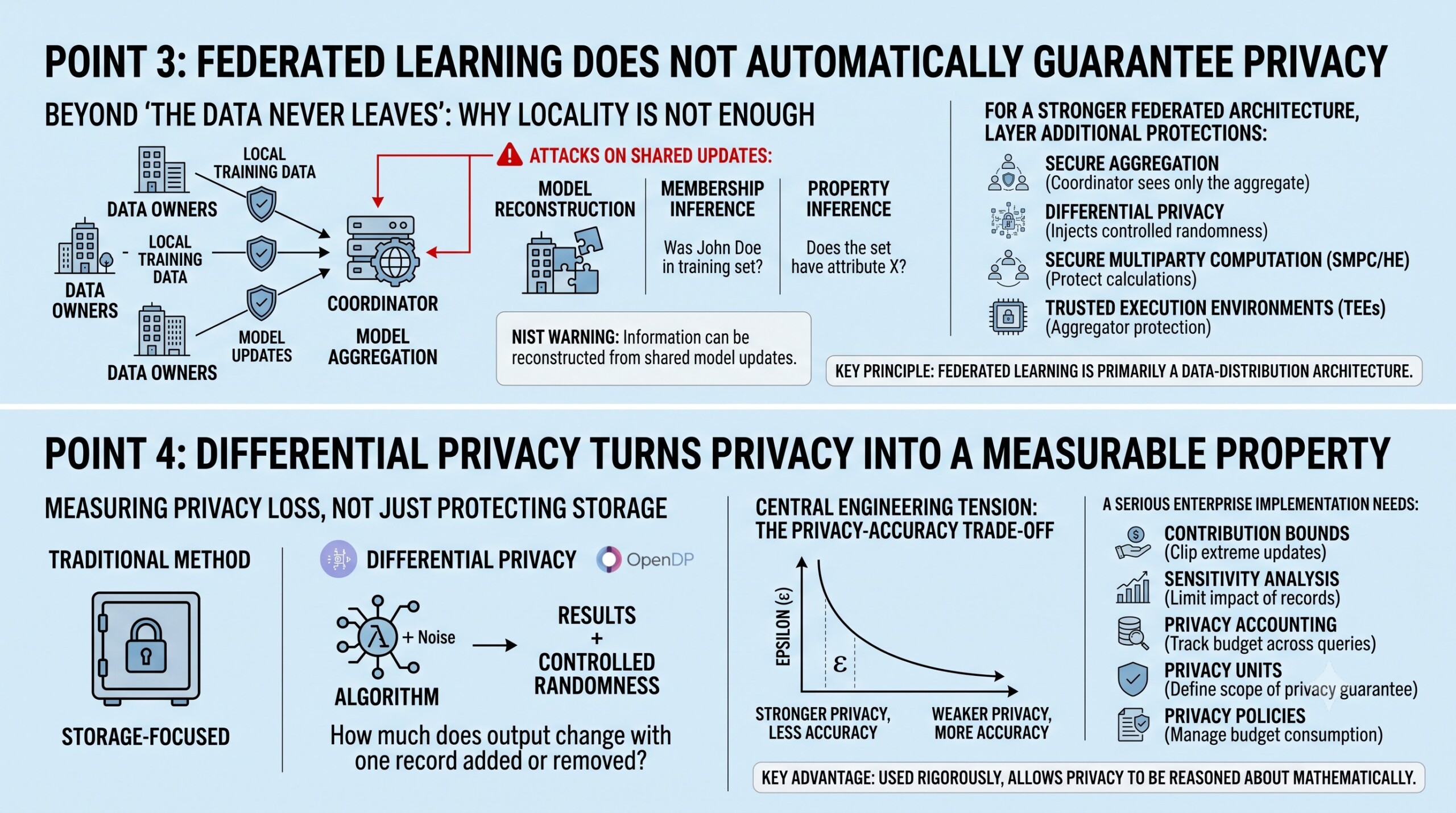
A frequent misunderstanding is that federated learning makes an AI system private simply because raw records never leave their original location. Keeping raw data local certainly reduces exposure, but model updates themselves can contain information about the data from which they were produced. A curious or malicious participant may try to reconstruct training examples, infer whether a particular person appeared in the training set, or extract sensitive characteristics from the eventual model.
NIST has specifically warned that information can sometimes be reconstructed from model updates shared during federated training. It also distinguishes attacks on updates during training from attacks against the completed model after training. This means that “the data never left the organisation” is not by itself a sufficient privacy claim.
A stronger federated architecture therefore layers additional protections around the process. Secure aggregation can prevent the coordinator from seeing individual participant updates and reveal only their aggregate. Differential privacy can restrict how much information about individual records survives in the model. Secure multiparty computation or homomorphic encryption can protect particular collaborative calculations. Trusted execution environments can protect the aggregator and other sensitive components while they are running.
This is one of the most important principles for enterprise architects. Federated learning is primarily a data-distribution architecture.
4. Differential privacy turns privacy into a measurable property
Differential privacy takes a different approach. Instead of concentrating mainly on where data is stored, it asks how much an output changes because one individual’s data was included in a dataset. A well-designed differentially private mechanism deliberately introduces controlled randomness so that an observer cannot confidently determine whether a particular individual’s record contributed to the result.
The concept is usually expressed using parameters including epsilon, which represents part of the privacy loss. Smaller privacy budgets generally imply stronger privacy but can reduce statistical accuracy. This creates one of the central engineering tensions in differential privacy: useful models and statistics must remain accurate enough for business purposes while still providing a meaningful privacy guarantee.
In machine learning, differential privacy can be incorporated into training by clipping contributions and injecting calibrated noise. OpenDP has become an important open-source ecosystem in this field. It defines differential privacy as a mathematically rigorous privacy framework and provides vetted software tools for applying it to statistical analysis.
Differential privacy is therefore not simply “adding noise to data”. A serious enterprise implementation needs contribution bounds, sensitivity analysis, privacy accounting, well-defined privacy units and policies governing how repeated queries consume the privacy budget. Used casually, noise can damage data without providing a meaningful guarantee. Used rigorously, differential privacy allows privacy to become a property that can be reasoned about mathematically rather than merely asserted in a policy document. A constantly updated Whatsapp channel awaits your participation.


5. Secure computation allows organisations to collaborate without revealing everything
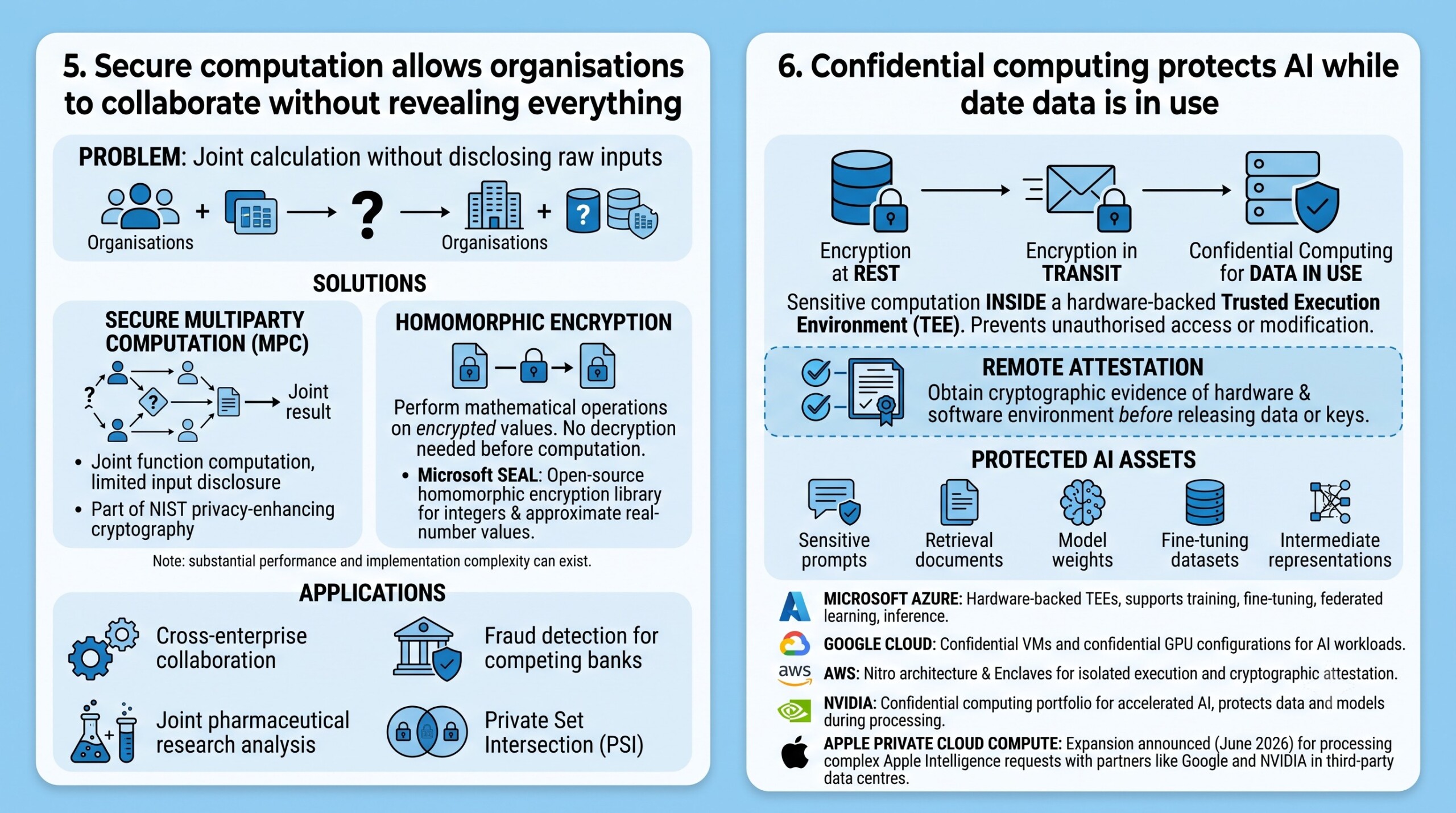
Some AI and analytics problems require several parties to calculate something jointly while remaining unwilling to disclose their raw inputs to one another. Secure multiparty computation, or MPC, addresses this class of problem by allowing multiple parties to jointly compute a function while limiting what each participant learns about the others’ inputs. NIST includes MPC within the broader category of privacy-enhancing cryptography.
Homomorphic encryption provides another important route. Instead of decrypting information before computation, homomorphic encryption allows certain mathematical operations to be performed on encrypted values. Microsoft SEAL is a prominent open-source homomorphic encryption library that supports calculations directly over encrypted integers and approximate real-number values. Microsoft itself cautions that homomorphic encryption is not a universal substitute for ordinary computing and that performance and implementation complexity can be substantial.
Secure computation is particularly interesting for cross-enterprise collaboration. Competing banks could contribute signals to fraud detection, pharmaceutical organisations could analyse joint research information, and companies could compare customer or supplier populations through techniques such as private set intersection without exchanging complete databases.
6. Confidential computing protects AI while data is in use
Encryption at rest protects stored information, while encryption in transit protects information moving between systems. Confidential computing is designed to address the third state: data in use. It performs sensitive computation inside a hardware-backed Trusted Execution Environment, or TEE, intended to prevent unauthorised parties from reading or modifying the workload while it runs.
A critical concept is remote attestation. Instead of simply trusting that a cloud server is configured correctly, an authorised party can obtain cryptographic evidence about the hardware and software environment before releasing data or encryption keys to it. This is particularly relevant to AI because sensitive prompts, retrieval documents, model weights, fine-tuning datasets and intermediate representations may otherwise exist in plaintext somewhere during execution.
Microsoft Azure supports confidential computing architectures based on hardware-backed TEEs and specifically discusses confidential training, fine-tuning, federated learning and inference. Google Cloud offers Confidential VMs and confidential GPU configurations, including environments designed for AI workloads. AWS uses its Nitro architecture and Nitro Enclaves to provide isolated execution and cryptographic attestation for sensitive workloads.
NVIDIA has extended this idea directly into accelerated AI. Its confidential computing portfolio protects data and models during AI processing and supports confidential GPU environments across cloud and enterprise infrastructure.
The trend is visible beyond conventional enterprise infrastructure. In June 2026, Apple announced an expansion of Private Cloud Compute, its privacy-oriented architecture for processing complex Apple Intelligence requests, including collaboration with Google and NVIDIA for workloads running in third-party data centres. Excellent individualised mentoring programmes available.
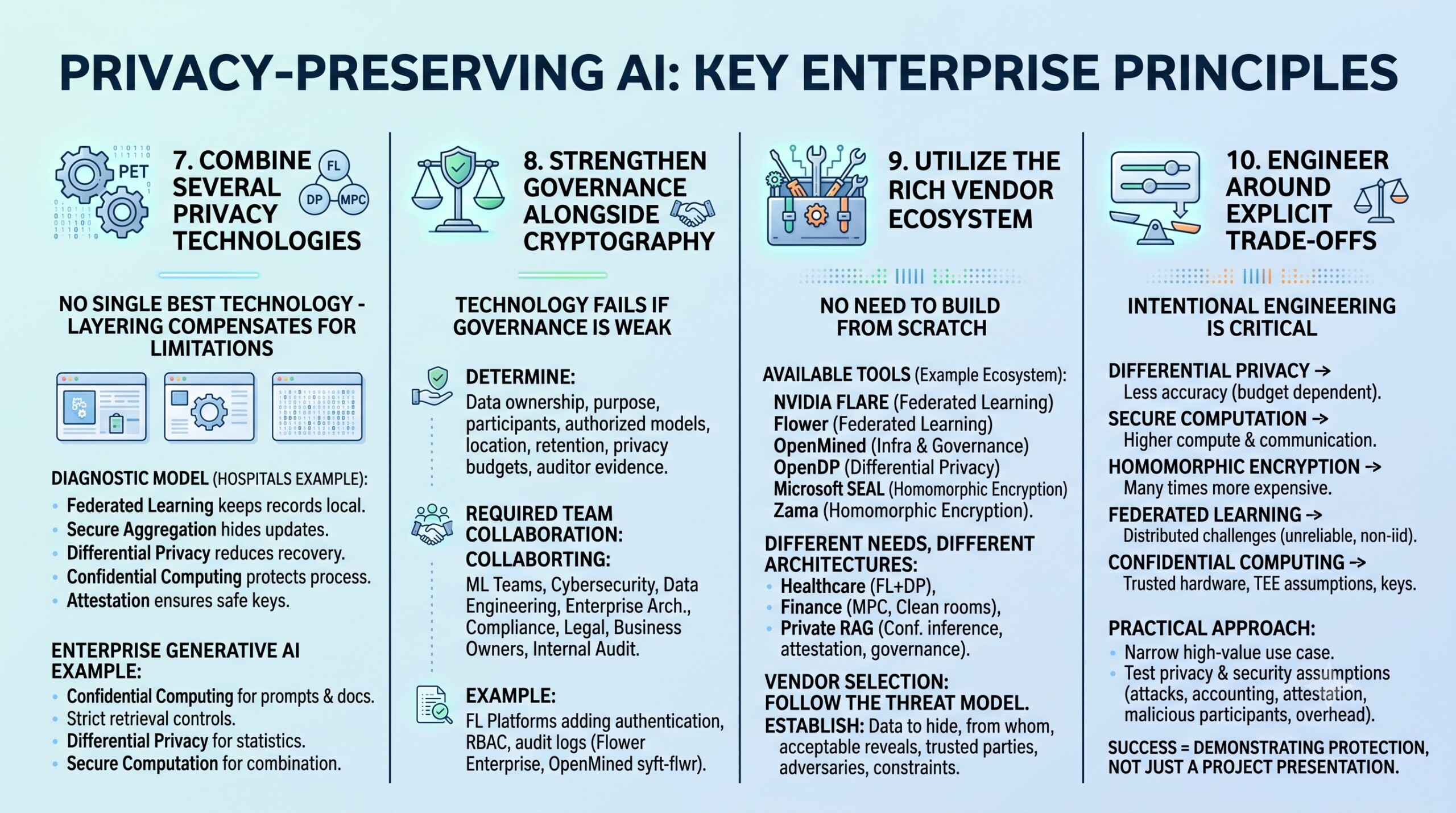
7. The strongest architecture combines several privacy technologies
Enterprises should resist the temptation to search for one “best privacy technology”. Federated learning, differential privacy, MPC, homomorphic encryption and confidential computing protect different surfaces and make different assumptions. OECD analysis similarly notes that PETs often compensate for one another’s limitations when used together.
Consider a consortium of hospitals training a diagnostic model. Federated learning could keep patient records within each hospital. Secure aggregation could prevent the central coordinator from seeing an individual hospital’s model updates. Differential privacy could reduce the possibility of recovering information about a specific patient from the completed model. A confidential computing environment could protect the aggregation service while updates are processed, while attestation could ensure that keys are released only to an approved workload.
The same layered principle applies to enterprise generative AI. A company might use confidential computing to protect prompts and proprietary documents during inference, strict retrieval controls to limit which records an AI agent can access, differential privacy for selected statistical outputs, and secure computation when information must be combined across organisational boundaries.
8. Enterprise privacy is about governance as much as cryptography
A technically sophisticated privacy mechanism can still fail if governance is weak. An enterprise must determine who owns each dataset, why the data is being processed, which parties are permitted to participate, which model is authorised, where computation may occur, how long outputs can be retained, how privacy budgets are managed, and what evidence auditors can inspect.
This is one reason federated learning platforms are adding capabilities that look increasingly like enterprise governance rather than machine-learning algorithms. Flower Enterprise highlights authentication, role-based access control and structured audit logs. OpenMined’s syft-flwr work focuses on governance, code approval, infrastructure and multi-party collaboration around Flower-based federated learning.
The enterprise implication is significant. Privacy can no longer belong only to the legal department, and AI architecture cannot belong only to data scientists. Privacy-preserving AI requires collaboration among machine-learning teams, cybersecurity, data engineering, enterprise architecture, compliance, legal functions, business owners and internal audit. Subscribe to our free AI newsletter now.
9. The enterprise vendor ecosystem is becoming much richer
By August 2026, organisations no longer have to develop every privacy-preserving component from first principles. NVIDIA FLARE and Flower provide major federated learning ecosystems, while OpenMined is working on infrastructure and governance around secure distributed collaboration. OpenDP provides carefully engineered differential privacy tools, and Microsoft SEAL and Zama provide important resources for homomorphic-encryption-based computation.
This does not mean the market has converged on one standard architecture. A healthcare research consortium may value federated learning and differential privacy, while a financial-services organisation performing joint fraud analytics may need MPC or confidential clean-room capabilities. An enterprise deploying private RAG over internal documents may care more about confidential inference, key management, attestation and agent governance than federated training.
Vendor selection should therefore follow the threat model rather than precede it. Enterprises should first establish what data must remain hidden, from whom it must remain hidden, what information can legitimately be revealed, which parties are trusted, which parties are merely “honest but curious”, whether malicious participants are possible, and what performance constraints exist.
10. Privacy-preserving AI must be engineered around explicit trade-offs
Every privacy-enhancing technology introduces trade-offs. Differential privacy can reduce statistical accuracy if the privacy budget is too restrictive. Secure computation may significantly increase compute and communication requirements. Homomorphic encryption can make some calculations many times more expensive than their plaintext equivalents. Federated learning introduces distributed-system challenges including unreliable participants, heterogeneous hardware, non-identically distributed data, network constraints and coordination overhead. Confidential computing introduces requirements around trusted hardware, attestation, key release, workload configuration and the security assumptions of the TEE itself.
A practical enterprise programme should therefore begin with a narrowly defined high-value use case. The organisation should classify the data, identify the adversaries, decide what must never be revealed, document acceptable outputs, estimate latency and accuracy requirements, and determine whether information truly needs to cross organisational boundaries. A small federated analytics project between a few business units may be a better starting point than immediately attempting federated training of a very large foundation model.
The next stage should test privacy and security assumptions rather than merely model accuracy. Teams should attempt membership-inference and reconstruction attacks, review privacy accounting, validate attestation, test malicious or compromised participants, measure computational overhead, confirm data deletion and retention behaviour, and ensure that logs provide evidence useful to security and compliance teams. Privacy engineering succeeds when a system can demonstrate why sensitive information remains protected, not when a project presentation simply describes the architecture as “private”. Upgrade your AI-readiness with our masterclass.
Conclusion
Privacy-preserving AI represents an important change in the relationship between data and artificial intelligence. For much of the digital era, organisations obtained greater analytical power by concentrating information into ever larger databases. Federated learning, differential privacy, secure computation and confidential computing make another model increasingly possible: valuable information can remain distributed, encrypted, isolated or mathematically protected while still contributing to useful computation.
The technologies are not interchangeable. Federated learning reduces unnecessary movement of raw data, differential privacy controls what outputs reveal about individuals, secure computation enables collaboration over protected inputs, and confidential computing protects sensitive information during execution. Enterprise privacy emerges when these technical mechanisms are combined with identity, access control, policy enforcement, auditability, data minimisation, purpose limitation and effective governance.
The direction of the industry is therefore becoming clearer. The future of enterprise AI will not depend only on creating larger or more capable models. It will also depend on the ability to prove that organisations can use valuable data without unnecessarily exposing it. For sectors built around trust, confidentiality and regulated information, privacy-preserving AI may ultimately become not a specialised branch of artificial intelligence, but part of the standard architecture through which serious enterprise AI is built.