AI memory explained
AI memory explained
Introduction
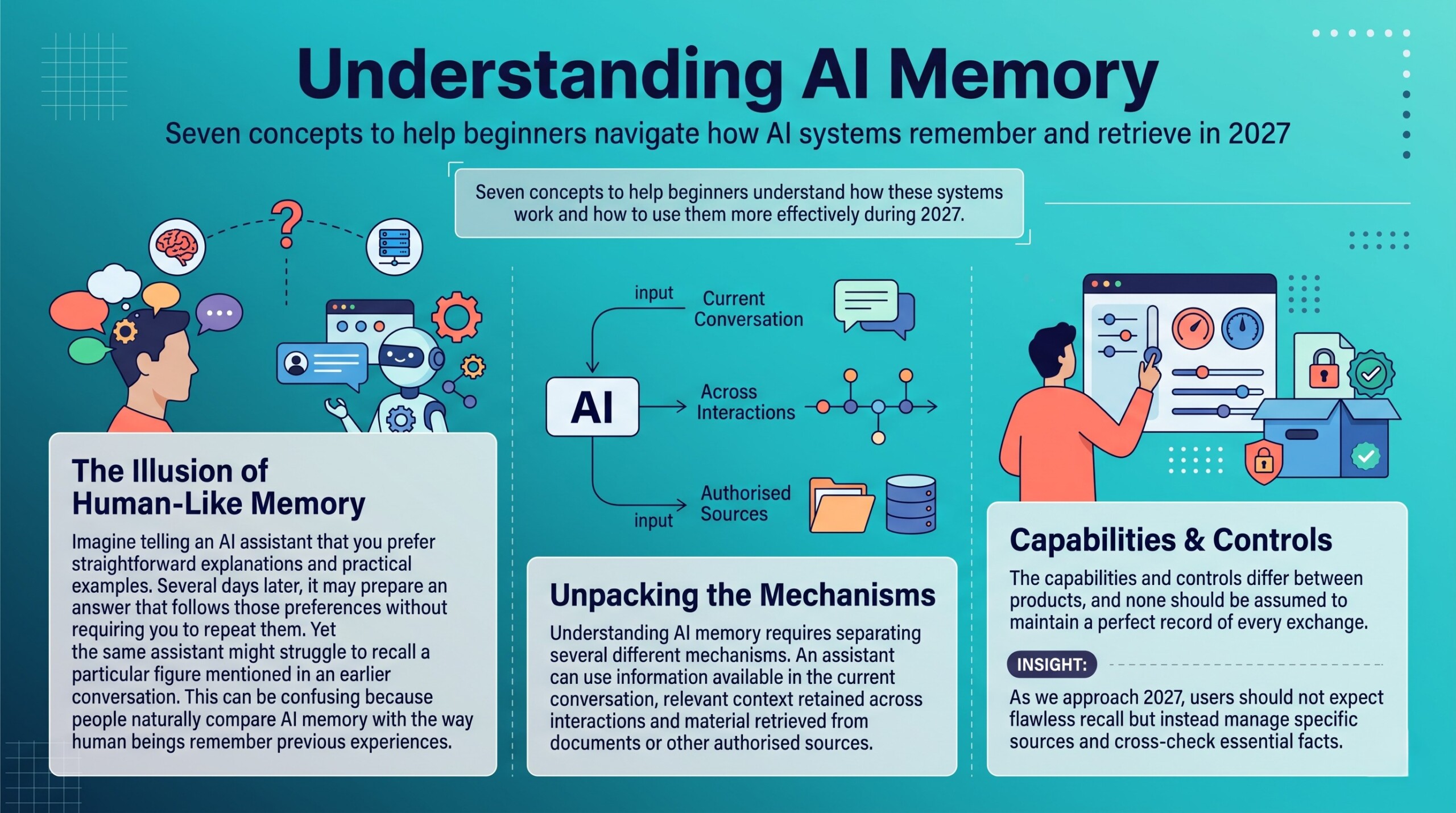
Imagine telling an AI assistant that you prefer straightforward explanations and practical examples. Several days later, it may prepare an answer that follows those preferences without requiring you to repeat them. Yet the same assistant might struggle to recall a particular figure mentioned in an earlier conversation. This can be confusing because people naturally compare AI memory with the way human beings remember previous experiences.
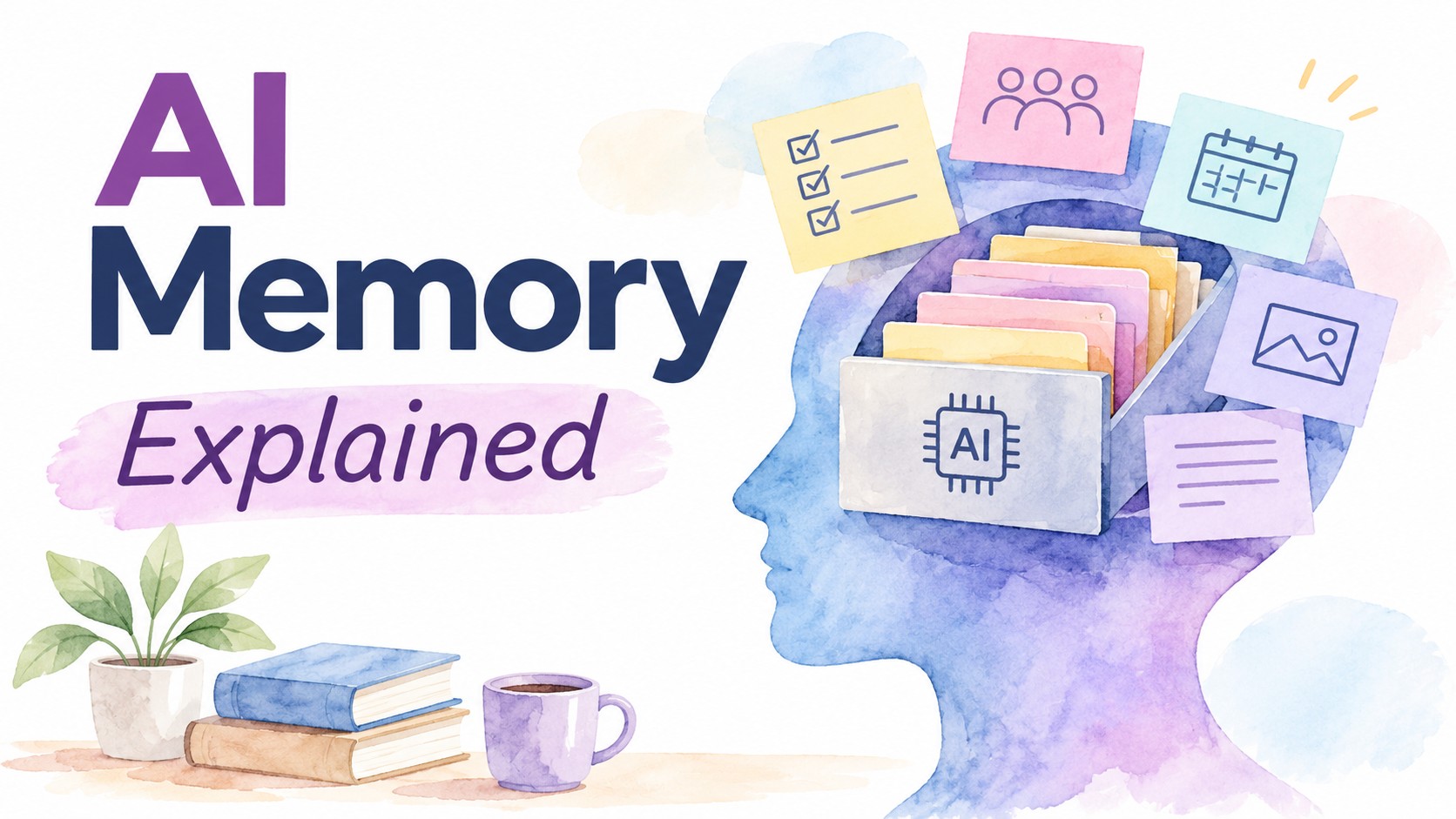
Understanding AI memory requires separating several different mechanisms. An assistant can use information available in the current conversation, relevant context retained across interactions and material retrieved from documents or other authorised sources. The capabilities and controls differ between products, and none should be assumed to maintain a perfect record of every exchange. Seven concepts will help beginners understand how these systems work and how to use them more effectively during 2027.
Let’s dive deep into it!
1. Conversation context provides immediate information
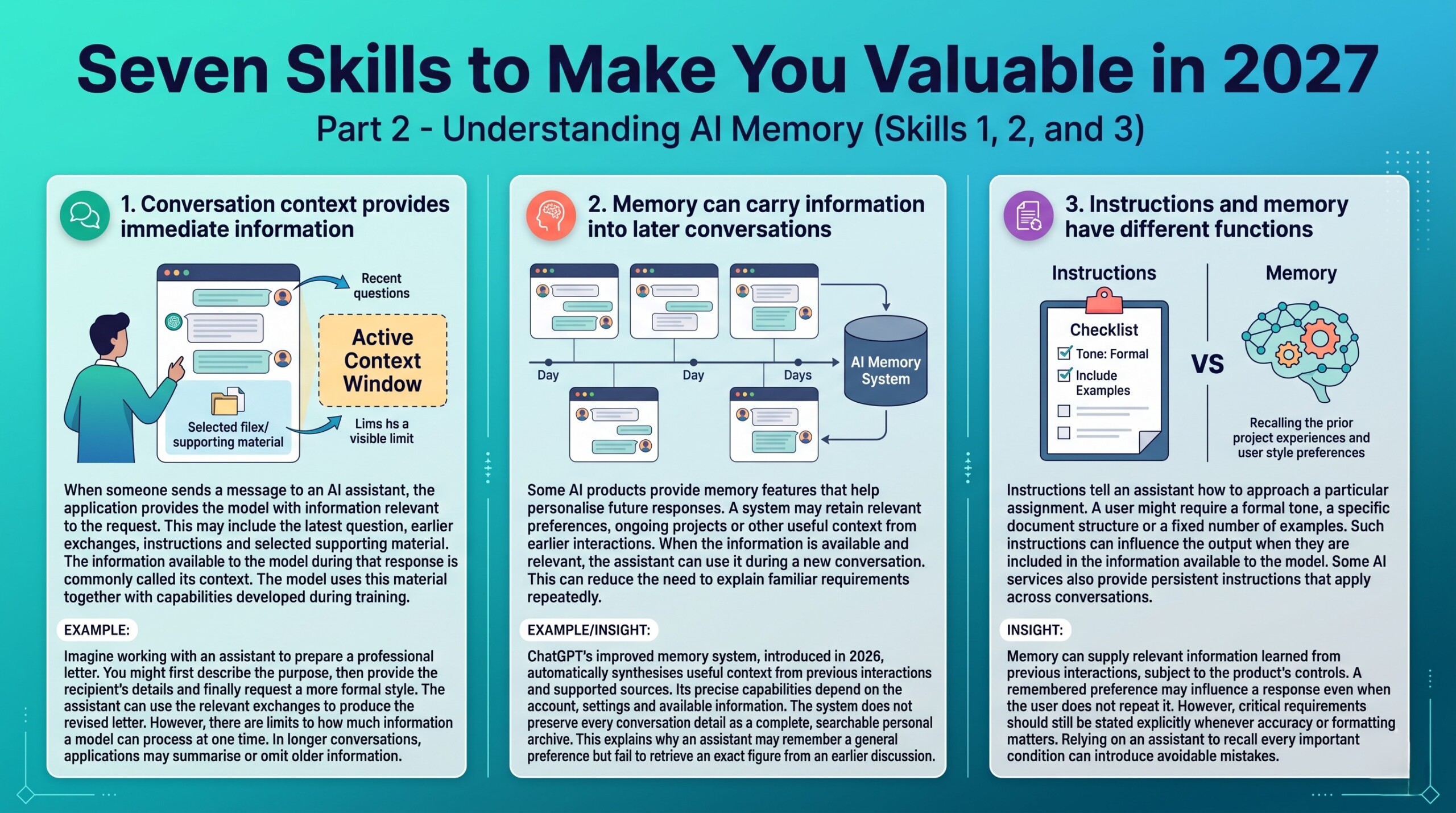
When someone sends a message to an AI assistant, the application provides the model with information relevant to the request. This may include the latest question, earlier exchanges, instructions and selected supporting material. The information available to the model during that response is commonly called its context. The model uses this material together with capabilities developed during training.
Imagine working with an assistant to prepare a professional letter. You might first describe the purpose, then provide the recipient’s details and finally request a more formal style. The assistant can use the relevant exchanges to produce the revised letter. However, there are limits to how much information a model can process at one time. In longer conversations, applications may summarise or omit older information.
2. Memory can carry information into later conversations
Some AI products provide memory features that help personalise future responses. A system may retain relevant preferences, ongoing projects or other useful context from earlier interactions. When the information is available and relevant, the assistant can use it during a new conversation. This can reduce the need to explain familiar requirements repeatedly.
ChatGPT’s improved memory system, introduced in 2026, automatically synthesises useful context from previous interactions and supported sources. Its precise capabilities depend on the account, settings and available information. The system does not preserve every conversation detail as a complete, searchable personal archive. This explains why an assistant may remember a general preference but fail to retrieve an exact figure from an earlier discussion.
3. Instructions and memory have different functions
Instructions tell an assistant how to approach a particular assignment. A user might require a formal tone, a specific document structure or a fixed number of examples. Such instructions can influence the output when they are included in the information available to the model. Some AI services also provide persistent instructions that apply across conversations.
Memory can supply relevant information learned from previous interactions, subject to the product’s controls. A remembered preference may influence a response even when the user does not repeat it. However, critical requirements should still be stated explicitly whenever accuracy or formatting matters. Relying on an assistant to recall every important condition can introduce avoidable mistakes.
4. Retrieval helps AI consult stored information
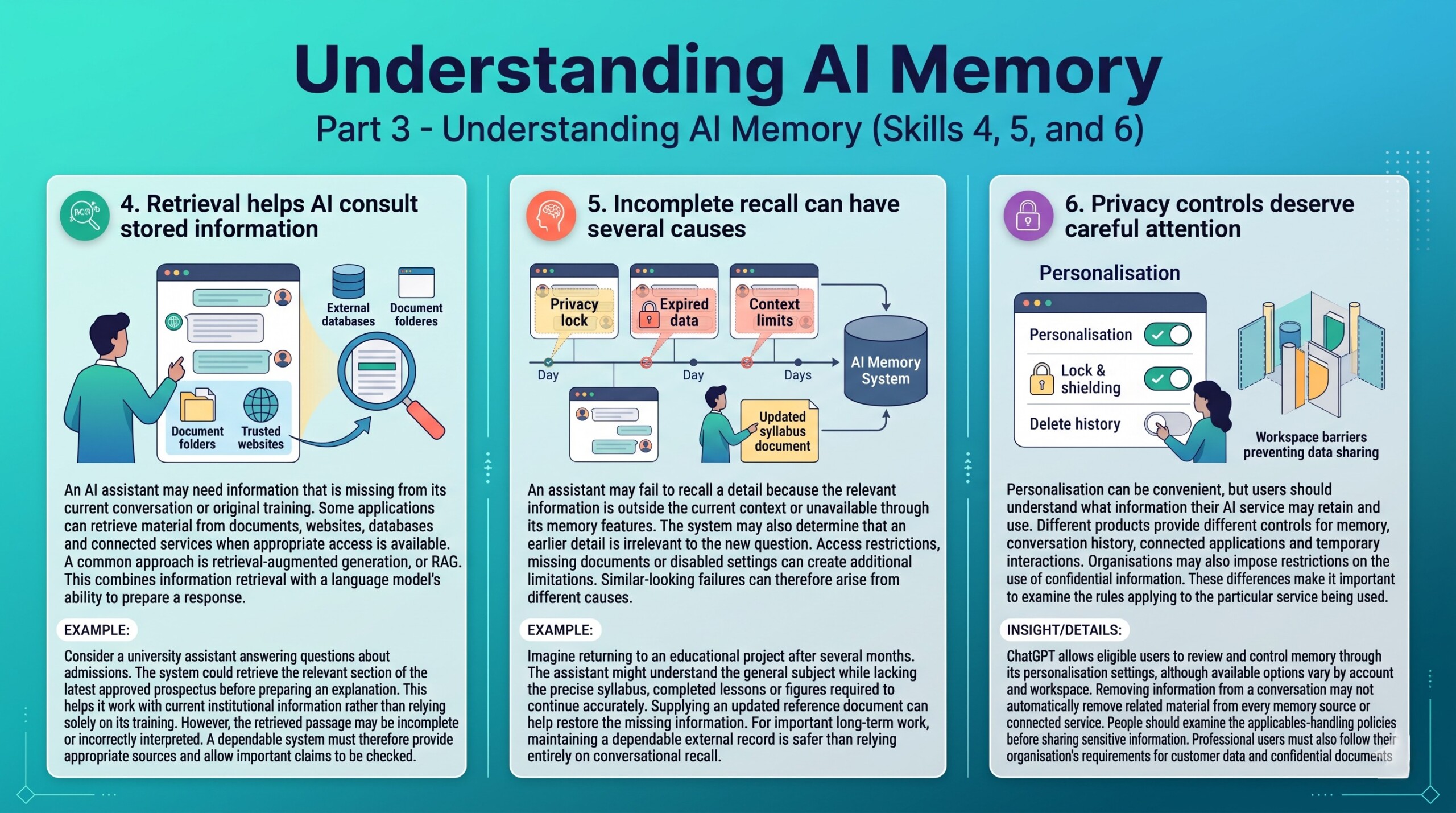
An AI assistant may need information that is missing from its current conversation or original training. Some applications can retrieve material from documents, websites, databases and connected services when appropriate access is available. A common approach is retrieval-augmented generation, or RAG. This combines information retrieval with a language model’s ability to prepare a response.
Consider a university assistant answering questions about admissions. The system could retrieve the relevant section of the latest approved prospectus before preparing an explanation. This helps it work with current institutional information rather than relying solely on its training. However, the retrieved passage may be incomplete or incorrectly interpreted. A dependable system must therefore provide appropriate sources and allow important claims to be checked.
5. Incomplete recall can have several causes
An assistant may fail to recall a detail because the relevant information is outside the current context or unavailable through its memory features. The system may also determine that an earlier detail is irrelevant to the new question. Access restrictions, missing documents or disabled settings can create additional limitations. Similar-looking failures can therefore arise from different causes.
Imagine returning to an educational project after several months. The assistant might understand the general subject while lacking the precise syllabus, completed lessons or figures required to continue accurately. Supplying an updated reference document can help restore the missing information. For important long-term work, maintaining a dependable external record is safer than relying entirely on conversational recall.
6. Privacy controls deserve careful attention
Personalisation can be convenient, but users should understand what information their AI service may retain and use. Different products provide different controls for memory, conversation history, connected applications and temporary interactions. Organisations may also impose restrictions on the use of confidential information. These differences make it important to examine the rules applying to the particular service being used.
ChatGPT allows eligible users to review and control memory through its personalisation settings, although available options vary by account and workspace. Removing information from a conversation may not automatically remove related material from every memory source or connected service. People should examine the applicable privacy and data-handling policies before sharing sensitive information. Professional users must also follow their organisation’s requirements for customer data and confidential documents.
7. Build a dependable working system around AI
A useful long-term approach is to maintain an accurate reference document for each important recurring project. This document can contain the objective, essential facts, preferred structure, completed work and outstanding decisions. It can be supplied or connected when a new assignment begins. The practice reduces dependence on uncertain recall and helps the user verify whether the assistant has followed the latest requirements.
Consider preparing a series of professional training sessions during 2027. A maintained reference file could record the syllabus, completed sessions, source requirements and decisions about future lessons. The assistant could use that information to support new work, while the teacher checks the output against the reference material. This combination of explicit instructions, dependable documents and careful review can make AI-assisted work more consistent over time.
Conclusion
AI memory is becoming an increasingly useful part of digital assistance, but it operates through mechanisms that differ from human recollection. Conversation context, cross-conversation memory, persistent instructions and information retrieval serve related but distinct purposes. Their reliability depends on the product, settings and information available to the system. During 2027, users who understand these differences will be better prepared to organise projects, protect important information and work effectively with AI assistants.