Are SaaS companies really dying due to AI?
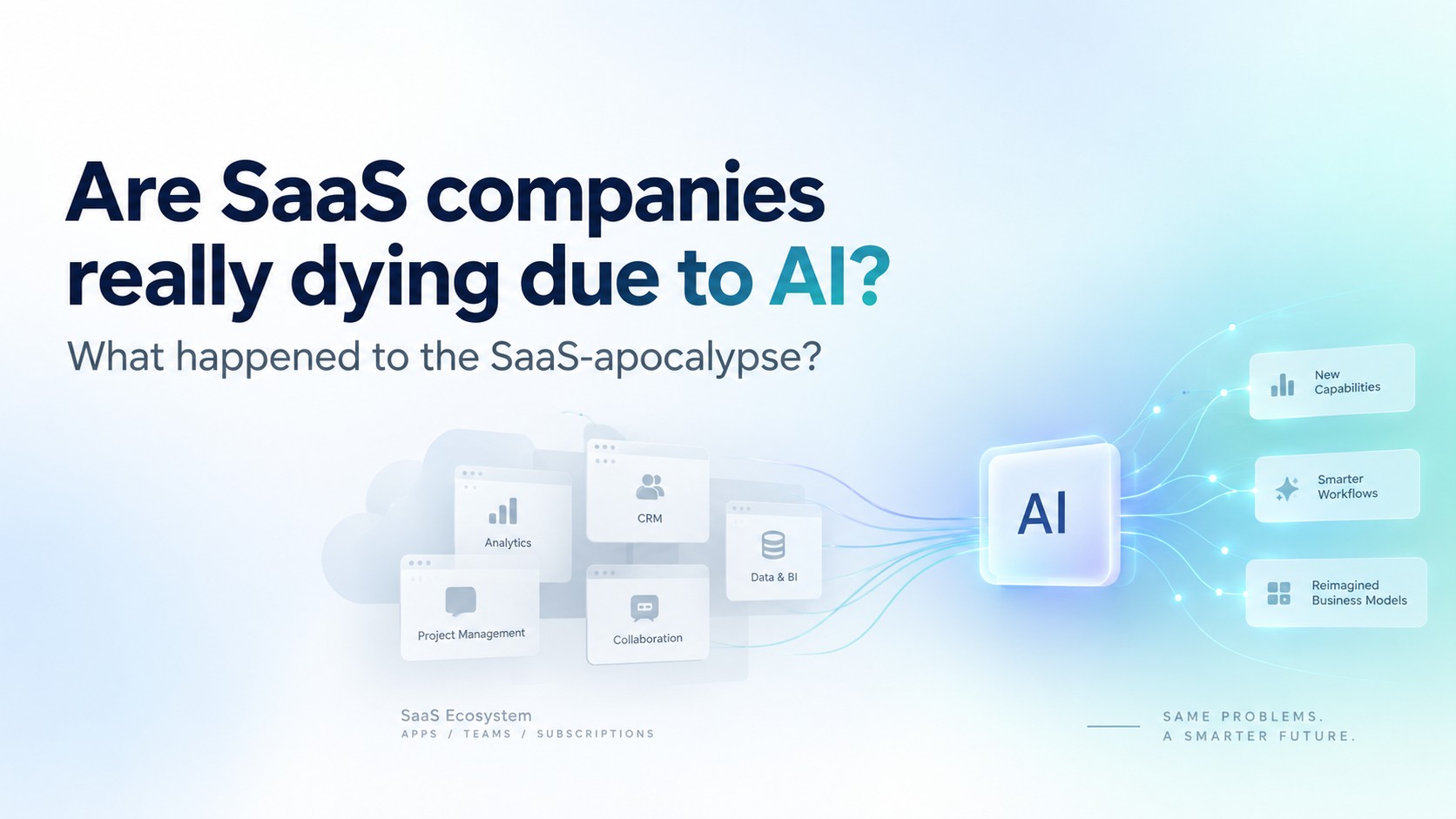
Are SaaS companies really dying due to AI?
What happened to the SaaS-apocalypse?
Introduction
Few technology narratives have generated as much anxiety as the idea that artificial intelligence will destroy Software as a Service. The argument appears logical: if an AI agent can create small applications, query business data, operate existing software and automate workflows, why should organisations continue paying for dozens of conventional SaaS products?
The evidence available as companies plan for 2027 suggests a more interesting transition. Some software categories are certainly under pressure, but Salesforce, Snowflake and other established vendors are also finding ways to make AI part of their growth story. Software is not disappearing; the place where software creates value is shifting. An excellent collection of learning videos awaits you on our Youtube channel.
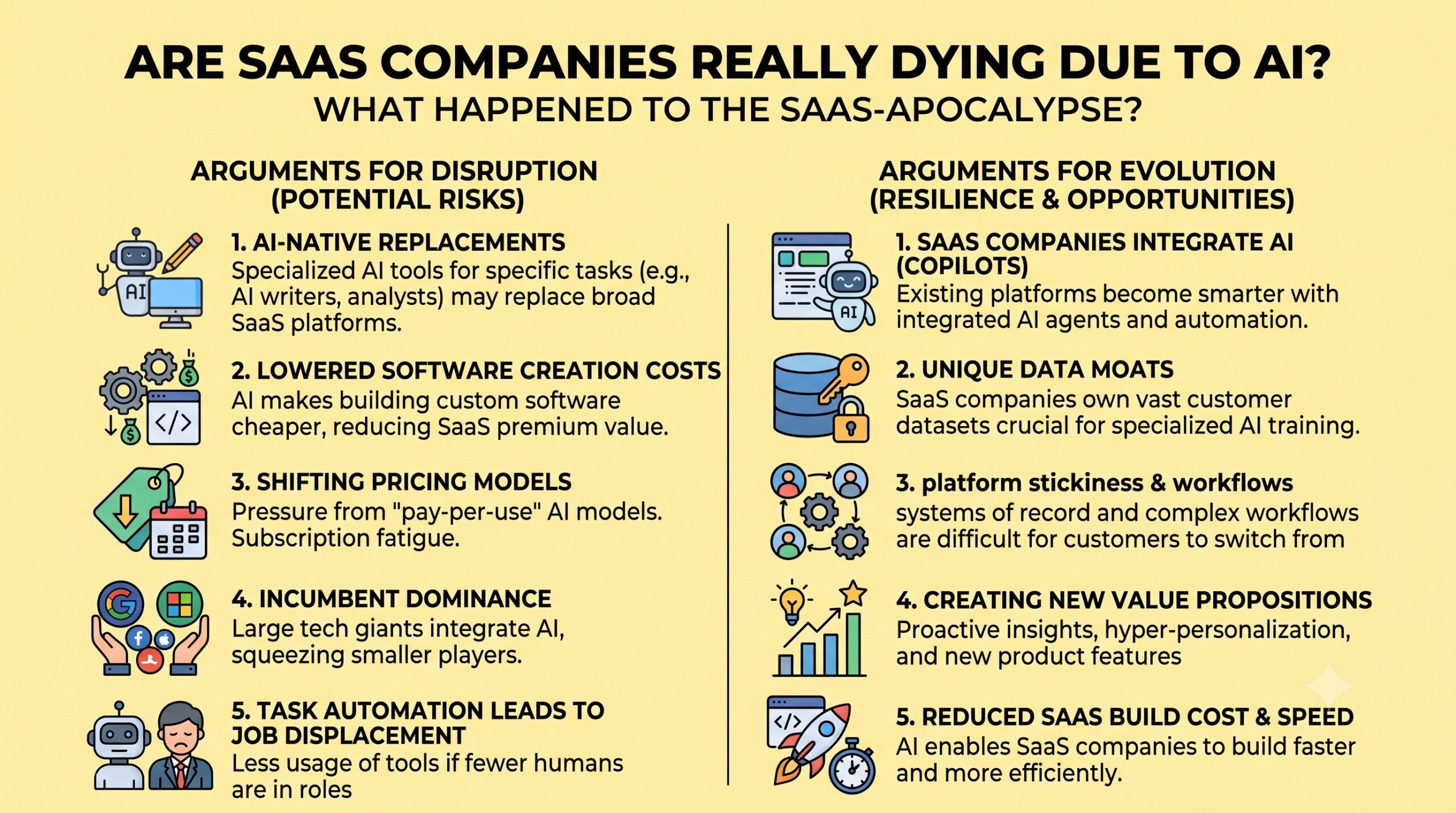
Let’s dive deep into it now!
1. AI threatens part of the traditional SaaS interface
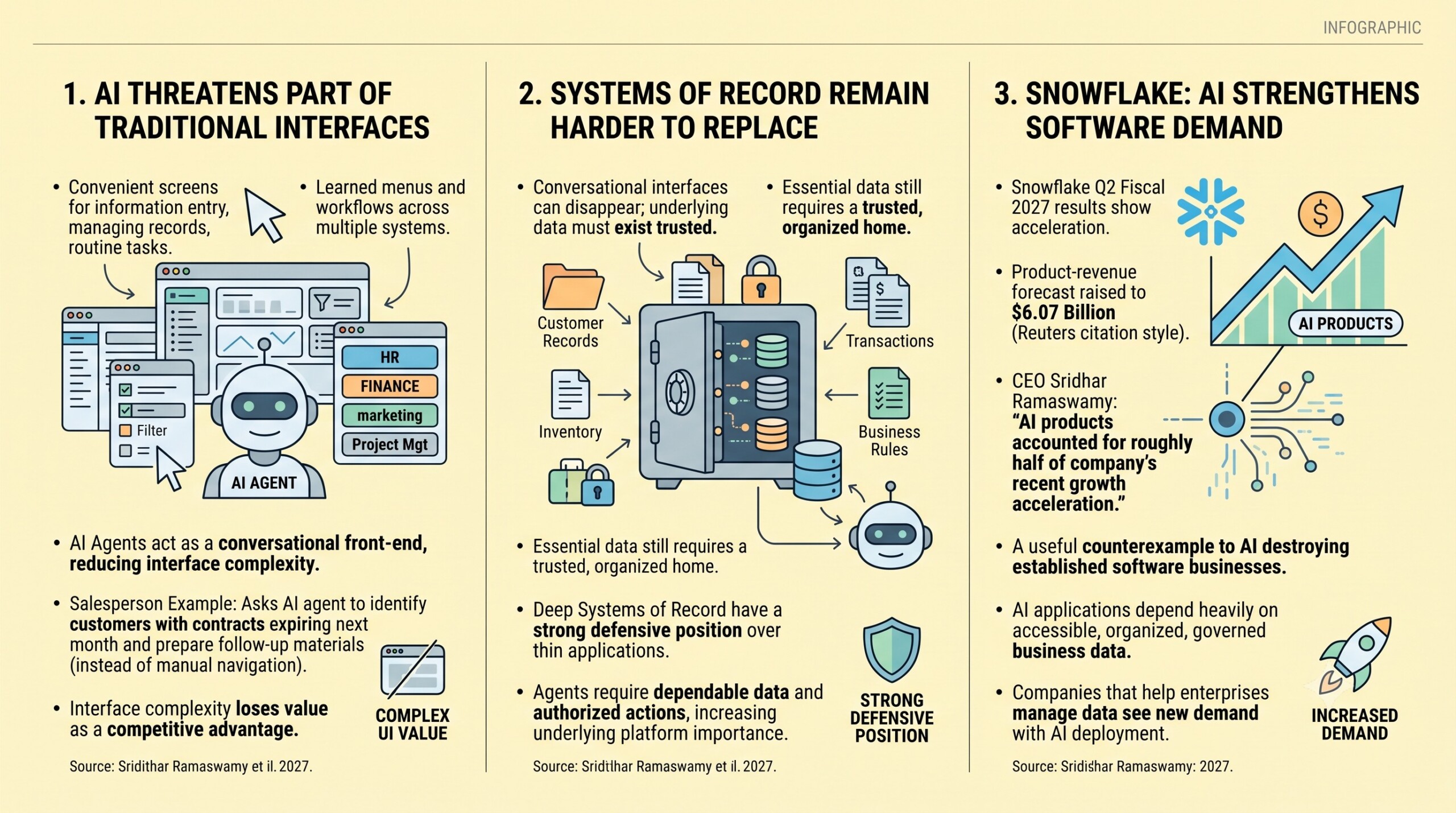
For years, many SaaS products created value by giving people convenient screens through which they could enter information, manage records and complete routine tasks. Employees learned menus, dashboards, filters and workflow buttons across customer-management, HR, finance, marketing and project-management systems.
An AI agent can increasingly sit in front of those interfaces. A salesperson may ask an agent to identify customers whose contracts expire next month and prepare follow-up material instead of navigating several screens manually. The more effectively this works, the less valuable interface complexity becomes as a competitive advantage.
2. Systems of record remain much harder to replace
A conversational interface can disappear without eliminating the system containing the underlying data. Customer records, contracts, inventory, employee information, transactions, permissions and business rules still need to live somewhere trusted.
This is why enterprise software companies with deep systems of record may have a stronger defensive position than thin applications that mainly provide a convenient front end. Agents require dependable data and authorised actions, which can increase the importance of the platforms underneath the conversation. A constantly updated Whatsapp channel awaits your participation.
3. Snowflake shows how AI can strengthen software demand
Snowflake reported strong second-quarter fiscal 2027 results in September and raised its annual product-revenue forecast to $6.07 billion. CEO Sridhar Ramaswamy said AI products accounted for roughly half of the company’s recent growth acceleration, providing a useful counterexample to the assumption that AI automatically destroys established software businesses.
The reason is straightforward. AI applications depend heavily on accessible, organised and governed business data. A company that helps enterprises store, manage and work with that data can gain new demand as organisations deploy more AI.


4. Salesforce is trying to redefine the SaaS relationship
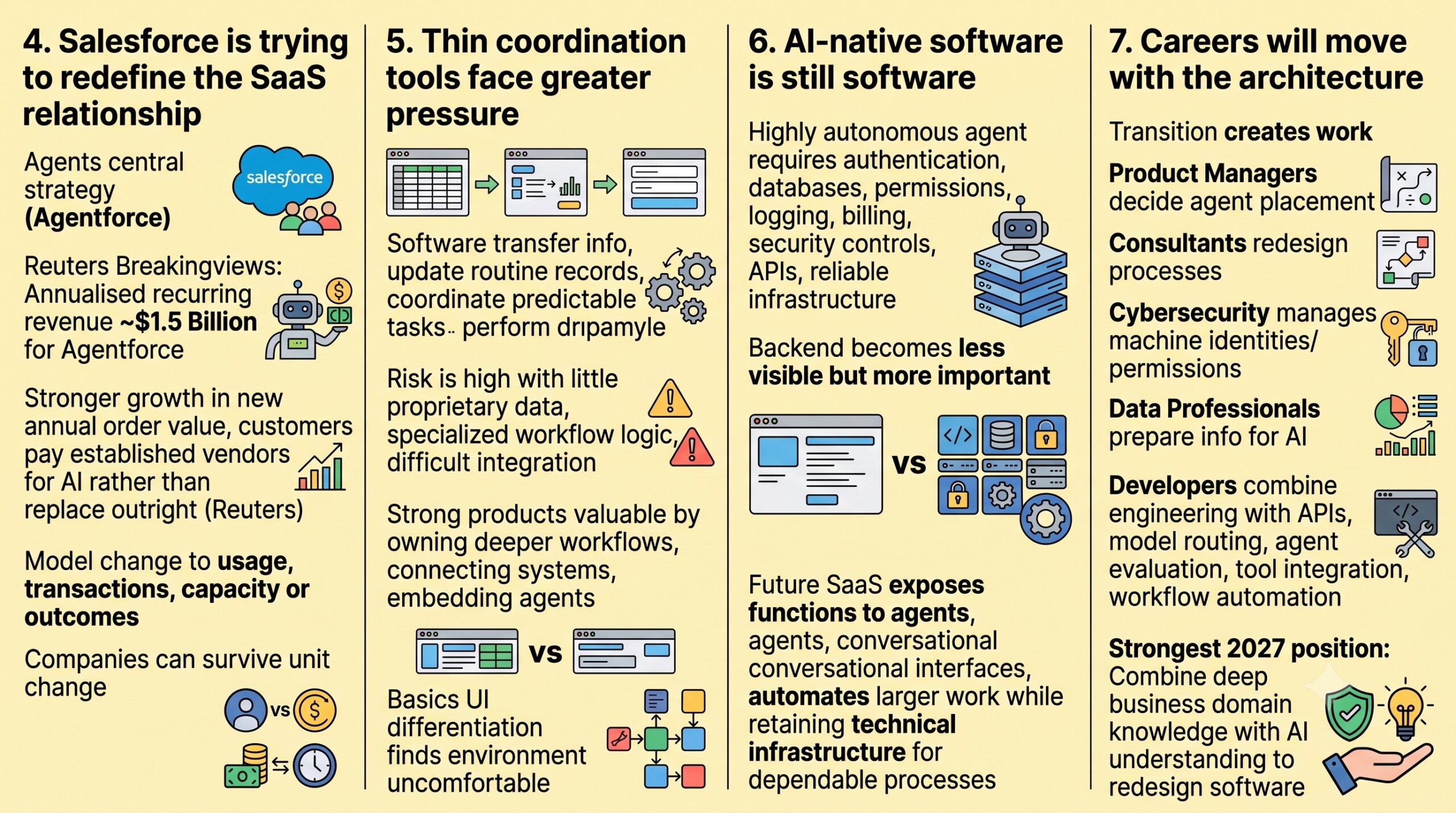
Salesforce has placed agents near the centre of its strategy through Agentforce. Reuters Breakingviews reported annualised recurring revenue of about $1.5 billion for Agentforce and noted stronger growth in new annual order value, suggesting that some customers are paying established software vendors for AI capabilities rather than replacing them outright.
The business model may still change substantially. Traditional SaaS often charges according to the number of human users, while an agentic system may eventually be priced around usage, transactions, capacity or outcomes. A company can survive while the unit by which it charges customers changes completely. Excellent individualised mentoring programmes available.
5. Thin coordination tools face greater pressure
Software that mainly transfers information between people, updates routine records or coordinates predictable tasks can be vulnerable when capable agents perform those functions directly. The risk is especially high where the product owns little proprietary data, specialised workflow logic or difficult integration.
That does not mean every simple SaaS application disappears. Strong products can become valuable by owning deeper workflows, connecting more systems or embedding agents themselves, but businesses whose differentiation consists mainly of a basic user interface may find the new environment uncomfortable.
6. AI-native software is still software
Even a highly autonomous AI agent requires authentication, databases, permissions, logging, billing, security controls, APIs and reliable infrastructure. Those components may become less visible to the human user while becoming more important to the system operating behind the scenes.
The future SaaS company may therefore look very different from the familiar collection of dashboards and forms. It may expose more functions directly to agents, offer conversational interfaces and automate larger pieces of work while retaining the technical infrastructure needed to keep business processes dependable. Subscribe to our free AI newsletter now.
7. Careers will move with the architecture
The transition creates work rather than merely eliminating it. Product managers will need to decide where agents belong, consultants will redesign processes, cybersecurity specialists will manage machine identities and permissions, and data professionals will prepare organisational information for reliable AI use.
Developers will increasingly combine conventional software engineering with APIs, model routing, agent evaluation, tool integration and workflow automation. For many professionals, the strongest position in 2027 may be the ability to combine deep knowledge of a business domain with enough AI understanding to redesign how the software serving that domain actually works.
Conclusion
AI is unlikely to kill SaaS as a category in 2027, but it can weaken parts of the old SaaS formula. Interfaces and routine coordination may lose value, while trusted data, workflows, security, integrations and systems of record gain importance. Professionals should therefore prepare for a software market being reshaped around agents rather than assume that software careers or software companies are about to disappear.