How to automate your professional work
How to automate your professional work
Getting smarter on the regular jobs
Introduction
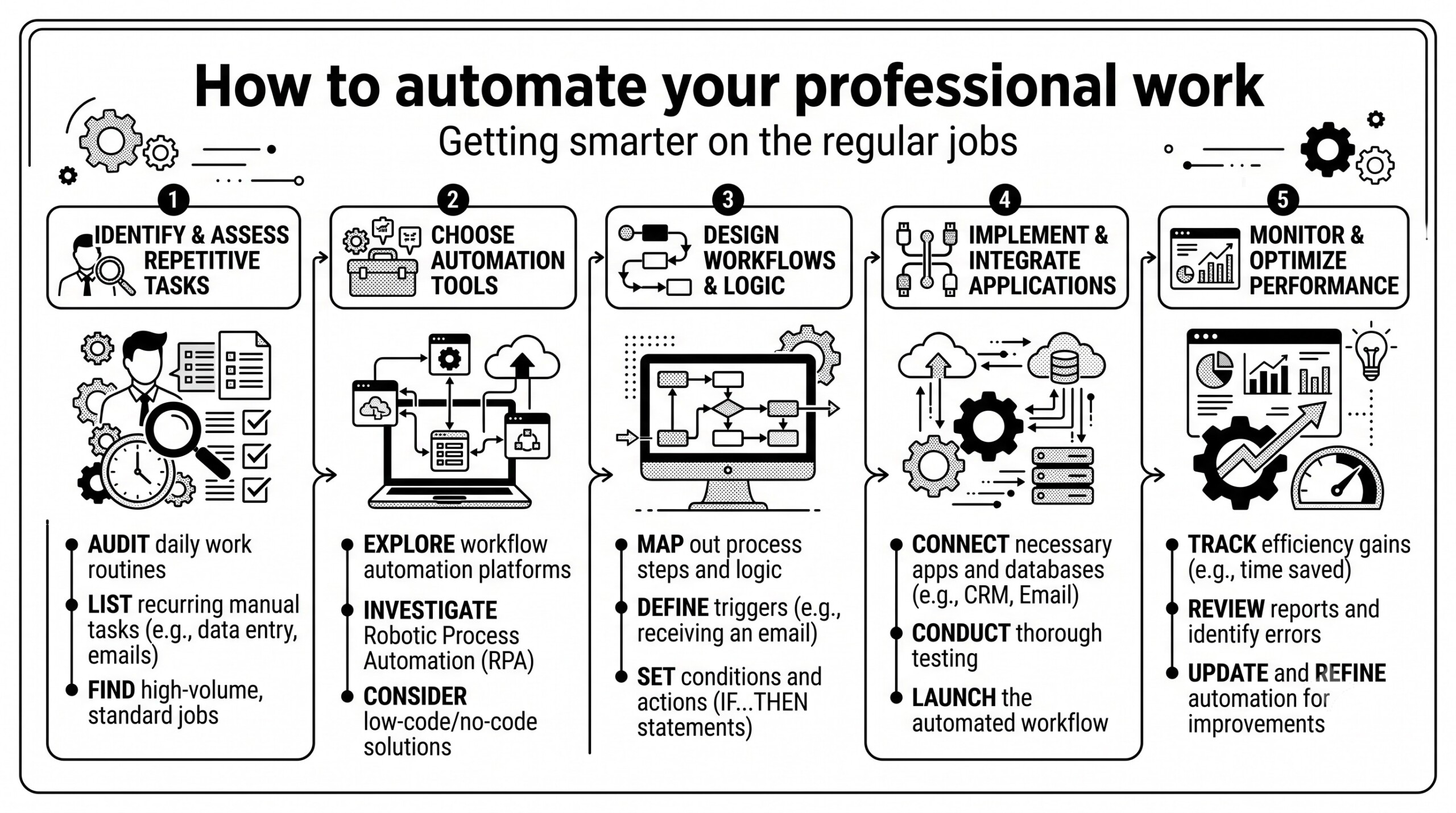
By 2027, many professionals will need to move beyond asking AI for occasional assistance and start thinking about which parts of their work can run as organised workflows. Current systems already combine reasoning models with browsers, files, business applications, search, code execution and connectors, allowing them to complete sequences of tasks that previously required repeated human intervention. OpenAI, Anthropic, Google, Microsoft and automation specialists such as Zapier are all building products around this shift.
Professional automation should not mean giving an AI unrestricted control over your job. A typical role contains repetitive administration, information gathering, analytical work, coordination, judgement, persuasion and accountability, and those categories deserve different levels of automation. The useful objective is to remove unnecessary manual execution while preserving human attention for decisions where context, expertise, relationships and consequences matter.
Let’s dive deep into it now!
1. Map your actual work before you automate anything
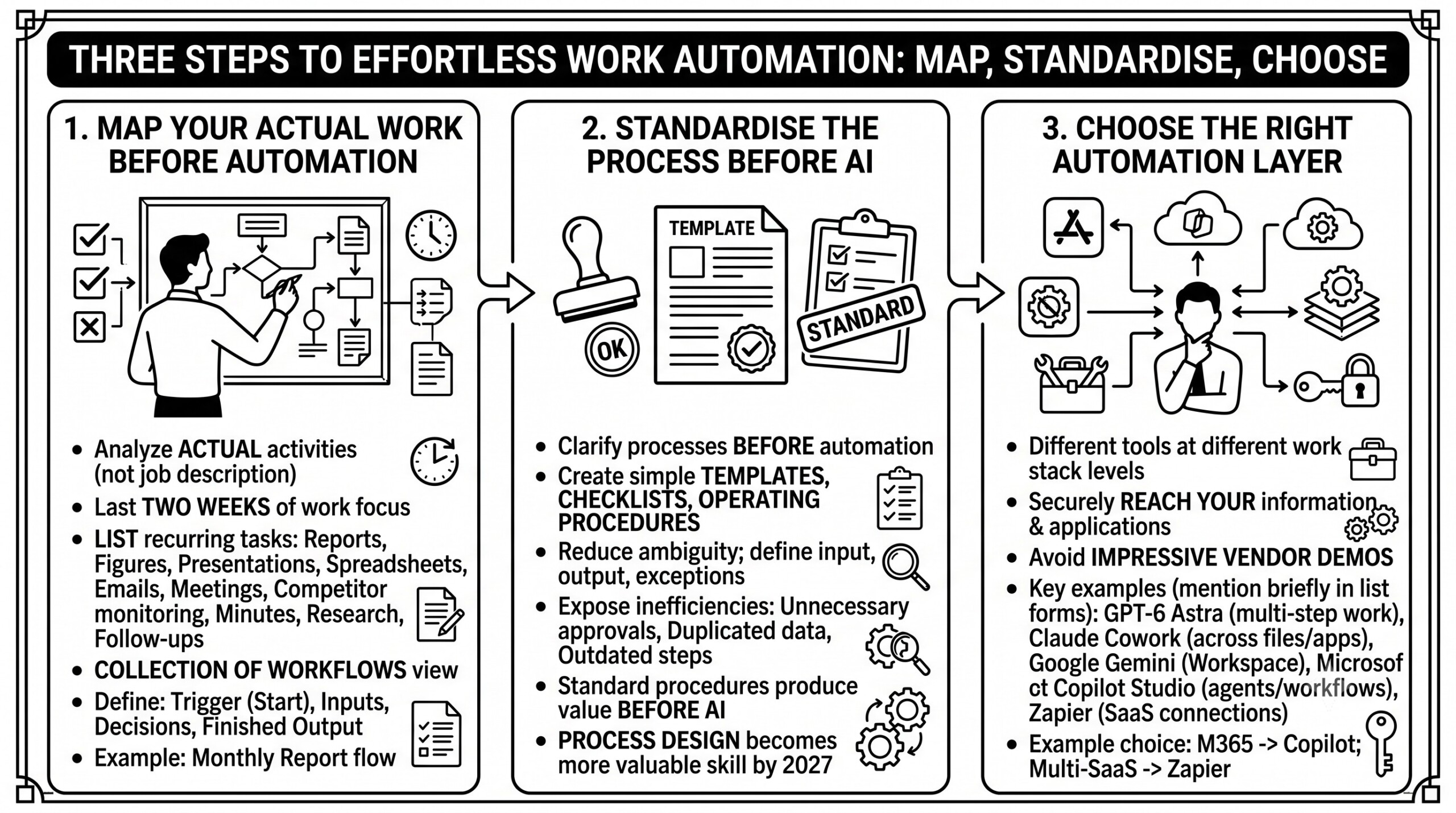
Begin with what you really did during the last two working weeks rather than with your job description. List recurring activities such as reading reports, extracting figures, preparing presentations, updating spreadsheets, answering routine emails, arranging meetings, monitoring competitors, writing minutes, compiling research and following up with colleagues. You will usually discover that a professional role is a collection of workflows rather than one indivisible job.
Then identify what starts each workflow, what information goes into it, what decisions are made and what the finished output should look like. A monthly management report, for example, may begin when new data arrives, continue through data collection and commentary, and end with a presentation sent to a leadership team. Once that process is visible, individual stages become much easier to automate safely.
2. Standardise the process before asking AI to perform it
Automation works best when the underlying process is reasonably clear. If three people perform the same task in completely different ways and nobody can explain what a good result looks like, an AI agent will inherit that ambiguity rather than magically remove it. Before automating a workflow, create a simple template, checklist or operating procedure describing the required inputs, output format and important exceptions.
This step often produces value even before AI is added. A standard procedure exposes unnecessary approvals, duplicated data entry and steps that exist only because nobody has questioned them for years. By 2027, process design may become an increasingly valuable professional skill because capable AI makes inefficient processes easier to see and easier to redesign. An excellent collection of learning videos awaits you on our Youtube channel.
3. Choose the right automation layer
Different tools now operate at different levels of the work stack. GPT-6 Astra can perform multi-step professional and computer work, Claude Cowork can operate across files and connected applications, Google Gemini can increasingly coordinate work across Workspace, Microsoft Copilot Studio can build agents and deterministic workflows, and Zapier can combine model reasoning with triggers and actions across thousands of applications.
You do not need all of them. A person whose work lives inside Microsoft 365 may begin with Copilot and Copilot Studio, while someone whose work crosses many SaaS applications may find an automation layer such as Zapier useful. The right question is not which vendor has the most impressive demo, but which system can securely reach the information and applications involved in your actual workflow.
4. Automate frequent, clear and reversible tasks first
The best first candidates are tasks that happen regularly, follow understandable rules and can be checked without much difficulty. Examples include extracting information from standard documents, preparing recurring summaries, classifying incoming requests, drafting routine responses, updating trackers or producing the first version of a report. The benefit compounds because even a small saving becomes substantial when the task occurs every day.
Avoid beginning with the most consequential decision in your job merely because it sounds impressive. Hiring decisions, financial approvals, public statements, legal commitments and sensitive customer actions may involve incomplete information and serious consequences. A low-risk workflow gives you room to learn how the AI behaves before increasing its authority. A constantly updated Whatsapp channel awaits your participation.


5. Graduate from a prompt to a bounded agent
A prompt usually asks a model to produce something, while an agentic workflow allows the system to decide among several steps and use tools to pursue an objective. GPT-6 Astra, Claude Fable 5.1 and the current generation of workplace agent systems are increasingly designed for these longer tasks. Ethan Mollick has described the change as a movement from merely working with chatbots toward managing AI systems that can perform substantial pieces of work.
The word “bounded” is crucial. Instead of telling an agent to “manage our competitors,” instruct it to collect specified information about a defined group of competitors, use approved sources, populate a standard table, identify uncertain items and prepare a briefing for review. A narrower objective is easier to evaluate, monitor and improve.
6. Put humans at the points where consequences change
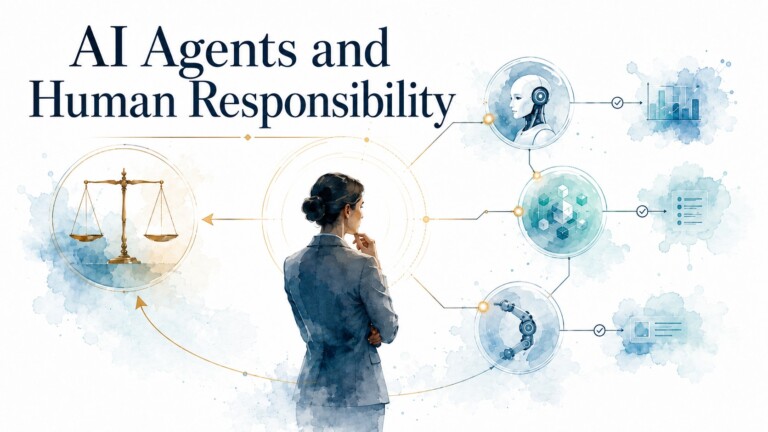
A well-designed automated workflow does not need a person approving every trivial step, because that would destroy much of the productivity gain. It does need explicit human checkpoints before actions that are expensive, irreversible, legally significant or reputationally sensitive. Microsoft’s current workflow tools, for example, can pause an agent flow and request information or approval from a designated human reviewer.
Think of this as designing an authority ladder. The AI may be allowed to research independently, draft without permission and update an internal working document, while sending an external message, approving a payment or changing a customer record may require confirmation. Clear authority is more valuable than either extreme of constant supervision or blind autonomy. Excellent individualised mentoring programmes available.
7. Measure automation by outcomes, then redesign your role
Do not measure success by how many AI tools you have installed or how many prompts your team sends. Measure cycle time, error rates, cost, quality, rework and the number of genuinely valuable human hours released. A workflow that saves thirty minutes but requires forty-five minutes of correction has created more technology without creating more productivity.
The larger opportunity is what happens after routine work disappears. A professional who saves six hours per week and merely produces more routine material has gained efficiency, while one who reinvests those hours in customers, strategy, learning, creativity or difficult decisions has changed the value of the role. The most durable 2027 career strategy is therefore not simply to automate work, but to move yourself toward the parts of work that benefit most from human judgement.
Conclusion
Professional automation begins with a surprisingly non-technical exercise: understanding your own work clearly enough to separate repetitive execution from valuable judgement. Map the workflow, standardise it, automate low-risk stages, connect the AI only to the information and tools it genuinely requires, add human approval where consequences rise, and measure whether the redesigned process is actually better. As AI systems become easier to operate, knowing how the work should be organised will matter at least as much as knowing which model button to press. Subscribe to our free AI newsletter now.