Seven skills to make you valuable in 2027
Seven skills to make you valuable in 2027
Introduction
Artificial intelligence is changing how many professional assignments are completed. Employees can use AI assistants to prepare reports, analyse data, draft correspondence, generate computer code and answer routine questions. As these capabilities improve, organisations will reconsider which activities require human effort and how different roles should be organised. The consequences will vary between occupations, but employees across many industries will need to adjust their working methods.
The strongest preparation involves developing practical abilities that remain useful when software performs more of the initial work. A teacher, accountant, administrator, engineer or sales professional can build these capabilities using familiar assignments. Advanced programming knowledge is unnecessary for many applications, although specialised technical roles will continue to require it. Seven skills offer a useful framework for professional development during 2027.
Let’s dive deep into it now!
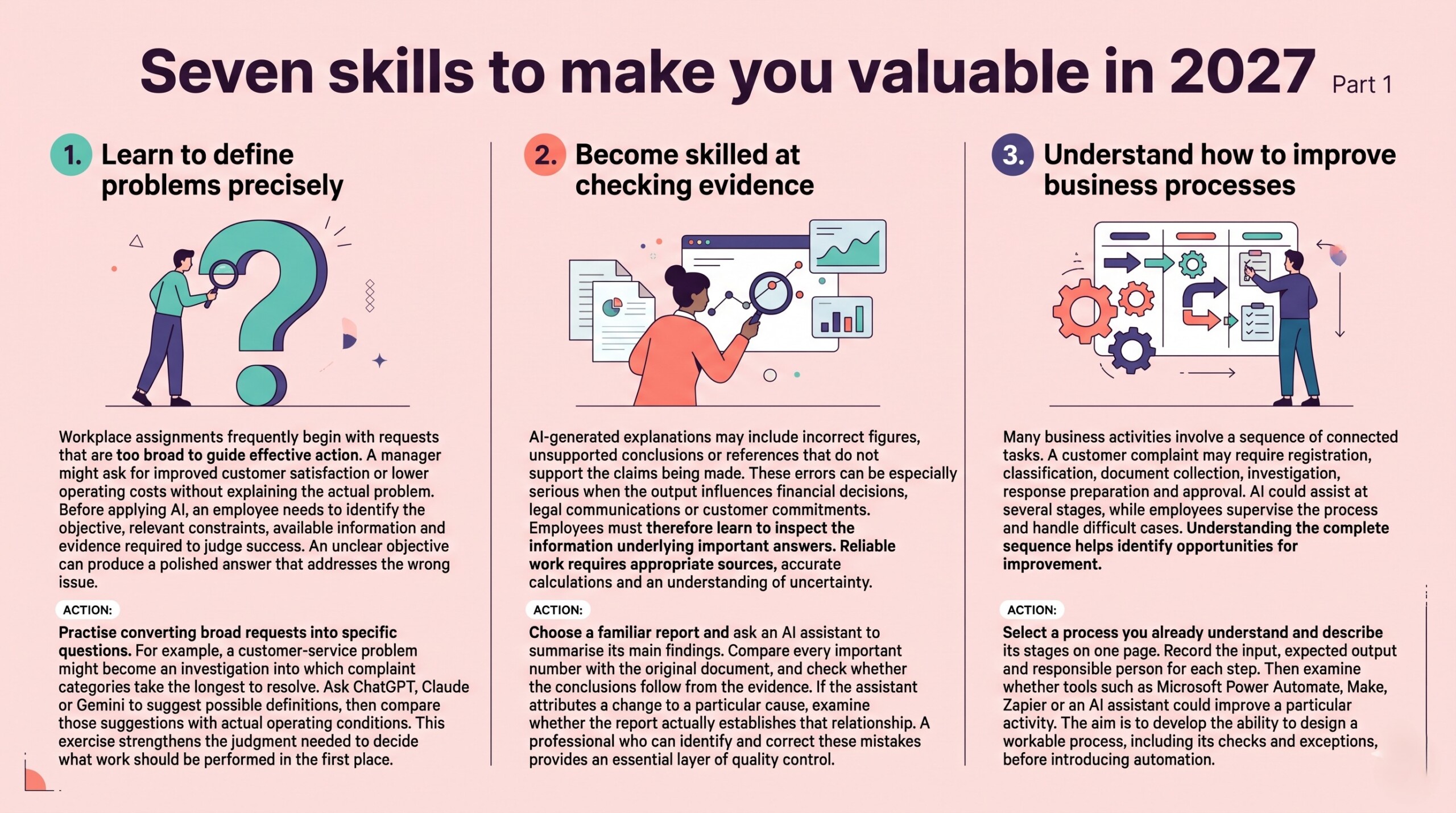
1. Learn to define problems precisely
Workplace assignments frequently begin with requests that are too broad to guide effective action. A manager might ask for improved customer satisfaction or lower operating costs without explaining the actual problem. Before applying AI, an employee needs to identify the objective, relevant constraints, available information and evidence required to judge success. An unclear objective can produce a polished answer that addresses the wrong issue.
Practise converting broad requests into specific questions. For example, a customer-service problem might become an investigation into which complaint categories take the longest to resolve. Ask ChatGPT, Claude or Gemini to suggest possible definitions, then compare those suggestions with actual operating conditions. This exercise strengthens the judgment needed to decide what work should be performed in the first place.
2. Become skilled at checking evidence
AI-generated explanations may include incorrect figures, unsupported conclusions or references that do not support the claims being made. These errors can be especially serious when the output influences financial decisions, legal communications or customer commitments. Employees must therefore learn to inspect the information underlying important answers. Reliable work requires appropriate sources, accurate calculations and an understanding of uncertainty.
Choose a familiar report and ask an AI assistant to summarise its main findings. Compare every important number with the original document, and check whether the conclusions follow from the evidence. If the assistant attributes a change to a particular cause, examine whether the report actually establishes that relationship. A professional who can identify and correct these mistakes provides an essential layer of quality control.
3. Understand how to improve business processes
Many business activities involve a sequence of connected tasks. A customer complaint may require registration, classification, document collection, investigation, response preparation and approval. AI could assist at several stages, while employees supervise the process and handle difficult cases. Understanding the complete sequence helps identify opportunities for improvement.
Select a process you already understand and describe its stages on one page. Record the input, expected output and responsible person for each step. Then examine whether tools such as Microsoft Power Automate, Make, Zapier or an AI assistant could improve a particular activity. The aim is to develop the ability to design a workable process, including its checks and exceptions, before introducing automation.
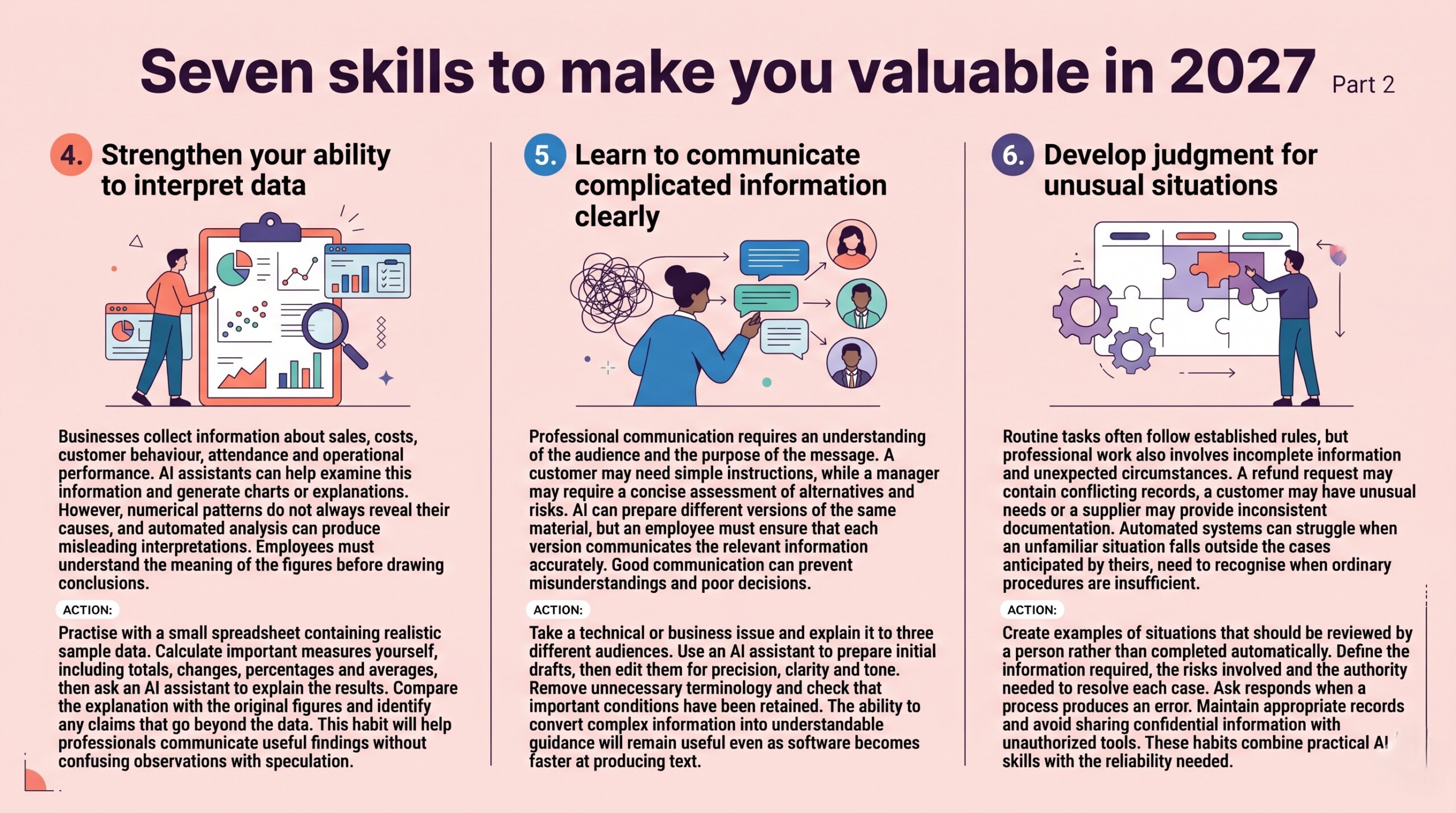
4. Strengthen your ability to interpret data
Businesses collect information about sales, costs, customer behaviour, attendance and operational performance. AI assistants can help examine this information and generate charts or explanations. However, numerical patterns do not always reveal their causes, and automated analysis can produce misleading interpretations. Employees must understand the meaning of the figures before drawing conclusions.
Practise with a small spreadsheet containing realistic sample data. Calculate important measures yourself, including totals, changes, percentages and averages, then ask an AI assistant to explain the results. Compare the explanation with the original figures and identify any claims that go beyond the data. This habit will help professionals communicate useful findings without confusing observations with speculation.
5. Learn to communicate complicated information clearly
Professional communication requires an understanding of the audience and the purpose of the message. A customer may need simple instructions, while a manager may require a concise assessment of alternatives and risks. AI can prepare different versions of the same material, but an employee must ensure that each version communicates the relevant information accurately. Good communication can prevent misunderstandings and poor decisions.
Take a technical or business issue and explain it to three different audiences. Use an AI assistant to prepare initial drafts, then edit them for precision, clarity and tone. Remove unnecessary terminology and check that important conditions have been retained. The ability to convert complex information into understandable guidance will remain useful even as software becomes faster at producing text.
6. Develop judgment for unusual situations
Routine tasks often follow established rules, but professional work also involves incomplete information and unexpected circumstances. A refund request may contain conflicting records, a customer may have unusual needs or a supplier may provide inconsistent documentation. Automated systems can struggle when an unfamiliar situation falls outside the cases anticipated by their designers. Employees need to recognise when ordinary procedures are insufficient.
Create examples of situations that should be reviewed by a person rather than completed automatically. Define the information required, the risks involved and the authority needed to resolve each case. Ask an AI assistant to suggest possible responses, then evaluate their suitability against the actual rules. This exercise develops practical judgment about escalation, exceptions and organisational responsibility.
7. Take responsibility for the final result
AI systems can assist with decisions and actions, but professional responsibilities remain attached to individuals and organisations. An employee may need to approve a financial statement, authorise a transaction or ensure that a customer receives correct information. Using AI does not automatically transfer those obligations to the software provider. Professionals must understand the rules and authority governing their work.
Establish clear checks whenever AI contributes to an important assignment. Decide who verifies calculations, approves external communications and responds when a process produces an error. Maintain appropriate records and avoid sharing confidential information with tools that have not been authorised for that purpose. These habits combine practical AI skills with the reliability that organisations need from trusted employees.
Conclusion
The workplace of 2027 will continue to change as AI systems become more capable and widely used. No set of skills can guarantee employment, and the effects will differ across professions and industries. Nevertheless, people can improve their preparation by learning to define problems, evaluate evidence, improve workflows, interpret data, communicate clearly, handle exceptions and take responsibility. The most productive starting point is the work they already understand, using AI to practise these abilities on real professional problems.