What are Forward Deployed Engineers (FDEs)
What are Forward Deployed Engineers (FDEs)
Introduction
Imagine a large hospital purchasing an advanced artificial intelligence system to improve patient administration. The software looks impressive during a demonstration, but the hospital soon discovers that its patient information is scattered across different databases, employees follow complicated procedures, and strict privacy requirements govern how information can be used. Someone must understand those practical problems, connect the technology to existing systems and make sure the new application performs reliably in everyday operations. That person may be a Forward Deployed Engineer, commonly known as an FDE.
The role is receiving growing attention as organisations invest in AI systems that must operate inside complicated business environments. Companies can access increasingly powerful AI models, yet converting those capabilities into dependable applications requires specialist engineering and close cooperation with the people who use them. Looking ahead to 2027, FDEs could become an important part of the workforce connecting AI development with business transformation. Their growing relevance also offers an interesting lesson for students and professionals wondering which skills will remain valuable as AI becomes more capable.
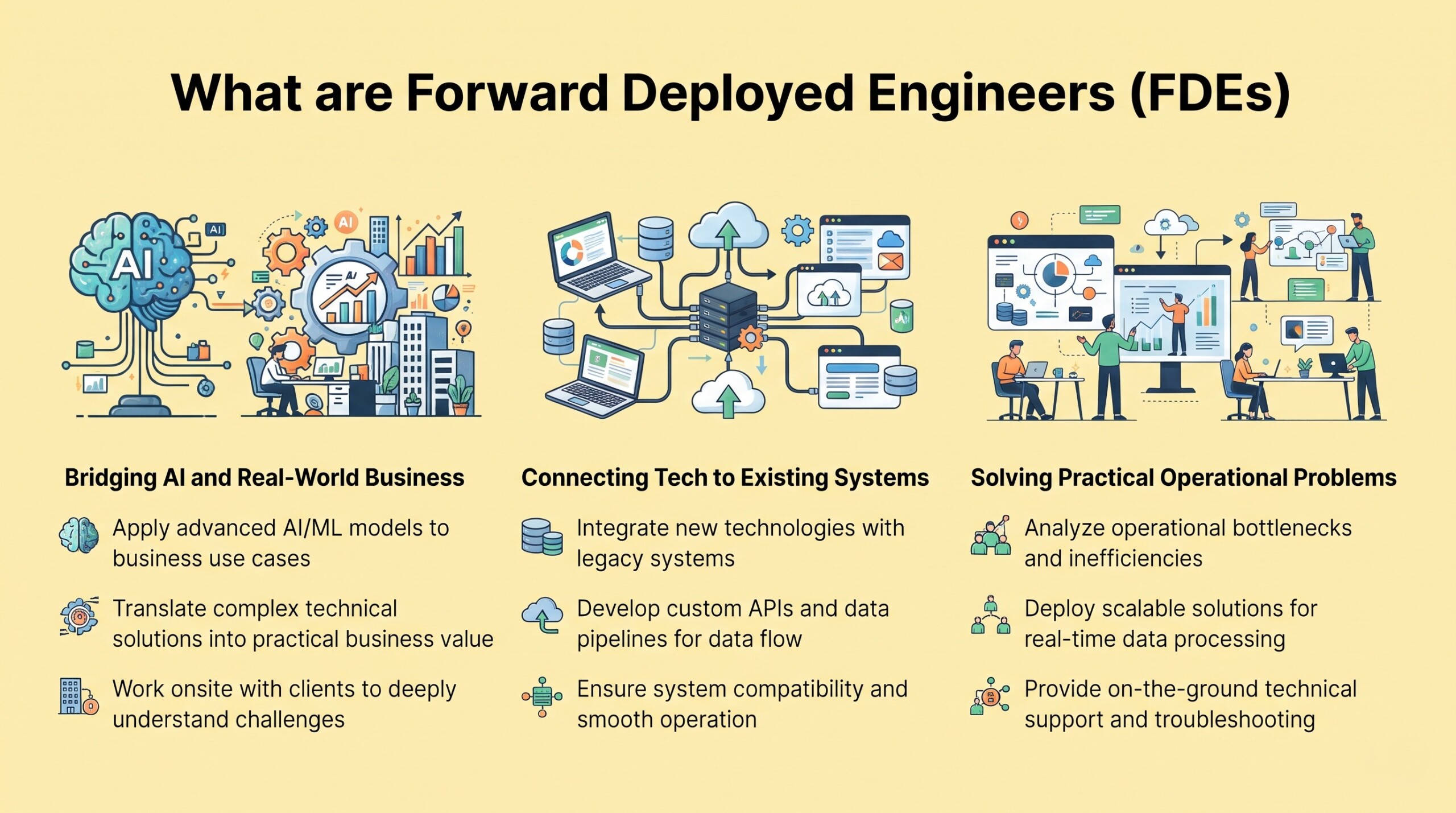
Let’s dive deep into it.
1. What exactly is a Forward Deployed Engineer?
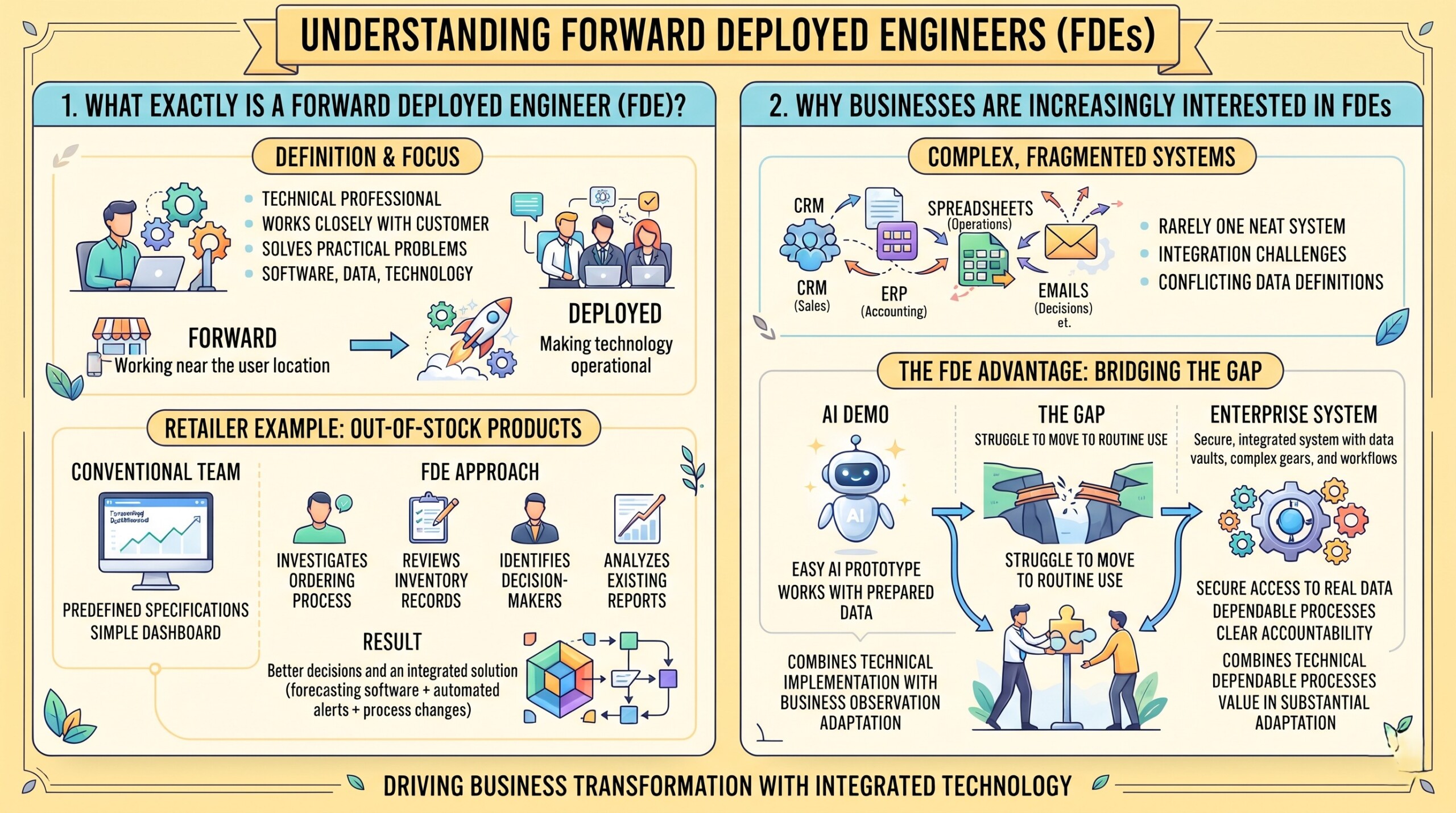
A Forward Deployed Engineer is a technical professional who works closely with a customer or business team to solve practical problems using software, data and technology. The word “forward” refers to working near the place where the solution will actually be used, while “deployed” describes the process of making technology operational. Instead of developing a general product without direct exposure to its users, an FDE spends substantial time understanding the customer’s environment and building a solution that fits its requirements. Depending on the organisation, the engineer may work at the customer’s location, remotely within its systems or as part of a joint implementation team.
Consider a retailer struggling to understand why certain products regularly run out of stock. A conventional software team might be asked to develop a forecasting dashboard based on predefined specifications. An FDE would be more likely to investigate how the retailer orders products, how inventory records are maintained, who makes purchasing decisions and why existing reports are insufficient. The resulting solution might combine forecasting software, automated alerts and changes to the ordering process. The engineer’s success would depend on whether the retailer can make better decisions, rather than simply whether the dashboard works.
2. Why businesses are increasingly interested in FDEs
Modern organisations rarely operate through one neat and perfectly organised software system. Customer information may sit in a CRM platform, accounting information in an ERP application, operational records in spreadsheets and important decisions in emails or meetings. An AI application that needs information from several of these sources must be integrated carefully. Different departments may also have conflicting definitions, incomplete records or approval requirements that are poorly documented.
These challenges explain why organisations often struggle to move promising AI demonstrations into routine business use. A chatbot may produce an attractive answer when given carefully prepared information, but a working enterprise system needs secure access to real data, dependable processes and clear accountability when something goes wrong. FDEs can help bridge that gap by combining technical implementation with close observation of business operations. Their value grows when the problem requires substantial adaptation rather than installing a standard product.
3. How the role differs from a software engineer or consultant
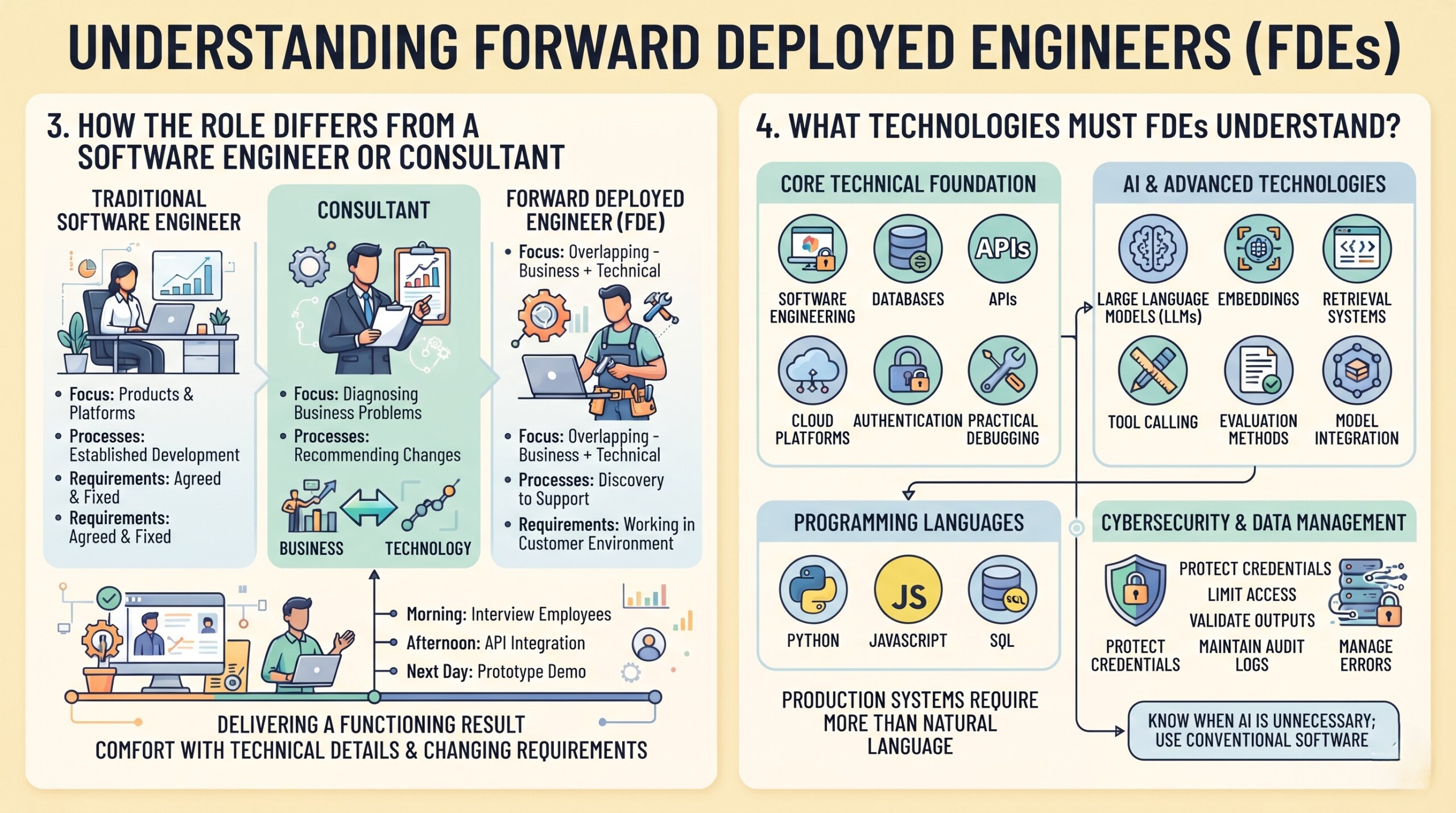
Traditional software engineers often work on products or platforms with established development processes and agreed requirements. Consultants may concentrate on diagnosing business problems, recommending changes or overseeing transformation programmes. Forward Deployed Engineers occupy an overlapping position because they must understand the business problem and personally contribute to building the technical solution. Their responsibilities often extend from initial discovery and prototyping to deployment, testing and support.
The boundaries among these roles are flexible, and many experienced consultants or software developers already perform comparable work. What makes the FDE description distinctive is the strong expectation of working directly within the customer’s operating environment and delivering a functioning result. An engineer might interview employees in the morning, examine an API integration during the afternoon and demonstrate a prototype to the business team the next day. This combination requires comfort with both technical details and changing business requirements.
4. What technologies must FDEs understand?
The technical foundation usually includes software engineering, databases, APIs, cloud platforms, authentication and practical debugging. An FDE working with artificial intelligence may also need to understand large language models, embeddings, retrieval systems, tool calling, evaluation methods and model integration. Programming languages such as Python, JavaScript and SQL remain useful because production systems require more than natural-language prompts. Engineers must be able to work with existing applications and diagnose failures when a model or integration behaves unexpectedly.
Cybersecurity and data management are equally important. A useful enterprise AI system may need to read confidential documents or operate business applications, so its permissions must be designed carefully. FDEs should understand how to protect credentials, limit access, validate outputs, maintain audit logs and manage errors. They also need to know when an AI model is unnecessary because a conventional software function can solve the problem more reliably and cheaply.
5. Why business understanding is becoming a major career advantage
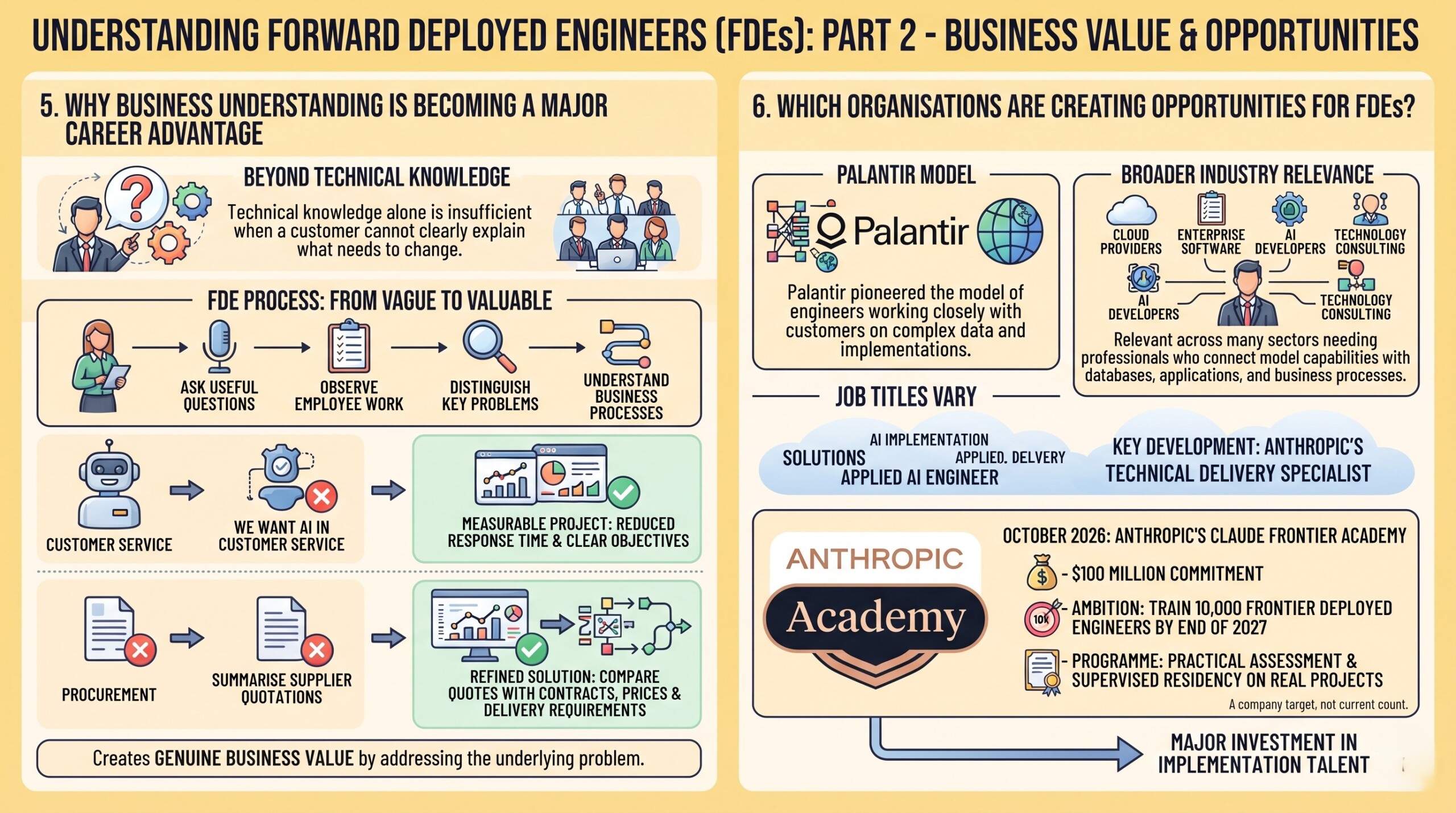
Technical knowledge alone may be insufficient when a customer cannot clearly explain what needs to change. The engineer must ask useful questions, observe how employees work and distinguish important problems from minor inconveniences. This often involves understanding a business process well enough to recognise where delays, mistakes or unnecessary manual effort occur. A strong FDE can translate a vague request such as “We want AI in customer service” into a measurable project with clear objectives.
Suppose a manufacturing company wants an AI assistant for its procurement department. The initial request may be to summarise supplier quotations, but conversations with employees reveal that the real difficulty is comparing quotations with contract terms, historical prices and delivery requirements. An FDE can refine the solution around that workflow and identify which decisions still require human approval. The result can create genuine business value because it addresses the underlying problem rather than the first feature somebody requested.
6. Which organisations are creating opportunities for FDEs?
Palantir is among the technology companies associated with the forward-deployed engineering model, having used engineers who work closely with customers on complex data and software implementations. The broader approach is also relevant to cloud providers, enterprise software companies, AI developers and technology consulting businesses. Organisations implementing large AI programmes increasingly need professionals who can connect model capabilities with databases, applications and business processes. The job title may vary, with related opportunities described as solutions engineer, AI implementation engineer, applied AI engineer or technical delivery specialist.
A notable development came in October 2026 when Anthropic announced its Claude Frontier Academy, backed by a stated commitment of $100 million and an ambition to train 10,000 Frontier Deployed Engineers by the end of 2027. The company described a programme involving practical assessment and a supervised residency on real organisational projects. This is a company target rather than evidence that 10,000 engineers have already qualified. It nevertheless provides a concrete example of how major AI developers are investing in implementation talent as businesses seek to convert AI spending into operational results.
7. How students and professionals can prepare for this career in 2027
A practical route begins with strong software fundamentals and a willingness to understand how organisations actually operate. Students can learn Python, SQL, APIs and cloud deployment, then build applications that solve problems using realistic data. Useful portfolio projects might include a customer enquiry assistant connected to a small database, a document-search tool with citations or an inventory dashboard that identifies unusual stock movements. Each project should demonstrate how the application handles errors, protects information and produces a result that can be checked.
Existing professionals can build on expertise they already possess in banking, manufacturing, healthcare, retail, education or another industry. A business analyst who learns software integration and AI evaluation may become a valuable contributor to implementation teams, even if the formal FDE title initially remains more accessible to experienced engineers. Communication, problem discovery, project ownership and collaboration will remain important differentiators. Employers may increasingly appreciate candidates who can explain an entire implementation, including the original problem, the technical decisions, the testing process and the measurable outcome.

Conclusion
Forward Deployed Engineering illustrates how AI careers are evolving as organisations move beyond experimentation. More capable models may automate parts of programming and software development, but companies will still need people who can understand complicated workflows, make appropriate engineering decisions and take responsibility for reliable implementation. The FDE role brings these responsibilities together through a combination of hands-on technology and business engagement. For people planning their careers around 2027, the opportunity lies in developing the ability to make advanced technology genuinely useful in the environments where organisations operate.