Your first 90 days in an AI-enabled job
Your first 90 days in an AI-enabled job
Introduction
Starting a new job has traditionally involved understanding an organisation’s products, meeting colleagues and becoming familiar with professional responsibilities. In 2027, employees may also encounter AI assistants, automated workflows, internal chatbots and intelligent software agents that participate in everyday business activities. Understanding this technological environment could become an important part of settling into a new professional role.
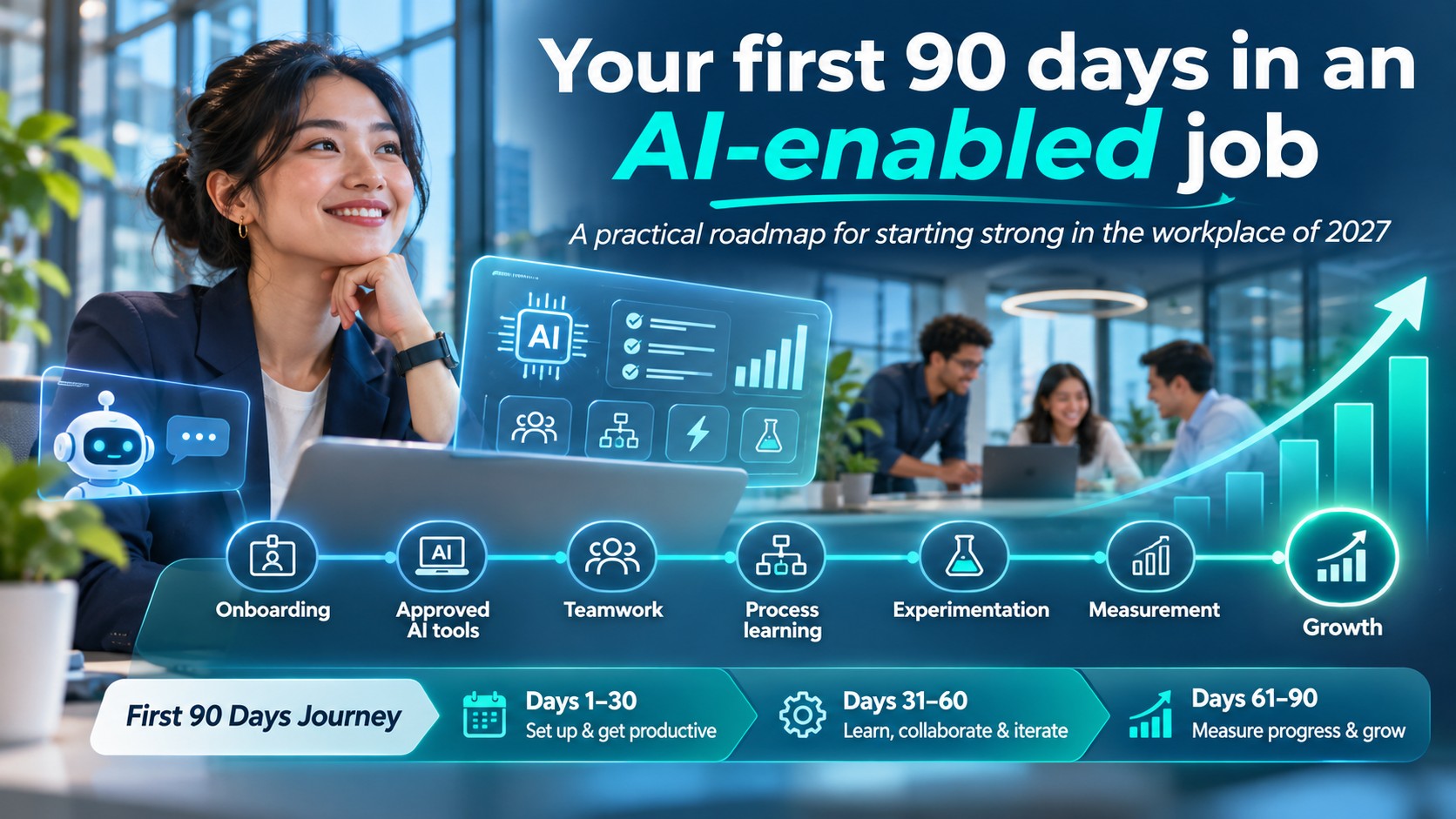
The first three months offer an excellent opportunity to build credibility while discovering how artificial intelligence can improve the quality of one’s work. Whether you are a fresh graduate, an experienced manager or someone changing careers, a structured approach can help you make useful contributions without introducing unnecessary technological complications. Here is a practical roadmap covering seven stages of your first 90 days.
Let’s dive deep into it now!
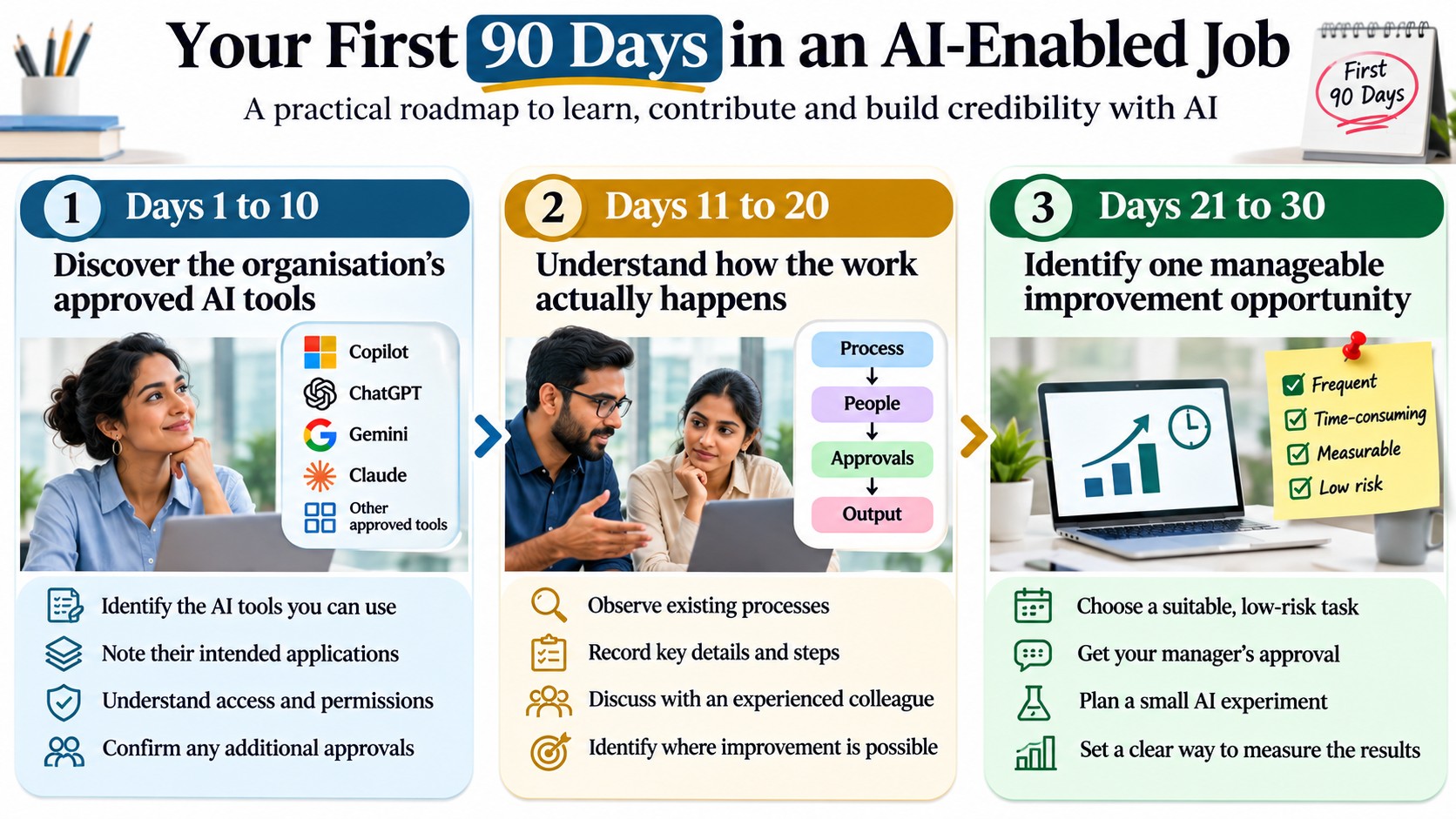
1. Days 1 to 10: Discover the organisation’s approved AI tools
Begin by identifying the AI applications your employer provides and permits. Some organisations may use Microsoft Copilot, while others may provide enterprise versions of ChatGPT, Gemini, Claude or specialised industry applications. Access and permissions can differ between departments according to their responsibilities and information security requirements.
Prepare a personal reference document recording the approved tools, their intended applications and the information you are permitted to share. Ask your manager or technology team whether particular assignments require additional authorisation. By the tenth day, you should aim to have a clear understanding of the technological resources available within your role.
2. Days 11 to 20: Understand how the work actually happens
New employees may be tempted to introduce AI before understanding the processes they are expected to support. However, apparently inefficient procedures sometimes exist because of customer requirements, regulatory obligations or previous operational experiences. Understanding these circumstances will help you identify where changes are genuinely worthwhile.
Select two or three recurring activities within your responsibilities and observe how colleagues complete them. Record the information required, the people involved, the approvals necessary and the expected results. Review your observations with an experienced colleague to ensure that you have understood the processes correctly.
3. Days 21 to 30: Identify one manageable improvement opportunity
Towards the end of your first month, look for an activity that occurs frequently, consumes considerable time and produces an output that can be checked easily. Potential examples include preparing internal meeting summaries, organising routine reports or drafting standard communications. Choose an assignment involving limited operational risk.
Discuss the opportunity with your manager and obtain appropriate approval before conducting an experiment. Establish how much time the existing process requires, what constitutes acceptable quality and how the AI-assisted approach will be evaluated. Your objective for the first month should be a clearly defined improvement opportunity supported by an initial measurement of existing performance.
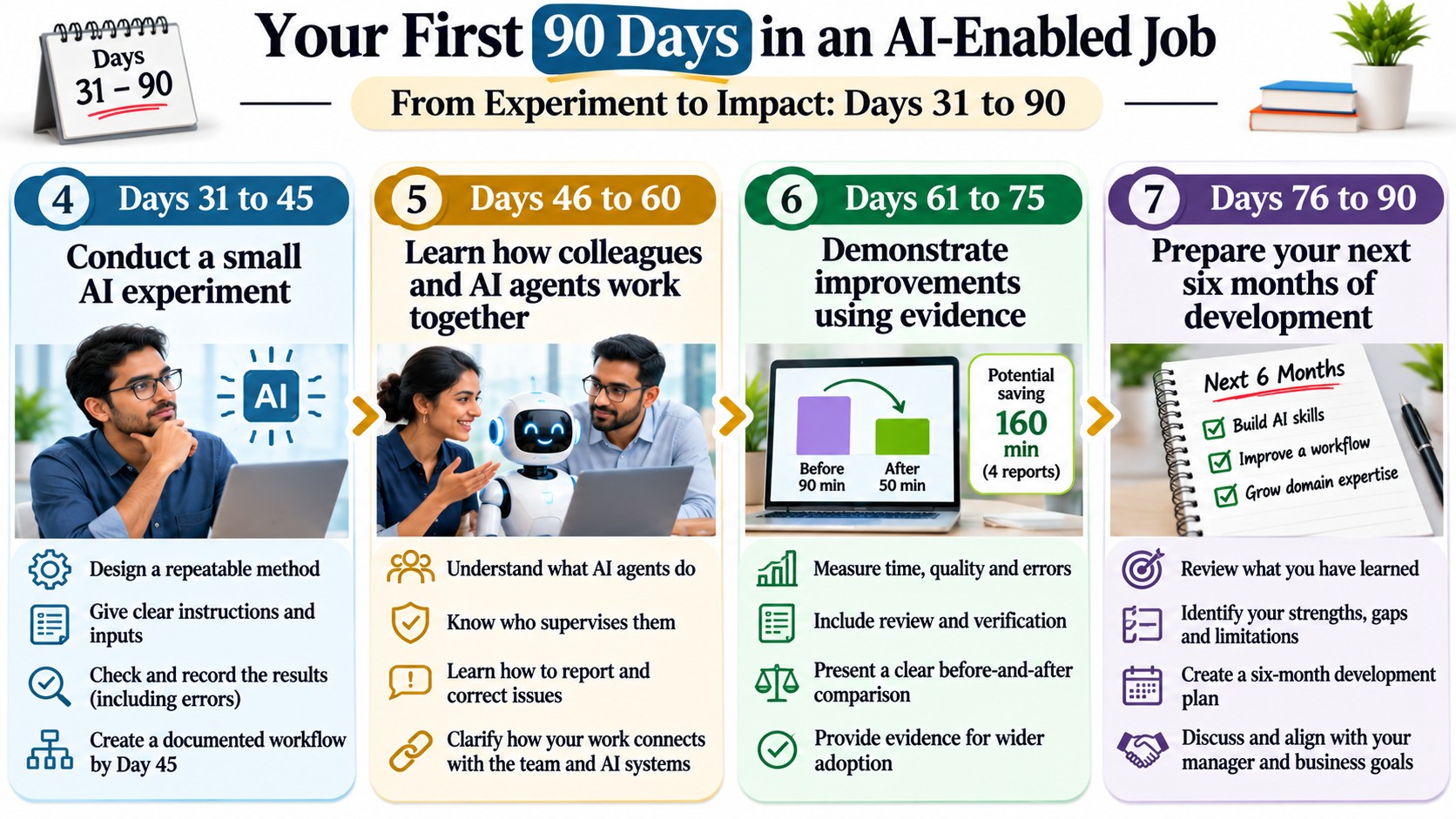
4. Days 31 to 45: Conduct a small AI experiment
Develop a repeatable method for completing the selected assignment with AI assistance. Specify the information required, prepare clear instructions for the system and identify the checks necessary before accepting its output. Use representative non-sensitive examples or authorised business information, following your organisation’s policies.
Record the results of several attempts, including errors, corrections and unexpected difficulties. An AI-generated sales summary, for example, might reduce preparation time while occasionally misinterpreting regional performance. By the forty-fifth day, aim to have a documented experimental workflow and sufficient initial evidence to assess whether it deserves further development.
5. Days 46 to 60: Learn how colleagues and AI agents work together
Some organisations are introducing AI agents that can assist with ongoing assignments or interact with several business applications. A new employee should understand which activities these agents perform, who supervises them and how unexpected results are handled. These arrangements can differ considerably between organisations and departments.
Ask experienced colleagues to explain the responsibilities associated with existing AI-assisted processes. Learn how to report incorrect outputs, request corrections and escalate unusual situations. Develop a clear understanding of where your responsibilities begin and how your work connects with the responsibilities of colleagues and automated systems.

6. Days 61 to 75: Demonstrate improvements using evidence
If your AI experiment has improved a business process, collect evidence concerning preparation time, output quality, error frequency and additional review requirements. Your manager will need reliable information to determine whether the proposed improvement deserves wider adoption. A convincing demonstration should account for the complete workflow, including verification.
Suppose a report previously required 90 minutes of preparation and an approved AI-assisted method reduces the total time to 50 minutes, including review. Across four comparable reports, the potential saving would be 160 minutes, provided that quality remains equivalent. Use this kind of straightforward measurement to prepare a concise before-and-after assessment based on your actual results.
7. Days 76 to 90: Prepare your next six months of development
Review what you have learned about the organisation, your responsibilities and its technological environment. Identify the activities you can now perform independently, those where AI provides meaningful assistance and the areas requiring further professional development. Include any limitations discovered during your experiment.
Prepare a concise six-month development plan and discuss it with your manager. Your objectives could include mastering approved departmental AI tools, improving another workflow or developing stronger expertise in data analysis and industry-specific applications. Connect each learning objective with the organisation’s actual business requirements.
Conclusion
The first 90 days in an AI-enabled job offer an opportunity to develop professional confidence while understanding how technology contributes to organisational performance. Employees who learn existing processes, respect information security, conduct manageable experiments and communicate measurable improvements can build a strong foundation for future responsibilities. By the end of the third month, aim to have earned the confidence of your colleagues, demonstrated a useful contribution and established a clear direction for continued learning.