China’s strategy is clear: Better and Cheaper intelligence
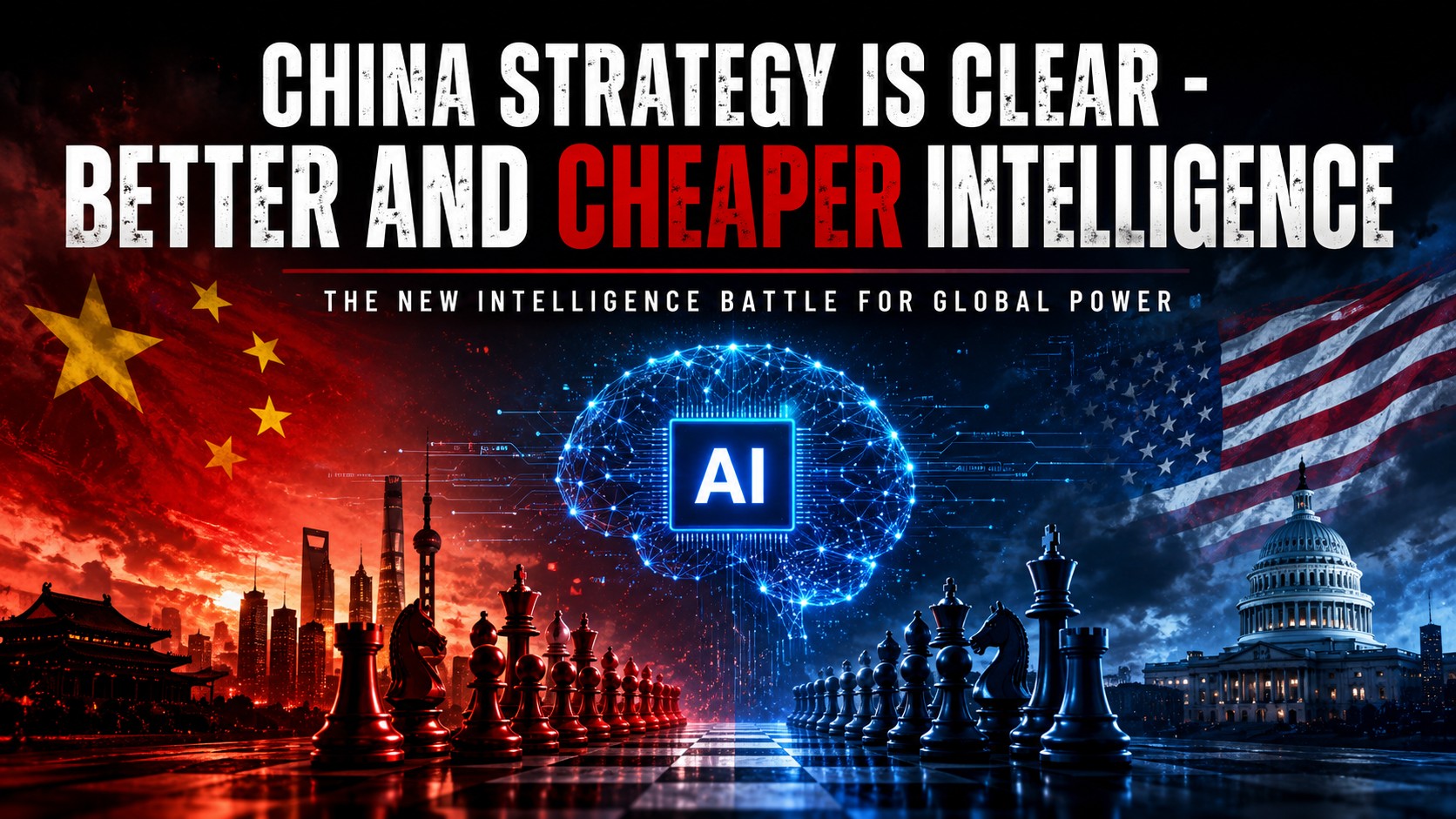
China’s strategy is clear: Better and Cheaper intelligence
The US may struggle to catch up here!
Introduction
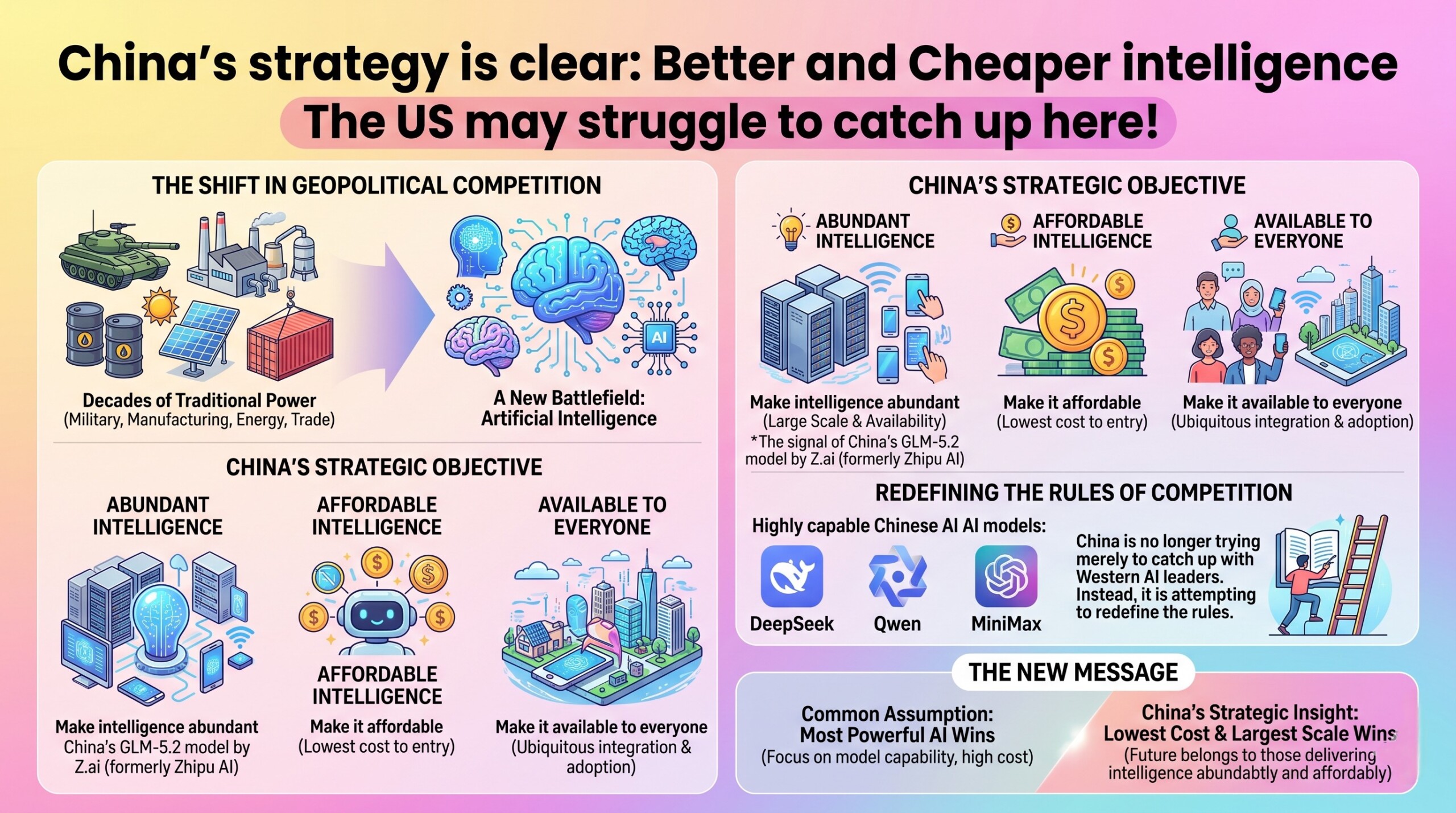
For decades, geopolitical competition was measured through military power, manufacturing capacity, energy resources, and trade influence. Today, a new battlefield has emerged: artificial intelligence.
The recent release of China’s GLM-5.2 model by Z.ai (formerly Zhipu AI) is not just another AI product launch. It is a signal of a much larger national strategy. China is increasingly pursuing a simple but powerful objective: make intelligence abundant, make it affordable, and make it available to everyone before competitors can do the same.
The emergence of highly capable Chinese AI models such as DeepSeek, Qwen, MiniMax, and now GLM-5.2 suggests that China is no longer trying merely to catch up with Western AI leaders. Instead, it is attempting to redefine the rules of competition.
The message is becoming clear: the future may not belong to the country with the most powerful AI model. It may belong to the country that delivers intelligence at the lowest cost and the largest scale.
Let’s dive deep into it now.
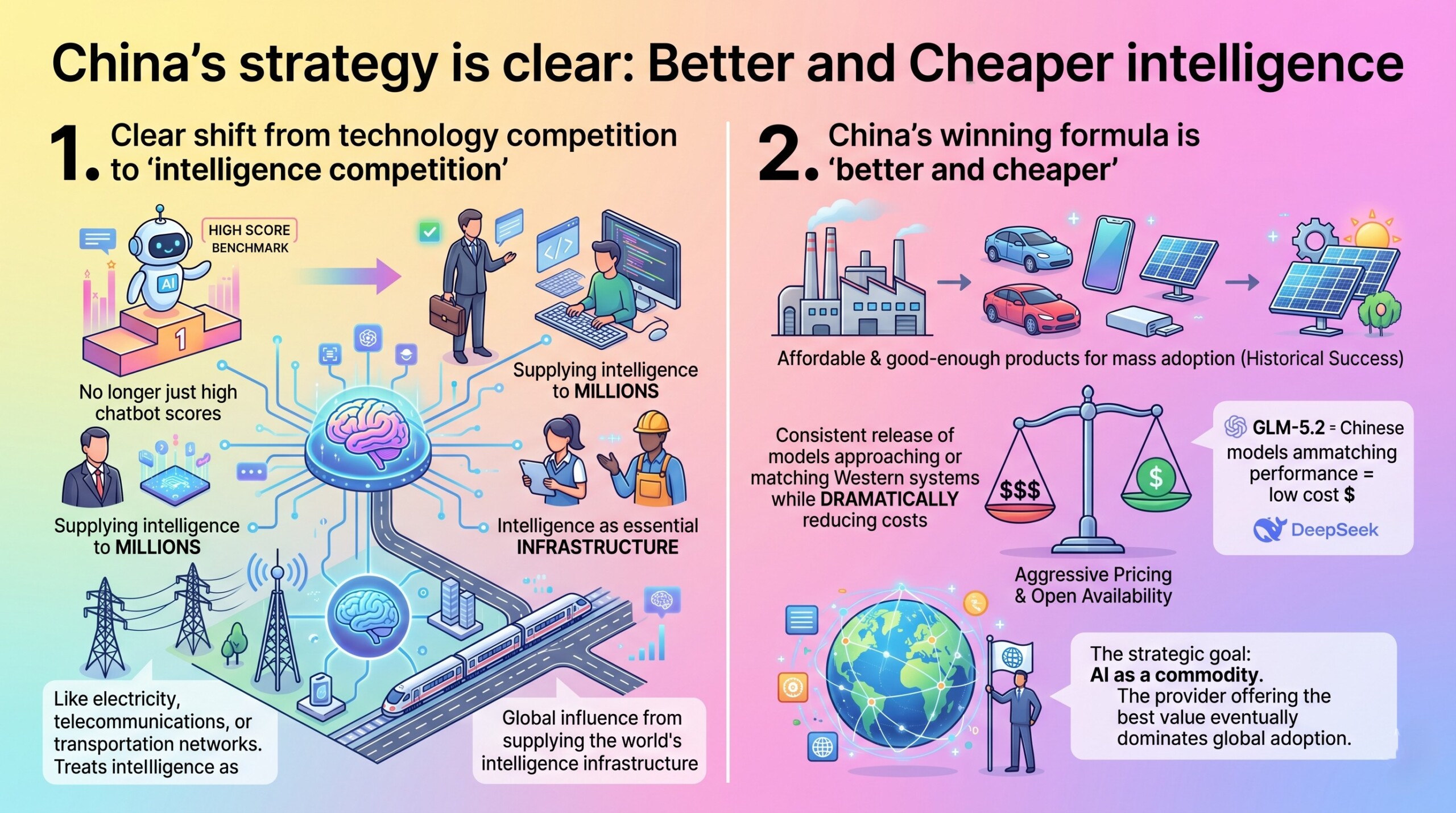
1. Clear shift from technology competition to ‘intelligence competition’
The AI race is no longer about who can build a chatbot with the highest benchmark score.
It is increasingly about who can supply intelligence to millions of businesses, developers, governments, students, and workers.
China appears to understand this transition. Rather than focusing solely on elite frontier models, Chinese firms are building systems that can be deployed widely and cheaply. Intelligence is being treated as infrastructure, much like electricity, telecommunications, or transportation networks.
The nation that supplies the world’s intelligence infrastructure may gain enormous economic and geopolitical influence. An excellent collection of learning videos awaits you on our Youtube channel.
2. China’s winning formula is ‘better and cheaper’
Historically, China transformed industries by making products both affordable and good enough for mass adoption.
The same formula is now being applied to AI.
Chinese AI companies are consistently releasing models that approach or match the performance of leading Western systems while dramatically reducing costs. GLM-5.2 follows the pattern established by DeepSeek and other Chinese models: strong performance, open availability, and aggressive pricing.
The strategic goal appears obvious. If AI becomes a commodity, the provider offering the best value will eventually dominate global adoption.
3. Open models are China’s soft power weapon
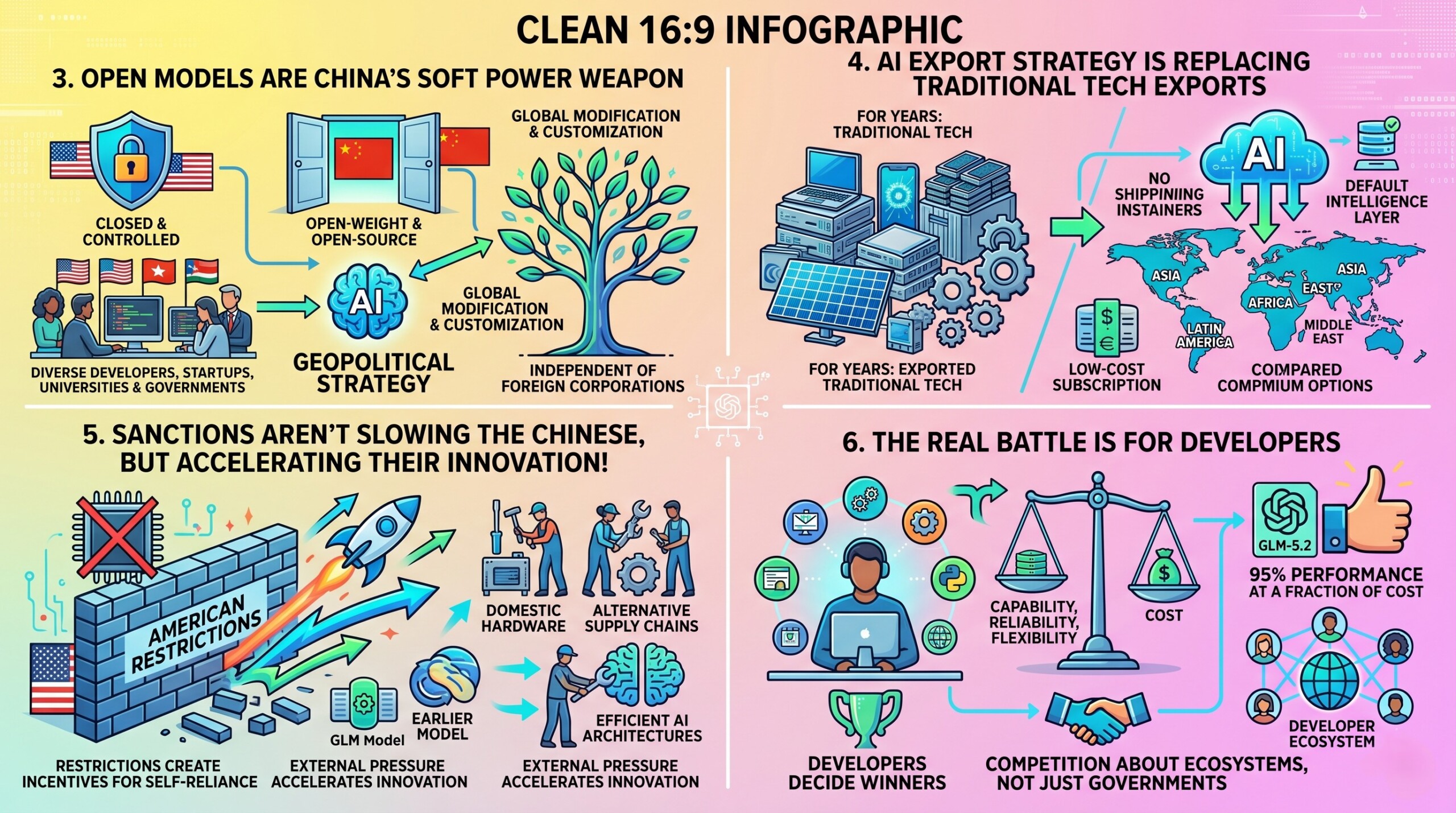
Many leading American AI systems remain closed and controlled.
China is increasingly moving in the opposite direction.
Open-weight and open-source models allow developers, startups, universities, and governments around the world to modify, deploy, and customize AI without depending on foreign corporations. GLM-5.2’s open approach reflects this broader trend.
This is not merely a technical choice.
It is a geopolitical strategy.
Every developer who builds on a Chinese model strengthens China’s position within the emerging global AI ecosystem. A constantly updated Whatsapp channel awaits your participation.

4. AI export strategy is replacing traditional tech exports
For years, China exported electronics, solar panels, telecom equipment, and manufacturing systems.
Now it is beginning to export intelligence itself. An AI model can be downloaded instantly and deployed anywhere in the world. There are no shipping containers, ports, or supply chains required.
Countries that cannot afford premium Western AI subscriptions may increasingly adopt lower-cost Chinese alternatives. As these models spread, they could become the default intelligence layer across large parts of Asia, Africa, Latin America, and the Middle East.
The strategic implications are enormous.
5. Sanctions aren’t slowing the Chinese, but accelerating their innovation!
Many observers expected American restrictions on advanced chips and technology exports to slow China’s AI progress.
Instead, those restrictions may be creating stronger incentives for self-reliance.
Chinese firms have invested heavily in domestic hardware, alternative supply chains, and more efficient AI architectures. Earlier GLM models were developed with significant use of domestic computing resources and local ecosystems.
History often shows that external pressure can accelerate domestic innovation. The AI race may be becoming another example. Excellent individualised mentoring programmes available.
6. The real battle is for developers
Developers ultimately decide which platforms win.
When developers choose an AI model, they care about capability, reliability, flexibility, and cost.
If a Chinese model delivers 95 percent of the performance at a fraction of the cost, many developers will choose the cheaper option.
Recent reactions from technology leaders and engineers suggest that models like GLM-5.2 are gaining serious attention beyond China.
This is why the competition is becoming less about governments and more about developer ecosystems.
7. Intelligence is becoming a strategic resource
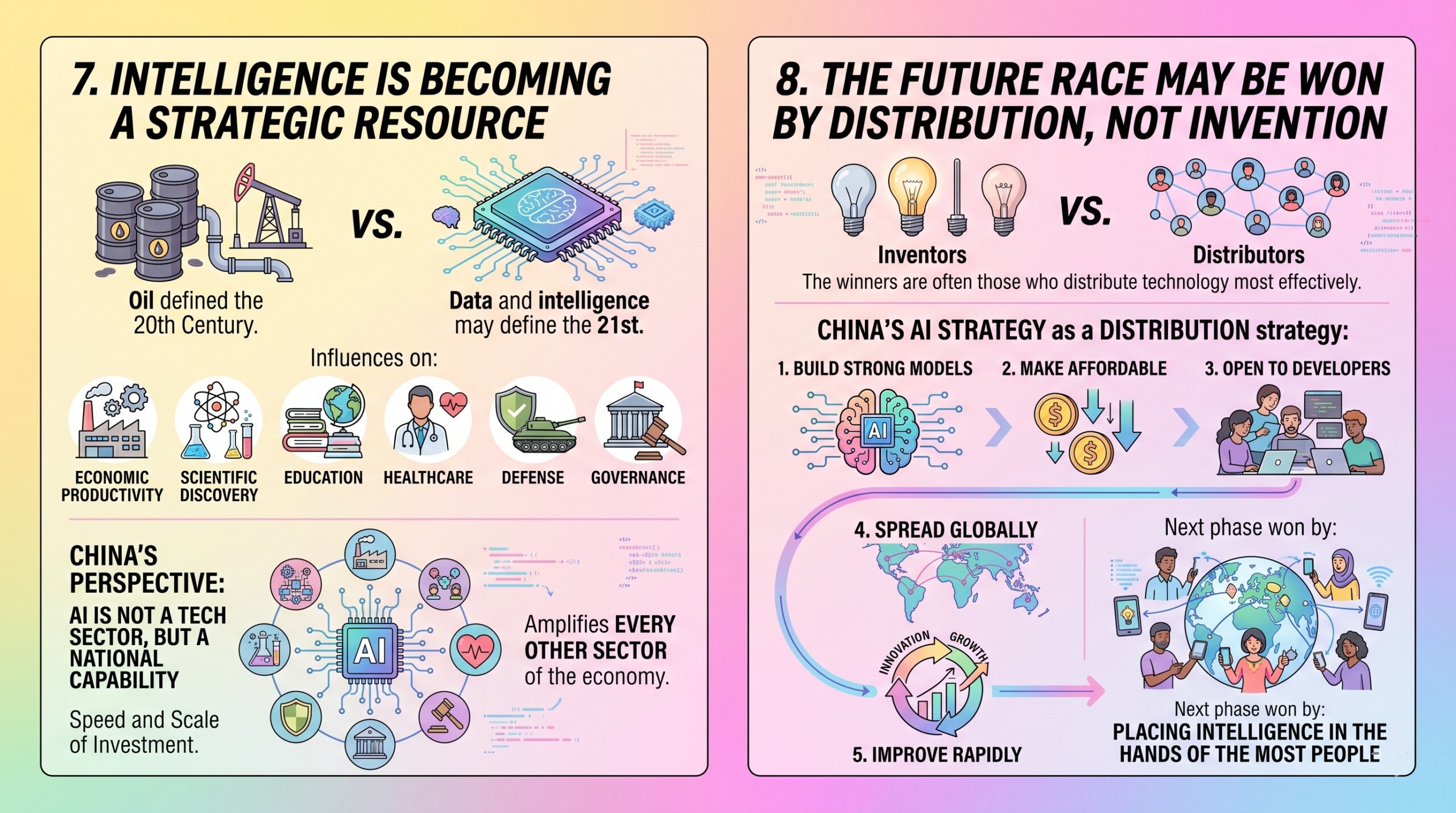
Oil defined the twentieth century. Data and intelligence may define the twenty-first.
Countries that control the production and distribution of intelligence will influence economic productivity, scientific discovery, education, healthcare, defense, and governance.
China increasingly appears to view AI not as a technology sector but as a national capability that can amplify every other sector of the economy.
That perspective may explain the speed and scale of Chinese AI investment. Subscribe to our free AI newsletter now.
8. The future race may be won by distribution, not invention
The history of technology teaches an important lesson.
Inventors do not always become dominant players. The winners are often those who distribute technology most effectively.
China’s AI strategy increasingly resembles a distribution strategy. Build strong models. Make them affordable. Open them to developers. Spread them globally. Improve them rapidly.
If this approach succeeds, the next phase of the AI race may not be determined by who invented the smartest model.
It may be determined by who placed intelligence in the hands of the most people.
Conclusion
GLM-5.2 is more than a new AI model. It is another piece of evidence that China has embraced a distinct strategy in the global AI contest.
While much of the West focuses on building the most powerful intelligence, China appears focused on building the most accessible intelligence. The distinction matters.
The coming decade may reveal that AI leadership is not measured solely by benchmark scores or scientific breakthroughs. It may be measured by adoption, affordability, and global reach.
China’s message to the world is becoming increasingly clear:
If intelligence becomes the most important resource of the twenty-first century, China intends to make it better, cheaper, and available everywhere. Upgrade your AI-readiness with our masterclass.
Share this with the world
Related Articles