Satya Nadella finds Enterprise life beyond the Frontier

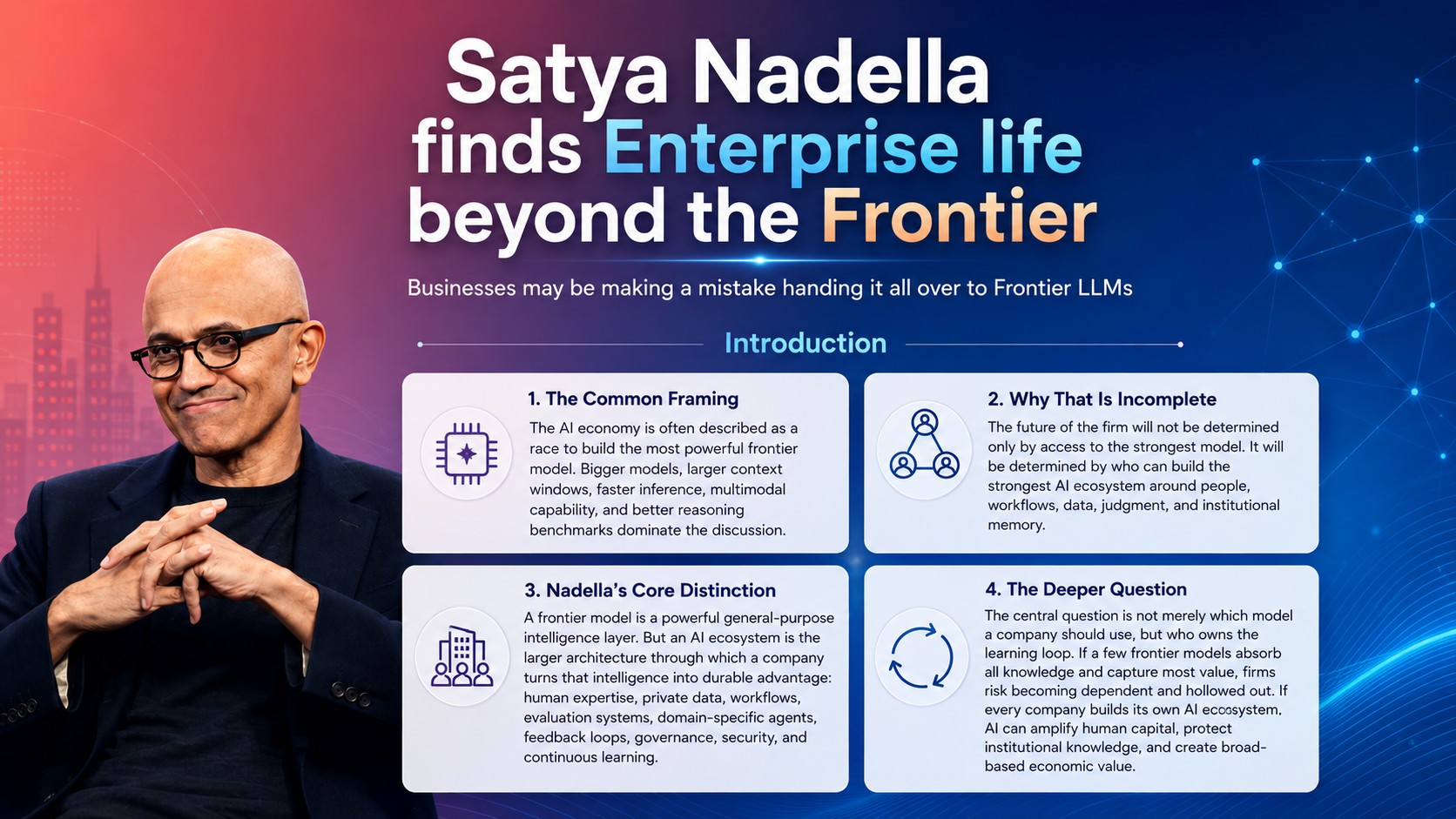
Satya Nadella finds Enterprise life beyond the Frontier
Businesses may be making a mistake handing it all over to Frontier LLMs
Introduction
The AI economy is often described as a race to build the most powerful frontier model. Bigger models, larger context windows, faster inference, multimodal capability, and better reasoning benchmarks dominate the discussion. But this framing is incomplete. The future of the firm will not be determined only by who has access to the strongest model. It will be determined by who can build the strongest AI ecosystem around people, workflows, data, judgment, and institutional memory.
Satya Nadella, the boss of Microsoft, in a recent essay explained the problem. A frontier model is a powerful general-purpose intelligence layer. But an AI ecosystem is the larger architecture through which a company turns that intelligence into durable advantage. It includes human expertise, private data, workflows, evaluation systems, domain-specific agents, feedback loops, governance, security, and continuous learning. A model may answer questions. An ecosystem learns how a firm thinks, acts, improves, and competes.
The central question, therefore, is not merely “Which model should a company use?” The deeper question is: “Who owns the learning loop?” If a few frontier models absorb all knowledge and capture most value, firms risk becoming dependent, replaceable, and intellectually hollowed out. But if every company builds its own AI ecosystem, then AI can amplify human capital, protect institutional knowledge, and create broad-based economic value.
Let’s dive deep into it now.
1. Frontier models are powerful, but they are not complete business systems
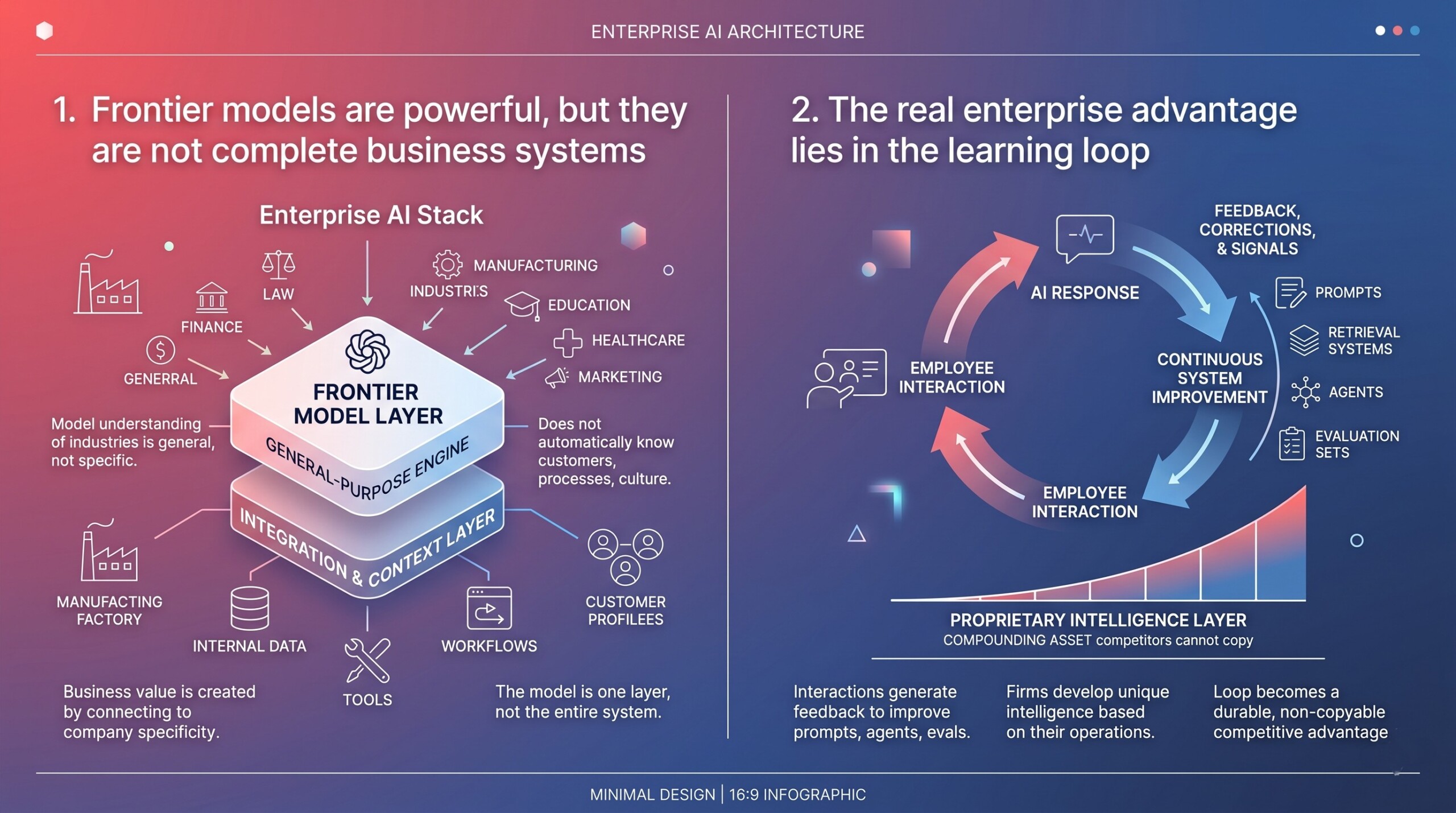
Frontier models are general-purpose engines. They are trained across vast bodies of text, code, images, audio, and other data. This gives them impressive breadth, but not automatic business specificity.
- A frontier model may understand finance, law, manufacturing, education, healthcare, or marketing in general terms.
- It does not automatically understand a particular company’s customers, internal processes, risk appetite, culture, or historical decisions.
- Business value comes when the model is connected to enterprise context, tools, data, and workflows.
- Therefore, the model is only one layer of the enterprise AI stack, not the whole system.
2. The real enterprise advantage lies in the learning loop
The strongest firms will not be those that merely consume AI outputs. They will be those that use AI interactions to continuously improve their systems.
- Every employee interaction with AI can generate feedback, corrections, examples, preferences, and process signals.
- These signals can improve prompts, retrieval systems, agents, evaluation sets, and workflow automation.
- Over time, the firm develops a proprietary intelligence layer based on its own operations.
- This learning loop becomes a compounding asset that competitors cannot easily copy. An excellent collection of learning videos awaits you on our Youtube channel.
3. Human capital and token capital must grow together
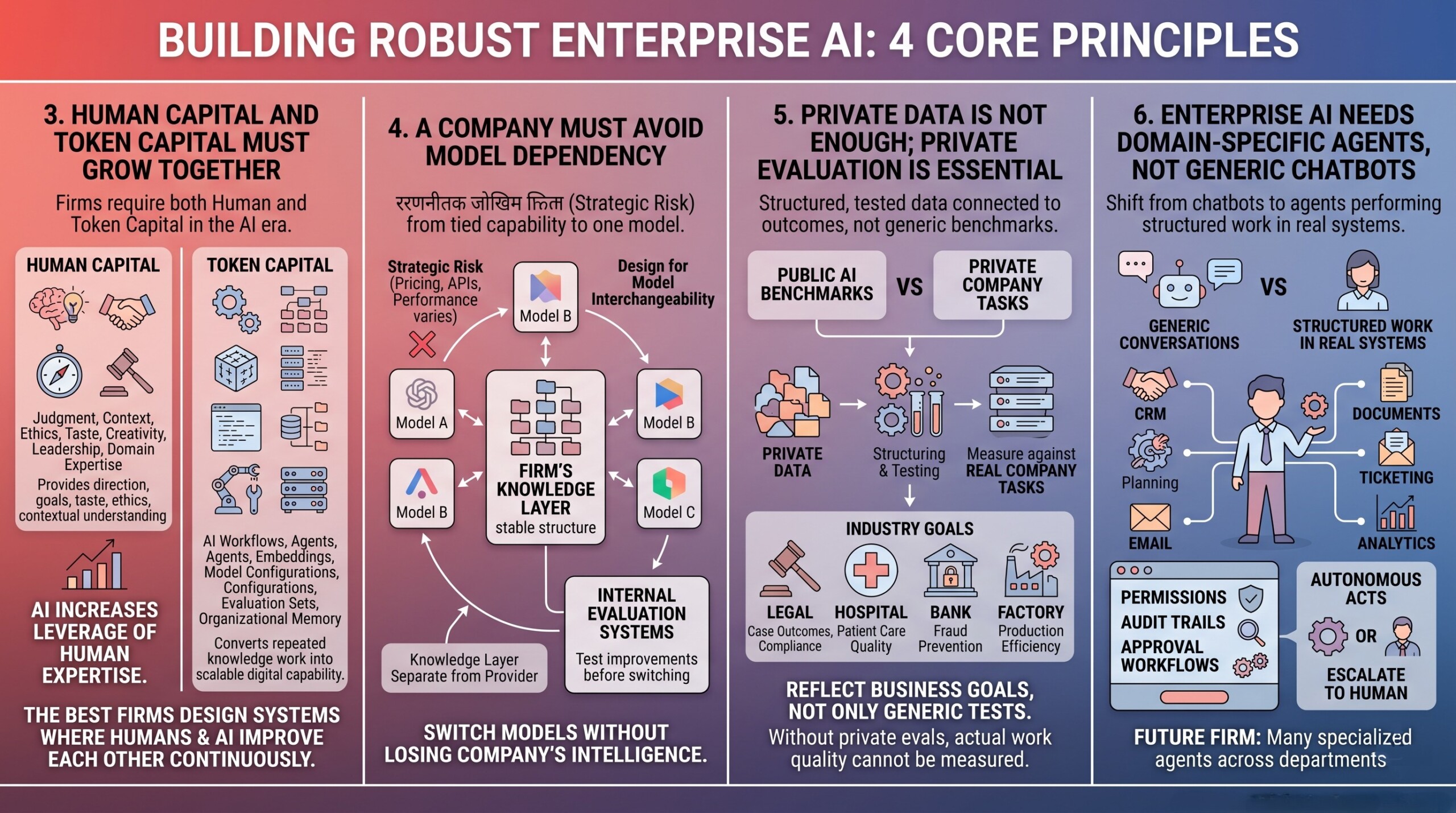
In the AI era, firms will need two forms of capital: human capital and token capital. Human capital includes judgment, relationships, creativity, leadership, and domain expertise. Token capital includes AI workflows, agents, embeddings, model configurations, evaluation sets, and organizational memory.
- Human capital provides direction, goals, taste, ethics, and contextual understanding.
- Token capital converts repeated knowledge work into scalable digital capability.
- AI does not reduce the value of human expertise; it increases the leverage of that expertise.
- The best firms will design systems where humans and AI improve each other continuously.

4. A company must avoid model dependency
If a firm’s entire AI capability is tied to one external model, it creates strategic risk. Models change, pricing changes, APIs change, policies change, and performance may vary across tasks.
- Companies should design AI systems with model interchangeability.
- The firm’s knowledge layer should be separate from the model provider.
- Internal evaluation systems should test whether a new model improves or weakens business outcomes.
- The goal is to switch models without losing the company’s accumulated intelligence. A constantly updated Whatsapp channel awaits your participation.
5. Private data is not enough; private evaluation is essential
Many firms assume that having private data is the main advantage. But private data alone does not create intelligence. It must be structured, tested, and connected to outcomes.
- Private evaluations measure AI performance against real company tasks.
- These evaluations should reflect business goals, not only public AI benchmarks.
- A legal firm, hospital, school, bank, or factory needs different success criteria.
- Without private evals, companies cannot know whether AI is actually improving work quality.
6. Enterprise AI needs domain-specific agents, not generic chatbots
A chatbot is useful, but it is not enough. Enterprise AI must move toward agents that can perform structured work inside real systems.
- Agents should connect to enterprise tools such as CRM, ERP, email, documents, ticketing systems, and analytics dashboards.
- They should operate within permissions, audit trails, and approval workflows.
- They should know when to act autonomously and when to escalate to a human.
- The future firm will contain many specialized agents working across departments. Excellent individualised mentoring programmes available.
7. Institutional memory must become queryable and usable
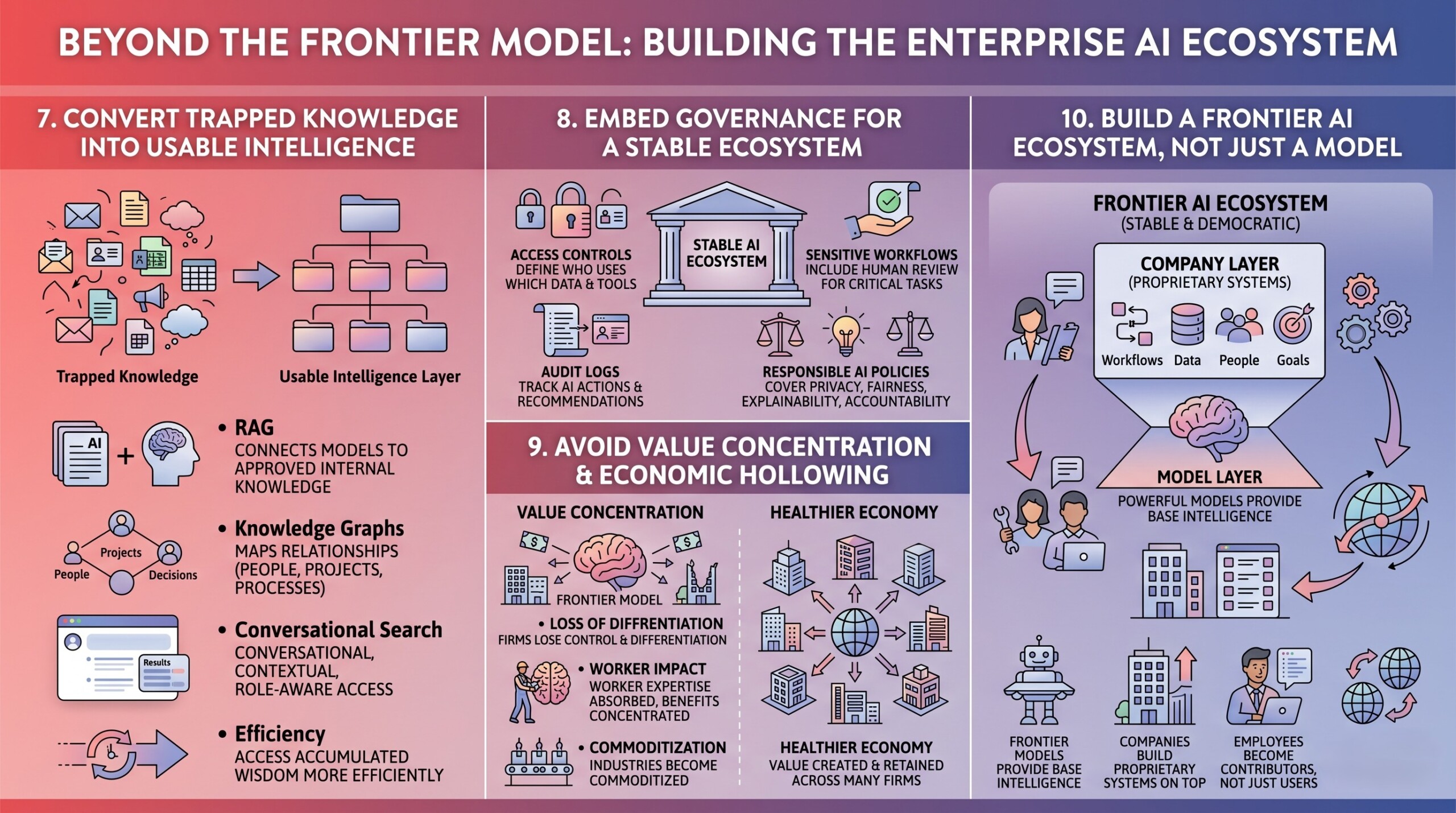
Most firms lose knowledge because it remains trapped in emails, meetings, documents, spreadsheets, and employee experience. AI ecosystems can convert this scattered memory into a usable intelligence layer.
- Retrieval-augmented generation can connect models to approved internal knowledge.
- Knowledge graphs can represent relationships between people, projects, clients, decisions, and processes.
- Search can become conversational, contextual, and role-aware.
- This allows employees to access the firm’s accumulated wisdom more efficiently.
8. Governance is central to a stable AI ecosystem
An AI ecosystem without governance can become risky, biased, insecure, or legally dangerous. Governance must be built into the architecture, not added later as an afterthought.
- Access controls must define who can use which data and tools.
- Audit logs must track what AI systems did, recommended, or changed.
- Sensitive workflows must include human review and approval.
- Responsible AI policies must cover privacy, fairness, explainability, and accountability. Subscribe to our free AI newsletter now.
9. The economic danger is value concentration
If only a few frontier models capture most of the value, entire industries may become dependent on external intelligence providers. This could create a new form of economic hollowing out.
- Firms may lose control over their knowledge and differentiation.
- Workers may see their expertise absorbed without receiving proportional benefit.
- Industries may become commoditized by systems trained on their own accumulated knowledge.
- A healthier economy requires value to be created and retained across many firms and sectors.
10. The stable future is a frontier ecosystem, not only a frontier model
A frontier ecosystem means powerful models plus broad participation, ownership, customization, and value creation across the economy. It is a more stable and democratic AI architecture.
- Frontier models provide the base intelligence layer.
- Companies build proprietary systems on top using their workflows, data, people, and goals.
- Employees become contributors to the firm’s AI capability, not merely users of external tools.
- Value flows across companies, industries, and countries instead of concentrating in a few platforms. Upgrade your AI-readiness with our masterclass.
Conclusion
The debate between frontier models and AI ecosystems is really a debate about ownership, learning, and economic power. Frontier models will be essential, but they cannot be the entire future of enterprise intelligence. If firms merely rent intelligence from external models, they risk losing control over their expertise, workflows, and differentiation. Satya Nadella has issued the timely warning!
The more durable path is to build AI ecosystems where human capital and token capital compound together. In such a system, employees teach the AI, the AI improves workflows, workflows generate better signals, and those signals strengthen the organization’s intelligence over time. This creates a new form of enterprise IP: the owned learning loop.
The companies that understand this early will not simply use AI. They will become learning machines. They will preserve human agency, protect institutional knowledge, and build AI systems that reflect their own purpose, culture, and strategy. That is the stable equilibrium the AI economy needs: not a world ruled by a few frontier models, but a world of thriving AI ecosystems.
Share this with the world
Related Articles