What happens when AI writes as well as humans
What happens when AI writes as well as humans
Introduction
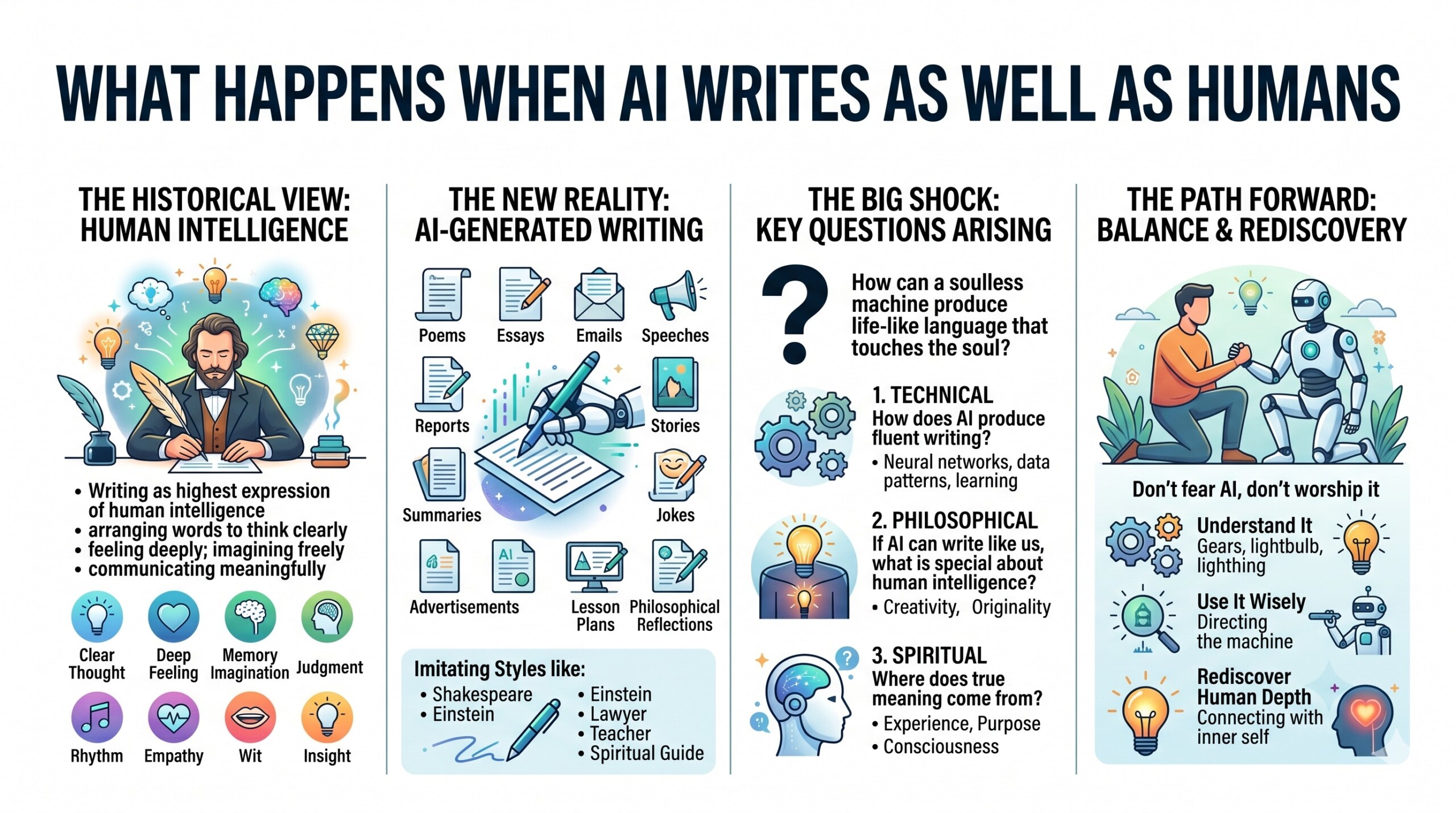
For centuries, writing was considered one of the highest expressions of human intelligence. To write well was not merely to arrange words. It was to think clearly, feel deeply, remember widely, imagine freely, and communicate meaningfully. A good writer seemed to possess something mysterious: judgment, rhythm, empathy, wit, memory, and insight.
Then came artificial intelligence.
Suddenly, a machine could write poems, essays, emails, speeches, reports, stories, summaries, jokes, advertisements, lesson plans, and even philosophical reflections. It could imitate Shakespeare, simplify Einstein, sound like a lawyer, behave like a teacher, and write motivational prose like a spiritual guide. This shocked many people. How can something without a soul write words that touch the soul? How can something without life produce language that feels alive?
This question is not only technical, but also philosophical and spiritual. The technical question is: How does AI produce such fluent writing? The philosophical question is: If AI can write like us, what is special about human intelligence? The spiritual question is: If machines can imitate expression, where does true meaning come from?
The answer is not to fear AI, nor to worship it. The answer is to understand it, use it wisely, and rediscover what is deepest in being human. An excellent collection of learning videos awaits you on our Youtube channel.
Let’s dive deep into it now.
1. AI writes well because it has learned the patterns of human language
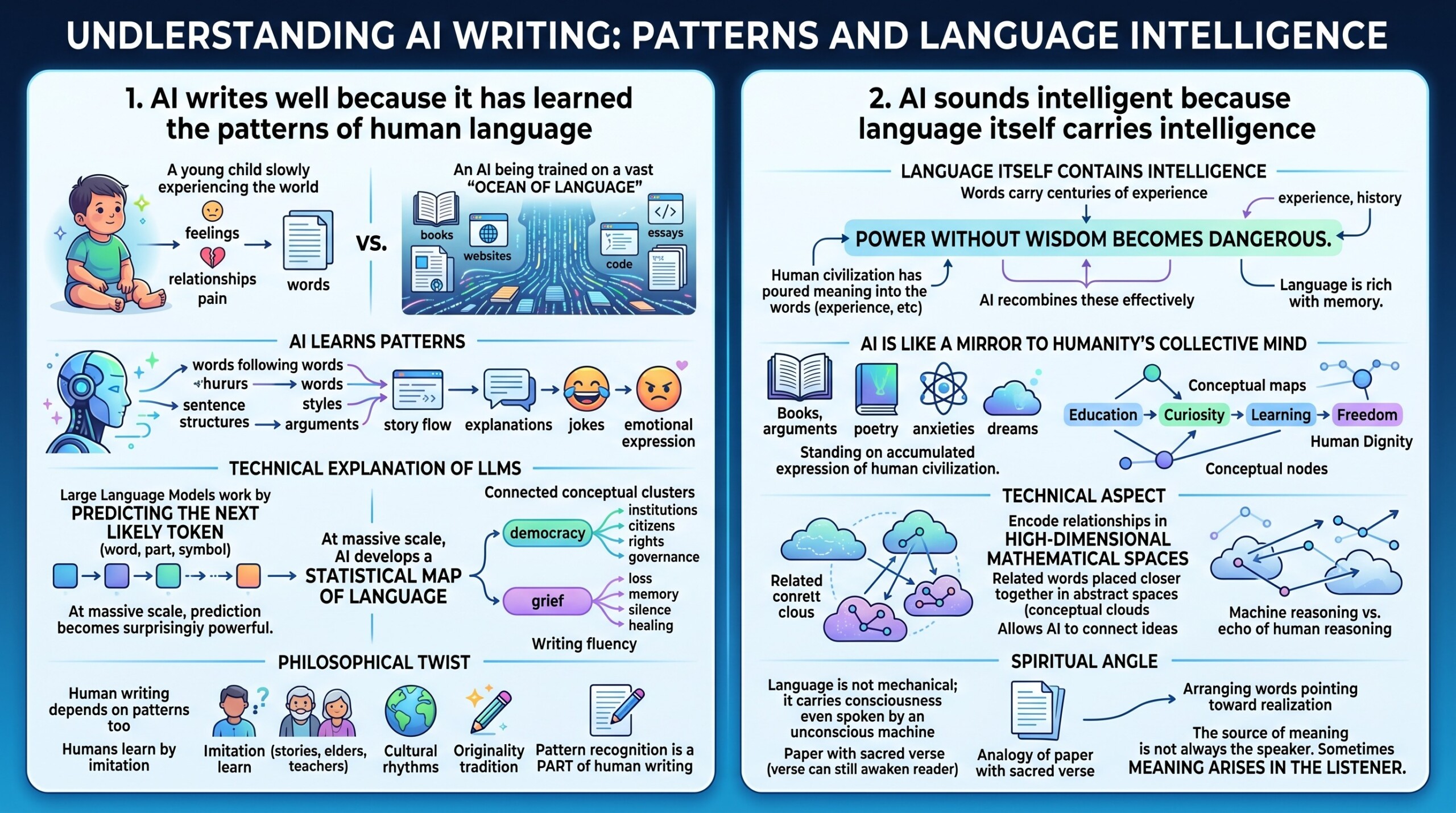
AI does not write like a human child who slowly experiences the world, feels pain, builds relationships, and then finds words. AI learns differently. It is trained on enormous amounts of text: books, articles, websites, discussions, code, essays, and many other forms of human expression.
From this ocean of language, AI learns patterns.
It learns that certain words often follow other words. It learns sentence structures. It learns styles. It learns how arguments are built, how stories flow, how explanations are framed, how jokes are structured, and how emotions are expressed in language.
Technically, large language models work by predicting the next likely token, where a token may be a word, part of a word, or a symbol. But this simple description can be misleading. At a massive scale, prediction becomes surprisingly powerful. By learning patterns across billions or trillions of examples, AI develops a statistical map of language.
It does not merely memorize sentences, but tries to learn relationships. It learns that “democracy” is related to voting, institutions, citizens, rights, and governance. It learns that “grief” is related to loss, memory, silence, and healing. It learns that a scientific explanation needs structure, that a legal answer needs caution, and that a classroom explanation needs examples.
This is why AI can write fluently. It has absorbed the visible architecture of human communication.
But here lies the philosophical twist: much of what we call “good writing” also depends on patterns. Human writers too learn by imitation. We read stories, listen to elders, observe teachers, absorb cultural rhythms, and slowly internalize language. We become original only after absorbing tradition.
So AI forces us to admit something humbling: a part of human writing is pattern recognition. But only a part.
2. AI sounds intelligent because language itself carries intelligence
When AI writes, it appears intelligent partly because human language already contains intelligence. Words are not empty containers. They carry centuries of human experience.
Take a sentence like: “Power without wisdom becomes dangerous.”
This sentence sounds thoughtful because human civilization has already poured meaning into the words “power,” “wisdom,” and “dangerous.” AI can recombine such words effectively because the language it has learned is already rich with human memory.
In this sense, AI is like a mirror held up to humanity’s collective mind. It reflects our books, our arguments, our poetry, our science, our anxieties, and our dreams. It writes well because we have written so much before it.
This is important. AI is not creating language from nothing. It is standing on the accumulated expression of human civilization.
Technically, AI models encode relationships between words and concepts in high-dimensional mathematical spaces. Words with related meanings are placed closer together in these abstract spaces. This allows AI to connect ideas. It can move from “education” to “curiosity,” from “curiosity” to “learning,” from “learning” to “freedom,” and from “freedom” to “human dignity.”
To a student, this may look like thinking. In one sense, it is a kind of machine reasoning. In another sense, it is the echo of human reasoning.
Spiritually, we may say: language is not merely mechanical. Language carries consciousness, even when spoken by an unconscious machine. A sacred verse printed on paper does not make the paper enlightened, but the verse can still awaken something in the reader. Similarly, AI may not possess inner realization, but it can arrange words that point toward realization.
The source of meaning is not always the speaker. Sometimes meaning arises in the listener. A constantly updated Whatsapp channel awaits your participation.
3. AI writes well because it can imitate many human voices
A human being usually has one natural style. A good writer may develop several styles, but even then there are limits. AI, however, can imitate many voices quickly.
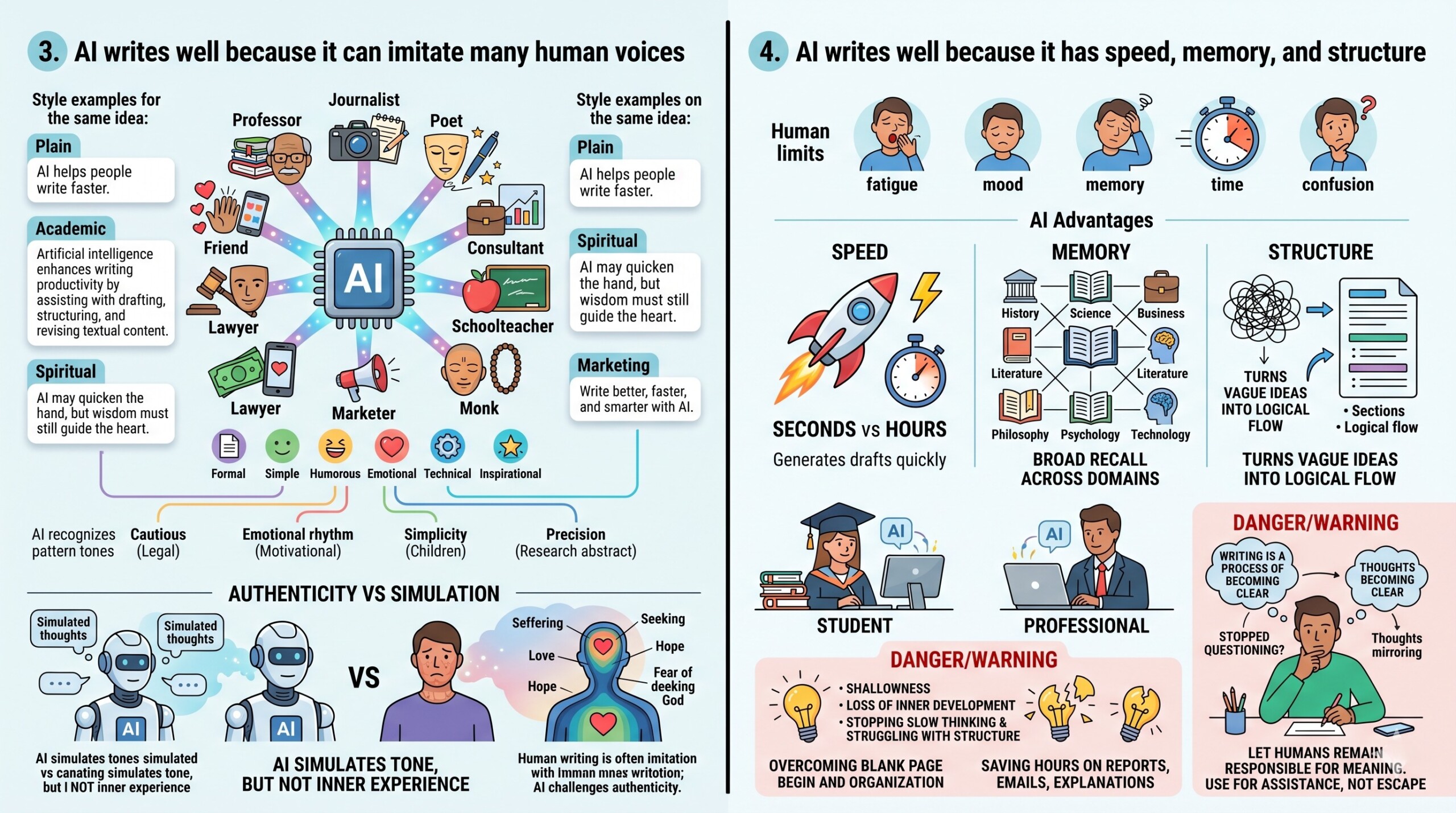
It can write like a professor, a journalist, a poet, a consultant, a schoolteacher, a monk, a marketer, a lawyer, or a friend. It can make the same idea formal, simple, humorous, emotional, technical, or inspirational.
This is one of AI’s greatest writing powers: style transfer.
For example, the same idea can be written in many ways:
Plain style:
“AI helps people write faster.”
Academic style:
“Artificial intelligence enhances writing productivity by assisting with drafting, structuring, and revising textual content.”
Spiritual style:
“AI may quicken the hand, but wisdom must still guide the heart.”
Marketing style:
“Write better, faster, and smarter with AI.”
The idea is similar, but the voice changes.
Technically, this happens because AI has learned different patterns of tone, vocabulary, sentence length, structure, and rhetorical style. It can recognize that a legal document uses cautious language, while a motivational speech uses emotional rhythm. It knows that a children’s explanation requires simplicity, while a research abstract requires precision.
Philosophically, this raises a deep question: if voice can be imitated, what is authenticity?
If AI can write “like” a compassionate person, does that mean it is compassionate? No. It means it can simulate the language of compassion. There is a difference between the appearance of compassion and the experience of compassion.
This distinction matters. A human writer suffers, loves, loses, hopes, fails, prays, and grows. AI does not. AI can describe heartbreak, but it has never had a heart broken. It can write about death, but it has never feared death. It can write about God, but it does not seek God.
So AI can imitate voice, but not inner life.
This is where human beings must become more honest. Much human writing is also imitation. We imitate fashionable opinions, popular phrases, borrowed emotions, and second-hand wisdom. AI challenges us to become more authentic than our own clichés.
4. AI writes well because it has speed, memory, and structure
Human writing is often limited by fatigue, mood, memory, time, and confusion. AI does not get tired in the human sense. It can generate a draft in seconds. It can produce outlines, rewrite paragraphs, summarize long documents, suggest titles, generate examples, and organize messy thoughts.
This gives AI three practical advantages.
First, AI has speed. It can produce a first draft much faster than most people.
Second, AI has broad recall. It can draw from many domains: history, science, business, literature, psychology, technology, and philosophy.
Third, AI is good at structure. It can turn a vague idea into sections, points, headings, and logical flow.
For students, this is extremely useful. Many students do not struggle because they have no ideas. They struggle because they do not know how to organize ideas. AI can help them begin. It can reduce the fear of the blank page.
For professionals, AI can save hours. It can prepare reports, summarize meetings, draft emails, convert bullet points into essays, and turn technical ideas into accessible explanations.
But this power has a danger. Speed can create shallowness. Because AI writes quickly, we may stop thinking slowly. Because AI gives structure, we may stop struggling with structure ourselves. Because AI provides answers, we may stop developing questions.
Writing is not only a product. Writing is also a process of becoming clear. When we write, we discover what we think. We meet our confusion. We refine our judgment. We encounter our own contradictions. If AI does all the writing, we may get polished output but lose inner development.
Spiritually, this is important. The blank page is not an enemy. It is a mirror. Silence before writing is not wasted time. It is the space where thought matures.
So we should use AI for assistance, but not for escape. Let AI help with drafting. But let humans remain responsible for meaning. Excellent individualised mentoring programmes available.
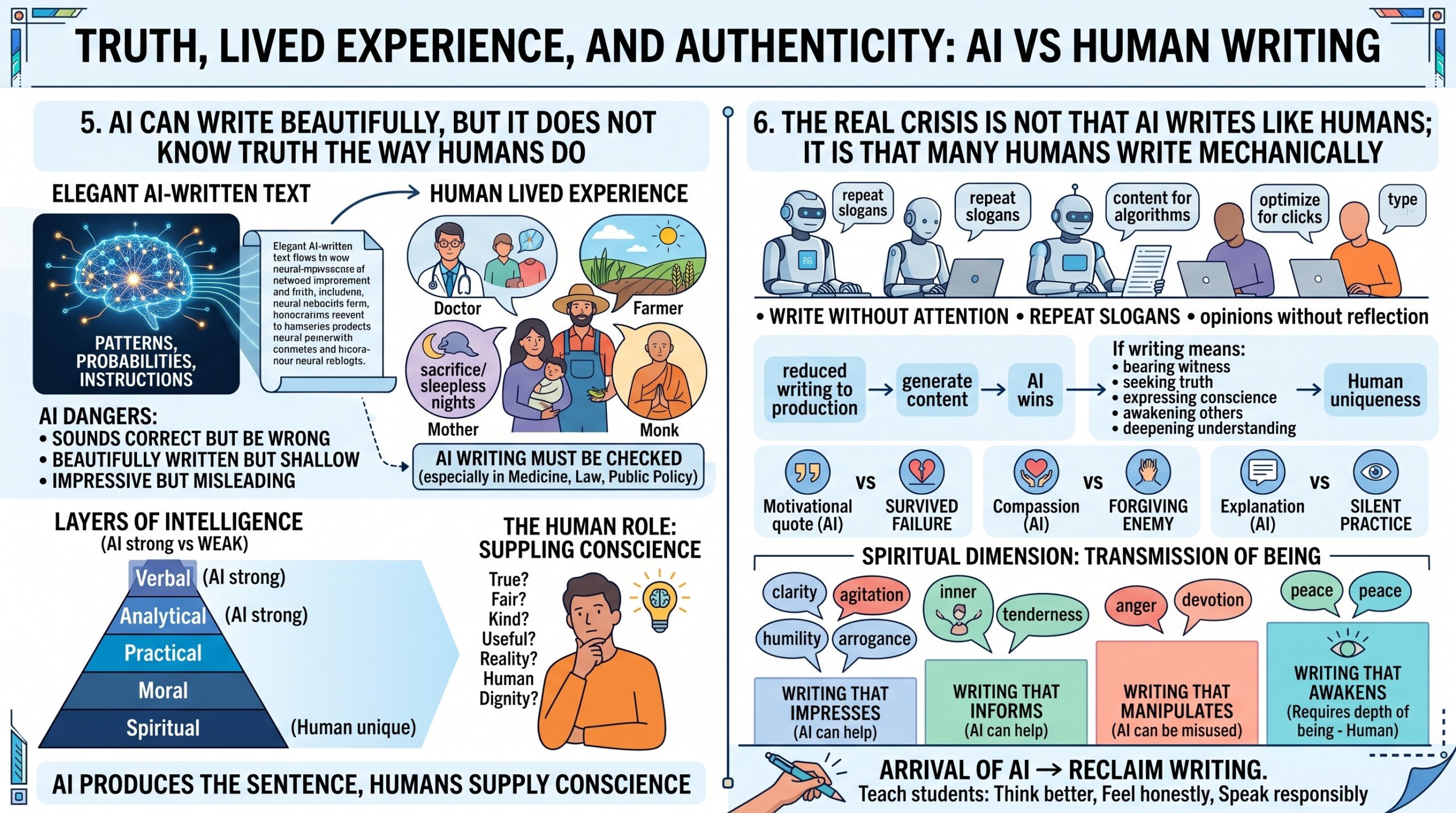
5. AI can write beautifully, but it does not know truth the way humans do
AI can produce confident, elegant, and persuasive writing. But fluency is not the same as truth.
This is one of the greatest dangers of AI writing. A sentence may sound correct and still be wrong. A paragraph may be beautifully written and still be shallow. An argument may be impressive and still be misleading.
AI does not know truth through lived contact with reality. It does not test truth through conscience, suffering, responsibility, or direct experience. It generates responses based on patterns, probabilities, instructions, and available information.
A human doctor who writes about illness has seen patients. A farmer who writes about rain has waited under a difficult sky. A mother who writes about sacrifice has lived sleepless nights. A monk who writes about silence has practiced silence. AI can write about all these things, but it has not lived them.
This does not make AI useless. It makes AI incomplete.
Technically, AI can make errors because it may generalize incorrectly, rely on outdated information, misunderstand context, or produce hallucinations. It may give an answer that sounds plausible but lacks grounding. This is why AI writing must be checked, especially in education, medicine, law, finance, science, and public policy.
Philosophically, AI reminds us that intelligence has layers. There is verbal intelligence: the ability to say things well. There is analytical intelligence: the ability to reason. There is practical intelligence: the ability to act wisely in real situations. There is moral intelligence: the ability to choose rightly.
And there is spiritual intelligence: the ability to see the unity, dignity, and sacredness of life. AI is strong in verbal and analytical assistance. It is weaker in lived, moral, and spiritual understanding.
Therefore, the human role becomes even more important. We must ask:
Is this true?
Is this fair?
Is this kind?
Is this useful?
Is this rooted in reality?
Is this aligned with human dignity?
AI can produce the sentence. But human beings must supply the conscience.

6. The real crisis is not that AI writes like humans; it is that many humans write mechanically
Many people fear that AI is becoming human-like. But perhaps the deeper problem is that many humans have become machine-like.
We write without attention. We repeat slogans. We forward opinions without reflection. We use ready-made phrases. We create content for algorithms. We optimize for clicks. We speak before we listen. We produce words without presence.
In such a world, AI naturally competes with us because we have reduced writing to production. If writing means only “generate content,” AI will often win. But if writing means bearing witness to life, seeking truth, expressing conscience, awakening others, and deepening understanding, then human writing still has a unique place.
AI can write a motivational quote. But a human being who has survived failure can write with a different authority. AI can write about compassion. But a human being who forgives an enemy knows something beyond words.
AI can explain meditation. But a human being who has sat in silence for years carries the fragrance of practice.
This is where the spiritual dimension enters. True writing is not merely information transfer. It is transmission of being. Something of the writer’s inner state enters the writing: clarity, agitation, humility, arrogance, tenderness, anger, devotion, or peace.
Students must learn this difference.
There is writing that impresses.
There is writing that informs.
There is writing that manipulates.
There is writing that awakens.
AI can help with the first two. It can be misused for the third. But the fourth still requires depth of being.
Therefore, the arrival of AI should not make us abandon writing. It should make us reclaim writing.
We must teach students not only how to write faster, but how to think better, feel more honestly, and speak more responsibly. Subscribe to our free AI newsletter now.
7. What should we do about it? Use AI as an instrument, not as a replacement for the self
The practical response to AI writing is not rejection. It is disciplined partnership.
We should not tell students, “Never use AI.” That would be unrealistic. We should also not tell them, “Let AI do everything.” That would be dangerous.
The right approach is: use AI as an instrument, not as a replacement for the self.
Here are practical principles.
- Use AI to brainstorm, but choose your own direction.
- Use AI to create outlines, but decide your own argument.
- Use AI to simplify complex topics, but verify important facts.
- Use AI to improve grammar and clarity, but preserve your own voice.
- Use AI to challenge your thinking, but do not surrender your judgment.
- Use AI to generate possibilities, but take responsibility for the final meaning.
For students, one powerful method is the “three-layer writing process.” First, write your raw thoughts without AI. This protects originality. Second, use AI to improve structure, clarity, examples, and flow. Third, revise again yourself, adding personal insight, judgment, and authenticity.
This method keeps the human being at the centre.
Technically, AI should be treated like a cognitive tool: similar to a calculator, search engine, grammar checker, tutor, editor, and brainstorming partner combined. It expands capacity, but it should not replace learning.
Philosophically, AI should make us ask: what is my own thought? What do I actually believe? What can I say from experience? What is worth saying?
Spiritually, AI should remind us that words are sacred. Speech can heal or harm. Writing can clarify or confuse. Language can liberate or manipulate.
Therefore, the ethical use of AI writing requires inner discipline.
Before publishing AI-assisted writing, ask:
Did I understand what I am saying?
Did I verify what matters?
Did I add my own judgment?
Did I remove falsehood and exaggeration?
Did I respect the reader?
Did I use AI to serve truth, or merely to produce content?
AI can write well. But only a human being can decide why the writing should exist.
Conclusion
AI writes as well as a human being because it has learned from human language at enormous scale. It recognizes patterns, imitates styles, organizes ideas, summarizes knowledge, and generates fluent expression with astonishing speed. In many everyday tasks, it can already write better than many people because it is patient, structured, and endlessly available.
But good writing is not only fluency. It is not only grammar, vocabulary, and style. Good writing is also truth, responsibility, experience, conscience, and presence.
So what should we do about AI writing? We should not panic. We should not become lazy. We should not romanticize the past. We should not blindly worship technology.
We should learn to use AI wisely, ethically, and creatively. We should teach students to become better questioners, better thinkers, better verifiers, and better human beings. We should let AI handle some mechanical burdens, while we deepen the human capacities that machines do not possess: awareness, empathy, conscience, lived experience, and spiritual insight.
The future of writing will not belong simply to humans or machines. It will belong to those humans who know how to use machines without becoming machines themselves.
The highest goal is not to write more. The highest goal is to write more truthfully.
And in that task, AI may become a useful assistant – but the human soul must remain the author. Upgrade your AI-readiness with our masterclass.
Share this with the world
Related Articles