Americans take to Chinese Open-Source AI
Americans take to Chinese Open-Source AI
The unthinkable has happened!
Introduction
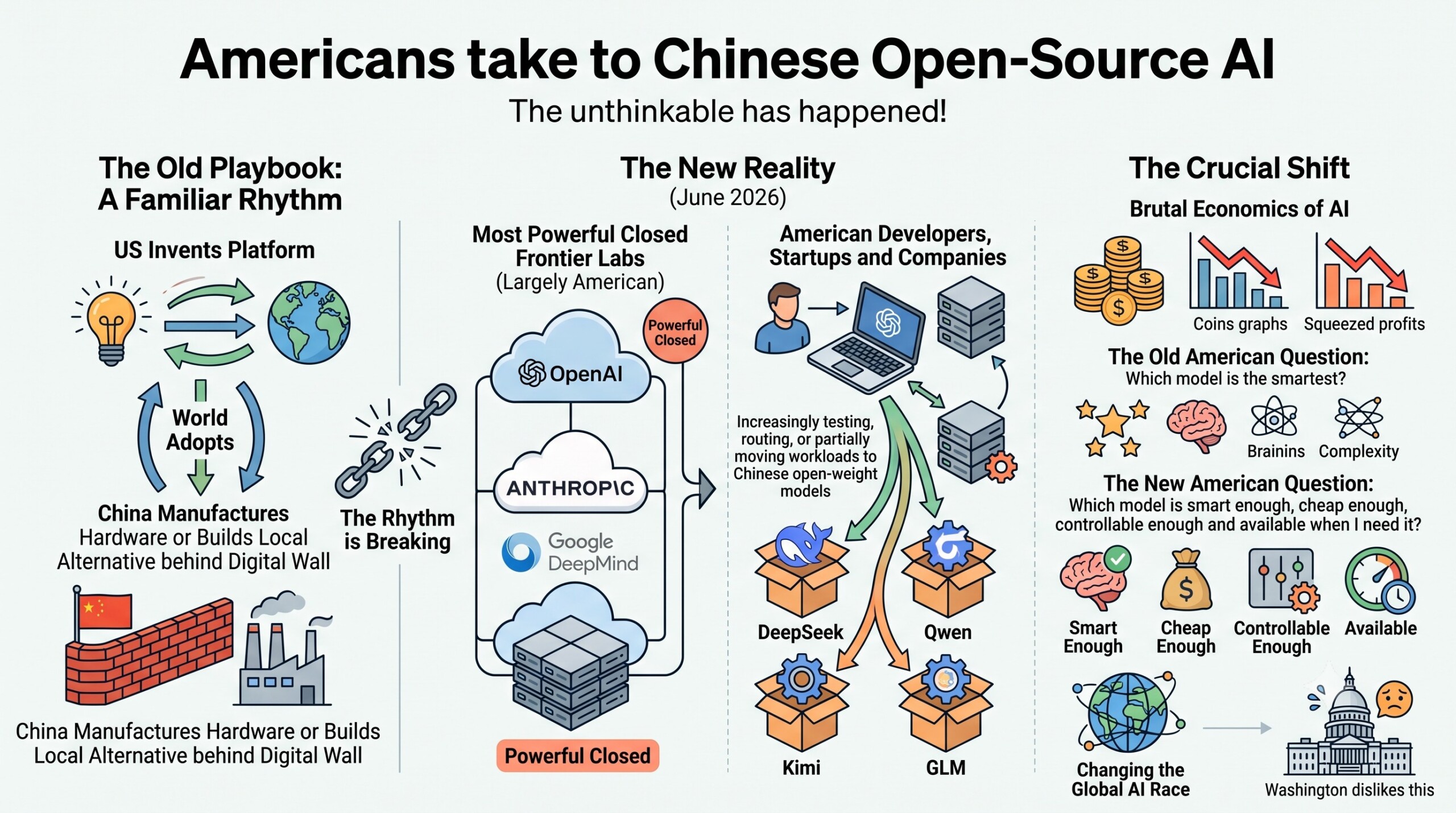
For decades, the American technology story had a familiar rhythm: the United States invented the platform, the world adopted it, and China either manufactured the hardware or built a local alternative behind its own digital wall. In artificial intelligence, that rhythm is breaking.
By June 2026, a strange and uncomfortable picture has emerged. The most powerful closed frontier labs are still largely American: OpenAI, Anthropic, Google DeepMind and others. Yet American developers, startups and even some larger companies are increasingly testing, routing or partially moving workloads to Chinese open-weight models such as DeepSeek, Qwen, Kimi and GLM. This is not because Silicon Valley has suddenly become sentimental about Beijing. It is because the economics of AI have turned brutal.
The new American question is no longer, “Which model is the smartest?” It is, “Which model is smart enough, cheap enough, controllable enough and available when I need it?”
That question is changing the global AI race. And the answer, more often than Washington would like, is coming from China.
Let’s dive deep into it now.
1. This is not ideology, but procurement logic.
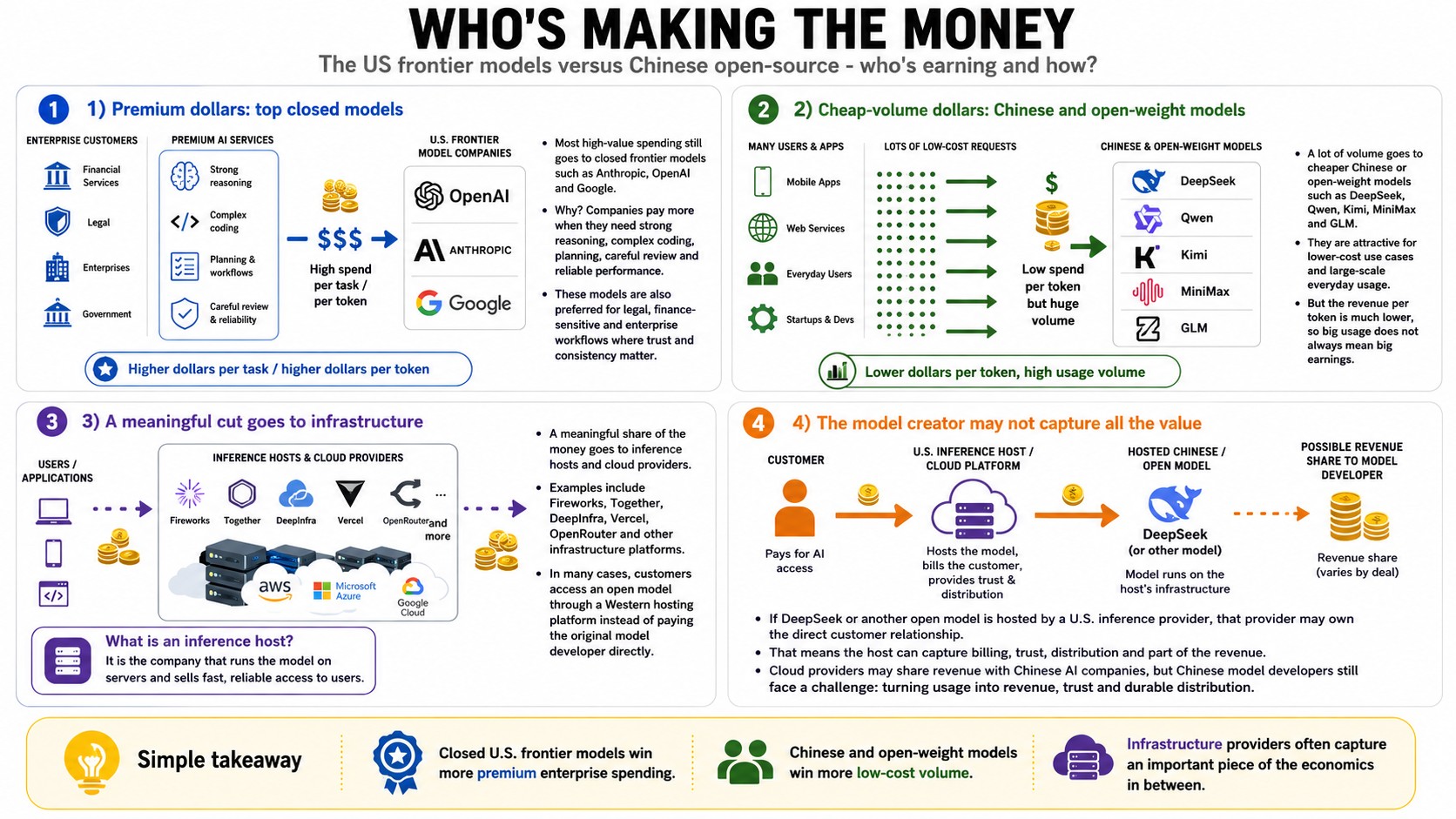
The first reason Americans are taking Chinese open-source AI seriously is simple: cost. AI bills have started to bite. Companies are reassessing heavy AI use as usage-based token pricing creates unpredictable and rising costs. Uber reportedly burned through its 2026 AI budget in just four months after employees rushed to adopt AI coding tools, forcing management to cap usage. Reuters also reported that executives including Satya Nadella, Nikesh Arora and Brian Armstrong have argued that smaller, cheaper models can handle a large share of corporate work.
This is where the drama begins. American companies want frontier intelligence, but they do not want frontier invoices. A model that is 90% as useful at a fraction of the price is not a second-class tool in a CFO’s spreadsheet. It is a business weapon.
The AI race is therefore shifting from a pure benchmark race to a procurement race. The winner is not always the model that dazzles in a demo. The winner is often the model that can answer millions of routine prompts without setting the finance department on fire.
2. Chinese models are now “close enough” for many real tasks
The Chinese models do not need to beat every American model on every benchmark to change the market. They only need to be good enough for enough use cases.
Chinese models are closing the gap with leading U.S. systems while charging as little as 18 cents per million tokens, compared with around $4 per million tokens on average for top models. The same report quoted an industry executive saying open-source models used to be more than a year behind leading AI models, but are now estimated to be roughly four months behind.
This is the uncomfortable middle ground for U.S. labs. If a Chinese model is slightly weaker but dramatically cheaper, many companies will not care that it loses on the hardest tasks. They will reserve premium American models for planning, strategy, difficult coding or sensitive analysis, and send routine summarization, classification, extraction, drafting, search and internal automation to cheaper alternatives.
The age of one-model loyalty is ending. An excellent collection of learning videos awaits you on our Youtube channel.
3. “Open-source” is the distribution weapon, even when “open-weight” is the more precise term
The phrase “open-source AI” is often used loosely. In many cases, “open-weight” is more accurate: the model weights are available, but the training data, full training pipeline or all system details may not be fully open in the traditional open-source software sense.
Still, the distribution advantage is real. Alibaba’s Qwen3 repository says its open-weight models are licensed under Apache 2.0. DeepSeek’s R1 release said its code and models were released under the MIT License and could be distilled and commercialized freely. Moonshot AI’s Kimi K2 repository says both code and model weights were released under a Modified MIT License.
That matters because open-weight models can be downloaded, tuned, routed, hosted privately, tested independently and embedded into products without asking a single closed lab for permission. For startups, this is freedom. For enterprises, it is leverage. For governments, it is a strategic alarm bell.
China’s most powerful move may not be building a model that is always number one. It may be releasing models that spread everywhere. Then, there is no going back to the frontier!

4. American developers are becoming model routers, not model loyalists
The new AI stack is not “choose Claude” or “choose GPT” or “choose DeepSeek.” It is: route the task to the right model at the right price.
Open-source tokens processed on OpenRouter rose to 65% in June 2026 from 34% in January, and that the four most popular models on OpenRouter were Chinese, with DeepSeek in the top position. Models from DeepSeek, Tencent, MiniMax and Xiaomi were among OpenRouter’s most popular, and that DeepSeek’s share of token usage on Vercel rose from under 1% to 17% in May, while revenue share stayed near 1%.
That last detail is revealing. Usage can grow faster than revenue because these models are cheap. They become infrastructure quietly, like plumbing beneath the floor. Nobody celebrates the pipe; everyone depends on the water.
The American developer is becoming less like a customer of one AI lab and more like an air-traffic controller, sending each task to whichever model gives the best mix of intelligence, speed, price and risk.
The spending pattern looks like this:
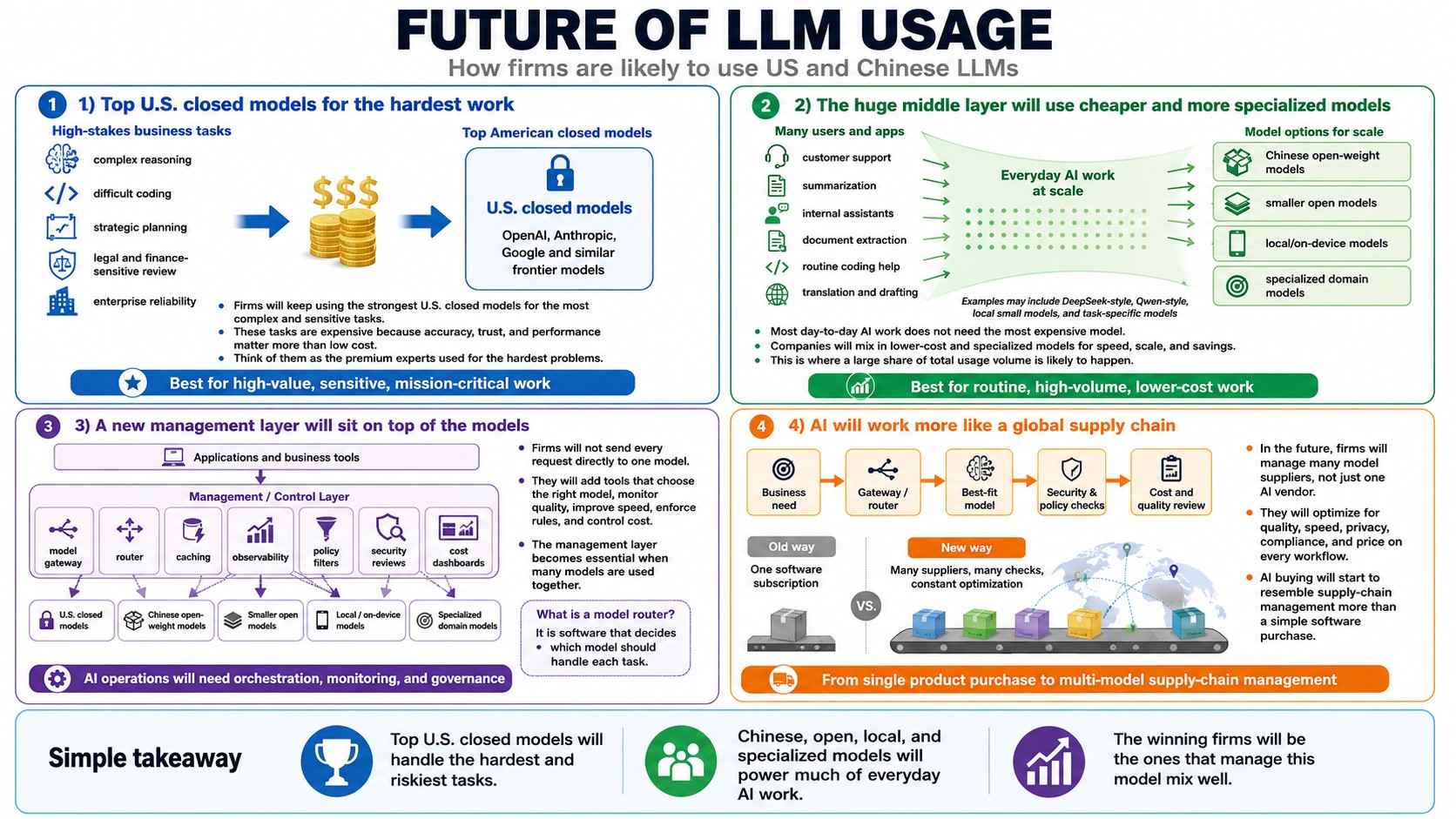
- High-value, low-volume tasks: companies still pay American frontier labs.
- Low-risk, high-volume tasks: companies route to Chinese/open models.
- Middle layer: startups experiment aggressively because every token affects margin. A constantly updated Whatsapp channel awaits your participation.
5. Startups are moving first because every token hits the margin
Startups feel this pressure before giants do. They do not have infinite AI budgets. If model costs explode, their unit economics break.
Lindy, a San Francisco company building AI work assistants, switched from Anthropic models to DeepSeek, according to founder Flo Crivello, who said on X that the move saved the company millions of dollars. He said that for lower tiers of intelligence, getting them at one-tenth the price would be foolish to ignore. Now this is a major indicator of where we’re headed.
Coinbase is another important example, though its case is framed as experimentation rather than a total migration. CEO Brian Armstrong said Coinbase was experimenting with defaulting to open-weight models such as GLM 5.2 and Kimi 2.7 through its LLM gateway, while still encouraging engineers to choose the right model for the task. Armstrong also emphasized routing prompts by difficulty, using caching, keeping context lean and improving visibility into AI spend.
This is the new corporate logic: do not suppress AI usage; make it economically sustainable. Chinese open models are becoming part of that answer.
6. Big companies are cautious, but the pressure is spreading
The adoption story is not frictionless. Large American companies, especially in regulated sectors, still worry about data security, censorship, sanctions, geopolitical risk and model behaviour. Businesses using Chinese models often try to process data in the U.S., run models on their own servers, or access them through American cloud providers rather than paying Chinese developers directly.
The politics are already visible. The U.S. lawmakers launched investigations into Airbnb and Anysphere, the owner of Cursor, after the companies disclosed they had used Chinese open models such as Qwen and Kimi in AI infrastructure. Airbnb CEO Brian Chesky later clarified that the company was not sending data to model developers.
This is the central contradiction: American companies want the economics of Chinese models without the political baggage of Chinese dependency. They want the savings, but not the headline risk. They want open weights, but not open controversy. Excellent individualised mentoring programmes available.
7. The Anthropic-Alibaba dispute has turned model training into a moral battlefield
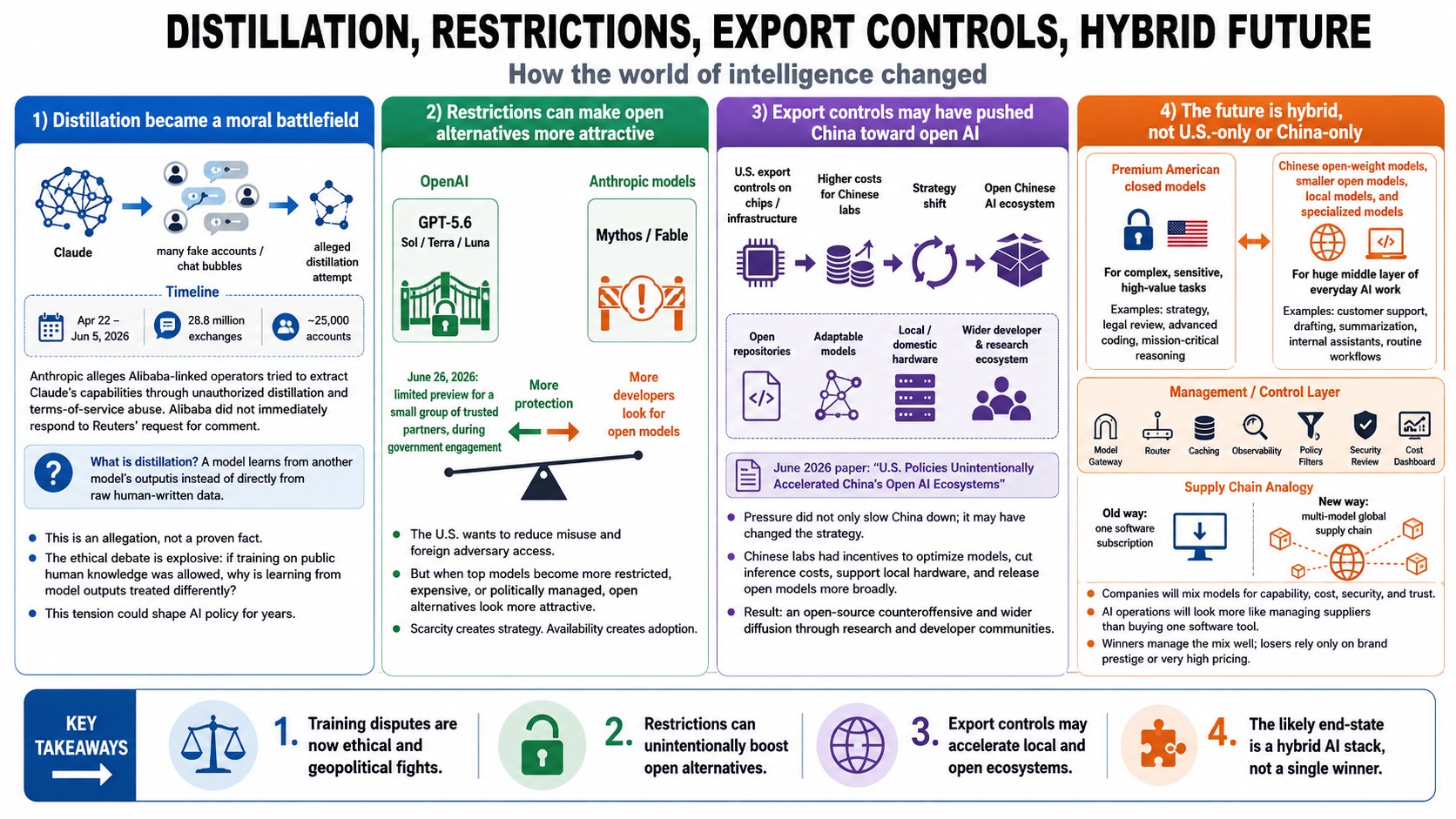
The most dramatic June 2026 flashpoint is Anthropic’s allegation against Alibaba, where it was accused of illicitly extracting Claude’s capabilities through what Anthropic described as a distillation effort. Anthropic said the campaign ran from April 22 to June 5, 2026, and generated more than 28.8 million exchanges with Claude through almost 25,000 fraudulent accounts. Alibaba did not immediately respond to Reuters’ request for comment.
The language around this story matters. It is inaccurate to say, as a confirmed fact, that Alibaba “stole Claude’s intelligence.” What is confirmed is that Anthropic has made a serious allegation of unauthorized model distillation and terms-of-service abuse. The broader ethical debate is more complicated.
Western labs trained on vast amounts of public internet text, code and media. Now they accuse rivals of using their model outputs to train other systems. Legally and contractually, these may be different issues. Morally and rhetorically, the argument is explosive: if scraping human knowledge was innovation, why is model-output learning theft?
That tension will define AI policy for years.
8. U.S. restrictions may be strengthening the appeal of open alternatives
At the same moment Chinese open models are spreading, access to some advanced U.S. frontier models has become more controlled.
OpenAI announced on June 26, 2026, a limited preview of GPT-5.6 Sol, Terra and Luna. It said that, as part of engagement with the U.S. government, it was starting with a limited preview for a small group of trusted partners whose participation had been shared with the government, before broader release. OpenAI also said it did not believe this kind of government access process should become the long-term default because it keeps the best tools from users, developers, enterprises, cyber defenders and global partners who need them.
Reuters also reported that Commerce Department restrictions on Anthropic’s Mythos and Fable models led Anthropic to disable access to those models globally.
This creates a paradox. The United States wants to protect frontier models from misuse and foreign adversaries. But if the most powerful American tools become more expensive, more restricted and more politically managed, many developers will naturally look for open alternatives. In AI, scarcity creates strategy. Availability creates adoption. Subscribe to our free AI newsletter now.
9. Export controls may have pushed China toward open AI as a survival strategy
The open-model boom is not accidental. A June 2026 research paper titled “U.S. Policies Unintentionally Accelerated China’s Open AI Ecosystems” argues that U.S. controls over chips and infrastructure raised the cost of Chinese AI development, but also increased the strategic value of open and locally adaptable AI systems. The paper says Chinese developers increased engagement with open-source large language model repositories substantially more than U.S. developers, and that Chinese-origin open models diffused widely through open-source communities and scientific research.
In other words, pressure did not simply slow China down. It may have changed China’s strategy.
Unable to rely freely on the most advanced imported chips, Chinese labs had stronger incentives to optimize architectures, reduce inference costs, support domestic hardware and release models broadly. The result is a kind of open-source counteroffensive. The West built walls around some frontier systems; China pushed models through every available gap.
10. The future is hybrid, not Chinese-only or American-only
The most likely future is not that Americans abandon OpenAI, Anthropic or Google and move entirely to Chinese models. That is too simplistic. The more realistic future is hybrid.
Companies will use top American closed models for the most complex, sensitive or high-value tasks. They will use Chinese open-weight models, smaller open models, local models and specialized models for the enormous middle layer of everyday AI work. They will add model gateways, routers, caching, observability, policy filters, security reviews and cost dashboards. AI will become less like buying one software subscription and more like managing a global supply chain.
Analysts expect businesses to follow a cloud-computing-style playbook, spreading across multiple providers in search of the best fit and price. That is the correct analogy. Just as companies learned not to depend blindly on one cloud, they are learning not to depend blindly on one model.
The winners will be those who can combine capability, cost, security and trust. The losers will be those who assume brand prestige alone can justify a 10x or 20x price gap forever. Upgrade your AI-readiness with our masterclass.
Conclusion
Americans are taking to Chinese open-source AI not because they have forgotten geopolitics, but because economics has a way of humiliating ideology. When a developer can get acceptable performance at a dramatically lower price, the procurement conversation changes. When an open-weight model can be hosted privately, tuned locally and routed cheaply, the platform conversation changes. When U.S. frontier models are expensive, restricted or scarce, the strategic conversation changes.
This is the dramatic reality of 2026: America may still lead at the frontier, but China is fighting aggressively at the distribution layer. The frontier wins headlines. Distribution wins habits. Habits become infrastructure. The United States should not respond only with fear, bans and accusations. Security concerns are real. Distillation abuse, data leakage, censorship and geopolitical dependence all deserve serious scrutiny. But a purely defensive policy will not be enough. If America wants to win the next phase of AI, it must compete not only with smarter closed models, but with cheaper, more available, more flexible open models of its own.
The new AI battlefield is not just inside research labs. It is inside procurement meetings, developer terminals, cloud invoices and model routers. And in that battlefield, the most dangerous model is not always the most intelligent one. It is the one that millions of people can actually afford to use.
Share this with the world
Related Articles