Palantir’s Alex Karp on ‘AI consumption versus AI transformation’
Palantir’s Alex Karp on ‘AI consumption versus AI transformation’
Introduction
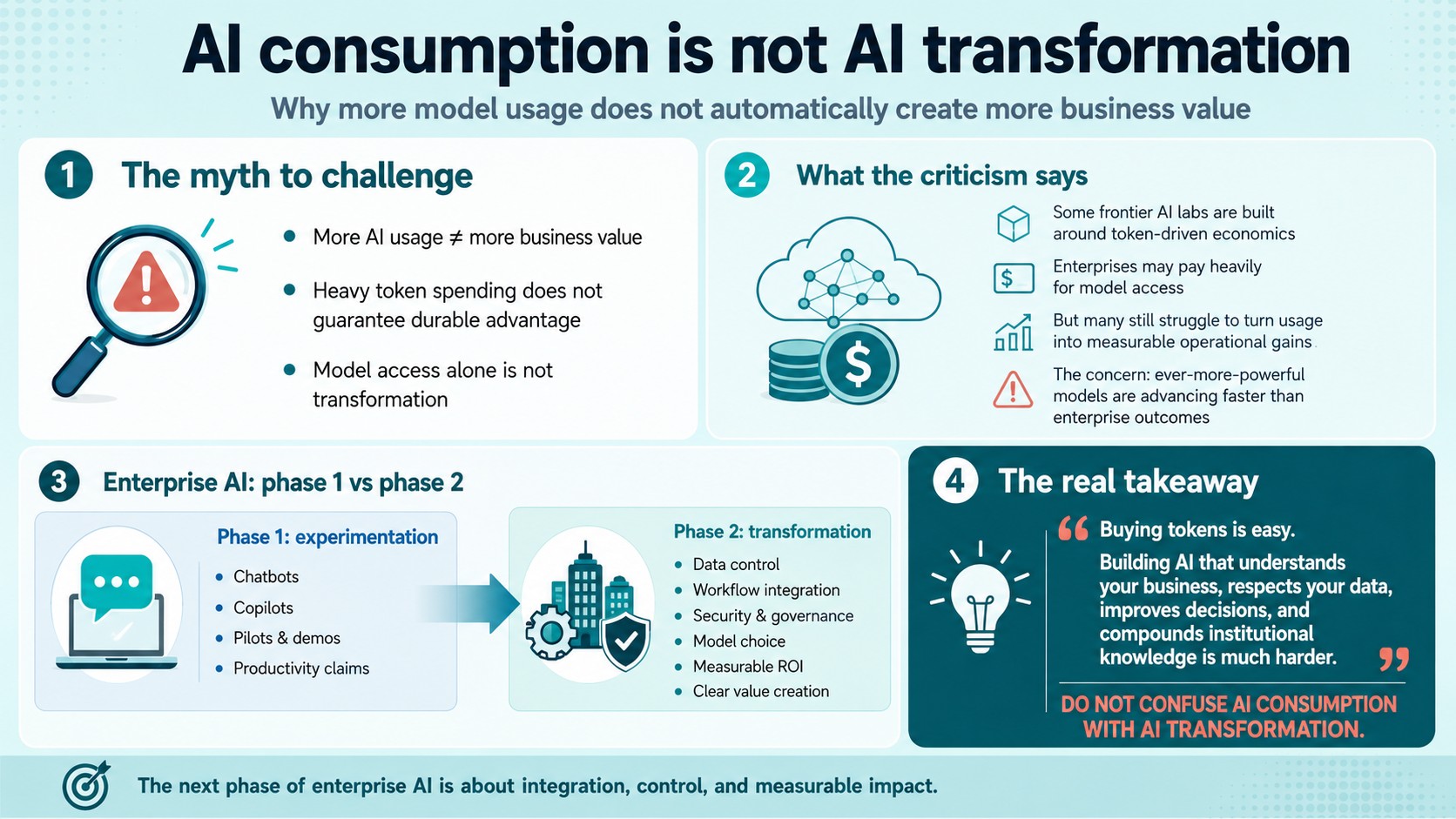
Alex Karp’s July 1, 2026 CNBC interview touched a nerve because it challenged one of the most fashionable assumptions in artificial intelligence: that more model usage automatically means more business value. His criticism was aimed at the token-driven economics of frontier AI labs, where enterprises pay heavily for model access while still struggling to convert that usage into durable operational advantage. Axios reported that Karp argued major AI labs have become too focused on building ever-more-powerful models while failing some of their largest enterprise customers.
The debate is not simply about OpenAI, Anthropic, Palantir, or any single company, but about the next phase of enterprise AI. The first phase was experimentation: chatbots, copilots, pilots, demos, and productivity claims. The next phase is harder. It requires data control, workflow integration, security, governance, model choice, measurable ROI, and a clear understanding of where value is actually created.
Karp’s central theme can be summed up this way: enterprises should not confuse AI consumption with AI transformation. Buying tokens is easy. Building AI that understands your business, respects your data, improves your decisions, and compounds your institutional knowledge is much harder.
Let’s dive deep into it now.
1. Token usage is not the same as value creation
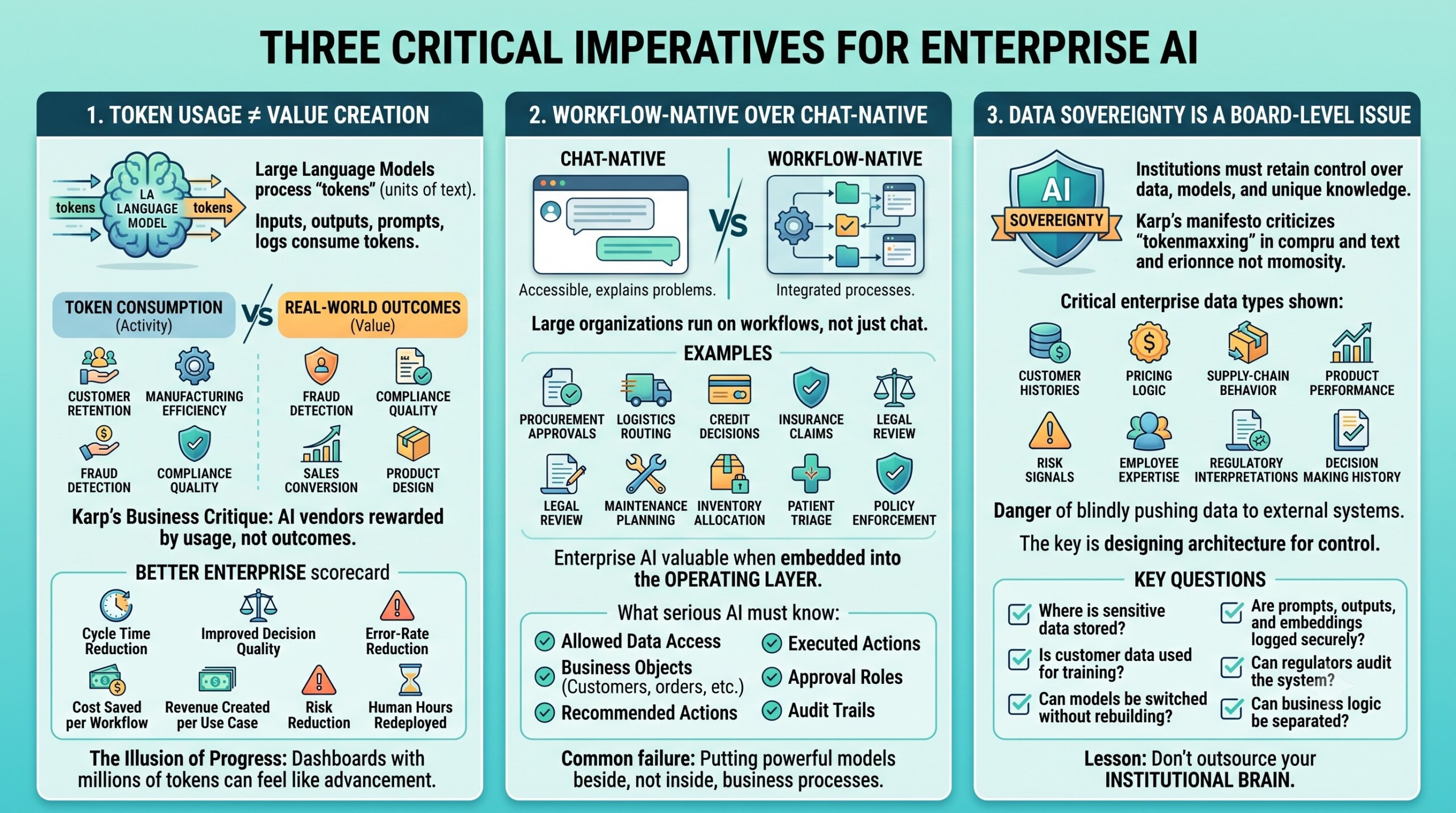
In large language models, a “token” is a unit of text processed by the model. Inputs, outputs, prompts, retrieved documents, logs, and generated responses can all add to token consumption. This makes token-based pricing easy to meter, but not always easy to connect to value.
A company may spend heavily on AI tokens and still have no meaningful improvement in customer retention, manufacturing efficiency, fraud detection, compliance quality, sales conversion, or product design. This is Karp’s strongest business critique: AI vendors may be rewarded when usage rises, even if the customer’s real-world outcomes do not improve proportionally.
Technically, this creates a measurement problem. Token volume measures activity, not impact. A better enterprise AI scorecard should track:
- reduction in cycle time;
- improvement in decision quality;
- error-rate reduction;
- cost saved per workflow;
- revenue created per use case;
- risk reduced through better monitoring;
- human hours redeployed to higher-value work.
The danger is that dashboards showing millions of tokens consumed can produce the illusion of progress. But an enterprise does not become intelligent merely because its software talks more.
2. Enterprise AI must be workflow-native, not chat-native
Most early generative AI adoption began with chat interfaces. That was useful because chat made AI accessible. But large organizations do not run on chat alone. They run on workflows: procurement approvals, logistics routing, credit decisions, insurance claims, legal review, maintenance planning, inventory allocation, patient triage, and policy enforcement.
A chat model can explain a problem. A workflow-native AI system can help solve it. That difference matters.
Palantir’s own documentation describes AIP as a platform that connects AI with an organization’s data and operations and is designed to drive automation across operational processes. This points to a broader technical principle: enterprise AI becomes valuable when it is embedded into the actual operating layer of the organization.
A serious enterprise AI system needs to know:
- what data it is allowed to access;
- what business objects it is reasoning about;
- what actions it may recommend;
- what actions it may execute;
- who must approve those actions;
- how the decision will be audited later.
This is where many AI deployments fail. They put a powerful model beside the business, not inside the business process. An excellent collection of learning videos awaits you on our Youtube channel.
3. Data sovereignty is becoming a board-level issue
Karp’s “AI sovereignty” argument is that institutions must retain control over the data, models, and operational knowledge that make them unique. Business Insider reported that Palantir’s manifesto urged companies to keep their data in-house and criticized “tokenmaxxing” as a form of spending that can feel like progress without building institutional strength.
This is technically important because enterprise data is not just raw information. It includes customer histories, pricing logic, supply-chain behaviour, product performance, risk signals, employee expertise, regulatory interpretations, and years of accumulated decision-making. When this data is pushed blindly into external systems, companies may lose control over the very material that defines their competitive edge.
Data sovereignty does not necessarily mean rejecting external AI providers. It means designing architecture so that the enterprise remains in control.
The key questions are:
- Where is sensitive data stored?
- Is customer data used to train vendor models?
- Can the company switch models without rebuilding everything?
- Are prompts, outputs, and embeddings logged securely?
- Can regulators audit the system?
- Can business logic be separated from model-provider logic?
The lesson is not “never use external AI.” The lesson is “never outsource your institutional brain without understanding the consequences.”
4. Model choice matters, but model dependency is dangerous
One important part of Karp’s critique is that enterprises are becoming more cost-sensitive. Axios reported that some U.S. companies are looking at cheaper Chinese AI models to lower AI spending, while U.S. frontier labs face both customer pushback and regulatory pressure.
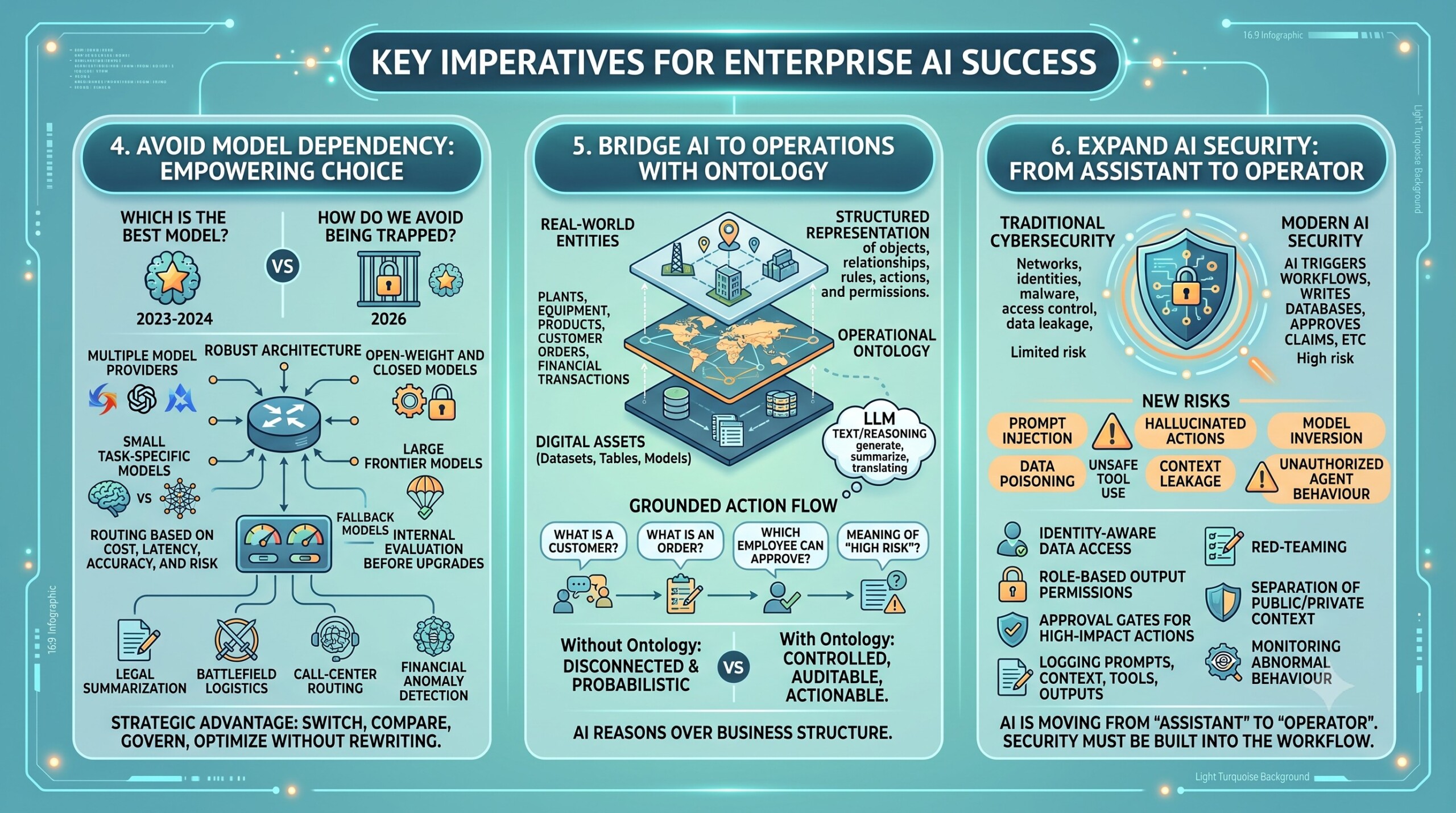
This reflects a major shift in enterprise AI architecture. In 2023 and 2024, many companies asked: “Which is the best model?” In 2026, the better question is: “How do we avoid being trapped by any single model?”
A robust enterprise AI architecture should support:
- multiple model providers;
- open-weight and closed models;
- small task-specific models;
- large frontier models for complex reasoning;
- routing based on cost, latency, accuracy, and risk;
- fallback models if one provider is unavailable;
- internal evaluation before model upgrades.
The future is unlikely to be one-model-fits-all. Enterprises will use different models for different tasks. A legal summarization task, a battlefield logistics task, a call-center routing task, and a financial anomaly-detection task do not need the same model, cost profile, or risk tolerance.
The strategic advantage will belong to companies that can switch, compare, govern, and optimize models without rewriting their whole AI stack. A constantly updated Whatsapp channel awaits your participation.
5. Ontology is the missing layer between AI and operations
One reason Palantir features prominently in this debate is its emphasis on ontology. In simple terms, an ontology is a structured representation of how an organization understands itself: its objects, relationships, rules, actions, and permissions.
Palantir’s documentation describes its Ontology as an operational layer that sits on top of digital assets such as datasets, virtual tables, and models, connecting them to real-world entities like plants, equipment, products, customer orders, and financial transactions.
This matters because LLMs are probabilistic language systems. They are powerful at generating, summarizing, reasoning, and translating between formats. But enterprises need more than language. They need grounded action.
An ontology helps answer questions such as: What is a customer? What is an order? Which supplier is linked to which factory? Which employee can approve which transaction? What does “high risk” mean in this business? What action should follow a forecast? Which system of record must be updated?
Without this layer, AI agents may produce impressive answers but remain disconnected from the true operating structure of the company. With it, AI can reason over the business in a controlled, auditable, and actionable way.

6. AI security is no longer only about cybersecurity
Traditional cybersecurity focuses on networks, identities, malware, access control, and data leakage. AI security includes all of that, but adds new risks: prompt injection, data poisoning, hallucinated actions, unsafe tool use, model inversion, context leakage, and unauthorized agent behaviour.
When an AI system can only answer questions, the risk is limited. When it can trigger workflows, write to databases, generate code, approve claims, update customer records, or interact with external tools, the risk profile changes dramatically.
Enterprise AI security must now include: identity-aware access to data; role-based permissions for model outputs; approval gates before high-impact actions; logging of prompts, retrieved context, tool calls, and outputs; red-teaming for prompt injection and jailbreaks; separation between public knowledge and private enterprise context; and monitoring for abnormal agent behaviour.
This is why Karp’s concern about data and IP protection is relevant beyond Palantir’s own commercial interests. AI is moving from “assistant” to “operator.” Once that happens, security must be built into the workflow, not pasted on at the end. Excellent individualised mentoring programmes available.
7. The real ROI of AI comes from compounding institutional knowledge
Many companies treat AI as a productivity layer: write faster, summarize faster, code faster, respond faster. Those are useful gains, but the deeper value comes when AI helps an institution learn faster.
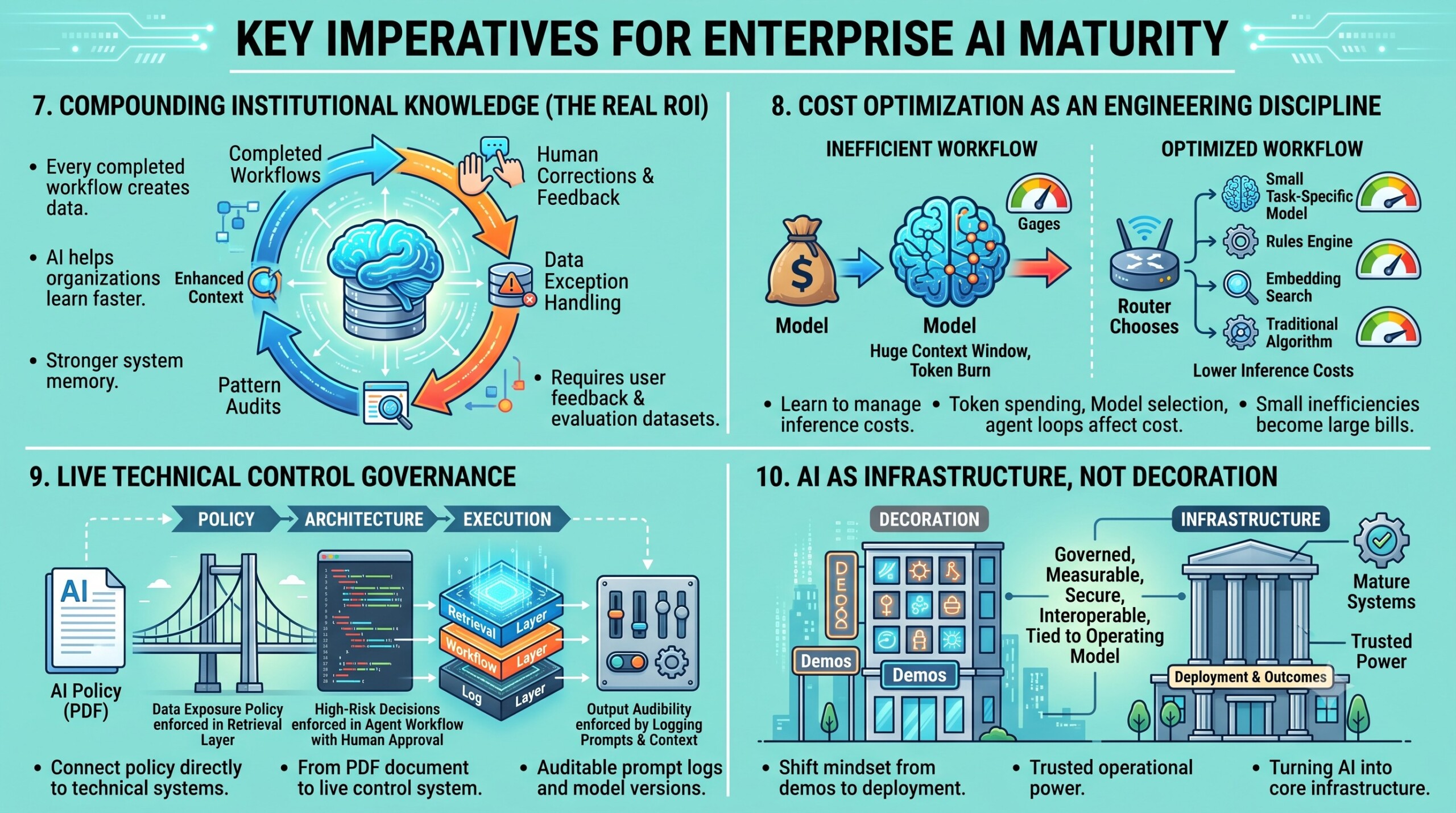
Every completed workflow creates data. Every human correction creates feedback. Every exception teaches the system something. Every audit reveals a pattern. Every customer interaction adds context. If captured properly, this becomes a compounding loop.
The strongest enterprise AI systems will not simply generate answers. They will improve the organization’s memory.
This requires feedback capture from users and evaluation datasets built from real business cases.
8. Cost optimization will become a core AI engineering discipline
In the cloud era, companies learned to manage compute costs. In the AI era, they must learn to manage inference costs. Token spending, context-window size, retrieval volume, model selection, agent loops, and output verbosity can all affect cost.
A poorly designed AI workflow may send huge context to an expensive model for a task that a smaller model, rules engine, embedding search, or traditional algorithm could handle more cheaply. This is not a theoretical concern. As AI usage scales across thousands of employees and millions of workflows, small inefficiencies become large bills.
Karp’s criticism of token economics is therefore also a challenge to AI engineers: do not build systems that look intelligent but burn money unnecessarily. Subscribe to our free AI newsletter now.
9. AI governance must connect policy, architecture, and execution
Many organizations write AI policies. Fewer connect those policies directly to technical systems. That gap is dangerous.
A policy may say that customer data should not be exposed to external models. But is that enforced in the retrieval layer? A policy may say that high-risk decisions need human approval. But is that enforced in the agent workflow? A policy may say that outputs must be auditable. But are prompts, context, model versions, and tool calls logged?
Good governance must be executable. The enterprise AI winners will be those that turn governance from a PDF document into a live technical control system.
10. The winners will treat AI as infrastructure, not decoration
The most important lesson from Karp’s interview is not that token pricing is always bad or that frontier models are useless. Frontier models are powerful, and companies such as OpenAI and Anthropic have pushed the field forward dramatically. Axios also noted that Karp praised Anthropic’s success even while criticizing parts of the frontier-lab business model.
The real lesson is that enterprise AI must mature.
AI cannot remain a decorative layer added to existing systems. It must become infrastructure: governed, measurable, secure, interoperable, and deeply tied to the organization’s operating model.
That requires a shift in mindset from demos to deployment and from tokens to outcomes. This is where the next competitive battle will happen. Not merely in who has the biggest model, but in who can turn AI into trusted operational power. Upgrade your AI-readiness with our masterclass.
Conclusion
Alex Karp’s CNBC interview became controversial because it said aloud what many enterprise leaders are beginning to feel privately: AI spending is rising faster than AI value in many organizations. The problem is not artificial intelligence itself. The problem is shallow implementation.
Token consumption is not transformation. A chatbot is not an operating model. A model subscription is not a strategy. A pilot is not a platform.
For enterprises, the future of AI will depend on sovereignty, architecture, governance, cost discipline, security, workflow integration, and measurable outcomes. The real question is not how many tokens a company can consume. The real question is how much intelligence it can retain, compound, and convert into better decisions.
That is the deeper message behind the “tokenmaxxing” debate. AI value will not belong to companies that merely rent intelligence by the token. It will belong to companies that build systems where intelligence becomes part of the institution itself.
Share this with the world
Related Articles