AI in Hospitality, Travel & Tourism Careers
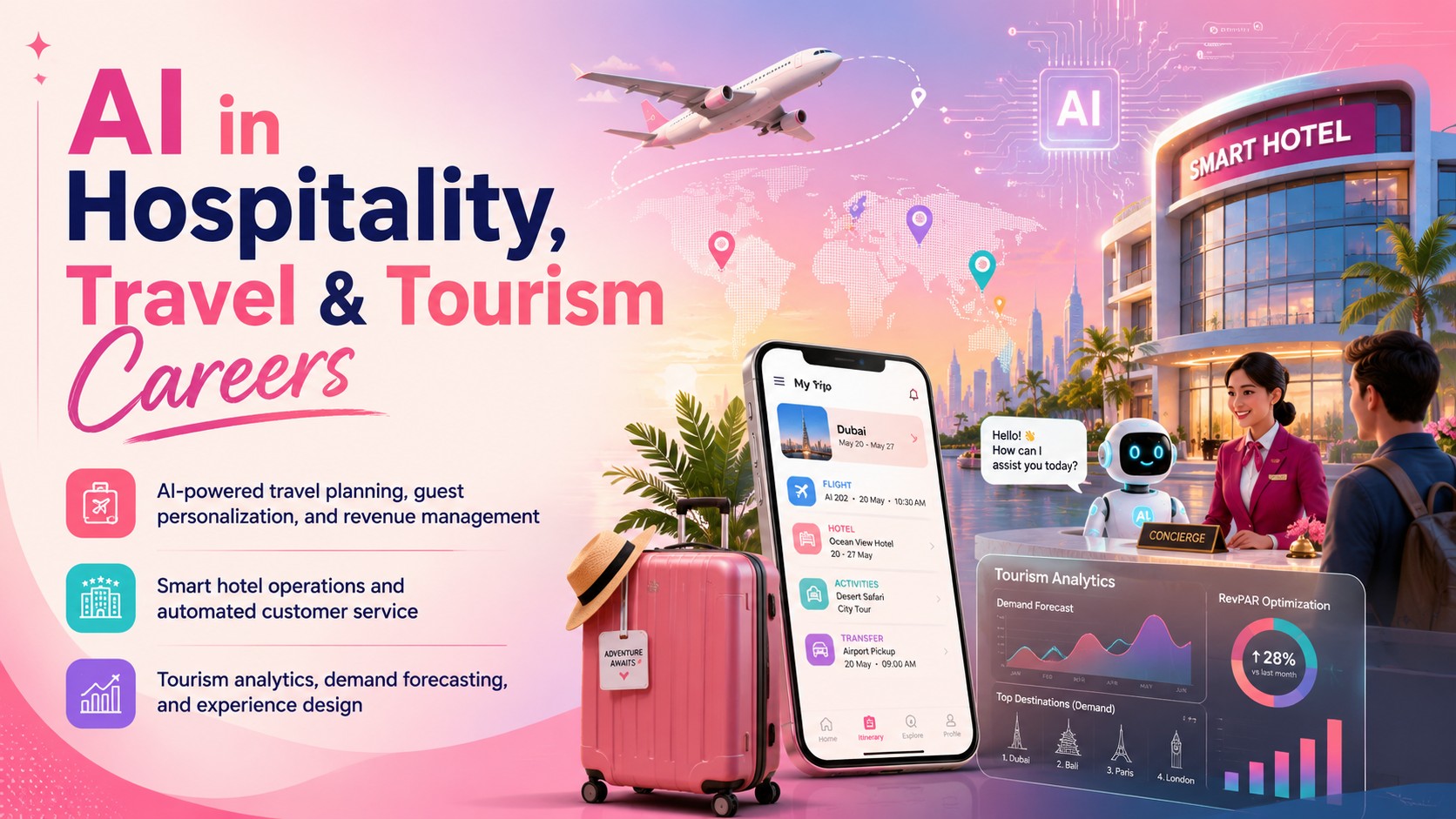
AI in Hospitality, Travel & Tourism Careers
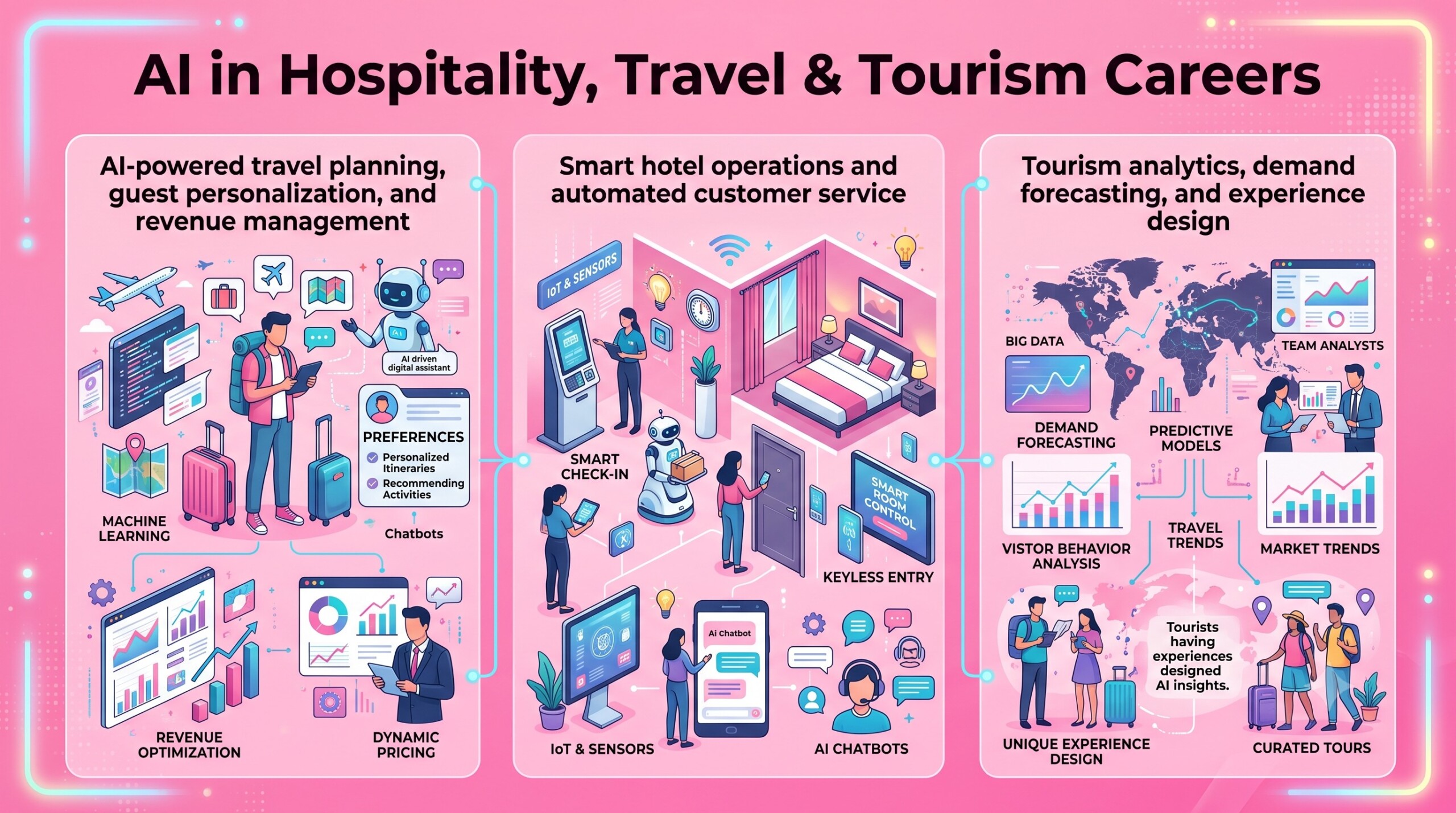
AI-powered travel planning, guest personalization, and revenue management; Smart hotel operations and automated customer service; Tourism analytics, demand forecasting, and experience design
Introduction
Travel and hospitality have always been deeply human industries. A memorable hotel stay, a well-designed holiday, a reassuring airline representative during a disruption, or a knowledgeable local guide can create experiences that technology alone cannot easily reproduce. Yet behind these human moments lies an enormous operational system involving reservations, pricing, customer data, transport, payments, marketing, housekeeping, food and beverage, destination management, loyalty programmes and thousands of daily service decisions.
Artificial intelligence is rapidly entering almost every part of that system. AI can now recommend destinations, construct itineraries, answer guest questions, predict hotel demand, adjust room prices, identify high-value customers, forecast flight disruption, analyse reviews, personalise offers and help tourism authorities understand changing visitor behaviour.
The career implication is important. The future hospitality professional will increasingly need a combination of service intelligence, commercial understanding, digital fluency and data literacy. A hotel manager does not need to become a machine-learning engineer, but understanding how an AI forecasting system reaches a recommendation may become as normal as understanding occupancy or RevPAR. A tourism professional may still need storytelling and destination knowledge, but increasingly also needs to understand visitor analytics, digital behaviour and algorithmic personalization. An excellent collection of learning videos awaits you on our Youtube channel.
Let’s dive deep into this.
1. AI-powered travel planning is creating a new front door to tourism
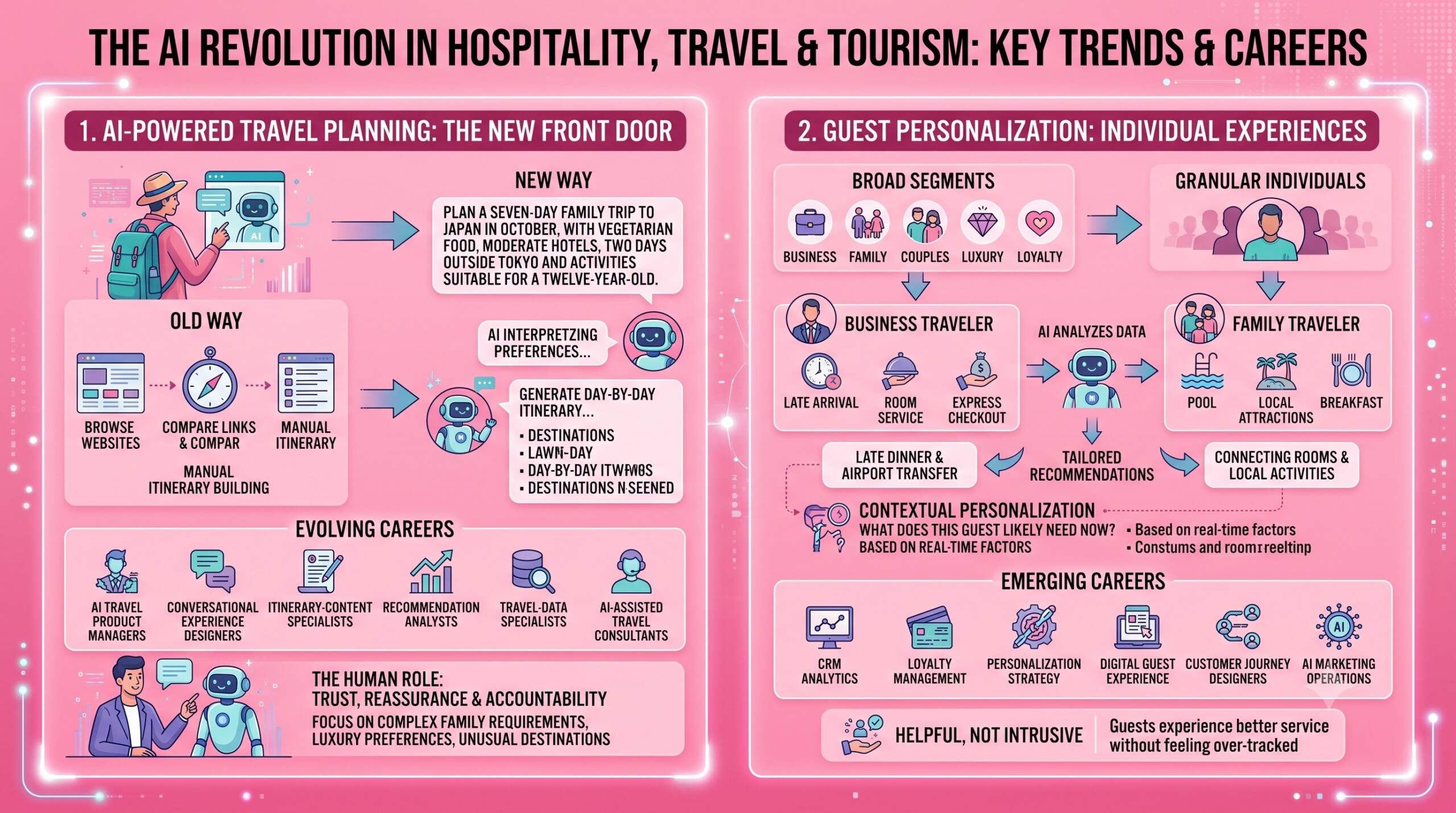
For decades, digital travel planning followed a familiar pattern. Travellers searched destinations, opened multiple websites, compared flights and hotels, read reviews, checked maps and manually assembled an itinerary. Generative and agentic AI are beginning to compress many of those activities into a conversation.
A traveller can increasingly ask an AI system something like: “Plan a seven-day family trip to Japan in October, with vegetarian food, moderate hotels, two days outside Tokyo and activities suitable for a twelve-year-old.” Instead of returning a list of links, an AI system can interpret multiple preferences simultaneously, propose destinations, compare alternatives, build a day-by-day itinerary and potentially move towards booking the components.
Expedia Group has been moving strongly in this direction. Amadeus is also developing agentic travel capabilities. This creates careers beyond the traditional travel agent. Travel businesses increasingly need AI travel product managers, conversational experience designers, itinerary-content specialists, recommendation analysts, travel-data specialists and AI-assisted travel consultants.
The human travel adviser is not necessarily disappearing. The role can become more sophisticated. Instead of spending substantial time checking routine combinations of flights and hotels, an adviser can use AI to generate alternatives quickly and spend more time understanding complicated family requirements, luxury preferences, accessibility needs, visas, unusual destinations, group travel or high-value experiences.
That suggests an important career principle. AI may increasingly create the itinerary, but trust, reassurance and accountability remain valuable human services.
2. Guest personalization is moving from segmentation towards individual experience
Traditional hospitality marketing often divided customers into broad segments such as business travellers, families, couples, luxury guests or loyalty members. AI allows much more granular personalization.
Consider two guests booking identical rooms. One frequently travels for work, arrives late, orders room service and prefers express checkout. Another is travelling with family, searches for local attractions, uses the swimming pool and regularly books breakfast. Treating them identically wastes information that could improve both the guest experience and hotel revenue.
AI can combine reservation history, loyalty information, interaction data, previous purchases, stated preferences and real-time context to recommend relevant services. A hotel might offer the business traveller airport transfer and late dining, while suggesting breakfast, connecting rooms or local activities to the family traveller.
The next step is increasingly contextual personalization. The system does not merely ask, “Who is this guest?” It asks, “What is this guest likely to need at this particular moment?”
This creates growing opportunities in CRM analytics, loyalty management, personalization strategy, digital guest experience, customer journey design, hospitality data analysis and AI marketing operations.
The best personalization should feel helpful rather than intrusive. Guests should experience better service without feeling that the hotel knows more about them than they intended to reveal. A constantly updated Whatsapp channel awaits your participation.


3. Smart hotels are turning operations into connected digital systems
One of the biggest changes in hospitality careers may occur behind the reception desk rather than in front of it.
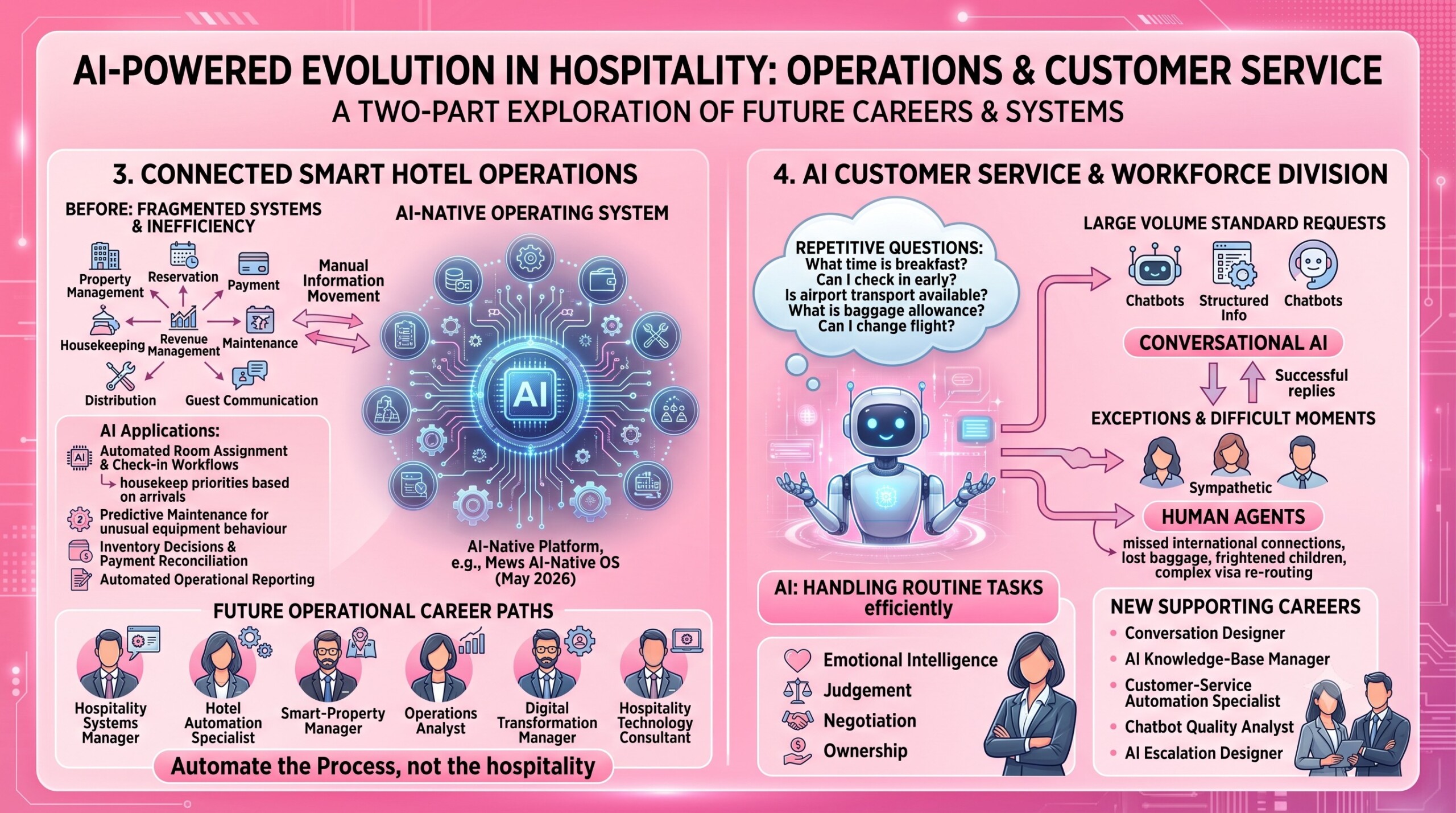
A modern hotel operates through property management systems, reservation platforms, payment systems, housekeeping applications, revenue management systems, point-of-sale systems, maintenance systems, distribution channels and guest communication platforms. Historically, many of these systems operated separately, forcing employees to move information manually between them.
AI-native hotel technology is increasingly connecting these systems. Mews, for example, announced a broader AI-native hospitality operating system in May 2026 combining areas including property operations, revenue management, distribution, guest messaging, automation and financial functions. The company argues that fragmented hotel technology remains a major source of operational inefficiency.
AI can help automate room assignment, check-in workflows, housekeeping priorities, payment reconciliation, maintenance requests, inventory decisions and operational reporting. Predictive maintenance can potentially identify unusual equipment behaviour before an air-conditioning unit or lift fails completely. Housekeeping systems can prioritise rooms according to arrival schedules rather than following a fixed sequence.
This changes the hotel operations career path. Future roles can include hospitality systems manager, hotel automation specialist, smart-property manager, operations analyst, digital transformation manager and hospitality technology consultant.
That finding captures the emerging hospitality model well. Automate the process, not necessarily the hospitality.
4. AI customer service will handle routine questions while people handle difficult moments
Hotels, airlines and travel companies receive enormous numbers of repetitive questions.
What time is breakfast? Can I check in early? Is airport transport available? What is the baggage allowance? Can I change my flight? Is the swimming pool open? Can I request a vegetarian meal?
Conversational AI is particularly well suited to these interactions because many questions can be answered quickly from structured information.
Airlines are following a similar path. Amadeus describes AI systems capable of handling booking changes, alternatives and payments conversationally, while its work with Air India demonstrates how generative AI has already been used at significant customer-service scale. This does not make customer service irrelevant. It changes which customer-service abilities become valuable.
AI can answer “What time is breakfast?” very efficiently. It is less naturally suited to a passenger who has missed an international connection, lost baggage, has a frightened child and needs a complicated visa-sensitive re-routing decision. Emotional intelligence, negotiation, judgement and ownership become more valuable as routine information becomes automated.
Future customer-service careers may therefore divide into two layers. AI handles large volumes of standard requests, while humans increasingly manage exceptions, recovery, complaints, complex sales, VIP relationships and emotionally sensitive interactions.
New supporting careers also emerge, including conversation designer, AI knowledge-base manager, customer-service automation specialist, chatbot quality analyst and AI escalation designer. Excellent individualised mentoring programmes available.
5. Revenue management is becoming an AI-driven commercial science
Few areas of hospitality are as naturally suited to AI as revenue management.
A hotel room or airline seat is a perishable product. If tonight’s hotel room remains empty, it cannot be stored and sold tomorrow. Similarly, an unsold airline seat loses its entire value when the aircraft departs.
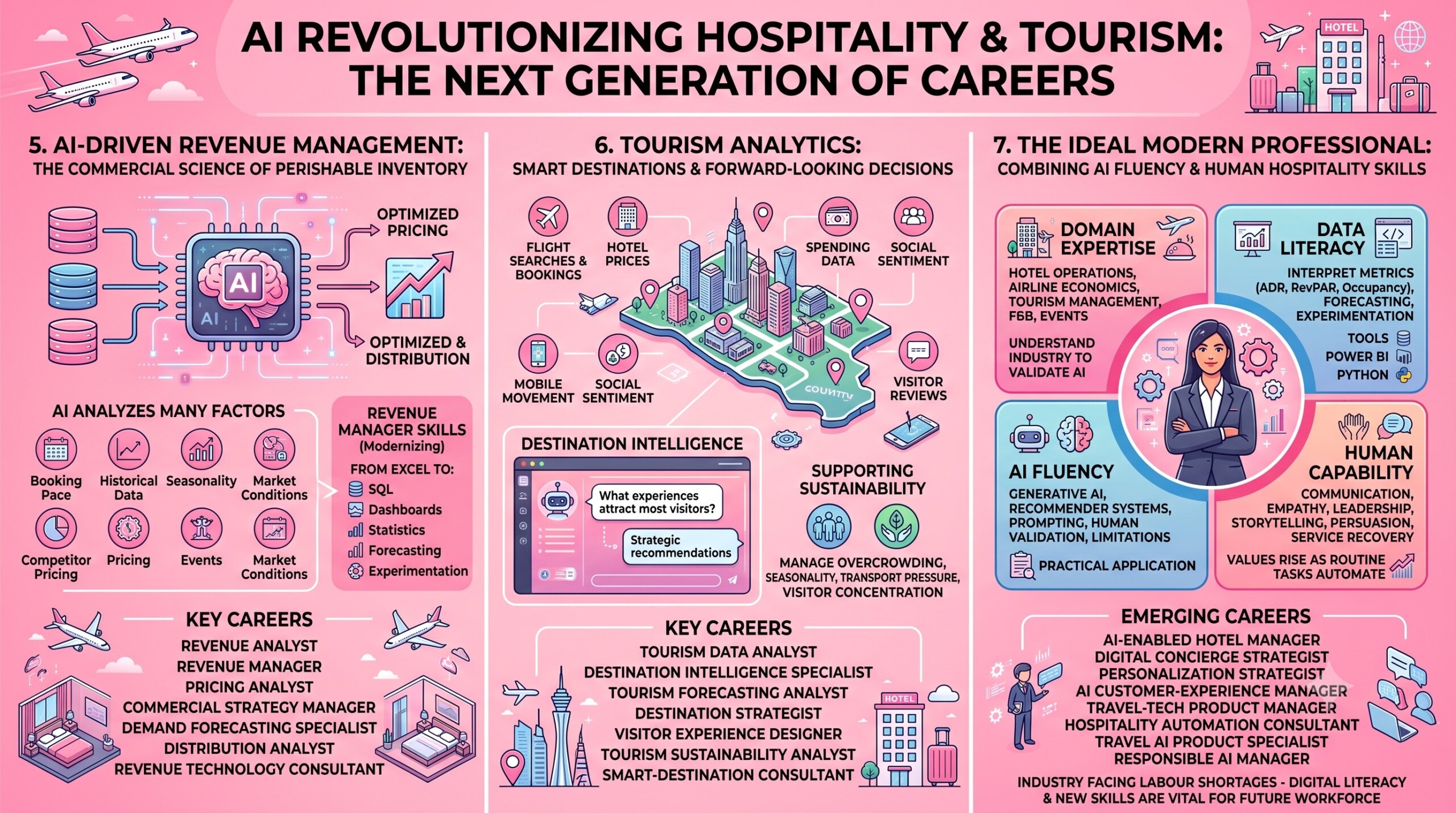
Revenue managers therefore try to predict demand and determine the right price, inventory and distribution strategy. AI can analyse booking pace, historical demand, seasonality, cancellations, competitor pricing, events, flight capacity and market conditions much faster than a human analyst working through spreadsheets.
The technology is becoming increasingly automated. In June 2026, Duetto and RateGain announced a partnership linking AI-powered distribution with hotel revenue optimisation so prices could be updated across distribution channels using demand forecasting and pricing intelligence.
This creates strong career opportunities for candidates who combine hospitality knowledge with quantitative skills. Relevant roles include revenue analyst, revenue manager, pricing analyst, commercial strategy manager, demand forecasting specialist, distribution analyst and revenue technology consultant.
The required skills are also changing. Excel remains useful, but SQL, dashboards, statistics, forecasting, experimentation and the ability to interrogate AI recommendations are becoming increasingly valuable.
6. Tourism analytics can help destinations predict demand and design better experiences
AI in tourism goes far beyond hotels and airlines. Entire cities, regions and countries increasingly use data to understand who is likely to visit, where visitors come from, what they spend, what experiences attract them and when congestion may occur.
Tourism intelligence platforms can combine flight searches, bookings, air capacity, hotel prices, mobile movement, spending information, social sentiment and visitor reviews. This allows destination management organisations to move from retrospective statistics towards forward-looking decisions.
Mabrian and The Data Appeal Company have also been developing conversational and agentic interfaces for destination intelligence. Their systems combine tourism datasets with AI so destination teams can ask questions, generate scenarios and obtain strategic recommendations rather than manually navigating numerous dashboards.
Analytics can also support sustainability. Tourism authorities can identify overcrowding, seasonality, transport pressure and visitor concentration, then design campaigns that spread travel geographically or encourage visits outside peak periods. WTTC’s June 2026 strategic priorities explicitly include destination stewardship, emerging technologies, workforce development and managing pressures associated with overcrowding.
This creates careers such as tourism data analyst, destination intelligence specialist, tourism forecasting analyst, destination strategist, visitor experience designer, tourism sustainability analyst and smart-destination consultant. Subscribe to our free AI newsletter now.
7. The best careers will combine AI capability with distinctly human hospitality skills
The most important question for students and professionals is not simply, “Will AI take hospitality jobs?” The better question is, “Which parts of hospitality work will AI perform, and what becomes more valuable when it does?”
Travel and tourism continue to require enormous numbers of people. WTTC’s workforce research has warned that the industry could face a substantial labour shortage over the next decade, including millions of unfilled hospitality positions. It specifically identifies digital literacy, AI adoption and new skills as important components of future workforce development.
AI is therefore likely to reshape occupations unevenly rather than eliminate the entire employment base.
A strong future hospitality professional should therefore build capabilities in four areas.
The first is domain expertise. Learn hotel operations, airline economics, tourism management, food and beverage, events, customer journeys or whichever segment you want to enter. AI becomes much more useful when the user understands the industry well enough to identify a poor recommendation.
The second is data literacy. Learn how to interpret dashboards, conversion, occupancy, ADR, RevPAR, profitability, customer segmentation, forecasting and experimentation. Advanced professionals can add Excel, SQL, Power BI, Tableau, Python or statistical modelling depending on their role.
The third is AI fluency. Learn how generative AI, recommendation systems, forecasting models, automation and AI agents work at a practical level. Understand prompting, workflow design, model limitations, hallucination, data privacy and human validation.
The fourth is human capability. Communication, empathy, storytelling, leadership, persuasion, cultural sensitivity and service recovery become more valuable when machines perform routine tasks.
This combination opens a wide spectrum of career possibilities: AI-enabled hotel manager, digital concierge strategist, travel-tech product manager, revenue optimisation specialist, tourism data analyst, destination intelligence manager, personalization strategist, AI customer-experience manager, hospitality automation consultant, travel AI product specialist and responsible AI manager for travel businesses.
Some of these titles already exist. Others will emerge gradually as functions that were previously separate become connected through AI.
Conclusion
AI is changing hospitality, travel and tourism from the moment a traveller begins dreaming about a journey until long after the trip ends. It can inspire destinations, build itineraries, personalise offers, answer questions, forecast demand, adjust prices, automate hotel operations and help destinations understand visitor behaviour.
Yet hospitality remains different from many other industries because its product is not merely a transaction. Its product is an experience involving trust, comfort, emotion, culture, memory and human interaction. This explains why widespread AI adoption can coexist with a continuing desire for human service at important moments.
The career opportunity therefore lies in becoming neither purely “technical” nor purely “traditional”. The strongest professionals will understand both sides. They will know how a hotel operates and how its data flows. They will understand a traveller’s emotions and an algorithm’s recommendation. They will know when automation improves service and when automation damages it. Upgrade your AI-readiness with our masterclass.