AI in Real Estate, Construction & PropTech Careers
AI in Real Estate, Construction & PropTech Careers
AI for property valuation, design planning, and project monitoring; Construction automation, risk prediction, and smart building systems; Data-driven real estate investment and facility intelligence
Introduction
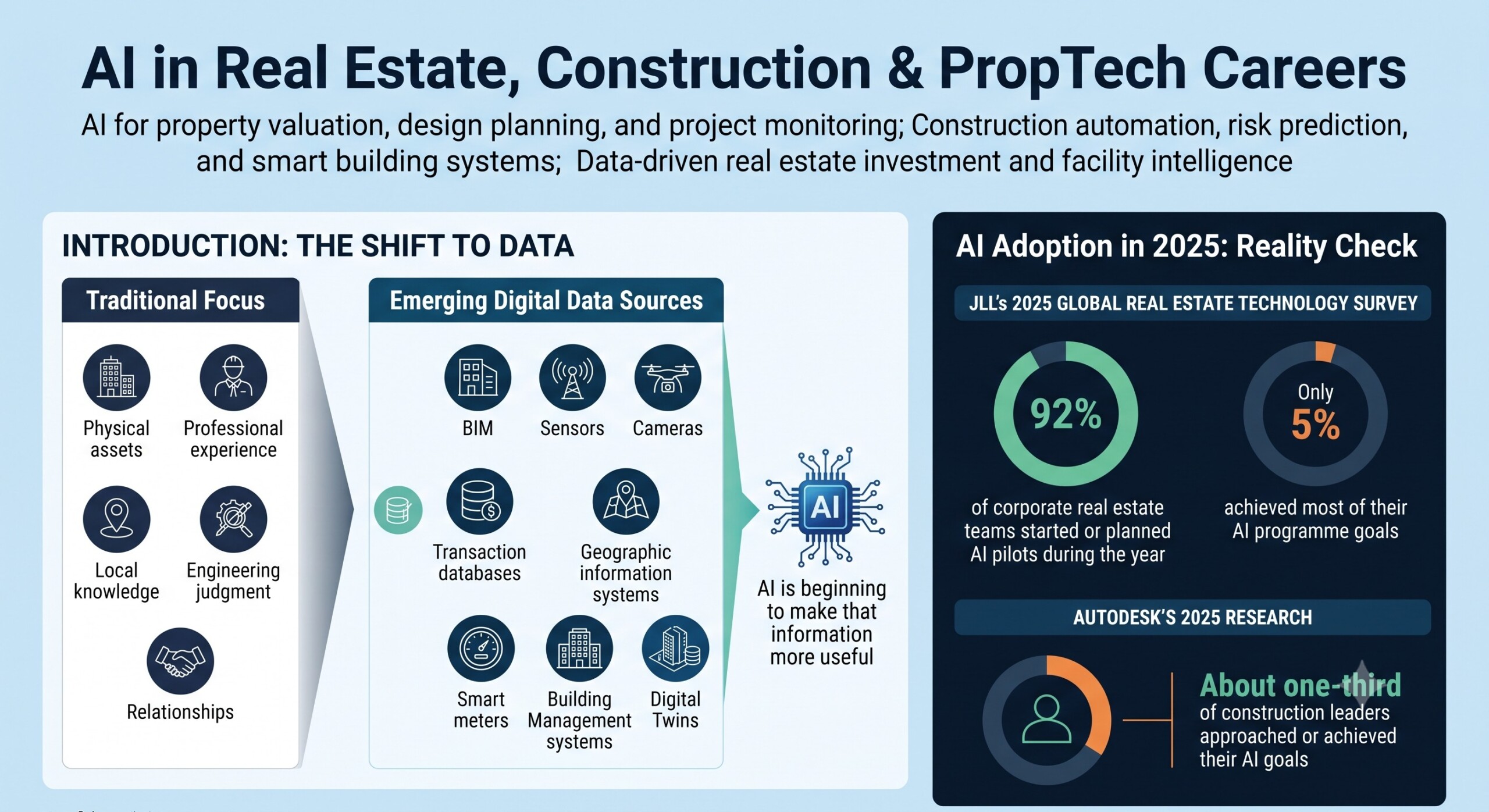
Real estate and construction have traditionally been industries in which physical assets, professional experience, local knowledge, engineering judgement and relationships mattered more than sophisticated software. That balance is changing. Buildings, construction sites and property portfolios are producing increasingly large quantities of digital data through Building Information Modelling, or BIM, sensors, cameras, drones, transaction databases, geographic information systems, smart meters, building management systems and digital twins. Artificial intelligence is beginning to make that information more useful.
The change should not be exaggerated. AI has certainly entered the built environment, but much of the industry is still learning how to use it effectively. JLL’s 2025 Global Real Estate Technology Survey found that 92 percent of corporate real estate teams surveyed had started AI pilots or planned to start them during the year, yet only 5 percent reported having achieved most of their AI programme goals. Construction presents a similar picture. Autodesk’s 2025 research found that only about one-third of construction leaders reported that they were approaching or had achieved their AI goals.
The important development is not the disappearance of architects, engineers, valuers, project managers, facility managers or property investors. It is the emergence of professionals who understand their traditional domain and can also work with AI, data and digital systems.
That combination of professional expertise and technology literacy points towards seven particularly important career areas. An excellent collection of learning videos awaits you on our Youtube channel.
Let’s dive deep into this.
1. AI-powered property valuation and market intelligence
Property valuation is one of the most visible areas in which AI and data science are entering real estate.
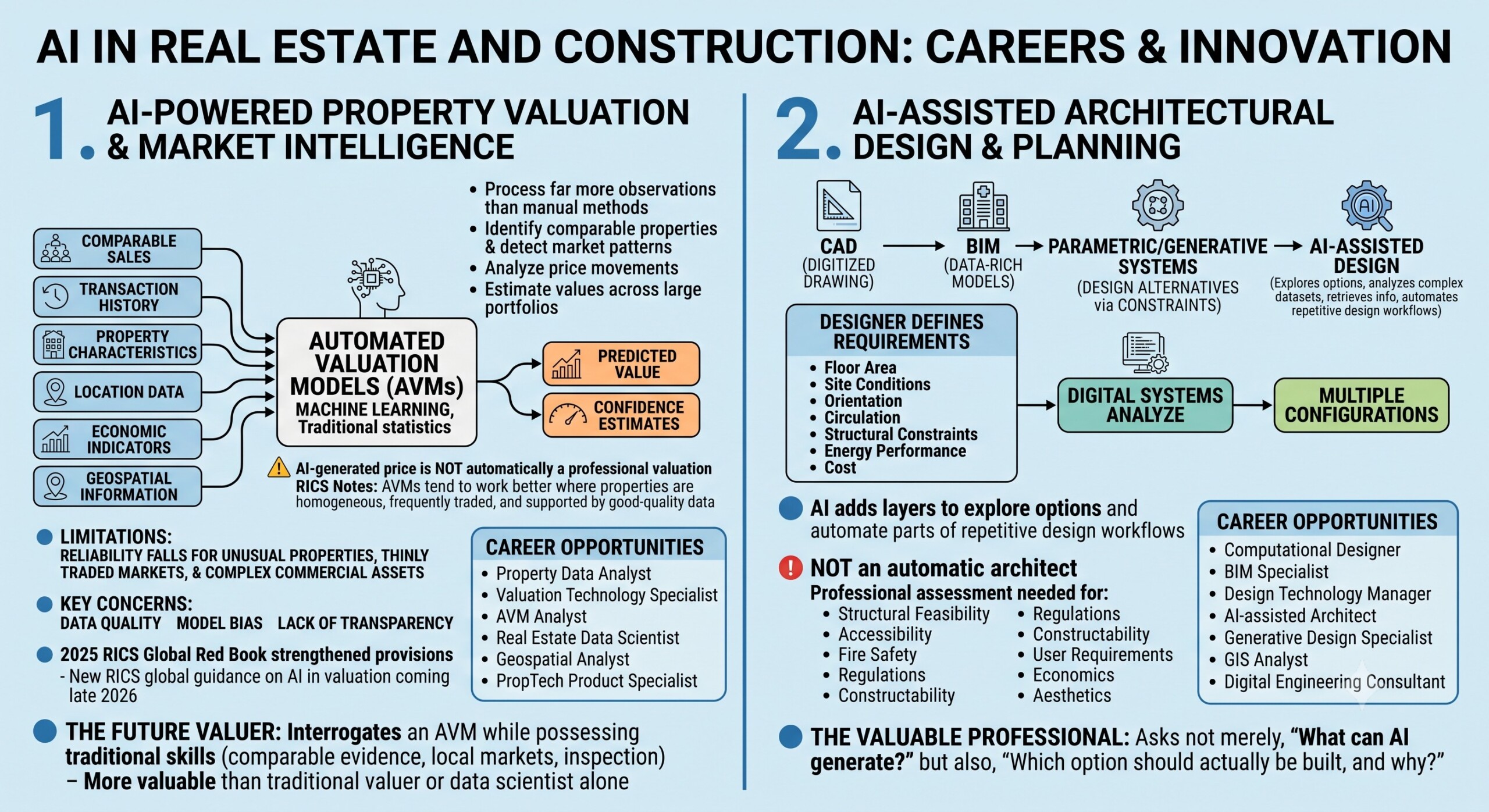
Automated Valuation Models, or AVMs, use property and market data to estimate values. Modern AVMs may use machine learning alongside more traditional statistical methods. Inputs can include comparable sales, transaction history, property characteristics, location data, economic indicators and geospatial information. Some systems also produce confidence estimates alongside the predicted value.
AI makes it possible to examine far more observations than an individual valuer could manually process. It can identify comparable properties, detect market patterns, analyse price movements and help estimate values across large portfolios. But an AI-generated price is not automatically a professional valuation.
RICS notes that AVMs tend to work better where properties are relatively homogeneous, frequently traded and supported by good-quality data. Their reliability can fall for unusual properties, thinly traded markets and complex commercial assets. Data quality, model bias and lack of transparency are important concerns. The 2025 RICS Global Red Book strengthened provisions dealing with models, automation and AI. RICS is also developing specific global guidance on AI in real estate valuation, with the guidance scheduled for publication later in 2026 following consultation.
This creates opportunities for property data analysts, valuation technology specialists, AVM analysts, real estate data scientists, geospatial analysts and PropTech product specialists.
A future valuer who understands comparable evidence, local markets and property inspection but can also interrogate an AVM may be considerably more valuable than either a traditional valuer with no data skills or a data scientist with little understanding of property.
2. AI-assisted architectural design and planning
Architecture and engineering are also moving towards AI-assisted design environments.
Traditional computer-aided design digitised drawing. BIM created data-rich models of buildings. Parametric and generative systems made it possible to produce alternatives by changing constraints and design parameters. AI adds another layer by helping professionals explore options, analyse complex datasets, retrieve information and automate parts of repetitive design workflows.
A designer might define requirements relating to floor area, site conditions, orientation, circulation, structural constraints, energy performance or cost. Digital systems can then help analyse different configurations far faster than manually developing every alternative. AI should not be confused with an automatic architect. A generated layout still needs professional assessment for structural feasibility, accessibility, fire safety, regulations, constructability, user requirements, economics and aesthetics.
Career opportunities consequently extend beyond conventional architecture. They include computational designers, BIM specialists, design technology managers, AI-assisted architects, generative design specialists, GIS analysts and digital engineering consultants.
The valuable professional will be someone who can ask not merely, “What can AI generate?” but also, “Which option should actually be built, and why?” A constantly updated Whatsapp channel awaits your participation.

3. AI for construction monitoring and digital twins
Once construction begins, AI gains another important source of information: the physical jobsite.
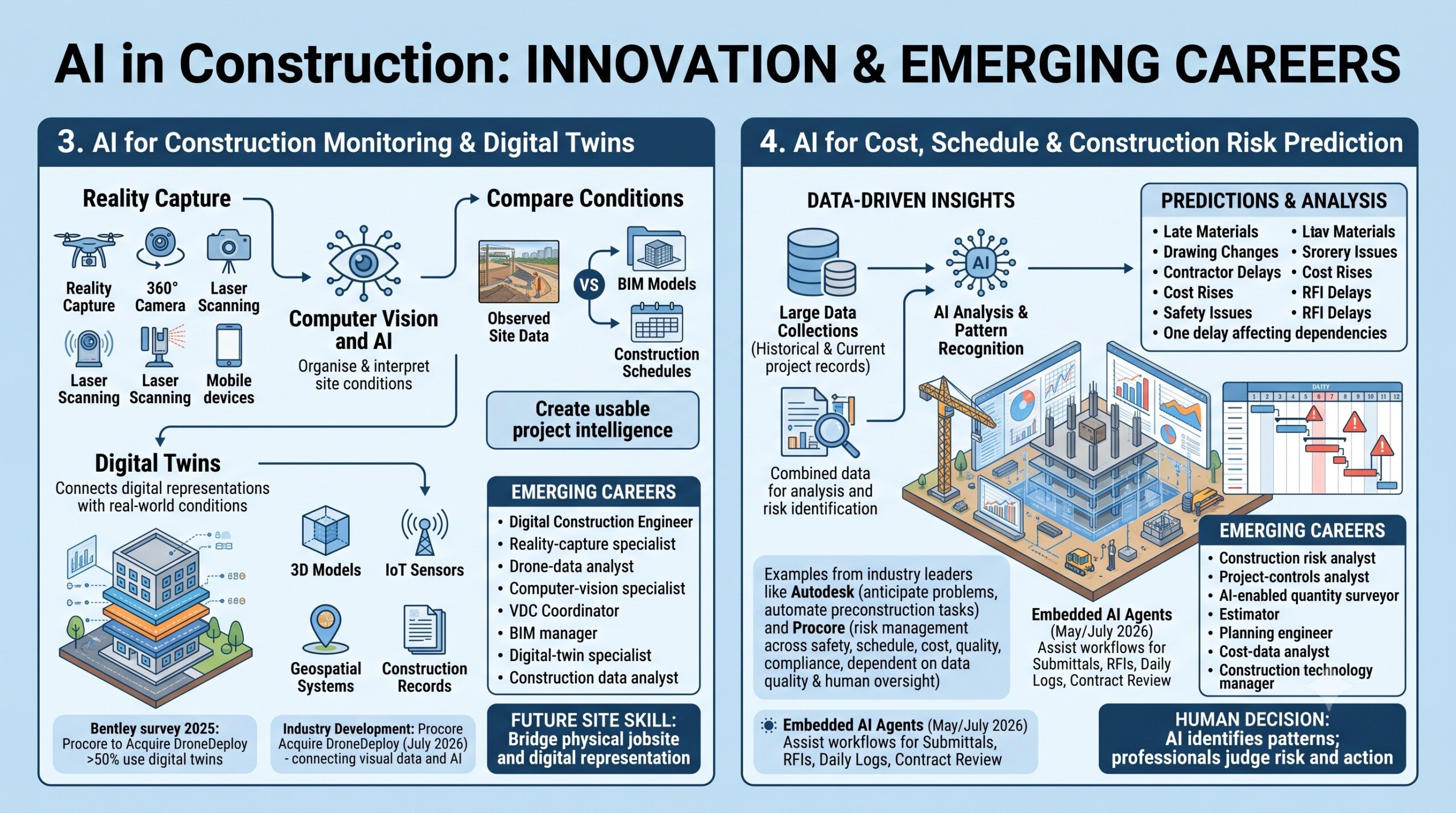
Construction companies increasingly capture site conditions using photographs, drones, 360-degree cameras, laser scanning, mobile devices and other forms of reality capture. Computer vision and related AI techniques can help organise and interpret this information.
Teams can compare observed conditions with BIM models or construction schedules, document work completed, identify deviations and create better records of project progress. The underlying purpose is not simply to create more images. It is to turn visual information into usable project intelligence.
A significant market development occurred in July 2026 when Procore announced an agreement to acquire DroneDeploy, a reality-capture and robotics company. Procore said DroneDeploy’s technology had been used on more than three million jobsites across more than 180 countries. The announcement illustrates how construction management platforms are increasingly connecting project records with aerial and ground-based visual data, AI and robotics.
Digital twins take the concept further. A digital twin connects digital representations of an asset with data describing its real-world condition. Depending on the application, information may come from 3D models, geospatial systems, IoT sensors, construction records and operating systems.
A 2025 Bentley survey of 2,000 infrastructure professionals found that more than half were already using digital twins on at least some projects. Bentley describes digital twins as being used across design, construction and operations, with analytics and simulation helping teams understand present conditions and test future scenarios.
This creates careers such as digital construction engineer, reality-capture specialist, drone-data analyst, computer-vision specialist, VDC coordinator, BIM manager, digital-twin specialist and construction data analyst.
The construction site of the future will therefore need people who understand both the concrete being poured on the ground and the digital representation of that concrete inside the project information system.
4. AI for cost, schedule and construction risk prediction
Every construction project operates under uncertainty. Materials may arrive late. Drawings may change. Contractors may fall behind schedule. Costs can rise. Safety issues may emerge. Requests for information can remain unresolved. One delay can affect several dependent activities.
AI is particularly suited to analysing large collections of project records and identifying patterns that deserve attention.
Historical information from previous projects can be combined with data from the current project to support schedule analysis, risk identification, estimating, scope review and project controls. Autodesk has highlighted applications in which construction teams analyse previous project information to anticipate future problems and automate repetitive tasks in design and preconstruction.
Procore’s September 2025 discussion of AI-based risk management similarly stressed applications across safety, schedule, cost, quality and compliance, while warning that the technology remains dependent on data quality and appropriate human oversight.
The field moved further in 2026 as construction software companies began embedding AI agents into everyday workflows. In May 2026, Procore announced agents designed to work with drawings, specifications and photographs and assist with processes such as submittals, requests for information, daily logs and contract review. In July it announced additional pre-built agents and configurable AI workflows. These are vendor products rather than evidence that construction has become autonomous, but they demonstrate the direction in which mainstream construction software is developing.
For professionals, this creates opportunities for construction risk analysts, project-controls analysts, AI-enabled quantity surveyors, estimators, planning engineers, cost-data analysts and construction technology managers.
AI can identify a pattern. An experienced project professional still has to decide whether that pattern represents a real project risk and what should be done about it. Excellent individualised mentoring programmes available.
5. Construction automation, robotics and physical AI
Some AI applications remain entirely digital. Construction automation is different because algorithms increasingly interact with machines operating in the physical world.
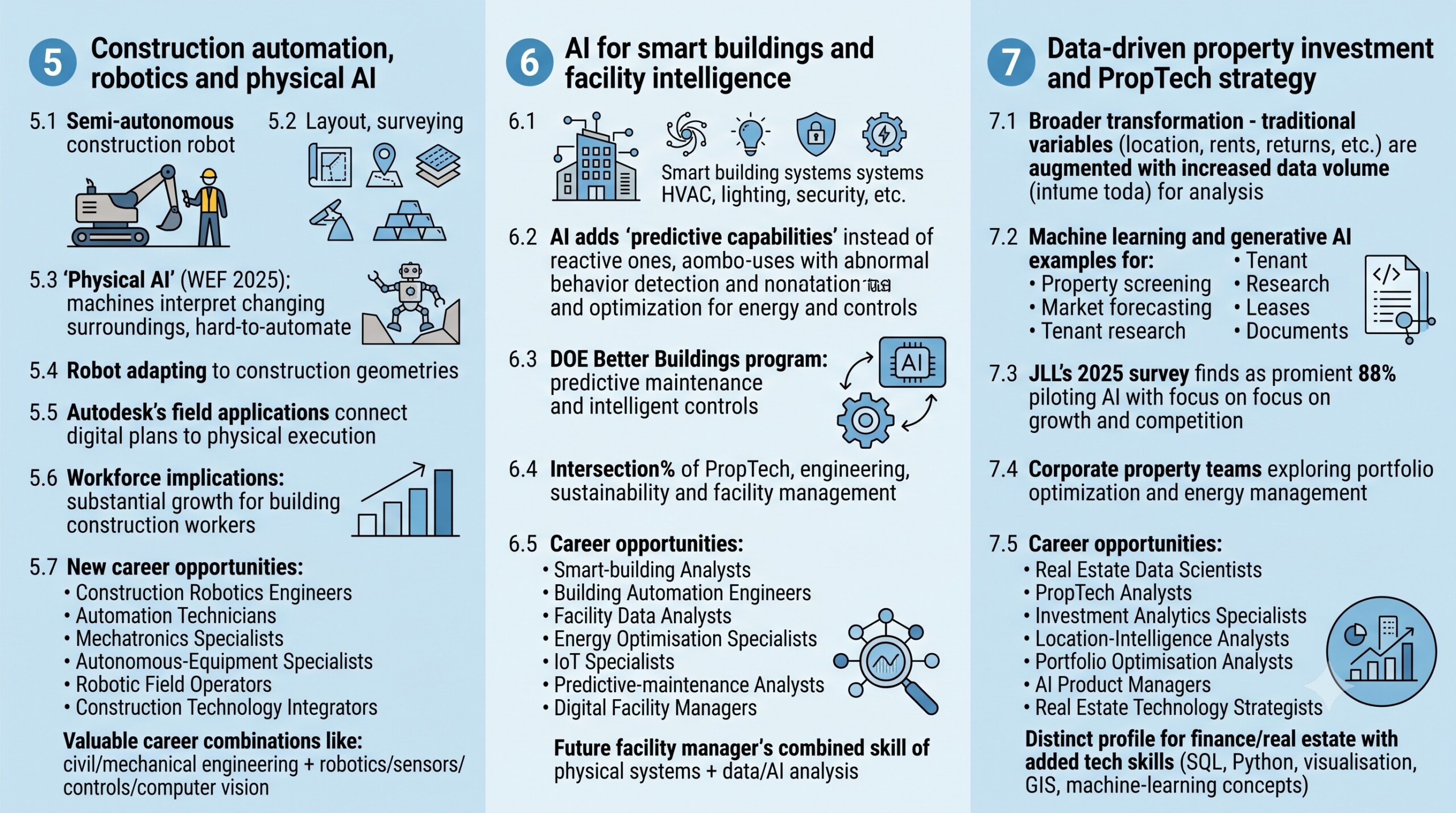
Robotic and semi-autonomous systems can assist with tasks such as layout, surveying, inspection, material handling and other repetitive or physically demanding activities. AI-based perception can help machines interpret changing surroundings rather than operate only within highly controlled industrial environments.
This is especially significant because construction sites are harder to automate than factories. The environment changes continuously as the building develops, workers and equipment move around the site, weather conditions change and each project may be different.
The World Economic Forum describes the convergence of AI, sensing and robotics as “physical AI”, in which machines gain greater capabilities for perception and autonomous action. Its 2025 work on heavy industry also noted that mobile robots using sensors, perception systems and AI can increasingly adapt to changing geometries and tasks in complex environments such as construction zones.
Autodesk’s April 2026 discussion of construction robotics highlighted practical field applications that connect digital plans with physical execution, while its 2026 construction trends analysis identified robotics, autonomous equipment and AI-based inspection as areas moving from experimentation towards wider project use.
The workforce implication is more complicated than simply saying robots will replace construction workers. The World Economic Forum expects robotics and autonomous systems to displace some tasks and jobs globally, but its Future of Jobs research also lists building construction workers among occupations expected to experience substantial absolute employment growth through 2030.
New opportunities are likely for construction robotics engineers, automation technicians, mechatronics specialists, autonomous-equipment specialists, robotic field operators and construction technology integrators.
Knowledge of civil or mechanical engineering combined with robotics, sensors, computer vision and controls can become an unusually valuable career combination.
6. AI for smart buildings and facility intelligence
AI’s role does not end when construction is completed. In many cases, the operational phase of a building lasts for decades and can generate far more data than the original construction project.
Modern buildings may contain sensors and connected systems for heating, ventilation and air conditioning, lighting, access control, elevators, fire protection, electricity consumption, occupancy and other functions.
AI and machine learning add predictive capabilities. Instead of simply responding after equipment fails, systems can analyse operational information to help identify abnormal behaviour and support preventive or predictive maintenance. They can also help optimise energy consumption and building controls.
The US Department of Energy’s Better Buildings programme in 2025 identified applications ranging from preventive maintenance to advanced building process controls. Its 2026 programme has continued to highlight AI for predictive maintenance, intelligent facility controls, energy optimisation and operational performance.
This creates an important intersection between PropTech, engineering, sustainability and facilities management.
Career opportunities include smart-building analysts, building automation engineers, facility data analysts, energy optimisation specialists, IoT specialists, predictive-maintenance analysts and digital facility managers.
A facility manager of the future may need to understand an air-conditioning plant and an energy dashboard, but also know enough about data and AI to question why a predictive model is recommending a particular intervention. Subscribe to our free AI newsletter now.
7. Data-driven property investment and PropTech strategy
Perhaps the broadest transformation is occurring in real estate investment itself.
Investors traditionally analyse location, rents, vacancy, tenant quality, comparable transactions, interest rates, development pipelines, demographic trends and expected returns. AI does not eliminate those variables. It increases the volume of information that can potentially be analysed together.
Machine learning and modern analytics can support property screening, portfolio analysis, market forecasting, rent analysis, tenant research, location intelligence and scenario modelling. Generative AI can also make large collections of research reports, leases, property documents and internal records easier to search and summarise, although important investment decisions still require verification and professional judgement.
JLL’s 2025 survey of more than 500 senior real estate investment decision-makers across 15 markets found that 88 percent had begun piloting AI and were pursuing an average of five use cases. Significantly, JLL reported that investors were shifting their emphasis beyond operational efficiency towards applications connected with growth and competitive positioning.
Corporate property teams are exploring similar approaches. JLL found that portfolio optimisation, energy management and data-related workflows were among the areas receiving attention from corporate real estate organisations.
This creates roles such as real estate data scientist, PropTech analyst, investment analytics specialist, location-intelligence analyst, portfolio optimisation analyst, AI product manager and real estate technology strategist.
For someone coming from finance or real estate rather than computer science, the opportunity can be especially interesting. Understanding discounted cash flows, cap rates, yields, leases, occupancy and development economics while also knowing SQL, Python, visualisation tools, GIS or machine-learning concepts can create a powerful professional profile.
Conclusion
AI in real estate and construction is not one career field. It is becoming a technological layer running across the entire lifecycle of the built environment.
Before construction, it can assist with market analysis, valuation, site assessment and design. During construction, it can support estimating, planning, monitoring, documentation, risk management and automation. After completion, it can help operate buildings, predict equipment problems, optimise energy consumption and provide intelligence about entire property portfolios.
The most promising careers therefore sit at the intersections: real estate plus data, architecture plus computational design, construction plus automation, engineering plus digital twins, facilities plus IoT, and investment plus analytics.
That is an important message for students and professionals considering careers in AI-enabled real estate and construction. They do not necessarily need to abandon architecture, civil engineering, quantity surveying, valuation, facilities management or real estate finance and become pure AI engineers. Upgrade your AI-readiness with our masterclass.