AI in Transportation, Mobility & Autonomous Vehicles Careers
AI in Transportation, Mobility & Autonomous Vehicles Careers
AI for route optimization, fleet intelligence, and traffic systems; Autonomous driving, driver-assistance systems, and safety validation; Mobility-as-a-service and intelligent logistics networks
Introduction
Artificial intelligence is moving transportation from a world of vehicles that are merely driven to one in which vehicles, fleets and road networks are increasingly sensed, predicted, optimized and automated. As of August 2026, some of the most mature applications are not futuristic robotaxis but practical systems already used for route planning, fleet management, predictive maintenance, driver safety, traffic optimization and logistics. Google Maps Platform, for example, supports fleet-wide route optimization and mid-day re-optimization, while U.S. transportation programmes are deploying smart signals and connected transportation systems to improve traffic flow and safety.
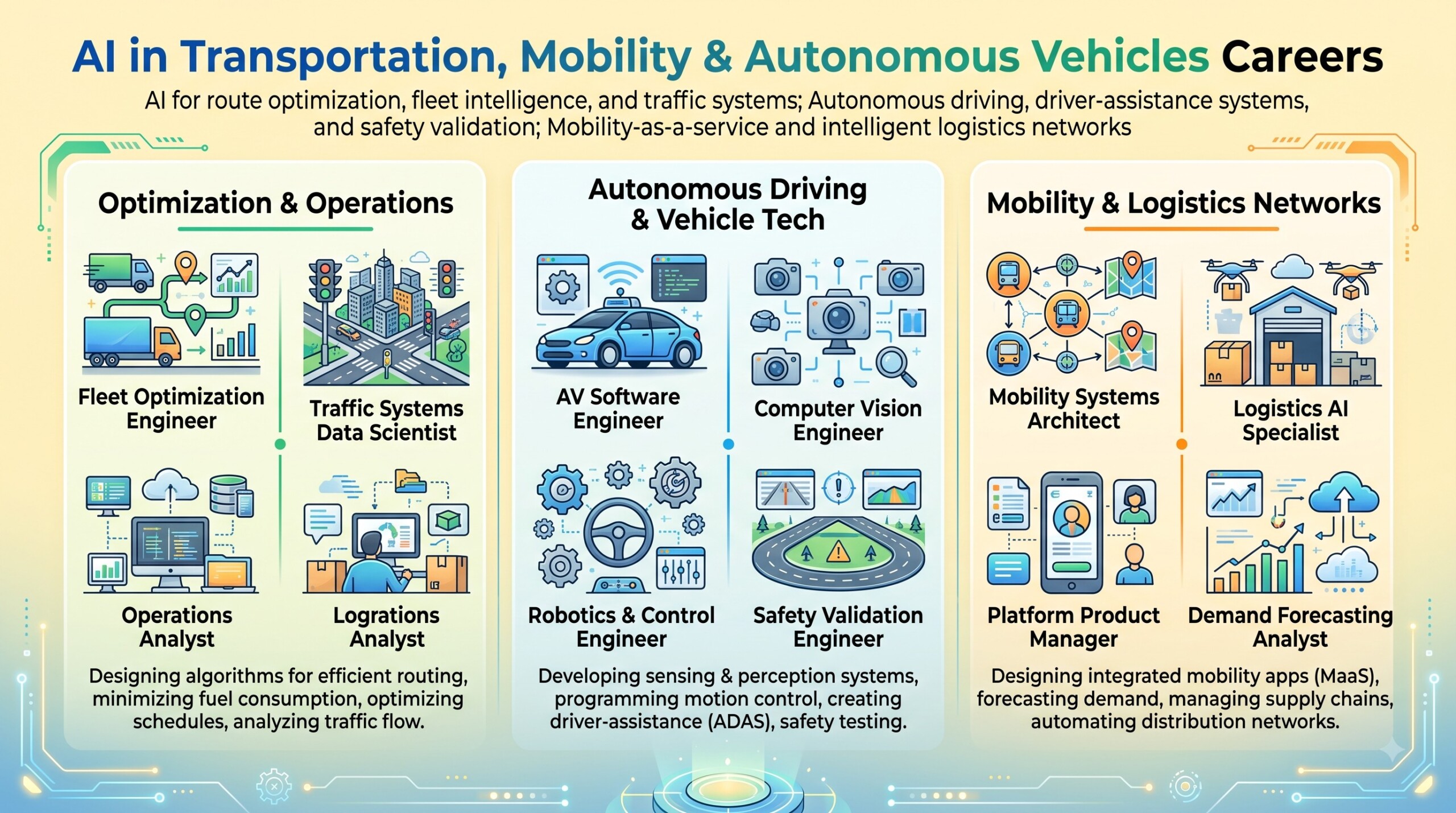
At the same time, autonomous transportation has moved well beyond the laboratory. Waymo says the public can now hail fully autonomous vehicles in a growing network of more than ten U.S. cities, while Aurora reported in July 2026 that its commercial driverless-trucking network had expanded to ten routes across the U.S. Sun Belt. Yet this does not mean every vehicle is about to become fully autonomous. The larger career opportunity lies across the entire technology stack—from analytics and optimization to ADAS, robotics, simulation, safety engineering, remote assistance and intelligent logistics. An excellent collection of learning videos awaits you on our Youtube channel.
Let’s dive deep into this.
1. Route optimization and intelligent traffic systems
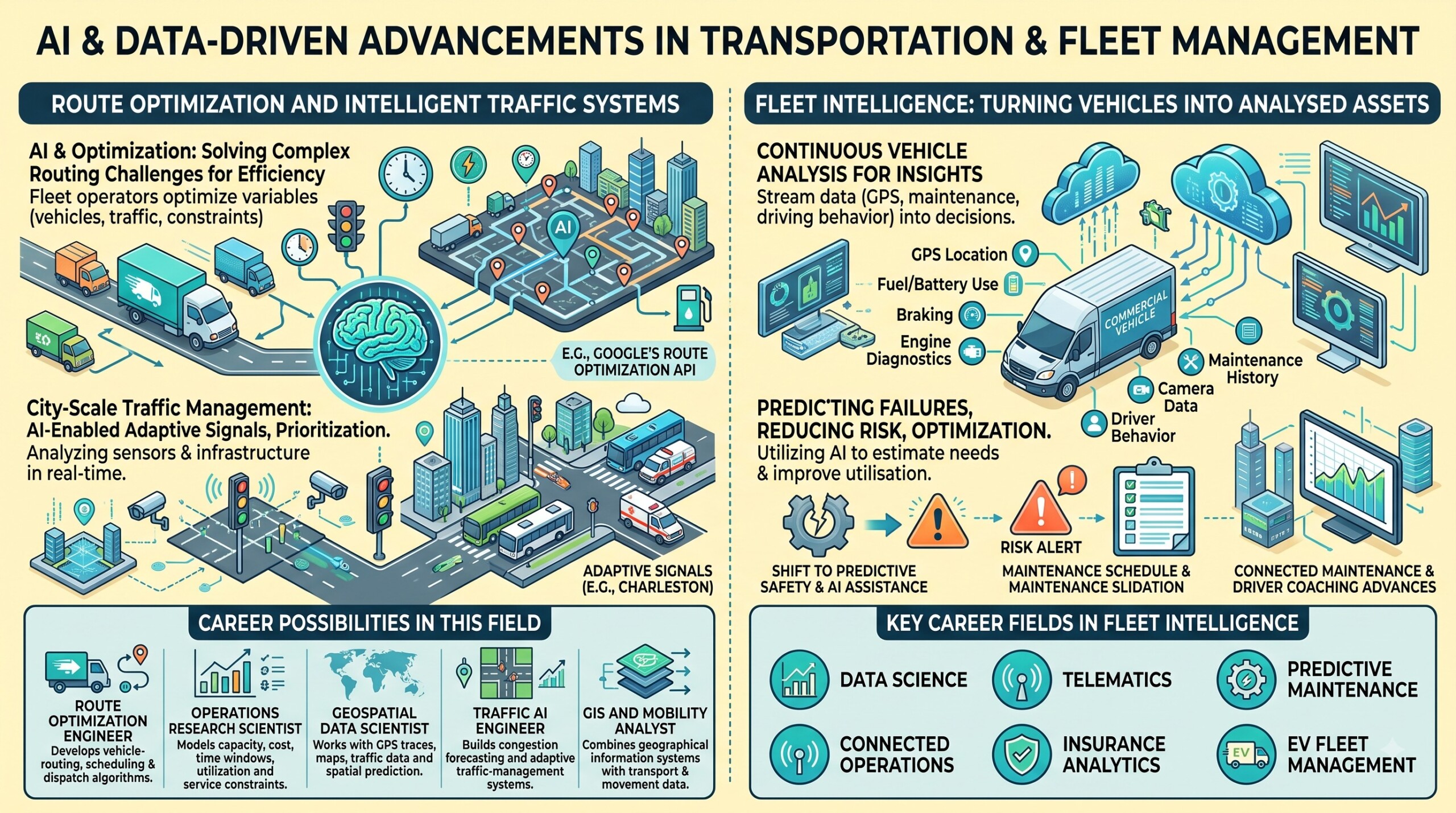
Transportation is fundamentally an optimization problem. A fleet operator may have hundreds of vehicles, thousands of deliveries, changing traffic conditions, vehicle capacities, driver working-hour restrictions and customers expecting precise arrival times. AI, operations research and mathematical optimization can continually evaluate these variables and decide which vehicle should perform which task, in what sequence and along which route. Google’s Route Optimization API, for example, assigns tasks and routes across fleets according to objectives and constraints such as time, distance, capacity, working hours and delivery windows.
The same thinking applies at city scale. AI-enabled traffic management can analyse information from road sensors, cameras and connected infrastructure and dynamically alter signals or routing decisions. The U.S. Department of Transportation highlighted AI-enabled adaptive signals in Charleston that monitor road activity in real time, while other SMART transportation projects include signal prioritization for buses, transit and emergency services. This creates a career field combining AI with civil engineering, geography, urban systems and operations research.
Career possibilities include:
- Route optimization engineer — develops vehicle-routing, scheduling and dispatch algorithms.
- Operations research scientist — models capacity, cost, time windows, utilization and service constraints.
- Geospatial data scientist — works with GPS traces, maps, traffic data and spatial prediction.
- Traffic AI engineer — builds congestion forecasting and adaptive traffic-management systems.
- GIS and mobility analyst — combines geographical information systems with transport and movement data.
2. Fleet intelligence: turning vehicles into continuously analysed assets
Commercial vehicles increasingly generate continuous streams of operational information. GPS location can be combined with mileage, fuel or battery use, braking events, engine diagnostics, maintenance history, camera data and driver behaviour. AI can convert these streams into decisions: predicting failures, identifying risky driving patterns, estimating maintenance needs, reducing idling, improving vehicle utilization or deciding which assets should be replaced.
This sector is advancing particularly quickly. Geotab’s 2026 commercial-transportation report draws on more than 5.8 million vehicle subscriptions and describes a shift toward predictive safety and conversational AI for fleet operations. Samsara’s June 2026 announcements added AI capabilities for connected maintenance, including tools intended to predict, prevent and automate maintenance work, while its March 2026 safety updates expanded AI-assisted driver coaching. Careers therefore span data science, telematics, predictive maintenance, connected operations, insurance analytics and EV fleet management. A constantly updated Whatsapp channel awaits your participation.

3. ADAS careers: AI that assists the human driver
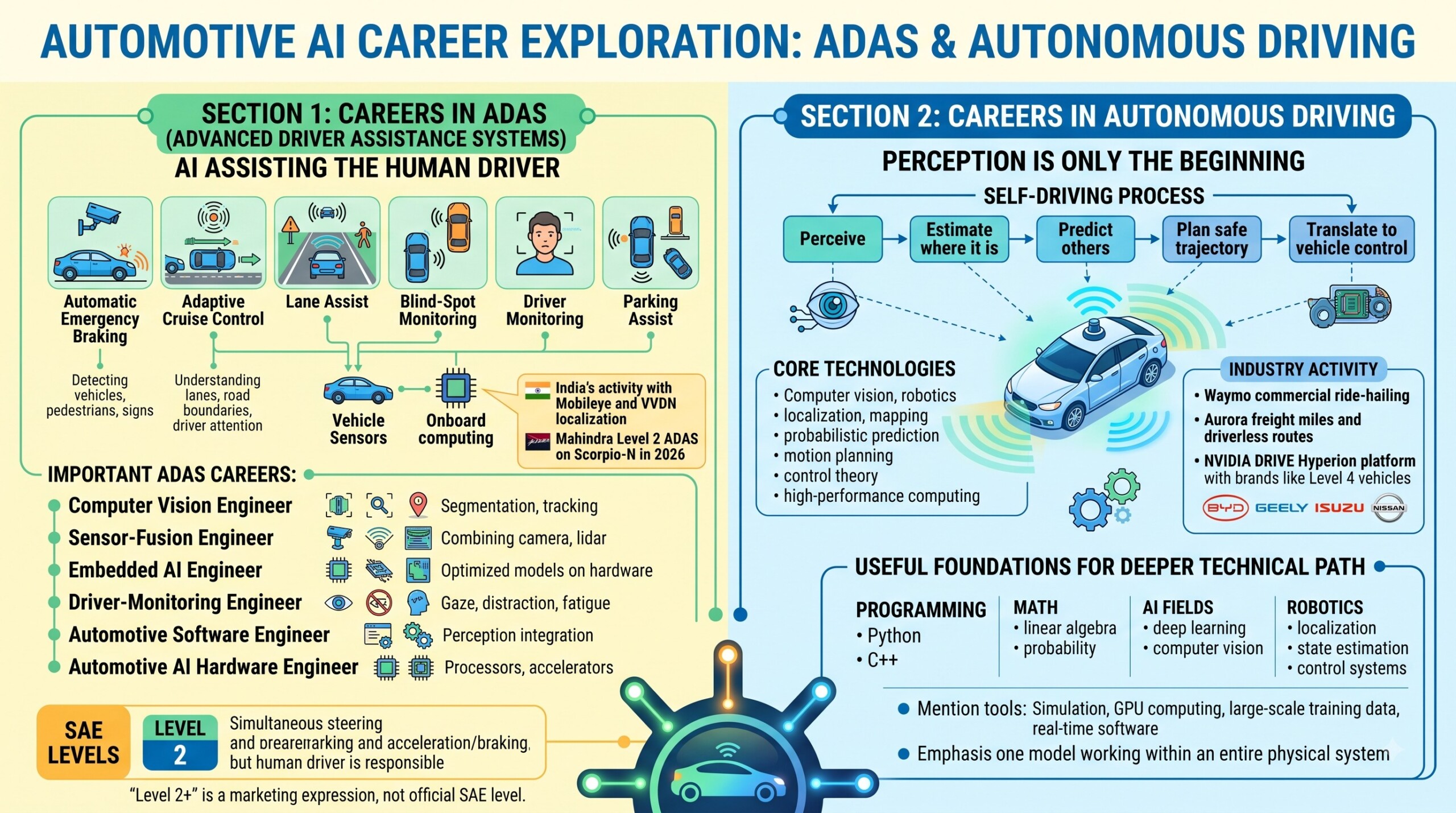
Advanced driver-assistance systems, or ADAS, represent one of the most important employment areas in automotive AI. Features such as automatic emergency braking, adaptive cruise control, lane assistance, blind-spot monitoring, driver monitoring and parking assistance depend on cameras, radar, sometimes lidar, vehicle sensors and increasingly sophisticated onboard computing. These systems require AI not only to detect vehicles and pedestrians but also to understand lanes, signs, road boundaries, driver attention and complex traffic situations.
The commercial ecosystem continues to expand. Mobileye’s current product portfolio ranges from ADAS to SuperVision, Chauffeur and its Mobileye Drive autonomous-driving system; in July 2026 it also announced cloud-enhanced ADAS for future Stellantis vehicles. In India, the market is moving rapidly as well: Mobileye and VVDN have been working on localization of ADAS technology, while Mahindra announced Level 2 ADAS on the Scorpio-N in August 2026.
Important careers include:
- Computer vision engineer — develops detection, segmentation, tracking and scene-understanding systems.
- Sensor-fusion engineer — combines camera, radar, lidar, GPS and inertial-sensor information.
- Embedded AI engineer — makes AI models run efficiently on automotive hardware.
- Driver-monitoring engineer — develops systems for gaze, distraction, fatigue and attention detection.
- Automotive software engineer — integrates perception and assistance functions with the rest of the vehicle.
- Automotive AI hardware engineer — works on processors, accelerators, cameras, radar and automotive compute platforms.
An important terminology point is worth remembering. SAE J3016 defines six levels of driving automation, Levels 0 through 5. “Level 2+” is an industry or marketing expression rather than an additional official SAE level. At SAE Level 2, the system may simultaneously assist steering and acceleration/braking, but the human driver remains responsible for supervising the driving task.
4. Autonomous driving: perception is only the beginning
A self-driving system needs much more than object recognition. It must first perceive the environment, then estimate where it is, predict what surrounding road users may do, plan a safe trajectory and finally translate that decision into steering, acceleration and braking. These capabilities bring together computer vision, robotics, localization, mapping, probabilistic prediction, motion planning, control theory and high-performance computing.
Commercial activity in 2026 demonstrates why these skills are becoming increasingly relevant. Waymo is operating fully autonomous ride-hailing at commercial scale and is preparing fully autonomous operations in additional cities. Aurora reported nearly 440,000 driverless miles by the end of June 2026 and ten driverless routes across its commercial freight network. NVIDIA announced in March that BYD, Geely, Isuzu and Nissan were developing Level 4-ready vehicles on its DRIVE Hyperion platform. These are different business and technology models, but together they show that autonomous-driving careers now extend beyond research into deployment engineering, fleet operations, simulation and production systems.
For someone seeking the deeper technical path, useful foundations include Python, C++, linear algebra, probability, deep learning, computer vision, robotics, localization, state estimation and control systems. Tools and concepts involving simulation, GPU computing, large-scale training data and real-time software are also increasingly important because an autonomous-driving model must work within an entire physical system rather than merely achieve a good benchmark score. Excellent individualised mentoring programmes available.
5. Safety validation is becoming a major AI profession
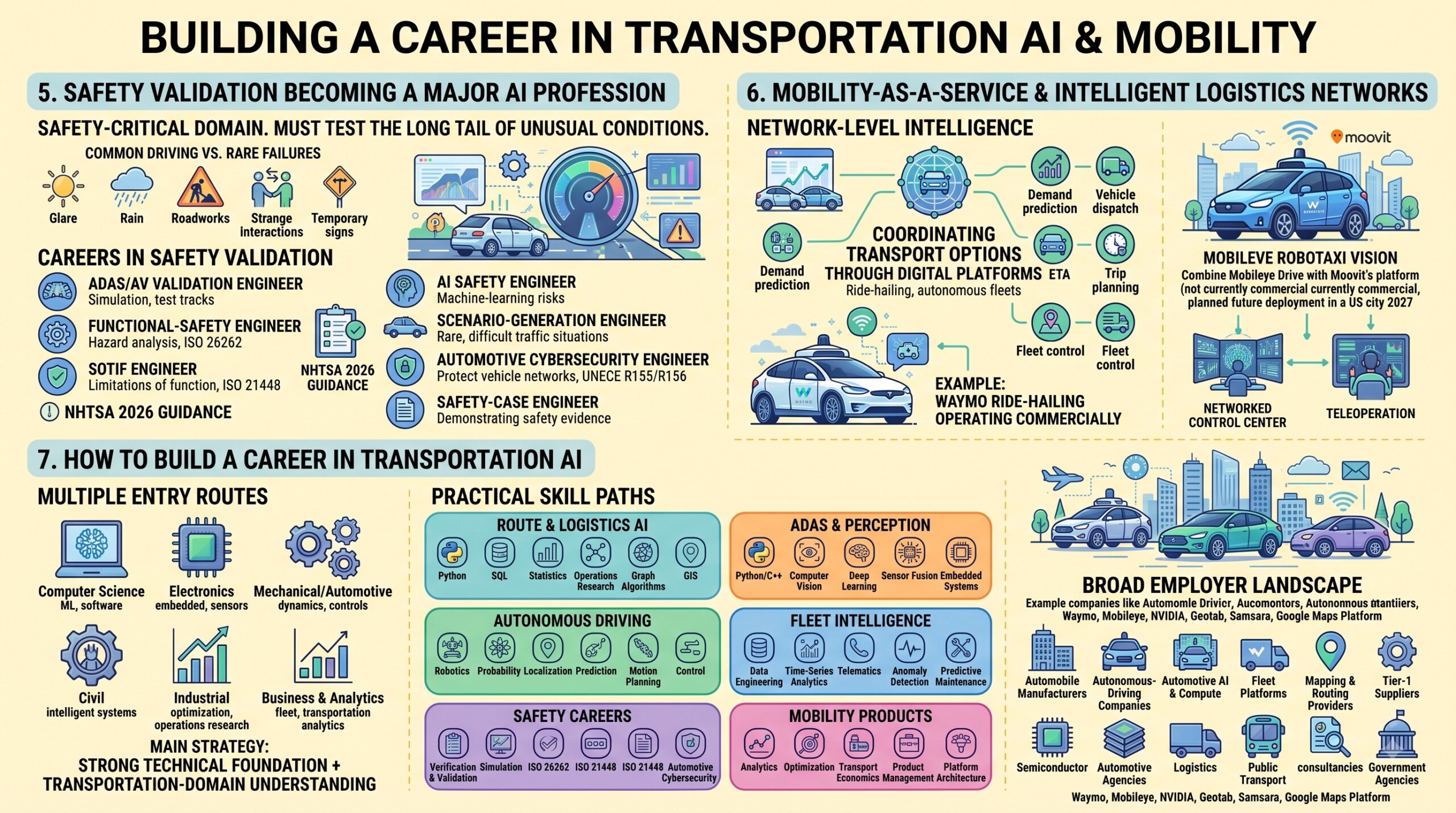
Autonomous transportation is a safety-critical domain. A model that works correctly 99% of the time may still be unacceptable if the remaining failures occur around pedestrians, cyclists, emergency vehicles or high-speed traffic. Developers therefore need to test not only common driving but the huge “long tail” of unusual conditions – glare, rain, roadworks, strange intersections, temporary signs, unusual vehicle behaviour, sensor degradation and situations the system has rarely encountered.
Regulation and safety engineering are consequently becoming substantial career domains of their own. NHTSA’s updated July 30, 2026 guidance asks automated-driving applicants to address the operational design domain, fallback behaviour, remote operations, safety cases, verification and validation, sensor limitations, software updates and interactions with first responders.
This creates careers such as:
- ADAS/AV validation engineer — tests automated systems in simulation, test tracks and real-world scenarios.
- Functional-safety engineer — works with hazard analysis, safety goals and ISO 26262.
- SOTIF engineer — investigates unsafe behaviour caused by limitations in intended system functionality.
- AI safety engineer — evaluates machine-learning risks, uncertainty, failure conditions and safety evidence.
- Scenario-generation engineer — builds rare, difficult and adversarial traffic situations for testing.
- Automotive cybersecurity engineer — protects vehicle networks, connectivity and software updates.
- Safety-case engineer — organizes evidence demonstrating why an automated system is acceptably safe within its defined operating conditions.
UNECE Regulations R155 and R156, dealing respectively with cybersecurity management and software-update management, further illustrate why the future automotive workforce needs expertise beyond conventional mechanical engineering.
6. Mobility-as-a-service and intelligent logistics networks
The intelligence of future transportation will not exist only inside vehicles. It will increasingly exist at the network level. Mobility-as-a-service aims to coordinate different transport options through digital platforms, while ride-hailing and autonomous fleets require systems for demand prediction, vehicle dispatch, repositioning, estimated arrival times, matching, trip planning and fleet control. When the vehicle itself becomes autonomous, software must coordinate both the driving intelligence and the commercial mobility operation.
This convergence is already visible. Waymo is operating fully autonomous ride-hailing in a growing number of cities. In June 2026, Mobileye announced plans to create its own vertically integrated robotaxi operation beginning in a U.S. city in 2027, combining Mobileye Drive with Moovit’s mobility platform, fleet-management technology, mission control and teleoperation infrastructure. The service is still a planned future deployment, rather than a current commercial Mobileye robotaxi service, but the architecture shows the direction in which autonomous mobility platforms are evolving. Subscribe to our free AI newsletter now.
7. How to build a career in transportation AI
There is no single route into this industry. Computer-science graduates may enter through machine learning, software engineering or computer vision; electronics engineers through embedded systems and sensors; mechanical and automotive engineers through vehicle dynamics and controls; civil engineers through intelligent transportation systems; and industrial engineers through optimization and operations research. Business and analytics graduates can also enter through fleet intelligence, transportation analytics, logistics and mobility-product roles.
The strongest career strategy is to combine one strong technical foundation with genuine transportation-domain understanding. Transportation AI is difficult precisely because algorithms must survive physical roads, human behaviour, regulatory constraints, weather, hardware limitations and real operating economics. Knowing how to train a neural network is useful; knowing what problem the network is solving, what happens when it fails and how it fits into a safe transportation system is far more valuable.
A practical skill path could be:
- For route and logistics AI: Python, SQL, statistics, operations research, graph algorithms, optimization and GIS.
- For ADAS and perception: Python/C++, computer vision, deep learning, sensor fusion and embedded systems.
- For autonomous driving: robotics, probability, localization, prediction, motion planning and control.
- For fleet intelligence: data engineering, time-series analytics, telematics, anomaly detection and predictive maintenance.
- For safety careers: verification and validation, simulation, ISO 26262, ISO 21448, ISO/PAS 8800 and automotive cybersecurity.
- For mobility products: analytics, optimization, transport economics, product management and platform architecture.
The employer landscape is equally broad. Students should look beyond automobile manufacturers to autonomous-driving companies such as Waymo and Aurora; automotive-AI and compute companies such as Mobileye and NVIDIA; fleet platforms such as Geotab and Samsara; mapping and routing providers such as Google Maps Platform; Tier-1 suppliers, semiconductor companies, logistics operators, public-transport organizations, engineering consultancies and government transportation agencies.
Conclusion
AI in transportation is no longer one career called “self-driving cars.” It is a growing collection of professions concerned with how people, vehicles and goods move safely and efficiently through the physical world. One professional may optimize tomorrow morning’s delivery routes; another may analyse millions of connected-vehicle records; another may design the perception system of an ADAS vehicle; and another may spend years proving that an autonomous system behaves safely before it is allowed to operate without a driver.
This combination of AI, robotics, optimization, connected vehicles, intelligent logistics and safety engineering has become one of the most multidisciplinary career landscapes in technology. The most durable opportunities will belong to people who can connect powerful AI techniques with the realities of vehicles, roads, logistics networks, regulation and human safety. Upgrade your AI-readiness with our masterclass.