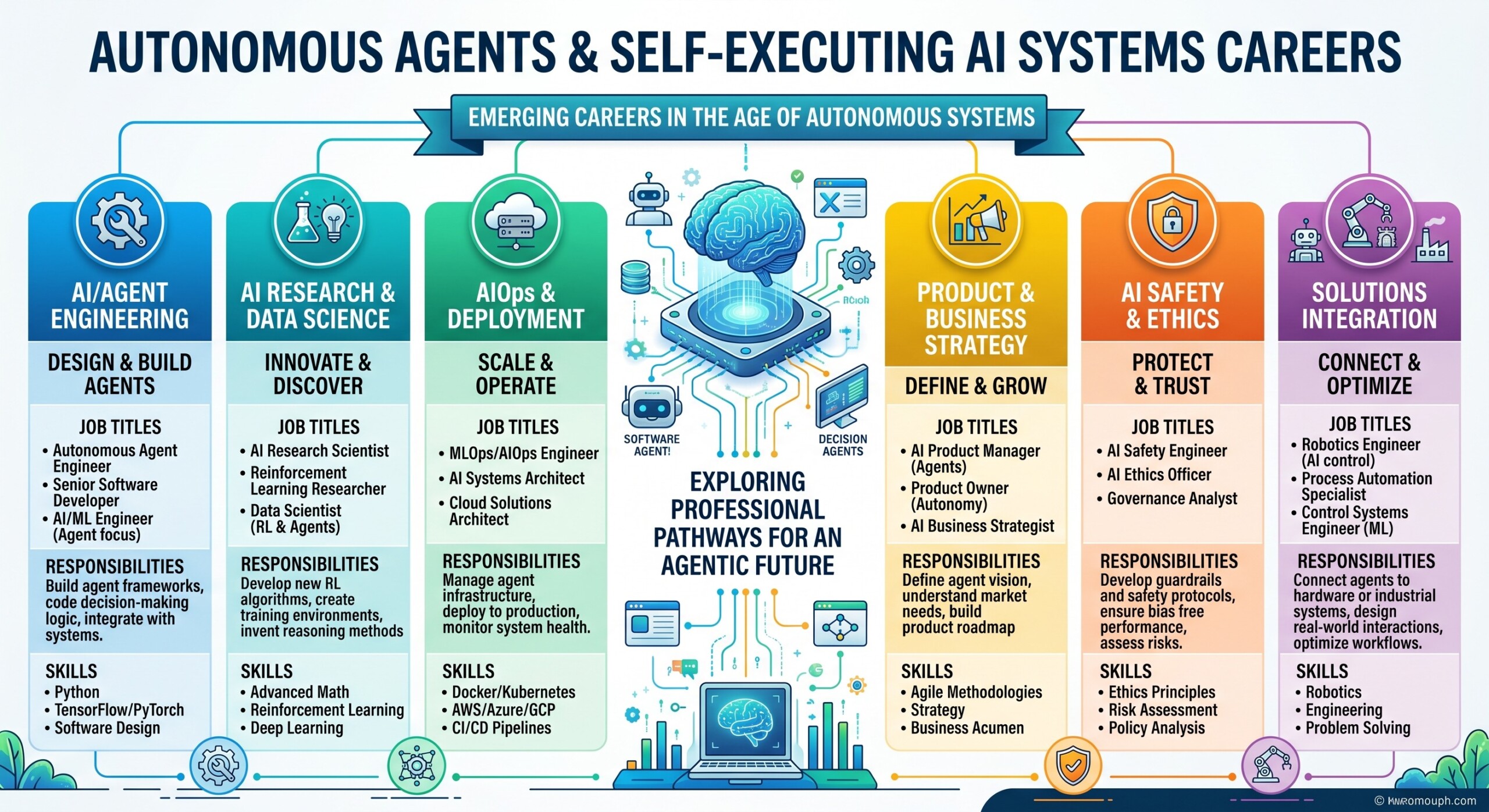
Autonomous Agents & Self-Executing AI Systems Careers
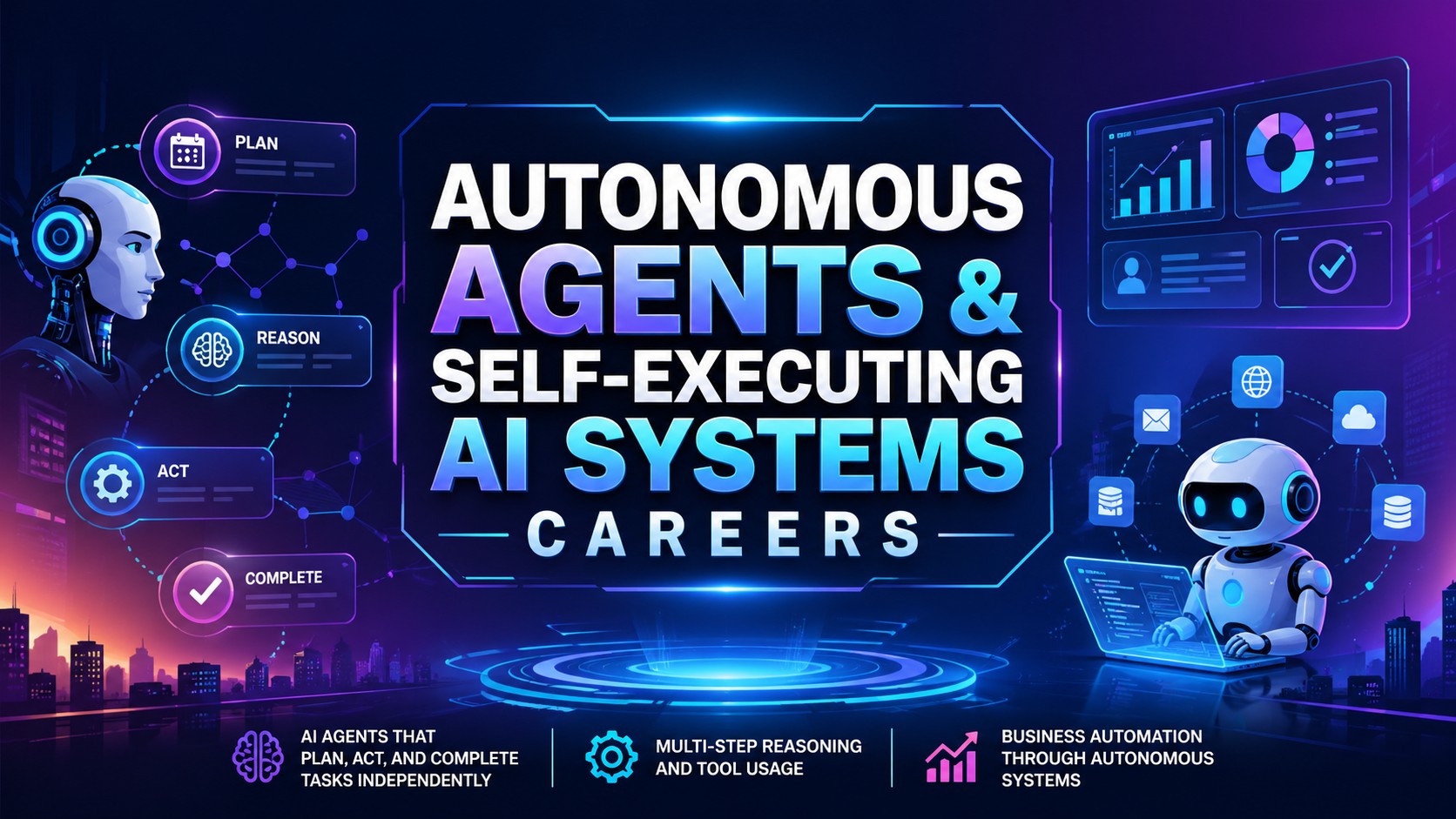
Autonomous Agents & Self-Executing AI Systems Careers
AI agents that plan, act, and complete tasks independently; Multi-step reasoning and tool usage;
Business automation through autonomous systems
Introduction
The year 2026 marks a decisive shift in artificial intelligence, moving from tools that respond to prompts to systems that independently plan, reason, and act toward goals. These systems, often called autonomous agents or agentic AI, represent the next evolution of AI. They are software entities capable of executing multi-step workflows, using tools, collaborating with other agents, and delivering outcomes with minimal human supervision.
Enterprises across finance, consulting, logistics, and technology are rapidly adopting these systems. Organizations are deploying AI agents for analysis, decision-making, and execution, making autonomous AI operational rather than experimental.
This transformation is not just technological. It is redefining careers, skills, and the nature of work itself. An excellent collection of learning videos awaits you on our Youtube channel.
1. From AI Tools to Autonomous decision systems
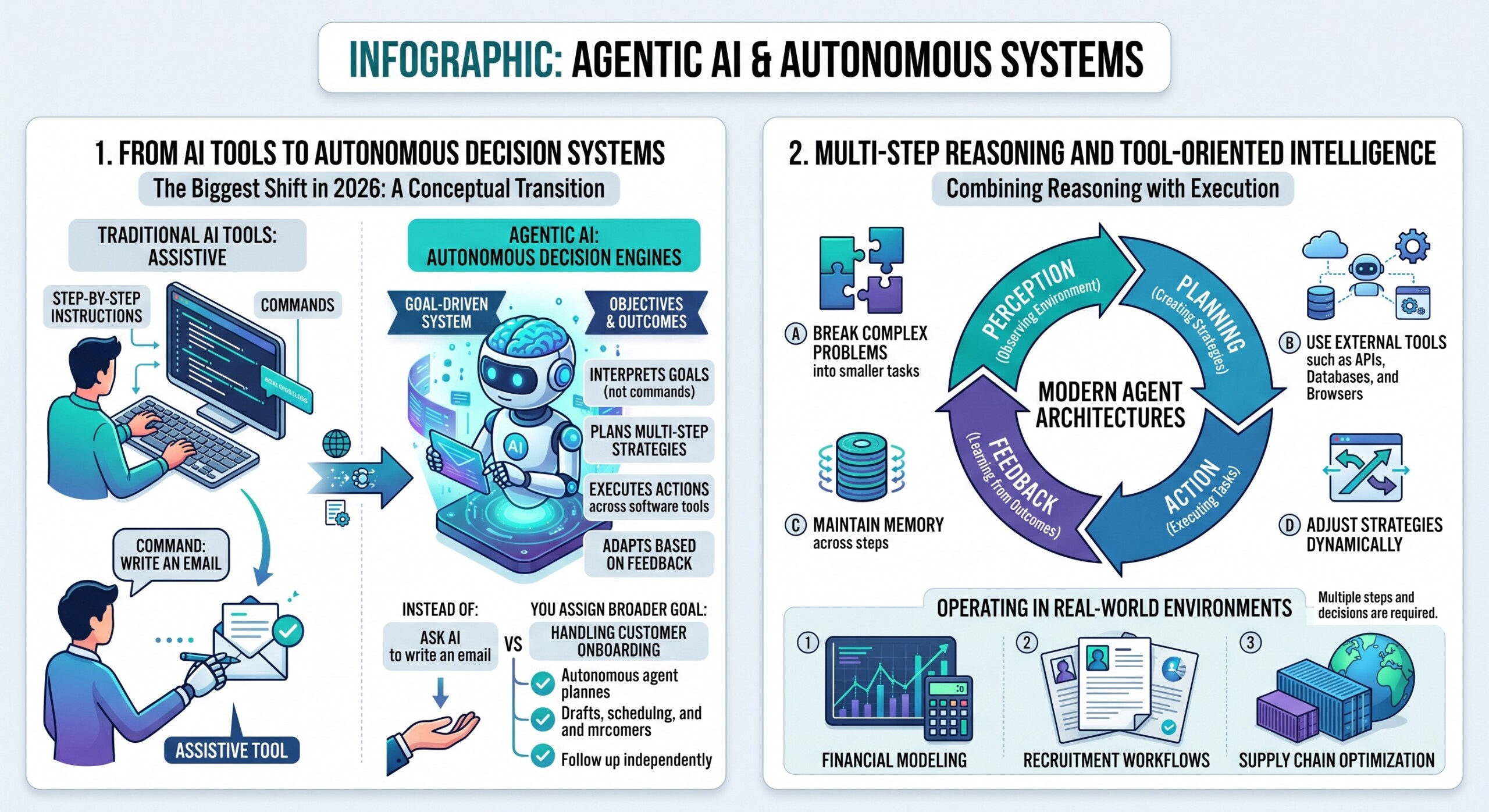
The biggest shift in 2026 is conceptual. AI is no longer just a tool. It is becoming a goal-driven system. Traditional AI required step-by-step instructions, but autonomous agents now operate based on objectives and outcomes.
These systems interpret goals instead of commands, plan multi-step strategies, execute actions across software tools, and adapt based on feedback. This transition defines agentic AI, where systems move from assistive tools to autonomous decision engines.
In practical terms, instead of asking AI to write an email, you assign a broader goal such as handling customer onboarding. The system then plans, drafts, schedules, and follows up independently.
2. Multi-Step Reasoning and Tool-oriented intelligence
Autonomous agents are powerful because they combine reasoning with execution. Unlike earlier models, they can:
- Break complex problems into smaller tasks
- Use external tools such as APIs, databases, and browsers
- Maintain memory across steps
- Adjust strategies dynamically
Modern agent architectures include perception, planning, action, and feedback loops. This allows them to operate in real-world environments such as financial modeling, recruitment workflows, and supply chain optimization, where multiple steps and decisions are required. A constantly updated Whatsapp channel awaits your participation.
3. Rise of Multi-Agent systems and digital workforces
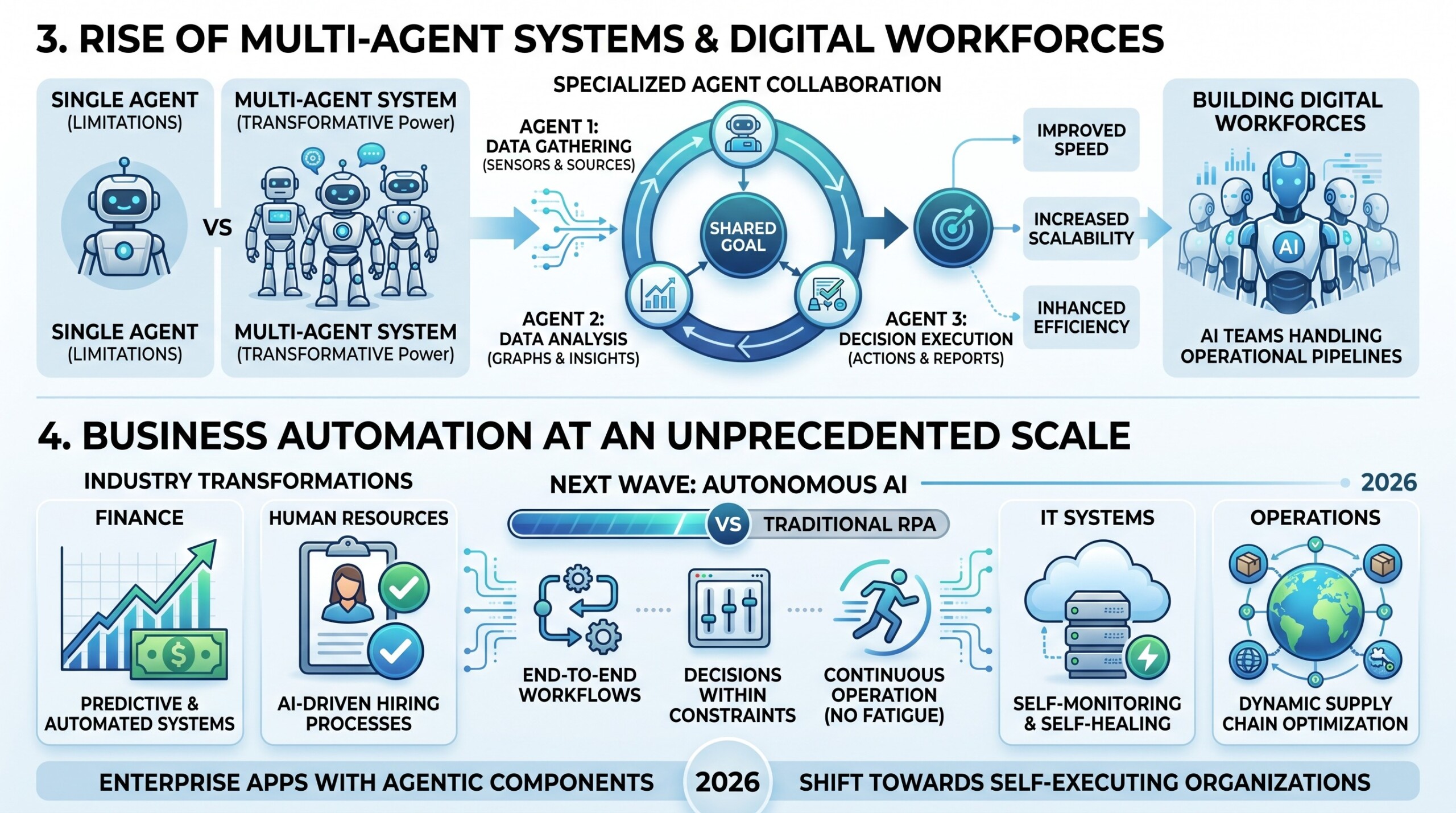
A single agent is powerful, but multiple coordinated agents are transformative. In 2026, organizations are increasingly deploying multi-agent systems where different agents specialize in specific tasks and collaborate toward a shared goal.
In such systems, one agent gathers data, another analyzes it, and a third executes decisions. This distributed approach improves speed, scalability, and efficiency while reducing dependence on human intervention for routine processes.
As a result, companies are building digital workforces, where teams of AI agents handle entire operational pipelines.
4. Business Automation at an unprecedented scale
Autonomous AI is driving the next wave of business automation, going far beyond traditional robotic process automation. These systems can run workflows end-to-end, make decisions within defined constraints, and operate continuously without fatigue.
Industries such as finance, human resources, IT, and operations are undergoing major transformation. Financial systems are becoming predictive and automated, hiring processes are increasingly AI-driven, IT systems are self-monitoring and self-healing, and supply chains are being optimized dynamically.
By 2026, many enterprise applications include agentic components, signaling a shift toward self-executing organizations. Excellent individualised mentoring programmes available.
5. Emerging career roles in Autonomous AI
This transformation is creating entirely new career paths.
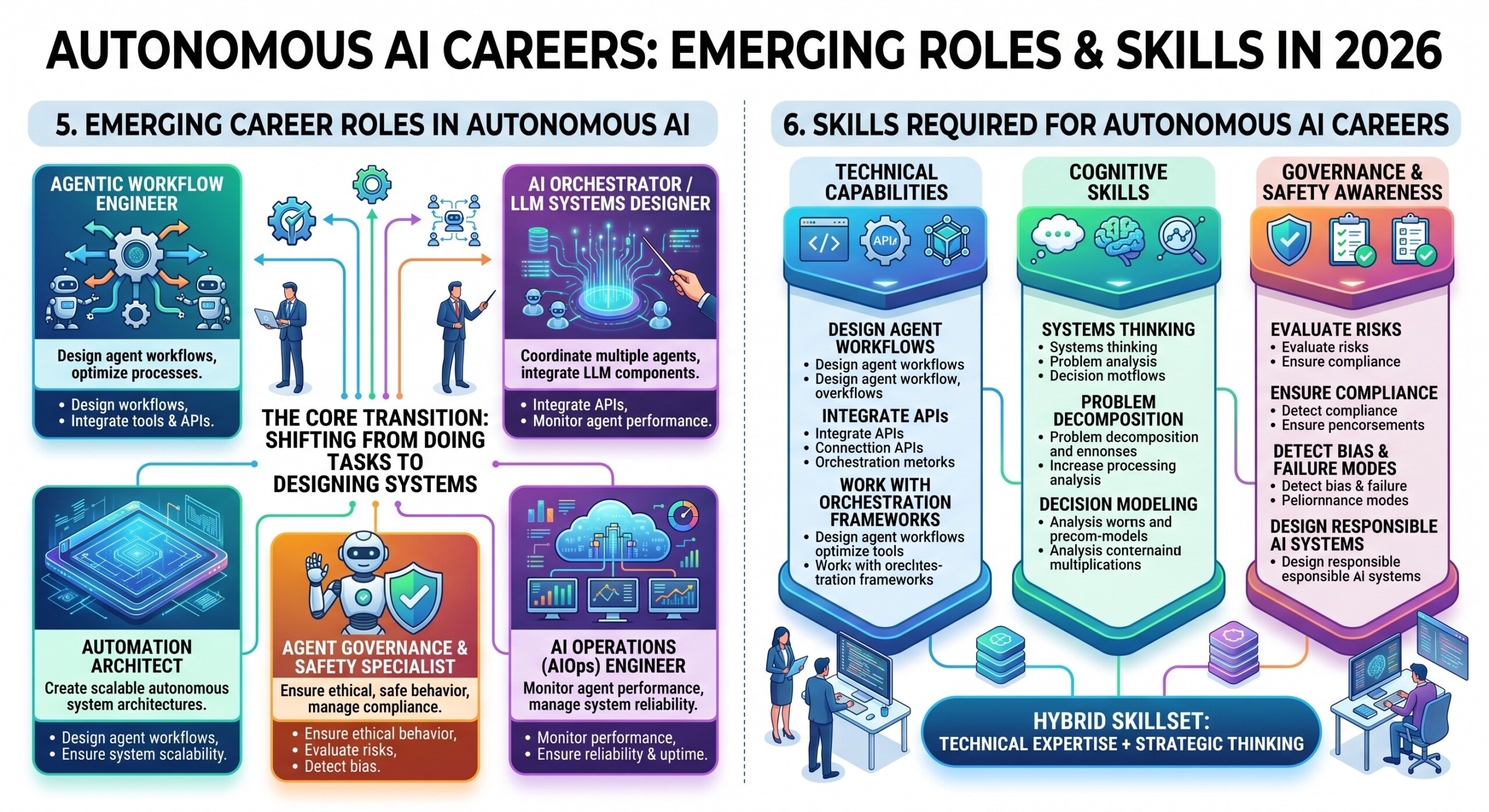
Core roles emerging in 2026:
- Agentic Workflow Engineer
- AI Orchestrator or LLM Systems Designer
- Automation Architect
- Agent Governance and Safety Specialist
- AI Operations (AIOps) Engineer
What these professionals do:
- Design agent workflows
- Integrate tools and APIs
- Monitor agent performance
- Ensure ethical and safe behavior
The focus is shifting from doing tasks to designing systems that perform tasks autonomously.
6. Skills Required for Careers in Autonomous AI
To succeed in this domain, professionals need a hybrid skillset that blends technical expertise with strategic thinking.
Technical capabilities include designing agent workflows, integrating APIs, and working with orchestration frameworks. At the same time, cognitive skills such as systems thinking, problem decomposition, and decision modeling are becoming essential.
In addition, governance and safety awareness is critical. Professionals must understand how to evaluate risks, ensure compliance, and detect bias or failure modes in autonomous systems. The ability to design responsible AI systems is becoming a core competency. Subscribe to our free AI newsletter now.
7. Challenges, Risks, and the Human Role
Despite its promise, autonomous AI introduces critical challenges.
Key risks:
- Loss of control as systems become more autonomous
- Incorrect or hallucinated decisions executed at scale
- Security vulnerabilities through tool misuse or prompt injection
- Ethical concerns regarding accountability
Why humans remain essential:
- Setting goals and defining constraints
- Monitoring system outputs
- Handling ambiguity and ethical dilemmas
- Designing and supervising the overall architecture
The future is not about AI replacing humans. It is about humans managing intelligent systems at scale.
Conclusion
Autonomous agents and self-executing AI systems represent one of the most profound shifts in technology. In 2026, we are witnessing the transition from AI as a passive assistant to AI as an active executor capable of reasoning, planning, and acting independently across complex environments.
This shift is redefining careers. Professionals are no longer just users of AI. They are becoming architects of intelligent systems. Those who understand how to design, orchestrate, and govern autonomous agents will lead the next wave of innovation.
The future of work is clear. You will not compete with AI. You will compete with people who know how to deploy autonomous AI systems effectively. Upgrade your AI-readiness with our masterclass.