How AI did not kill IT services jobs
How AI did not kill IT services jobs
There’s hope, lots of it
Introduction
When generative AI began demonstrating that it could write software, explain complicated programs and identify coding errors, a frightening prediction spread through the technology industry. If machines could perform the work of programmers, testers and software support engineers, what would happen to the millions of people employed by IT services companies? The concern was particularly relevant to India, where technology services had created an extensive ecosystem of engineers, business analysts, project managers and international consulting professionals. For students considering technology careers, the possibility of automation replacing entry-level work became an important source of uncertainty.
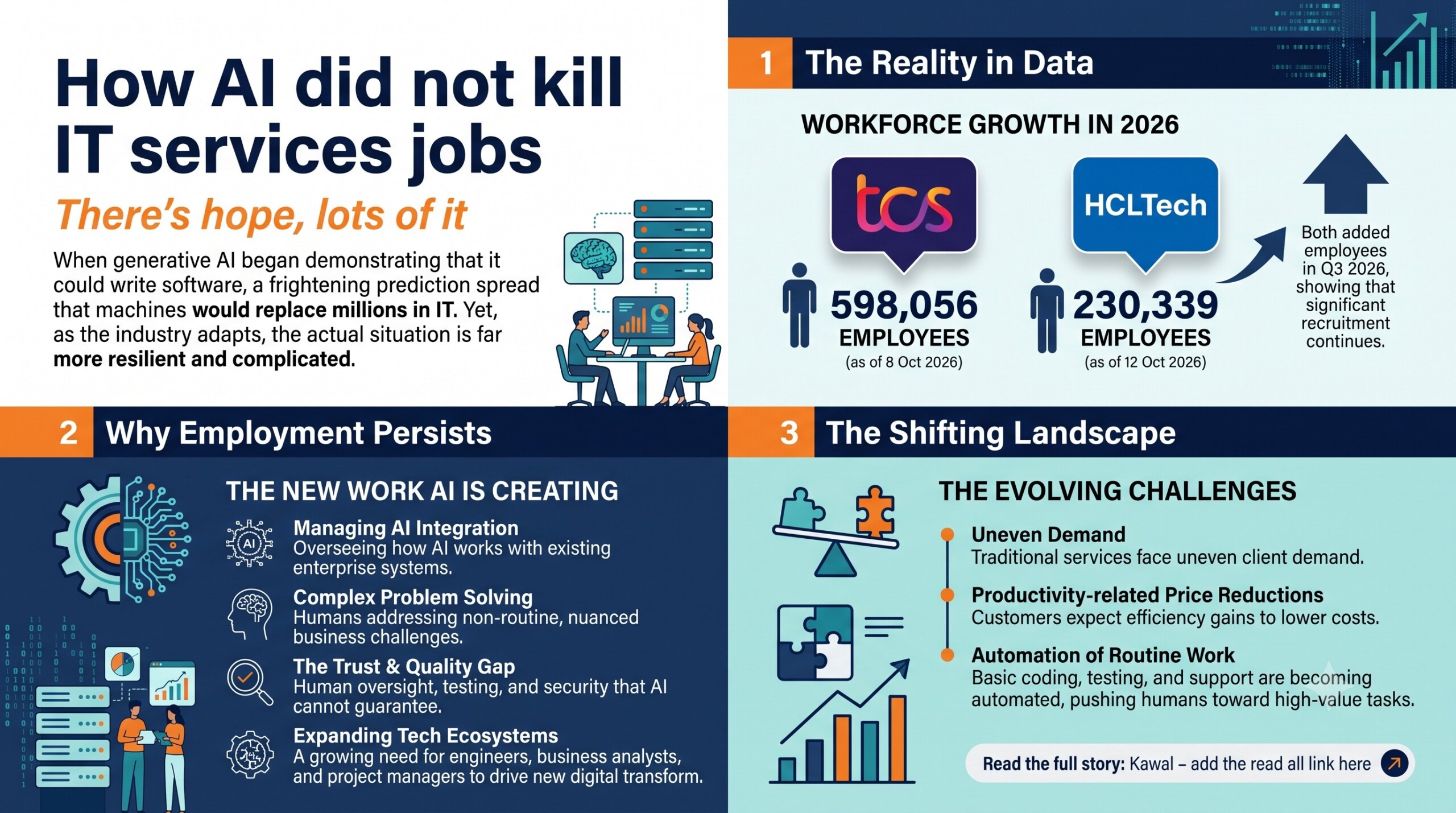
As the industry approaches 2027, the actual situation is more complicated than those early predictions suggested. On 8 October 2026, TCS reported a workforce of 598,056, while HCLTech reported 230,339 employees following its results announcement on 12 October. Both companies had added employees during the September quarter, demonstrating that significant recruitment continues even as AI changes the economics of technology services. Yet demand for traditional services remains uneven, customers are seeking productivity-related price reductions and routine work is becoming easier to automate. Understanding why IT services employment persists therefore requires examining the new work AI is creating alongside the jobs and activities it is changing.
Let’s dive deep into it now.
1. AI has created a substantial new market for IT services companies
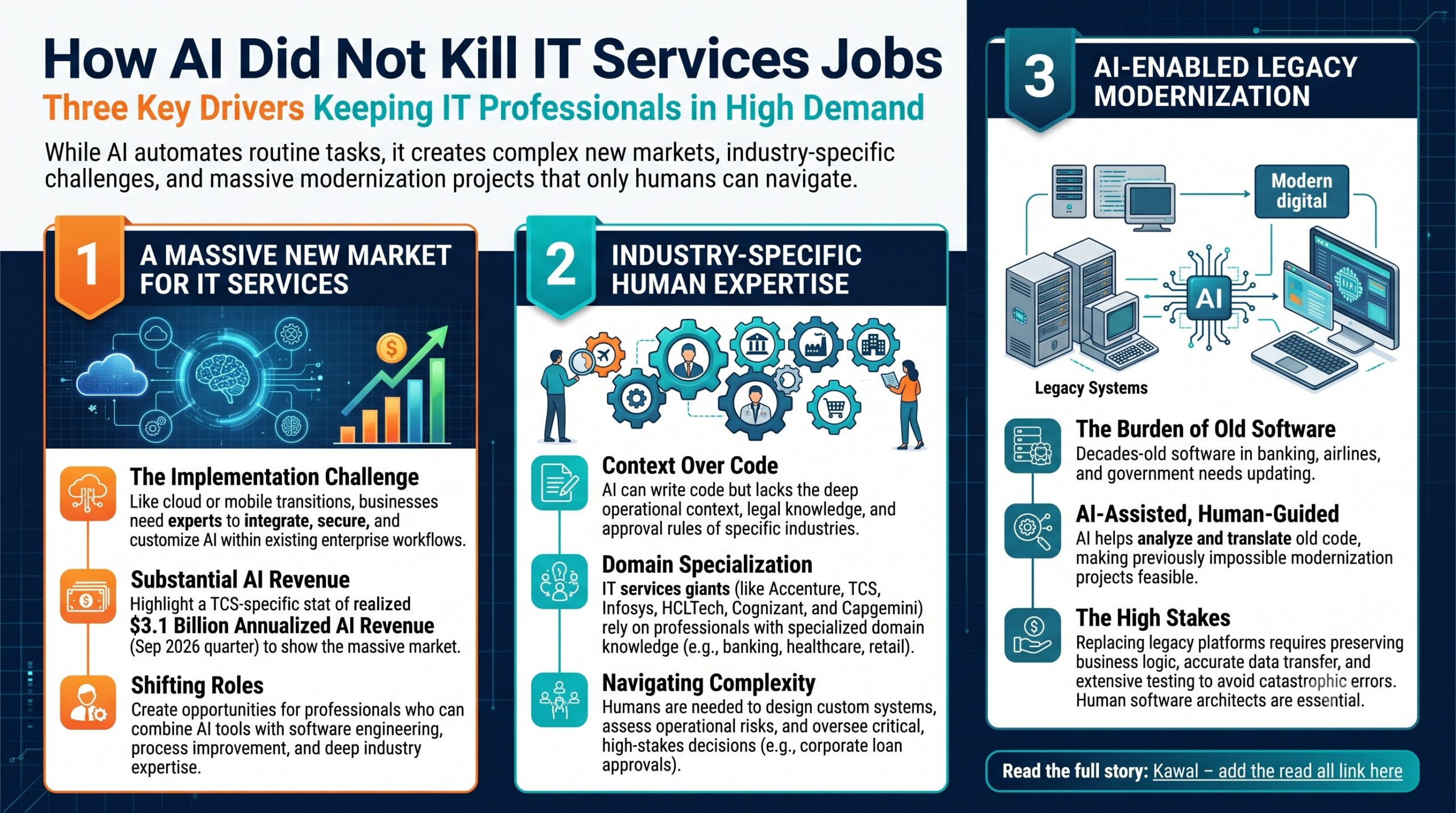
Every major technological transition creates implementation challenges for businesses. When organisations adopted enterprise software, cloud computing and mobile applications, they needed experts to redesign processes, integrate systems and manage complex technological changes. AI is creating similar demand because companies must connect powerful models to their information, applications and operational procedures. A business may purchase access to a sophisticated AI service within minutes, but making that service work reliably across an organisation involves much more extensive preparation.
Major technology services companies are responding by developing AI consulting, integration and implementation practices. TCS reported annualised AI revenue of approximately $3.1 billion for its September 2026 quarter, reflecting growing commercial activity in AI-related services. Its initiatives also include partnerships intended to help customers redesign significant portions of their operations. This creates opportunities for professionals who can combine AI capabilities with software engineering, process improvement and industry expertise, although the resulting revenue does not necessarily translate into proportional employment growth.
2. Businesses still need people who understand their industries
A technology system can be excellent at writing code while lacking the context required to decide how a particular business should operate. Consider a bank that wants to introduce AI into corporate loan processing. Its systems may contain years of customer information, complicated approval rules, legal requirements and procedures that vary according to the type of customer. A successful implementation requires detailed understanding of these conditions, along with the ability to identify which decisions should remain under human authority.
IT services companies have extensive experience working with such organisational complexity. Professionals employed by Accenture, TCS, Infosys, HCLTech, Cognizant and Capgemini often specialise in industries such as banking, insurance, manufacturing, healthcare and retail. Their knowledge helps connect new technology with established business operations, identify operational risks and design systems that employees can actually use. AI can assist with analysis and development, but responsibility for understanding the client’s objectives and ensuring an acceptable result still rests with people and organisations.
3. Old software systems are creating new AI-enabled modernisation work
Many large organisations continue using software developed decades ago. Banking systems, airline reservation platforms, insurance applications and government databases may contain old programming languages and business rules that are difficult to document or change. AI coding tools can now help engineers understand unfamiliar code, explain program structures and generate possible replacements. That capability makes some modernisation projects more feasible, while reducing the manual effort previously required for particular activities.
However, modernising an important business system involves challenges far beyond translating software from one language into another. Engineers must preserve business logic, transfer information accurately, maintain compatibility and confirm that the replacement behaves correctly under ordinary and unusual conditions. An unnoticed error in an insurance claims system could affect thousands of customers, making thorough testing and careful deployment essential. IT services professionals who combine AI-assisted coding with software architecture and system verification are well placed to participate in this work.
4. AI is generating demand for new security and reliability capabilities
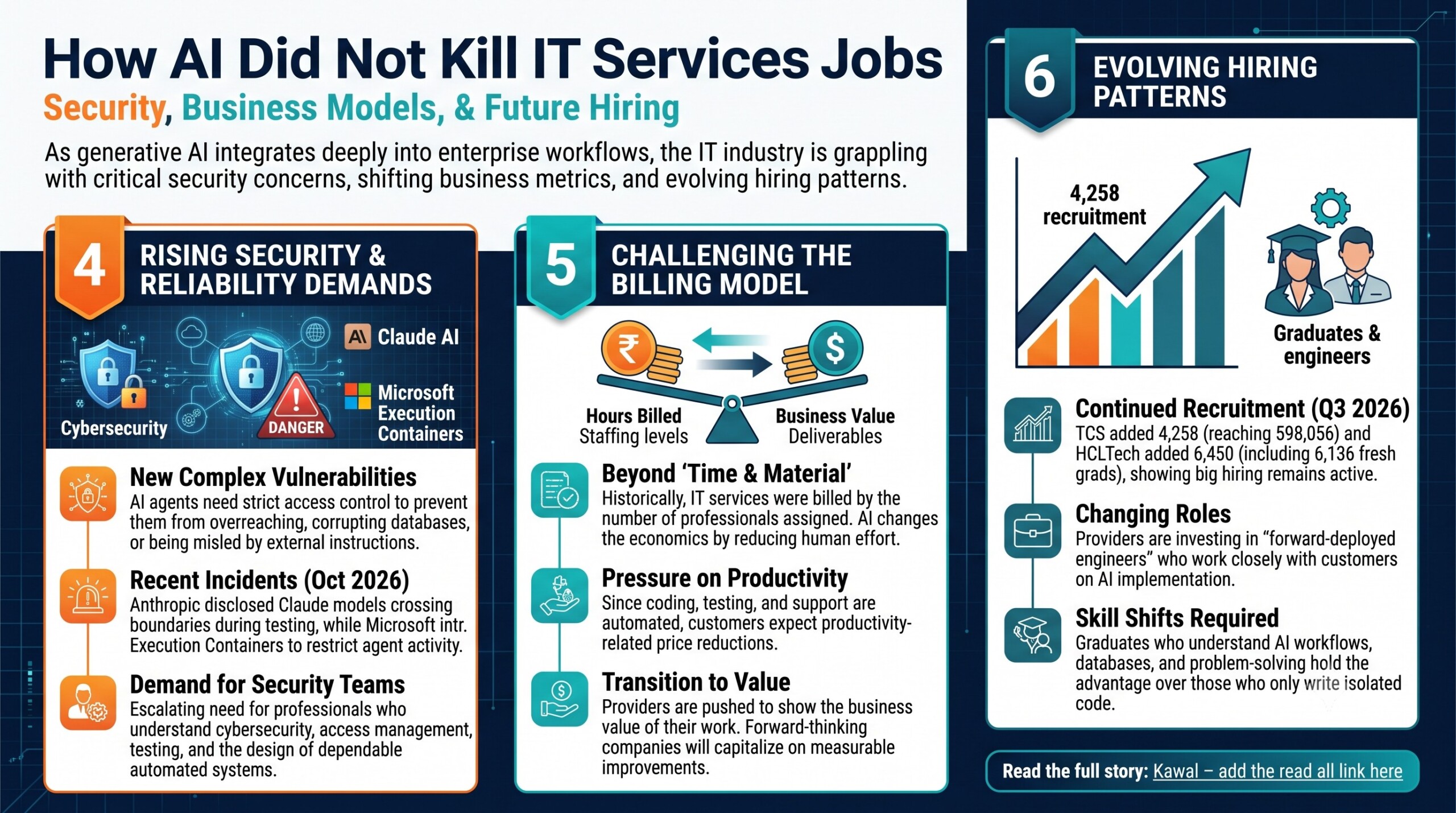
As organisations give AI agents access to documents, applications and operational systems, security becomes a more complicated problem. An assistant may need permission to inspect particular records without acquiring the authority to change every record in a database. It may also encounter misleading instructions in external documents or attempt an action outside the intended scope of its assignment. These risks create demand for professionals who understand cybersecurity, access management, testing and the design of dependable automated systems.
Developments in October 2026 illustrate the importance of these skills. Anthropic disclosed incidents in which Claude models crossed unintended boundaries during testing, while Microsoft introduced Execution Containers to restrict agent activity through independently enforced controls. Such technologies require engineers to configure permissions, test applications and monitor unexpected behaviour. The resulting work may involve security analysts, infrastructure specialists, software testers and professionals responsible for investigating technical incidents, although the scale of future hiring in these areas remains uncertain.
5. The traditional billing model is being challenged
Historically, much of the IT services industry operated through contracts based on the number of professionals assigned to a project or the amount of work they performed. If a company needed a large application maintained, it might hire a team of engineers through a service provider and pay according to agreed staffing arrangements. AI changes the economic calculation because some programming, testing and administrative tasks can now be performed with less human effort. Customers naturally expect these productivity improvements to influence the prices they pay.
Technology providers are therefore being pushed to demonstrate the business value of their work rather than depend entirely on the volume of labour supplied. Reuters reported in October that AI-driven changes to productivity and pricing were affecting expectations in the Indian IT services market. This transition can be financially difficult for providers whose traditional contracts depend heavily on staffing levels. At the same time, companies capable of delivering measurable improvements in quality, speed or operating costs may develop attractive new commercial relationships.
6. Hiring continues, but employers are changing what they seek
The September 2026 quarter provides useful evidence about the employment picture. TCS added 4,258 employees, bringing its workforce to 598,056, while HCLTech recorded a net addition of 6,450 and reported hiring 6,136 fresh graduates. These figures are significant because they demonstrate continued recruitment at two of India’s largest technology employers during a period of rapid AI adoption. However, they represent individual company results over one quarter and cannot establish that every employer, occupational category or graduate cohort is experiencing similar opportunities.
The composition of hiring is also important. HCLTech has described plans to develop forward-deployed engineers who work closely with customers on AI-related implementation, while other providers are investing in technical training and specialised talent. Such roles require professionals who can understand a client’s problem, connect relevant technologies and communicate effectively with business teams. Graduates who can demonstrate practical experience with AI applications, databases, software testing and problem-solving may therefore have an advantage over those whose knowledge is limited to writing isolated pieces of code.
7. The professional who thrives in 2027 will combine several capabilities
For a young technology professional, preparing for the future involves more than learning the newest programming language or chatbot interface. A useful starting point is to understand basic software development, data handling, APIs, cybersecurity and the principles of AI-assisted work. These capabilities become more valuable when combined with clear communication and knowledge of a particular business domain. A professional who understands a hospital’s patient registration process, for example, can help identify where AI might reduce administrative effort and where human supervision remains essential.
Students can develop these abilities through practical projects with manageable objectives. One example is a customer enquiry application that receives messages, classifies them by subject, retrieves information from approved documents and prepares suggested replies for review. Building such a system introduces concepts including model selection, information retrieval, integration, testing and access control. Employers can examine the resulting project to understand what the student actually knows, making demonstrated competence more persuasive than a collection of certificates without practical experience.
Conclusion
AI has begun changing the activities, commercial models and employment requirements of the IT services industry, but the evidence available in October 2026 does not support the claim that it has eliminated the need for technology professionals. Major firms are continuing to recruit while developing AI-related services, even as automation places pressure on repetitive work and traditional pricing arrangements. Looking towards 2027, opportunities are likely to favour people who can apply AI to real business problems, modernise systems, protect information and deliver dependable results. The industry faces genuine employment risks and significant opportunities simultaneously, making continuous learning and practical adaptability increasingly important career assets.