How to do competitor research using AI

How to do competitor research using AI
Getting smarter on the regular jobs
Introduction
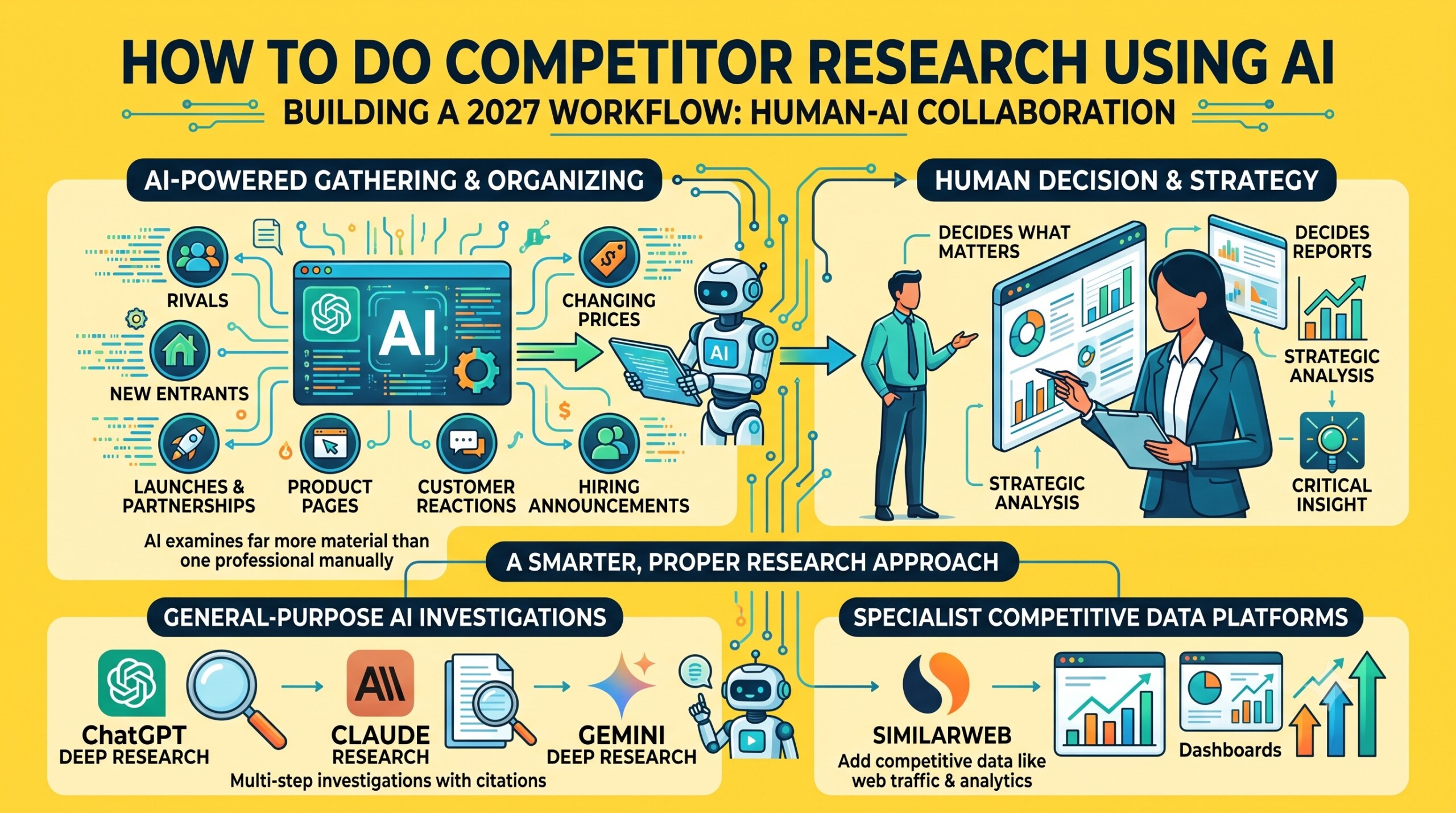
Competitor research sounds simple until you try to do it properly. A company may face obvious rivals, cheaper substitutes, new entrants, changing prices, hundreds of product pages and a constant stream of launches, partnerships, hiring announcements and customer reactions.
AI can now examine far more of this material than one professional could process manually. Heading into 2027, the better approach is not to ask AI for a generic competitor report. It is to build a research workflow in which AI gathers, compares and organises evidence while a human decides what matters.
ChatGPT Deep Research, Claude Research and Gemini Deep Research can conduct multi-step investigations with citations. Specialist platforms such as Similarweb can then add competitive data that general-purpose AI systems do not automatically possess.
Let’s dive deep now!
1. Begin with the business decision
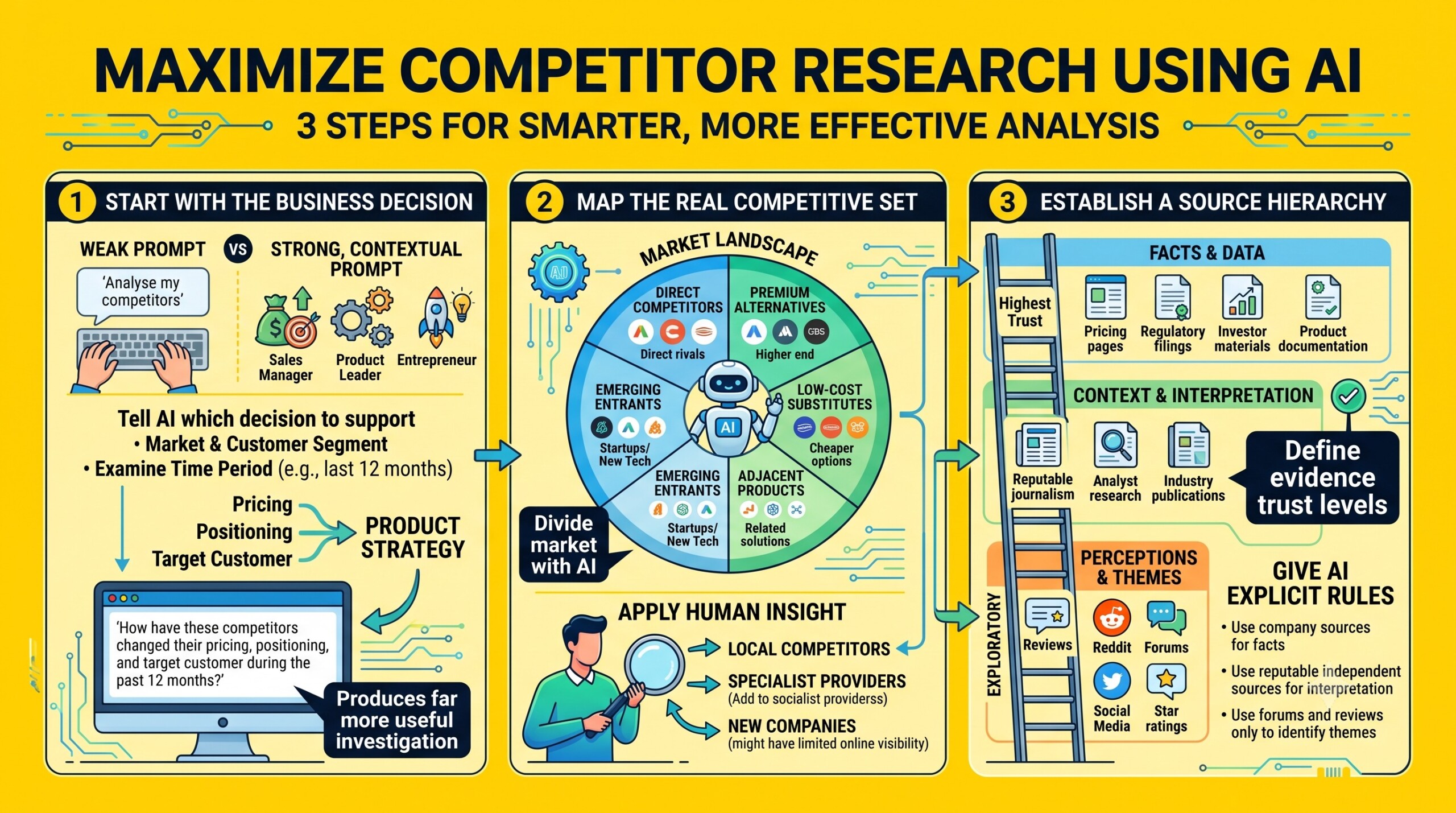
“Analyse my competitors” is usually a weak research prompt. A sales manager, product leader and entrepreneur may examine the same company for completely different reasons.
Tell the AI what decision the research should support, which market and customer segment matter, and what period should be examined.
For example, ask:
How have these three competitors changed their pricing, positioning and target customer during the past 12 months, and what could those changes mean for our product strategy?
That produces a much more useful investigation than asking for everything available about the companies.
2. Map the real competitive set
The competitor everyone talks about may not be the company actually taking customers.
Use AI to divide the market into direct competitors, premium alternatives, low-cost substitutes, adjacent products and emerging entrants. Ask it to explain why each company belongs in a category and provide evidence for uncertain classifications.
Then apply human knowledge.
Local competitors, specialist providers and new companies can have limited online visibility, so automated research may overlook precisely the businesses that matter most in a particular market. An excellent collection of learning videos awaits you on our Youtube channel.


3. Define the source hierarchy first
Research quality depends heavily on evidence.
Company pricing pages, product documentation, regulatory filings, investor materials and official announcements are useful for establishing facts. Credible journalism, analyst research and industry publications can provide independent context.
Reviews, Reddit, forums and social media are valuable for discovering customer perceptions and recurring complaints, but they should not automatically be treated as representative evidence.
Give the AI explicit rules such as:
Use company and regulatory sources for factual claims. Use reputable independent sources for interpretation. Use forums and reviews only to identify themes that require further verification.
This simple instruction can substantially improve a research report.
4. Use research agents for collection and synthesis
Modern research tools can now do more than run a single web search.
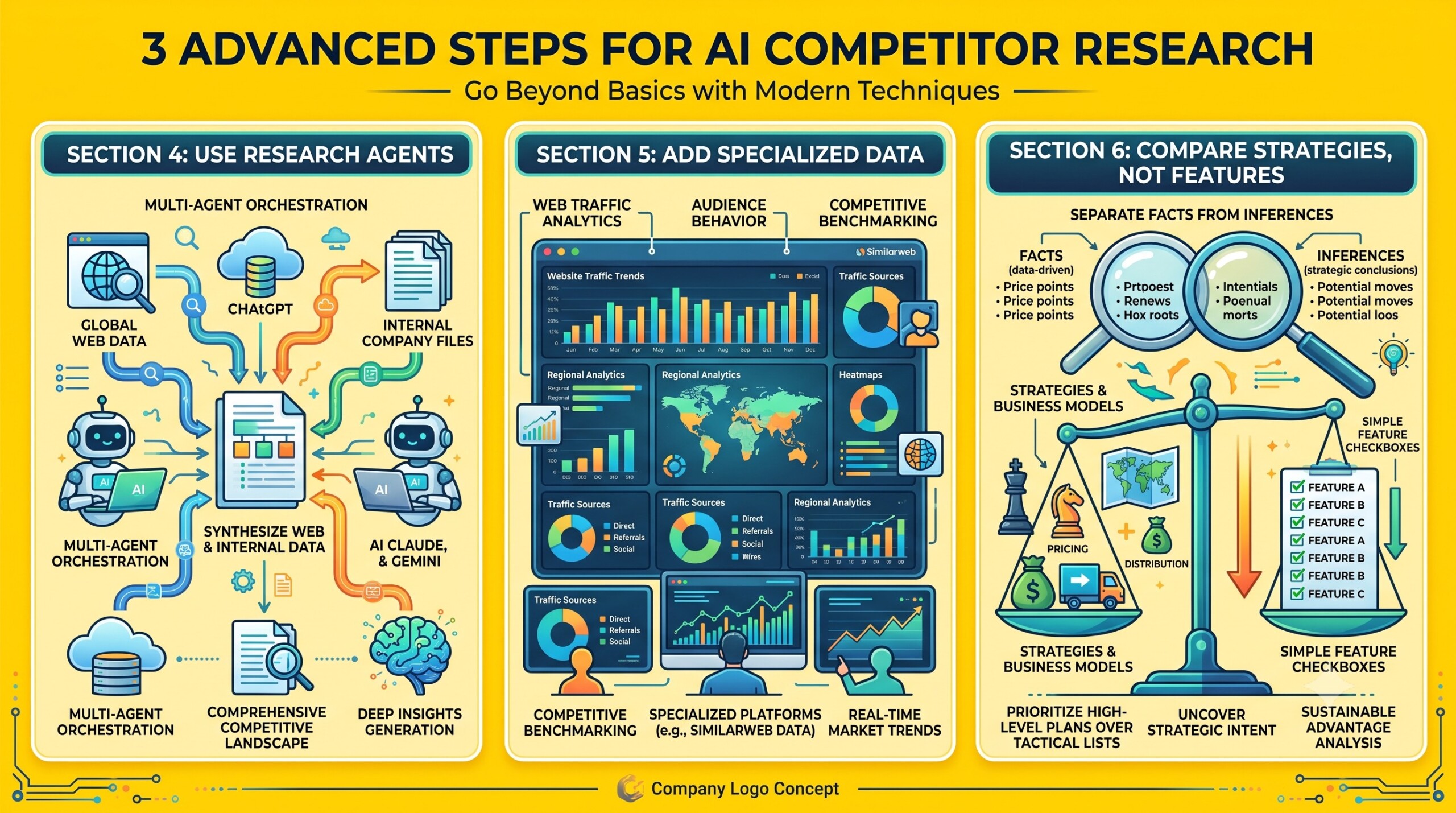
ChatGPT Deep Research can investigate across the public web, uploaded files and supported connected sources. Its 2026 update also allows users to restrict research to selected websites or prioritise trusted domains while still searching more broadly.
Claude Research conducts successive searches that build on earlier findings and can combine web information with connected workplace sources. Anthropic says its advanced research mode can investigate hundreds of internal and external sources and return citations to the originals. Gemini Deep Research can use Google Search and, with permission, sources including Gmail, Drive, uploaded files and NotebookLM notebooks.
These systems can dramatically reduce collection time. Important commercial claims should still be opened and checked at the original source. A constantly updated Whatsapp channel awaits your participation.
5. Add data the AI does not automatically possess
A chatbot can read a competitor’s website. It does not automatically know how much traffic the site receives, which channels generate visits or how engagement is changing.
Specialist platforms such as Similarweb provide estimates covering traffic, engagement, search, referrals and marketing channels. Its April 2026 data upgrade added greater channel granularity, including separate categories for Gen AI, affiliates, paid social and organic social, together with recalculated historical data. This creates useful new questions.
Is a competitor gaining visits from traditional search or AI platforms? Is growth coming from paid marketing, referrals or direct traffic? Has its channel mix changed after a product launch?
Use AI to interpret these patterns, but distinguish correlation from causation. A traffic increase after a launch does not prove that the launch caused it.
6. Compare strategies, not just features
Feature tables are easy to generate but can hide how companies actually compete.
A product with fewer features may succeed because it is cheaper, easier to adopt, better distributed, better integrated or more trusted by a particular customer segment.
Ask AI to analyse several dimensions separately: pricing, positioning, target customers, product capabilities, distribution, partnerships, marketing channels and recent strategic changes.
Then ask a second question: Which conclusions are directly supported by evidence, which are reasonable inferences, and where is the evidence insufficient?
That second pass often produces more value than another page of competitor features. Excellent individualised mentoring programmes available.
7. Turn research into continuous monitoring
A competitor report starts becoming outdated almost immediately.
Prices change. Product pages are updated. Executives announce new priorities. Companies form partnerships, launch products, hire for new capabilities and enter new markets.
Instead of repeating a complete analysis every few months, maintain a small set of high-value sources and periodically ask AI to identify only material changes. Monitor items such as pricing pages, product releases, leadership announcements, major job postings, partnerships, regulatory filings and important shifts in digital traffic.
The goal is not a daily flood of competitor news. It is an early-warning system that answers a much more useful question:
What changed since our last review, and does it matter to our business?
Conclusion
AI makes competitor research faster because it can search, classify, compare and synthesise more information than most professionals could inspect manually.
But the competitive advantage does not come simply from having access to an AI model.
It comes from defining the business question, selecting trustworthy sources, combining public research with specialist data, separating evidence from inference and monitoring changes over time.
Professionals who build that workflow can move beyond occasional competitor reports and create something much more valuable: a continuously updated system for understanding how their market is changing. Subscribe to our free AI newsletter now.