Synthetic Data Generation for AI Training and Evaluation
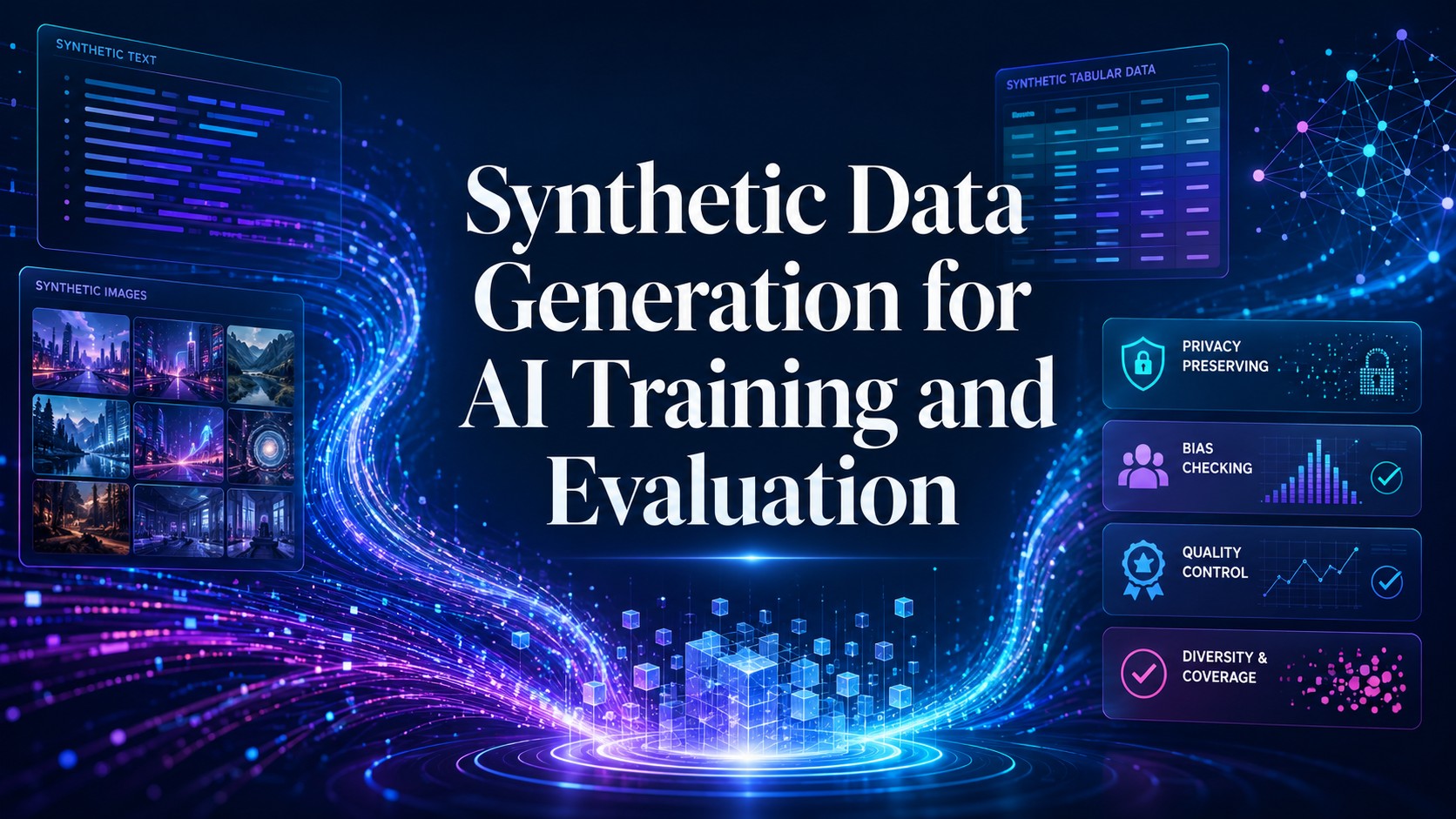
Synthetic Data Generation for AI Training and Evaluation
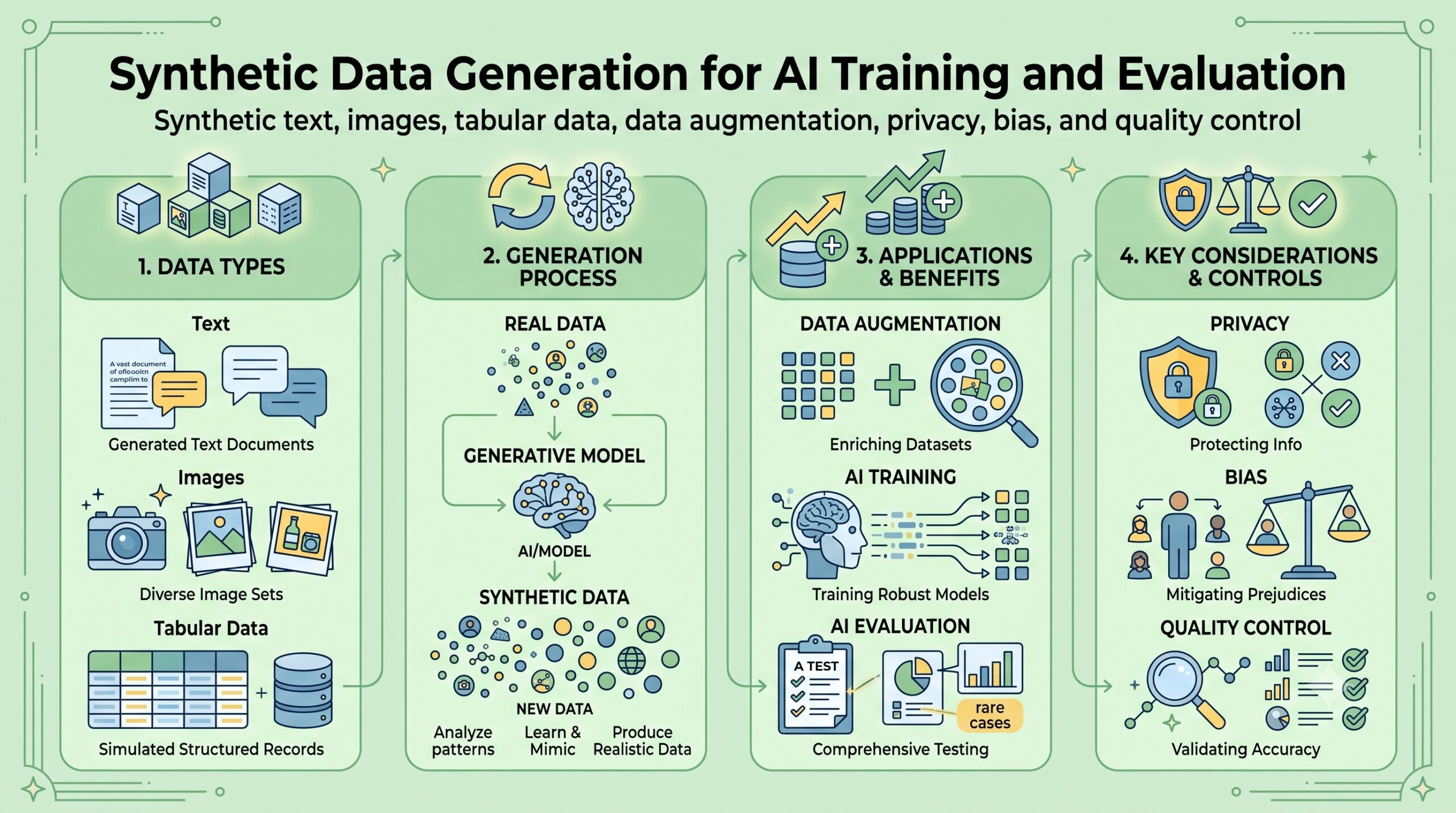
Synthetic text, images, tabular data, data augmentation, privacy, bias, and quality control
Introduction
Synthetic data has moved from a specialist research technique to a mainstream part of the AI development pipeline. In simple terms, synthetic data is artificially generated data that imitates the structure, patterns, relationships, and edge cases of real-world data without being a direct copy of it. It may be generated by statistical models, simulations, rule-based engines, generative adversarial networks, diffusion models, large language models, digital twins, or domain-specific simulators.
The reason for its rapid rise is clear. Modern AI systems need large, diverse, well-labeled, legally usable, and carefully evaluated data. Real data is often expensive to collect, legally restricted, biased, incomplete, poorly labeled, or unavailable for rare situations. Synthetic data helps fill these gaps. It can produce synthetic text for LLM fine-tuning, synthetic images and videos for computer vision, synthetic tabular data for banking and healthcare analytics, and synthetic test scenarios for autonomous systems, cybersecurity, agents, and enterprise software.
Synthetic data is especially relevant because enterprises are under pressure to build AI systems faster while also meeting stricter expectations on privacy, bias, explainability, and data governance. Gartner has predicted that by 2026, 75% of businesses will use generative AI to create synthetic customer data, compared with less than 5% in 2023. At the same time, regulations such as the EU AI Act require high-risk AI systems to use training, validation, and testing datasets that are relevant, representative, and as error-free as possible for the intended purpose.
Synthetic data, therefore, is not just “fake data.” Used well, it is a strategic tool for AI training, AI evaluation, privacy-safe experimentation, and responsible innovation. Used carelessly, it can create false confidence, amplify bias, leak sensitive patterns, or degrade model quality. The key is not whether data is real or synthetic, but whether it is fit for purpose, traceable, evaluated, and governed.
Let’s dive deep into the topic now.
1. Synthetic data is becoming a core AI infrastructure layer
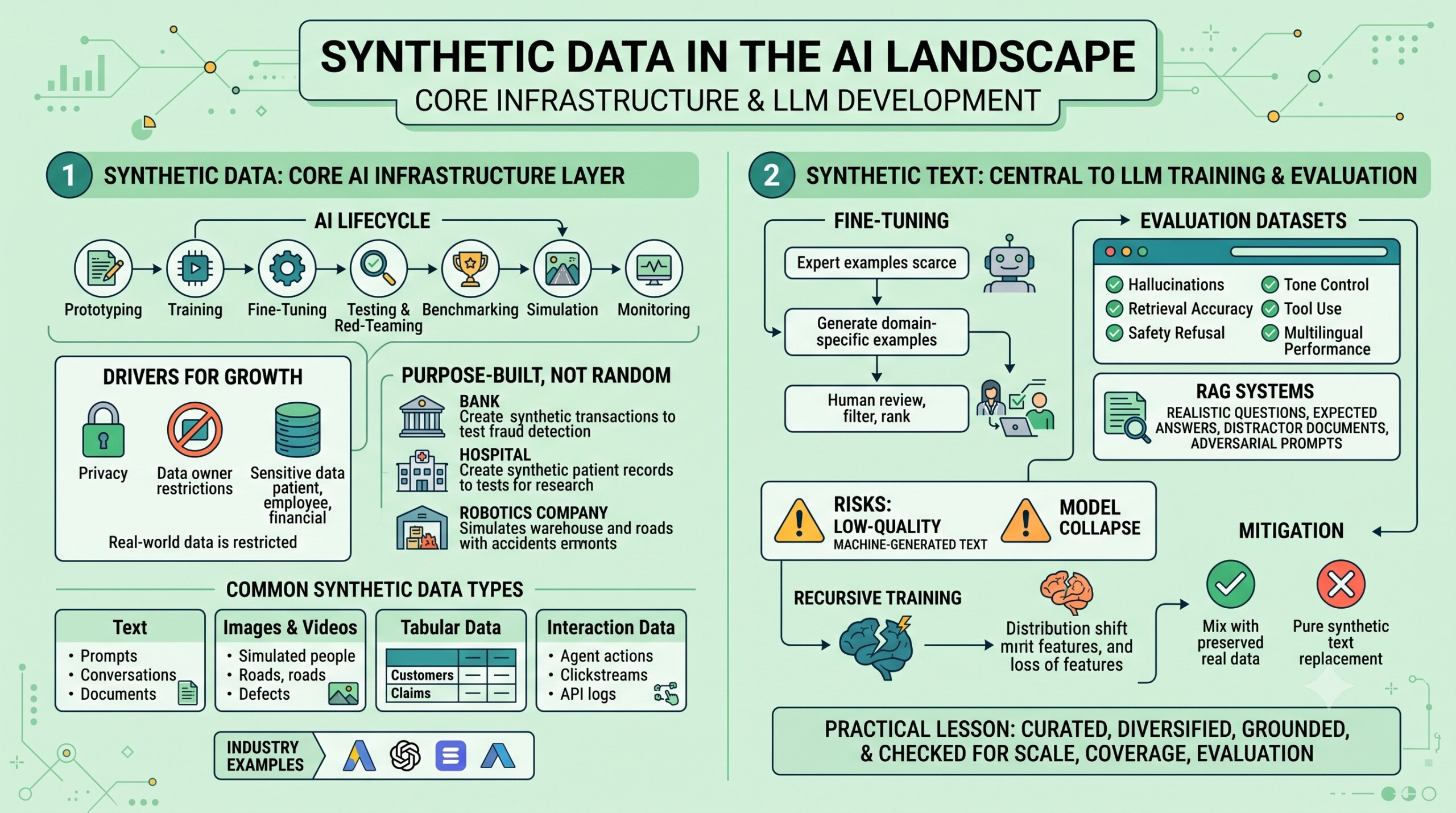
Synthetic data is now used across the AI lifecycle: prototyping, training, fine-tuning, testing, red-teaming, benchmarking, simulation, and monitoring. Its importance has grown because real-world data pipelines are becoming harder to operate. Data owners are restricting web scraping, privacy laws are tightening, and enterprises are reluctant to expose sensitive customer, patient, employee, or financial data to AI systems.
The most useful synthetic data is not random. It is generated to serve a specific purpose. For example, a bank may create synthetic transaction records to test fraud-detection models. A hospital may create synthetic patient records to support research without exposing protected health information. A robotics company may simulate warehouses, roads, lighting conditions, and rare accidents that are too costly or dangerous to capture in the real world.
Common synthetic data types include:
- Synthetic text: prompts, conversations, reasoning traces, legal documents, medical notes, support tickets, training dialogues, and RAG evaluation questions.
- Synthetic images and videos: simulated people, objects, factories, roads, weather, defects, satellite scenes, and autonomous-driving scenarios.
- Synthetic tabular data: structured rows and columns representing customers, claims, transactions, patients, students, devices, or supply-chain events.
- Synthetic interaction data: agent actions, tool-use traces, clickstreams, API logs, cyberattack scenarios, and user-behaviour simulations.
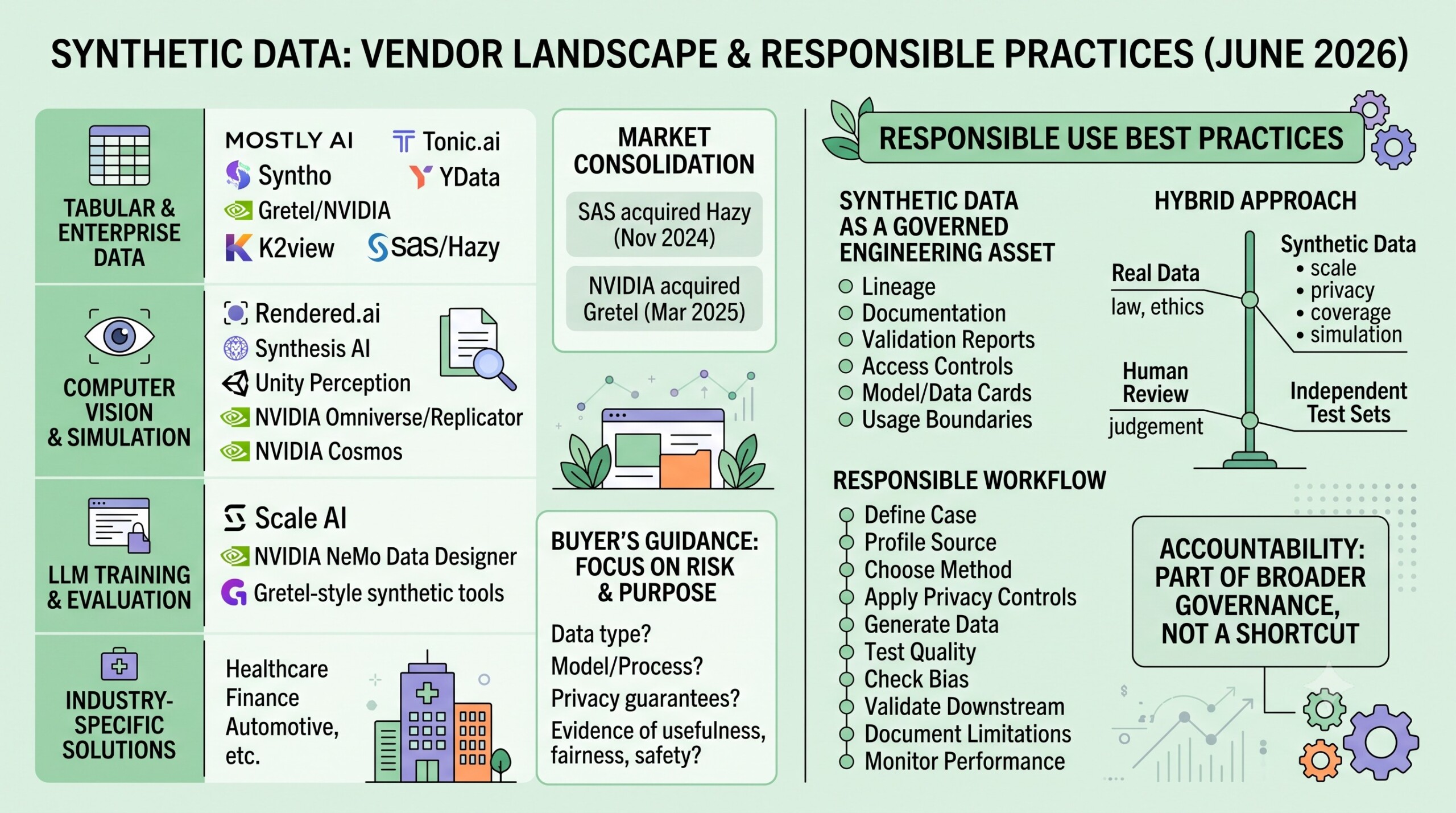
Vendors and platforms now reflect this variety. NVIDIA’s NeMo Data Designer focuses on synthetic data generation and validation for AI workflows, including automated quality checks and LLM-based judging. MOSTLY AI, Syntho, Tonic.ai, SAS/Hazy, Gretel, YData, K2view, Rendered.ai, Unity Perception, and Synthesis AI represent different parts of the market, from privacy-safe tabular data to computer-vision simulation.
2. Synthetic text is central to LLM training and evaluation
Synthetic text has become one of the most important forms of synthetic data because large language models need many examples of instructions, answers, reasoning, edge cases, and domain-specific language. Synthetic text can be used to generate question-answer pairs, customer-service conversations, legal reasoning examples, coding problems, policy scenarios, multilingual examples, and evaluation datasets.
For LLM fine-tuning, synthetic text is often used when expert-written examples are scarce or expensive. A model can generate thousands of domain-specific examples, and human experts can review, filter, or rank them. For evaluation, synthetic text can create test sets for hallucination, retrieval accuracy, safety refusal, tone control, tool use, multilingual performance, and domain compliance. This is especially valuable for RAG systems, where teams need many realistic questions, expected answers, distractor documents, and adversarial prompts.
However, synthetic text must be used carefully. If an organization trains models mostly on low-quality machine-generated text, the model may learn shallow patterns, generic phrasing, or hidden errors. A 2024 Nature paper warned that recursively training models on generated data can create distribution shift and eventually “model collapse,” where models lose important features of the original data distribution. Later research suggests the risk can be reduced when synthetic data is mixed with preserved real data rather than replacing real data completely.
The practical lesson is simple: synthetic text is powerful for scale, coverage, and evaluation, but it should be curated, diversified, grounded in real domain knowledge, and checked against human or real-world reference data. An excellent collection of learning videos awaits you on our Youtube channel.
3. Synthetic images and videos are transforming computer vision
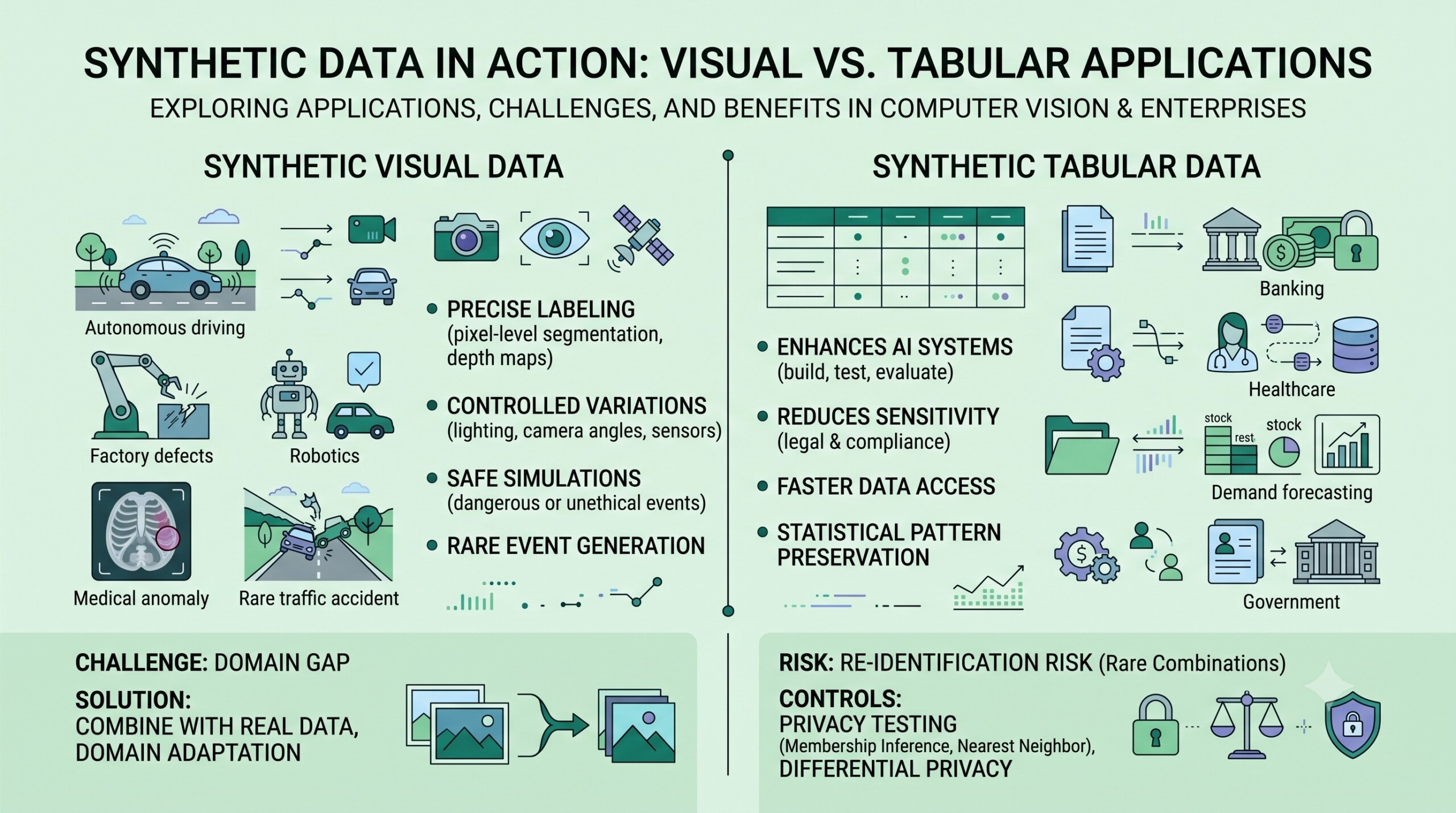
Synthetic visual data is especially useful in computer vision because real-world image collection is expensive and labeling is slow. A model for detecting scratches on factory parts, pedestrians at night, crop diseases, damaged roads, medical anomalies, or rare traffic accidents may need thousands of precisely labeled examples. Synthetic generation can produce these examples with automatic labels, segmentation masks, bounding boxes, depth maps, pose information, and lighting variations.
This is why synthetic visual data is widely used in autonomous driving, robotics, manufacturing, surveillance testing, retail analytics, AR/VR, satellite imagery, and medical imaging research. Rendered.ai, for example, positions its platform around physically accurate, sensor-specific synthetic imagery for computer-vision use cases. Unity’s Perception package provides tools for generating large-scale synthetic datasets for computer-vision training and validation. NVIDIA’s Cosmos platform and world foundation models are also aimed at physical AI, robotics, and simulation-based training.
Visual synthetic data is useful when teams need:
- Rare events: accidents, machine failures, fraud signatures, unusual weather, low-light conditions, or safety incidents.
- Perfect labels: pixel-level segmentation, object locations, depth, pose, motion, and 3D geometry.
- Controlled variation: lighting, camera angle, ethnicity, age, clothing, object position, background, or sensor type.
- Safe simulation: situations that are dangerous, expensive, unethical, or legally difficult to capture in real life.
The biggest challenge is the “domain gap.” Synthetic images may look realistic but still differ from real-world camera noise, human behaviour, sensor imperfections, or environmental complexity. Therefore, the best results often come from combining synthetic images with real images, validating on real-world test sets, and using domain adaptation.

4. Synthetic tabular data is valuable for enterprises
Tabular data is the familiar data of rows and columns: customer records, loan applications, insurance claims, invoices, medical records, employee data, sales transactions, logistics events, and IoT readings. For enterprises, this is often the most commercially valuable and most sensitive data. It is also the data that legal, compliance, and cybersecurity teams are most reluctant to share widely.
Synthetic tabular data helps teams build, test, and evaluate AI systems without exposing the original records. A good synthetic table should preserve statistical distributions, correlations, constraints, time dependencies, and business logic. Gretel describes synthetic tabular data as machine-generated structured data that mimics the statistical patterns and relationships found in real-world datasets, with evaluation based on distribution comparison, correlation preservation, ML performance testing, and privacy checks.
This is highly relevant for sectors such as banking, insurance, healthcare, telecom, education, retail, and government. For example, a bank can create synthetic transaction histories for fraud testing; a hospital can generate synthetic patient journeys for analytics; a retailer can test demand-forecasting models on synthetic seasonal data; and a government department can share synthetic citizen-service records for research.
The risk is that synthetic tabular data can appear privacy-safe while still preserving rare combinations that point back to individuals. Outliers, small subgroups, and unusual feature combinations must be handled carefully. This is why privacy testing, membership-inference testing, nearest-neighbour analysis, and differential privacy are becoming important parts of synthetic-data quality control. A constantly updated Whatsapp channel awaits your participation.
5. Synthetic data is a strong tool for data augmentation
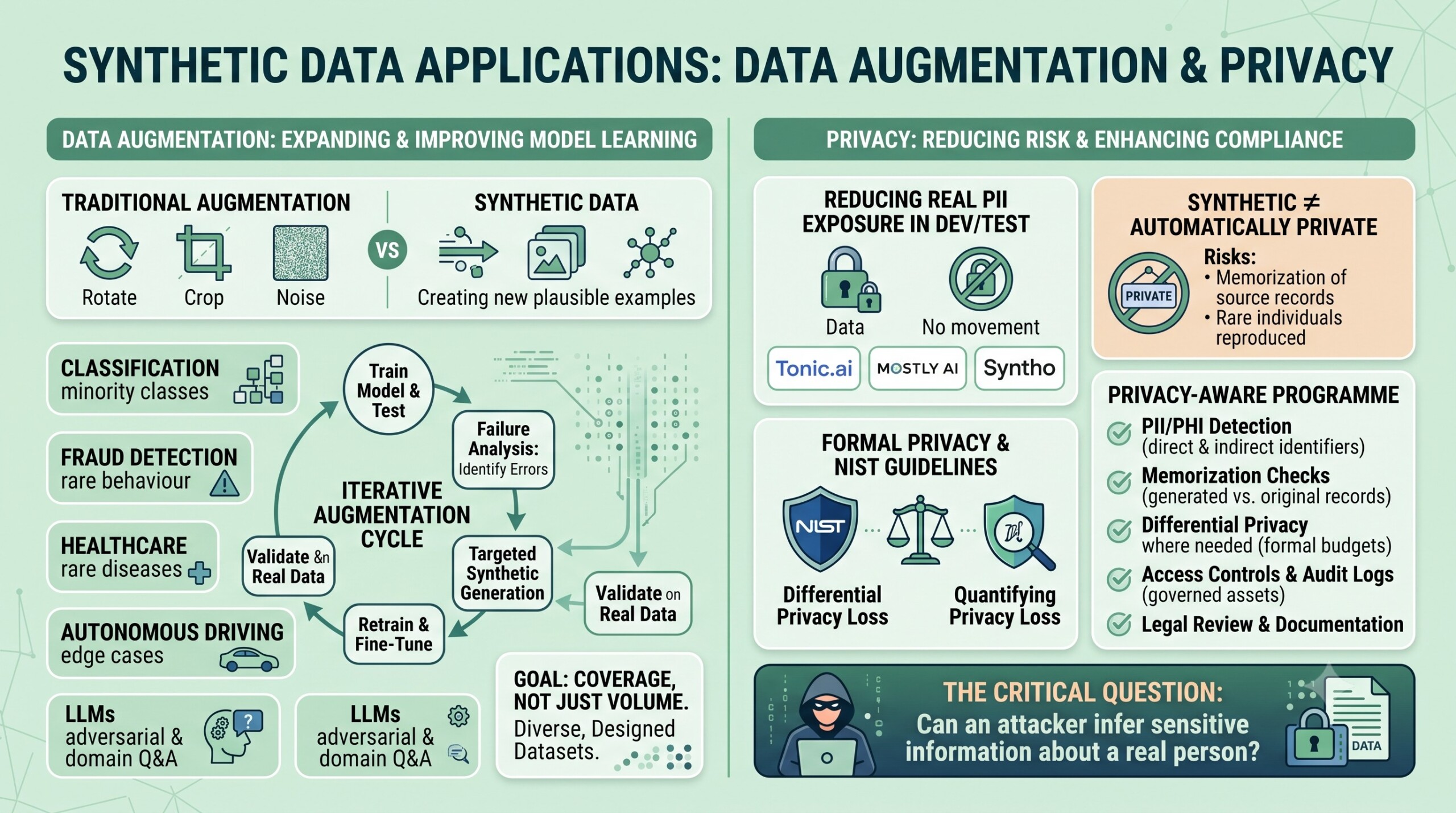
Data augmentation means expanding or modifying existing datasets to improve model learning. Traditional augmentation includes rotating images, cropping photos, translating text, adding noise, or changing brightness. Synthetic data takes this further by creating entirely new but plausible examples.
In classification tasks, synthetic data can increase examples for minority classes. In fraud detection, it can create more examples of rare fraudulent behaviour. In healthcare, it can represent rare diseases. In autonomous driving, it can simulate edge cases such as a child suddenly crossing a road in rain at night. In LLM systems, it can create adversarial prompts, multilingual examples, or domain-specific question-answer pairs.
The goal is not merely to increase data volume, but coverage also. A small, diverse, well-designed synthetic dataset may be more useful than a massive but repetitive one. Synthetic augmentation should be guided by model failure analysis: where does the model perform poorly, which groups are underrepresented, which cases are safety-critical, and which examples are missing from real data?
The best augmentation pipelines are iterative. Train the model, test it, identify errors, generate targeted synthetic examples, retrain or fine-tune, and test again on real-world validation data. This makes synthetic data part of continuous model improvement rather than a one-time data-generation exercise.
6. Privacy is a major driver, but synthetic data is not automatically private
Privacy is one of the strongest reasons organizations adopt synthetic data. Synthetic datasets can reduce the need to move real personal data into development, analytics, testing, or AI-training environments. Tonic.ai, for example, emphasizes realistic production-like test data that preserves privacy and compliance in complex environments. MOSTLY AI describes its platform around privacy-safe synthetic data for AI workloads and global data sharing. Syntho combines masking, rule-based generation, and AI-generated synthetic data in one platform.
Still, synthetic data should not be treated as automatically anonymous. If the generator memorizes source records, or if rare individuals are reproduced too closely, privacy can be compromised. NIST finalized guidelines in 2025 for evaluating differential privacy guarantees, emphasizing that differential privacy is a mathematical framework for quantifying privacy loss.
A privacy-aware synthetic data programme should include:
- PII and PHI detection: identify direct and indirect identifiers before generation.
- Memorization checks: test whether generated records are too close to original records.
- Differential privacy where needed: use formal privacy budgets for high-risk use cases.
- Access controls and audit logs: treat synthetic datasets as governed assets, not disposable files.
- Legal review: document whether synthetic data is safe enough for sharing, model training, or publication.
The privacy question is not “Is this synthetic?” but “Can an attacker infer something sensitive about a real person from this synthetic dataset?” Excellent individualised mentoring programmes available.
7. Bias can be reduced or amplified
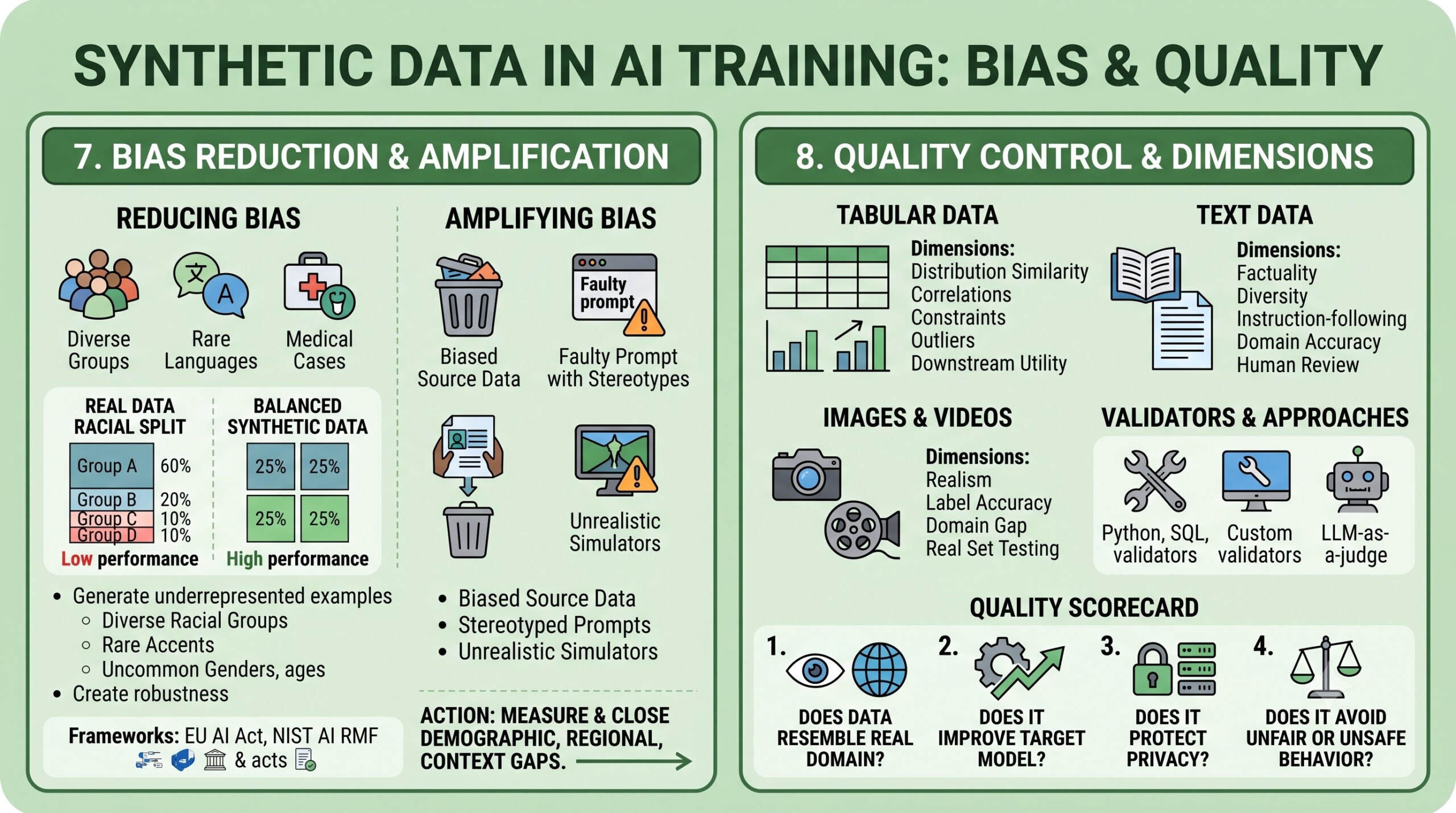
Synthetic data is often promoted as a way to reduce bias, and it can help. Teams can generate examples for underrepresented groups, rare languages, difficult accents, unusual medical cases, minority fraud patterns, or low-frequency operational events. This can make models more robust and fair.
But synthetic data can also amplify bias. If the source data is biased, the generator may reproduce that bias. If the prompt used to generate text reflects stereotypes, the synthetic text may encode them. If a visual simulator creates unrealistic people, environments, or geographies, the model may fail in the real world. Synthetic data can create the illusion of diversity while still being narrow, stereotyped, or statistically distorted.
The EU AI Act’s emphasis on relevant, representative, and bias-managed training, validation, and testing datasets is important here. NIST’s AI Risk Management Framework also frames trustworthy AI around validity, reliability, safety, privacy, transparency, and fairness with harmful bias managed.
Bias control requires measurement. Organizations should compare model performance across demographic groups, regions, languages, product categories, device types, and operational contexts. Synthetic data should be used to close measured gaps, not to claim fairness without evidence.
8. Quality control is the heart of synthetic data
The success of synthetic data depends on quality control. A dataset may look realistic to humans but still fail statistically. Another dataset may match distributions but fail on downstream model performance. A third may improve model accuracy but introduce privacy leakage or bias. Therefore, quality must be evaluated across several dimensions.
For tabular data, quality checks include distribution similarity, correlation preservation, constraint validity, missing-value behaviour, time-series consistency, outlier handling, and downstream ML utility. For text, checks include factuality, diversity, toxicity, duplication, instruction-following quality, domain accuracy, and human review. For images and videos, checks include realism, label accuracy, object geometry, domain gap, sensor realism, and performance on real validation sets.
NVIDIA’s NeMo Data Designer highlights validation through Python, SQL, custom validators, and LLM-as-a-judge approaches. Research on synthetic text evaluation also stresses that synthetic text should be assessed across utility, fairness, privacy leakage, distributional differences, and domain-expert feedback, especially in high-stakes domains such as healthcare and law.
A practical quality scorecard should answer four questions:
- Does the data resemble the real domain?
- Does it improve the target model or evaluation process?
- Does it protect privacy?
- Does it avoid unfair or unsafe behaviour? Subscribe to our free AI newsletter now.
9. Vendor landscape as of June 2026
The synthetic data market is broad, and vendors specialize in different kinds of data and workflows. No single vendor is best for every use case. The right choice depends on whether the organization needs tabular data, text, images, simulation, software testing, privacy preservation, LLM evaluation, or physical AI training.
Relevant vendor categories include:
- Tabular and privacy-safe enterprise data: MOSTLY AI, Syntho, Tonic.ai, Gretel/NVIDIA, YData, K2view, and SAS/Hazy.
- Computer vision and simulation:ai, Synthesis AI, Unity Perception, NVIDIA Omniverse/Replicator, and NVIDIA Cosmos.
- LLM training and evaluation data: Scale AI, NVIDIA NeMo Data Designer, Gretel-style synthetic data tooling, and specialized evaluation platforms.
- Industry-specific synthetic data: healthcare, finance, insurance, telecom, cybersecurity, automotive, robotics, and manufacturing solutions.
The market is also consolidating. SAS announced in November 2024 that it had acquired the principal software assets of Hazy to strengthen its data and AI portfolio with synthetic data capabilities. Wired reported in March 2025 that NVIDIA acquired Gretel, reflecting the growing strategic value of synthetic data for model training and fine-tuning.
For buyers, the vendor question should not begin with features. It should begin with risk and purpose: What kind of data is needed? What model or process will use it? What privacy guarantees are required? What evidence proves that the synthetic data is useful, fair, and safe?
10. Best practices for using synthetic data responsibly
Synthetic data should be treated as a governed engineering asset. It should have lineage, documentation, validation reports, access controls, model cards or data cards, and clear usage boundaries. A synthetic dataset created for software testing should not automatically be reused for clinical AI training. A dataset created for model evaluation should not be added to training data without checking for contamination.
The best organizations follow a hybrid approach. They use real data where lawful, ethical, and necessary; synthetic data where scale, privacy, coverage, or simulation is needed; and human review where judgement matters. They also keep independent real-world test sets to avoid overfitting to synthetic patterns.
A responsible synthetic data workflow includes defining the use case, profiling the source data, choosing the generation method, applying privacy controls, generating data, testing quality, checking bias, validating on downstream tasks, documenting limitations, and monitoring performance after deployment.
Most importantly, synthetic data should not be used to avoid accountability. If an AI system affects people’s credit, health, education, job opportunities, safety, or rights, synthetic data must be part of a broader governance system, not a shortcut around evidence. Upgrade your AI-readiness with our masterclass.
Conclusion
Synthetic data generation is one of the most important data practices in AI today. It helps organizations overcome data scarcity, protect privacy, improve model coverage, simulate rare events, build evaluation datasets, and accelerate AI development. It is useful for synthetic text, images, videos, tabular records, agent traces, software testing, computer vision, robotics, and enterprise analytics.
But synthetic data is not magic. It can be biased, unrealistic, overfitted, privacy-leaking, or misleading. Poorly generated synthetic data can damage model quality, and excessive reliance on machine-generated data can contribute to distribution shift or model collapse. The future is not synthetic data replacing real data; the future is well-governed hybrid data ecosystems where real, synthetic, simulated, and human-reviewed data each play the right role.
The winning approach is clear: generate synthetic data for a defined purpose, evaluate it rigorously, preserve privacy mathematically where needed, test for bias, validate against real-world outcomes, and document every major assumption. In AI, data quality is model quality. Synthetic data is valuable only when it makes the system more reliable, more useful, more private, and more trustworthy.