Google puts AI in search
Google puts AI in search
Introduction
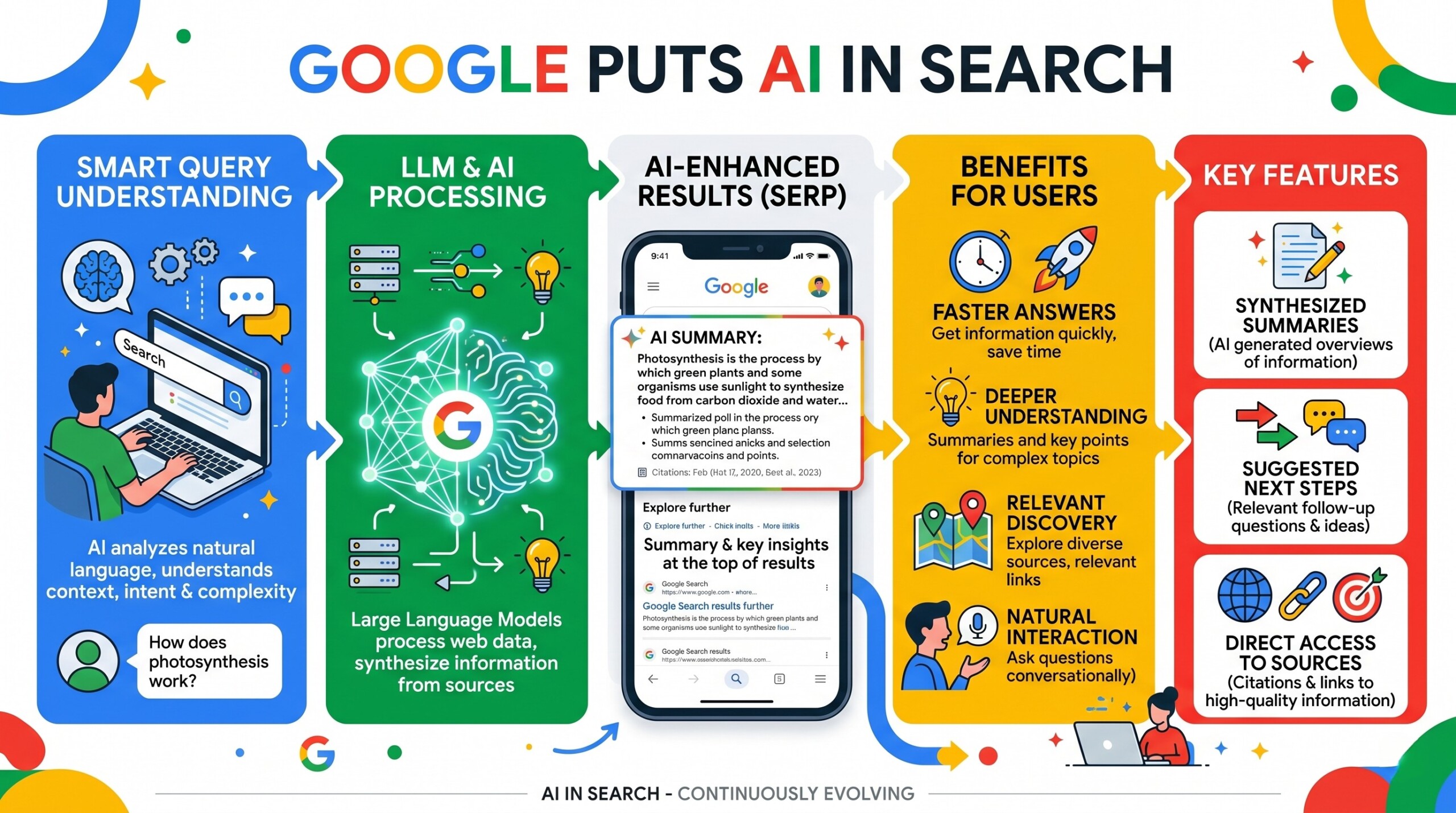
Google Search is undergoing one of the biggest changes in its history. For more than two decades, Google mainly helped users by showing a ranked list of links. Now, with generative AI, Search is becoming more answer-oriented, conversational, visual, and task-focused.
Google’s AI features in Search include AI Overviews, AI Mode, Gemini-powered responses, follow-up questions, planning help, visual search, and more agent-like assistance. Google describes this as a new AI-powered Search experience that uses its Gemini models and agentic capabilities to help users ask more complex questions and get richer answers.
15 key insights
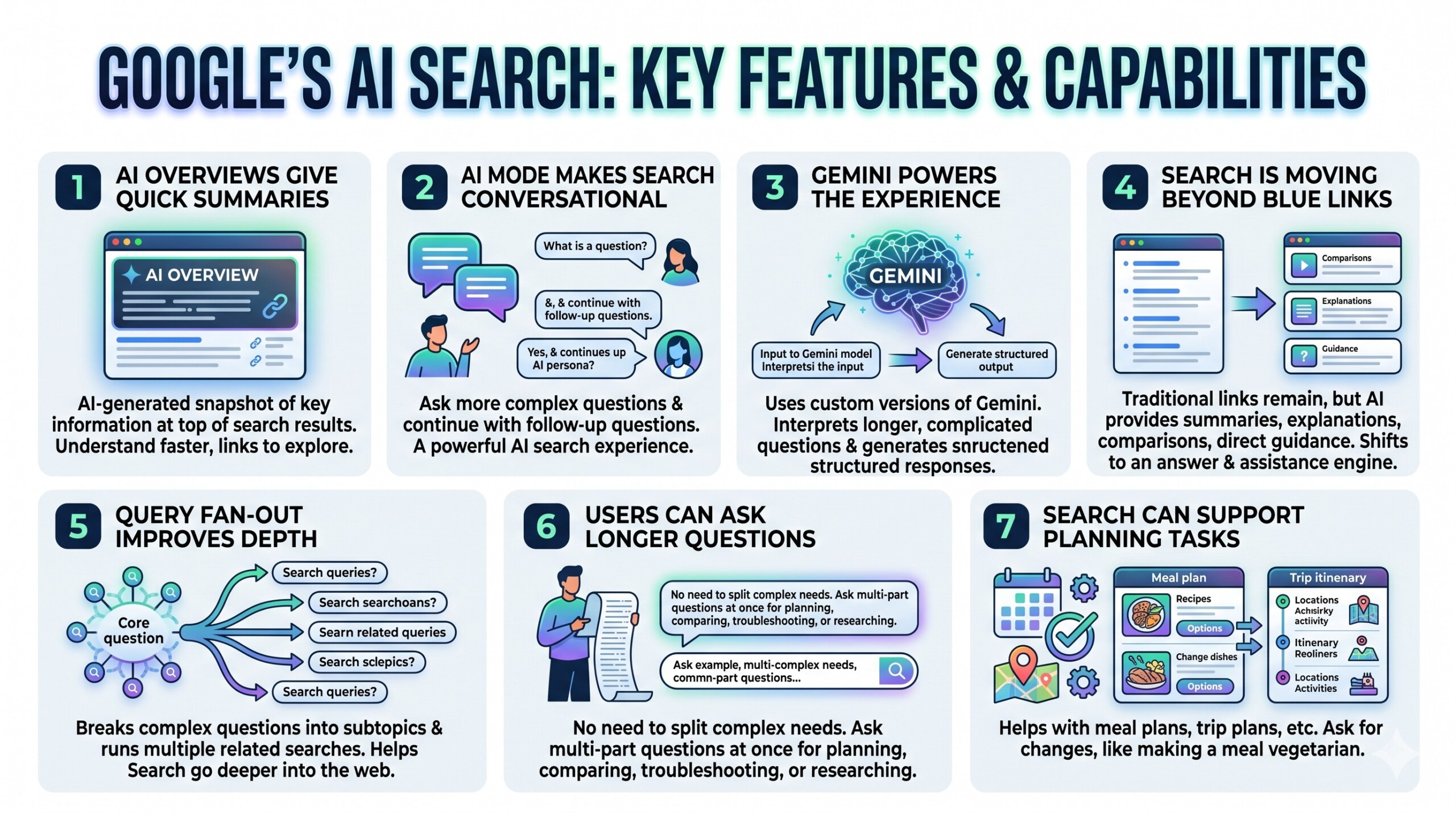
1. AI Overviews give quick summaries
AI Overviews provide an AI-generated snapshot of key information at the top of some search results. They are meant to help users understand a topic faster, while still offering links to explore more.
2. AI Mode makes Search conversational
AI Mode allows users to ask more complex questions and continue with follow-up questions. Google calls it one of its most powerful AI search experiences.
3. Gemini powers the experience
Google’s AI Search features use custom versions of Gemini. This helps Search interpret longer, more complicated questions and generate structured responses.
4. Search is moving beyond blue links
Traditional links are still present, but AI Search increasingly gives summaries, explanations, comparisons, and direct guidance. This shifts Google from only a search engine toward an answer-and-assistance engine.
5. Query fan-out improves depth
In AI Mode, Google can break a complex question into subtopics and run multiple related searches at once. Google calls this “query fan-out,” and says it helps Search go deeper into the web.

6. Users can ask longer questions
Earlier, users often had to split a complex need into many small searches. With AI in Search, they can ask multi-part questions in one go, such as planning, comparing, troubleshooting, or researching.
7. Search can support planning tasks
Google has shown AI Search helping with meal plans, trip plans, and other practical tasks. Users can ask for changes, such as replacing a meal with a vegetarian option.
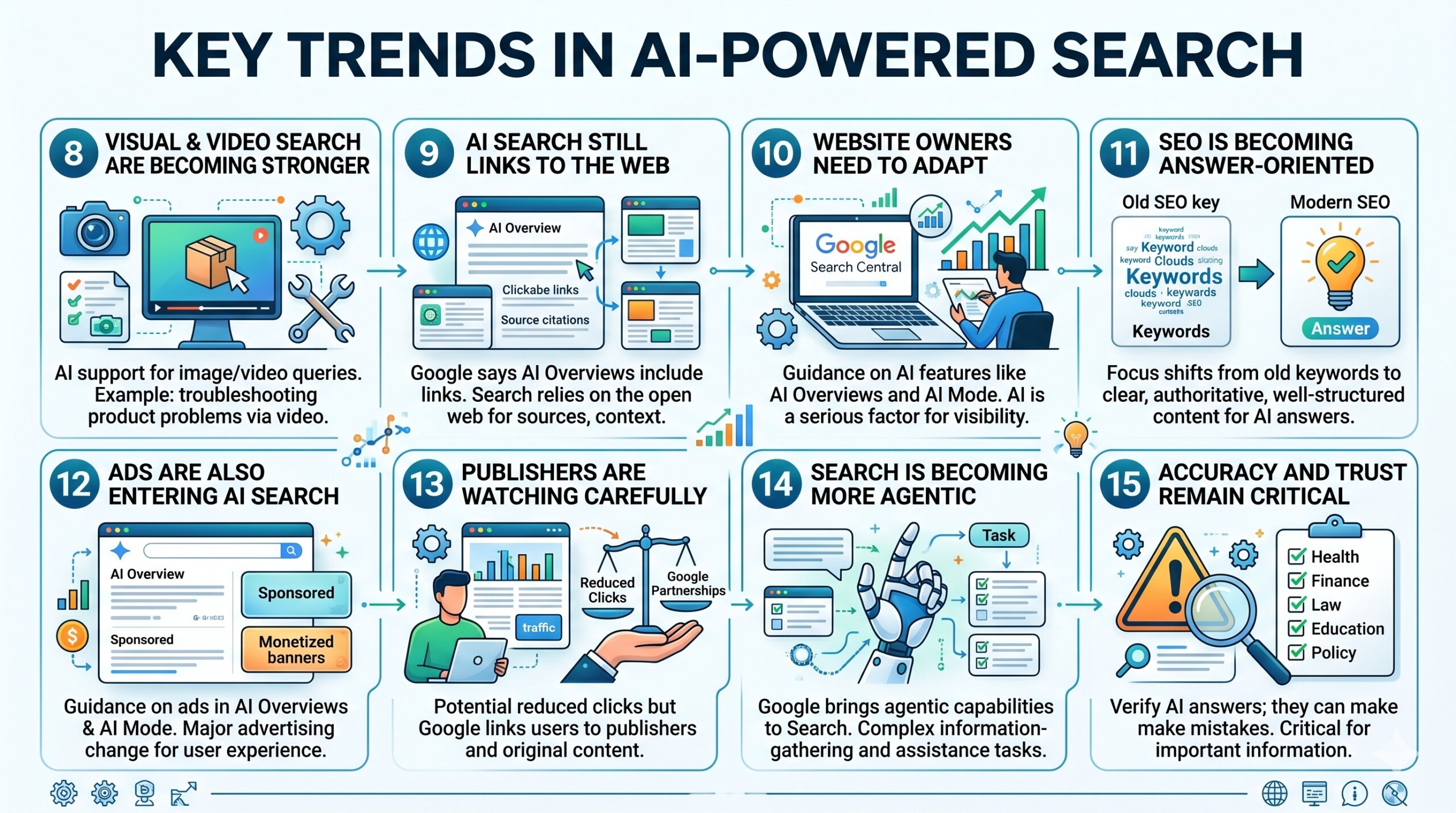
8. Visual and video search are becoming stronger
Google has also been adding AI support for searching with images and videos. For example, users may show a product problem through video and receive troubleshooting steps.
9. AI Search still links to the web
Google says AI Overviews include links so users can dig deeper. This is important because Search still depends on the open web for sources, context, and further exploration.
10. Website owners need to adapt
Google Search Central now has guidance for site owners on how AI features like AI Overviews and AI Mode work. This shows that AI Search is becoming a serious factor for content visibility.
11. SEO is becoming answer-oriented
Old SEO focused heavily on keywords and rankings. AI Search rewards content that is clear, authoritative, well-structured, and useful enough to be included in AI-generated answers.
12. Ads are also entering AI Search
Google has official guidance on ads and AI Overviews, and has also discussed ads in AI Mode. This means AI Search is not only a user experience change but also a major advertising change.
13. Publishers are watching carefully
AI-generated answers may reduce some clicks to websites, because users may get answers directly on Google. At the same time, Google is introducing features and partnerships intended to connect users with publishers and original content.
14. Search is becoming more agentic
Google says it is bringing agentic capabilities to Search, meaning users may be able to ask Search to perform more complex information-gathering and assistance tasks.
15. Accuracy and trust remain critical
AI-generated search answers can be useful, but they must be checked carefully. Because generative AI can make mistakes, users should still verify important information through trusted links, especially for health, finance, law, education, and policy.
Conclusion
Google putting AI into Search marks a major shift in how people find and use information. Search is no longer only about typing keywords and clicking links. It is becoming conversational, summarized, visual, personalized, and more action-oriented.
For users, this can make information discovery faster and easier. For publishers, educators, businesses, and website owners, it changes how visibility works online. The future of Google Search will not simply be about ranking on page one; it will be about being useful, trustworthy, structured, and relevant enough to appear inside AI-powered answers.