Databricks goes the Chinese way
Databricks goes the Chinese way
Introduction
Databricks has become one of the important companies in the new AI battlefield, not because it is trying to beat OpenAI, Anthropic or Google model-for-model, but because it is building the enterprise control room where many models can be used together.
That includes American closed models, open-source models, private models and, increasingly, Chinese open-weight models such as DeepSeek, Qwen and Kimi.
This matters because the AI race is no longer only about the smartest model. It is also about governance, cost control, routing, monitoring, security and enterprise data. That is where Databricks is positioning itself.
Let’s dive deep into it.
1. Databricks is not choosing China over America
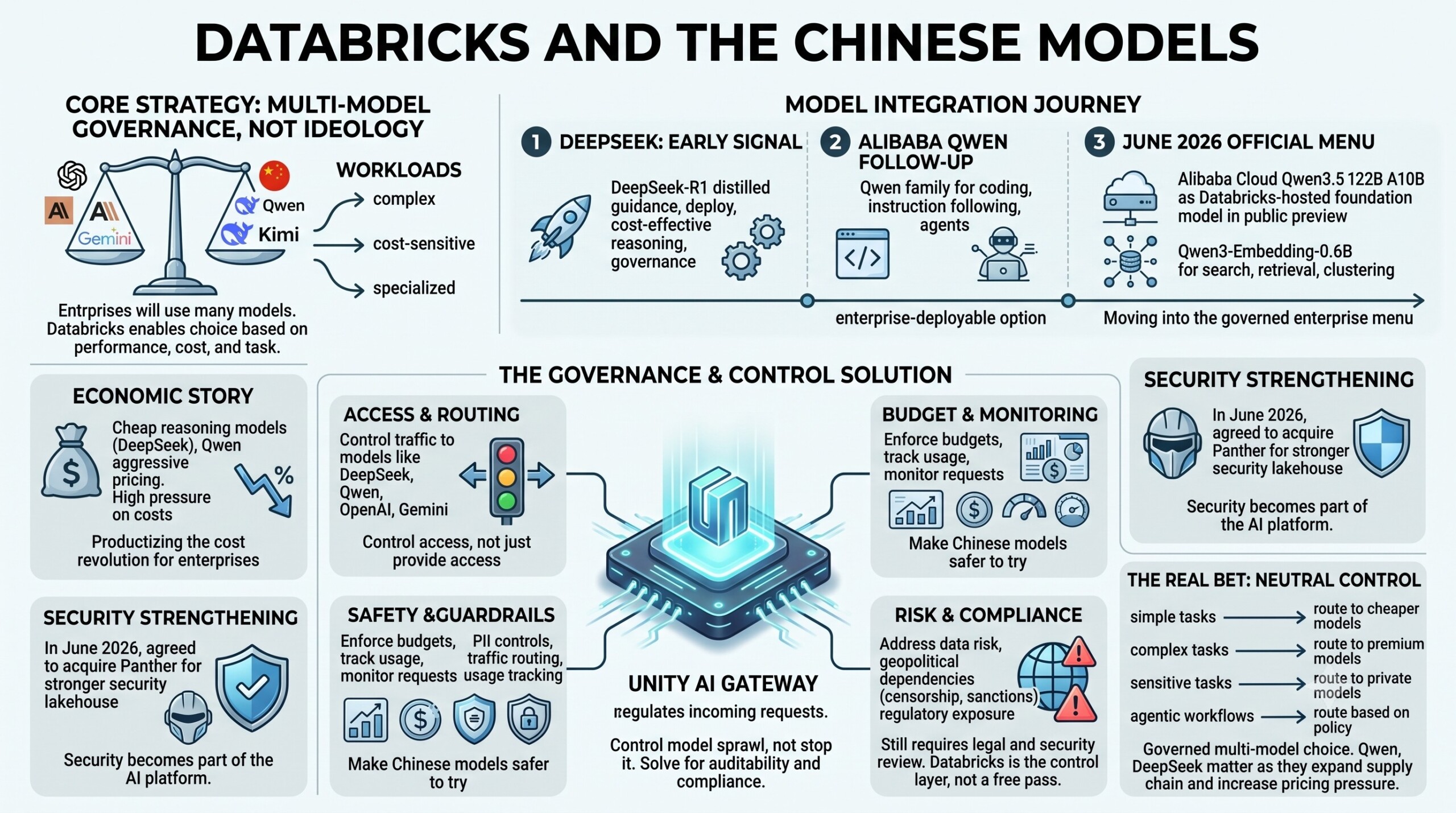
Databricks is not saying Chinese LLMs are better than American frontier models. It is saying enterprises will use many models. OpenAI may handle one workload, Claude another, Gemini another, and Chinese open models may handle cost-sensitive or specialized tasks.
This is not ideology. It is infrastructure logic.
2. DeepSeek was the first big signal
After DeepSeek-R1 shook the AI world, Databricks quickly published guidance on running DeepSeek-R1 distilled models on Databricks Model Serving. It highlighted deployment, cost-effective reasoning and governance alongside OpenAI, Amazon Bedrock and other models.
The message was clear: enterprises could experiment with DeepSeek-style reasoning without losing control of their AI stack.
3. Then came Alibaba’s Qwen
Databricks also published guidance on serving Alibaba’s Qwen models. This mattered because Qwen is one of China’s most important model families, especially for coding, instruction-following and agentic AI workloads.
By showing how Qwen could be brought into Databricks infrastructure, the company helped turn a Chinese open-weight model into an enterprise-deployable option. An excellent collection of learning videos awaits you on our Youtube channel.
4. By June 2026, Qwen became more official
By June 2026, Databricks documentation listed Alibaba Cloud Qwen3.5 122B A10B as a Databricks-hosted foundation model in public preview. It also listed Qwen3-Embedding-0.6B for semantic search, retrieval, clustering and classification.
That is a significant shift. Qwen is no longer only something adventurous developers can experiment with. It is moving into the governed enterprise model menu.
5. Databricks is serving Kimi and Qwen at scale
Databricks has said its inference platform serves models ranging from open-source options like Kimi and Qwen to proprietary models such as OpenAI, Gemini and Claude.
This is the real story. Chinese models are being absorbed into enterprise inference platforms where cost, latency, reliability and governance matter.

6. Model routing is becoming the business
Databricks’ Unity AI Gateway is central to this strategy. It allows companies to control which AI services teams can use, how traffic is routed, how budgets are enforced, and how requests are monitored.
That is exactly what enterprises need when they start testing Chinese LLMs. They do not simply want access. They want controlled access. A constantly updated Whatsapp channel awaits your participation.
7. Databricks is solving model sprawl
The old software world preferred standardization. The AI world is moving in the opposite direction. Developers want Claude, Codex, Gemini, Qwen, DeepSeek, Kimi, Llama and private models.
Databricks is not trying to stop this sprawl. It is trying to govern it.
8. Chinese LLMs fit the economics story
Chinese models became attractive because they changed the cost conversation. DeepSeek showed that reasoning models could be powerful and cheaper than many expected. Alibaba’s Qwen family added further pressure with strong performance and aggressive pricing.
Databricks is not creating this cost revolution. It is productizing it for enterprises.
9. Databricks makes Chinese models safer to try
For enterprises, the problem is not only performance. It is data risk, auditability, access control, budget control and compliance.
Databricks tries to answer these concerns with Unity AI Gateway, service policies, PII controls, guardrails, traffic routing, usage tracking and audit logs. It does not remove geopolitical risk, but it gives companies a governed way to experiment. Excellent individualised mentoring programmes available.
10. The risks remain real
Chinese-origin models still raise questions around data security, censorship, sanctions, regulatory exposure and political dependency.
Databricks cannot make every model harmless. Enterprises still need legal review, security review and clear data-classification policies. Databricks provides the control layer, not a free pass.
11. Its security push supports the strategy
In June 2026, Databricks agreed to acquire Panther, an AI security operations platform, strengthening its security lakehouse vision.
This connects directly to the multi-model AI future. As companies use more models, more agents and more automated workflows, security becomes part of the AI platform itself.
12. The real bet is neutral control
Databricks is betting that the future will not be OpenAI-only, Claude-only, Gemini-only or Qwen-only. It will be multi-model.
Companies will route simple tasks to cheaper models, complex tasks to premium models, sensitive tasks to private models, and agentic workflows to whichever model performs best under policy.
That is why Chinese LLMs matter to Databricks. They expand the model supply chain, increase pricing pressure and make governance platforms more valuable. Subscribe to our free AI newsletter now.
Conclusion
The Databricks story in June 2026 is clear: it has gone all in on the multi-model future, and Chinese LLMs are now part of that future.
DeepSeek gave Databricks a chance to show that Chinese reasoning models could be used inside a governed enterprise platform. Qwen moved from technical experiment to public-preview foundation model. Kimi and Qwen now appear beside OpenAI, Gemini and Claude in Databricks’ inference story.
Databricks is not betting on China alone. It is betting on the end of one-model loyalty. In the next phase of AI, companies will not ask only, “Which model is best?” They will ask, “Which model is best for this task, at this price, under this policy, with this data risk?”
Databricks wants to own that question. That is why its Chinese LLM move matters. It turns DeepSeek, Qwen and Kimi from geopolitical headlines into enterprise infrastructure. Upgrade your AI-readiness with our masterclass.