What is Nvidia’s plan for your laptop
What is Nvidia’s plan for your laptop
Introduction
Nvidia wants to move artificial intelligence from distant data centres into your personal computer. For years, the company’s biggest AI story has been about giant server farms, powerful GPUs, and cloud-based AI models. Now Jensen Huang wants to bring that same AI logic to laptops and desktops.
At Computex 2026 in Taipei, Nvidia unveiled RTX Spark, a new chip platform for Windows PCs, built in collaboration with Microsoft. The idea is simple but ambitious: the next phase of AI will not happen only in the cloud. It will also happen on the devices we use every day.
Nvidia’s bet is that future laptops will not merely run apps. They will run AI agents: software systems that can plan, assist, create, code, analyse, and complete complex tasks locally. This could change the role of the PC from a passive tool into an active assistant.
Let’s dive deep into it.
- RTX Spark is Nvidia’s new AI-focused chip for personal computers. It is meant for laptops and small desktops, not just data centres. This shows Nvidia’s intention to bring high-end AI computing closer to ordinary users.
- The chip is being developed with Microsoft. Nvidia and Microsoft have worked together to make RTX Spark run with Windows. This partnership matters because Windows remains the dominant operating system for PCs.
- RTX Spark combines CPU and GPU capabilities. Traditional PCs rely heavily on CPUs, but AI workloads need GPU acceleration. Nvidia’s plan is to make the GPU central to the future AI PC.
- The CPU side uses Arm-based designs. This puts Nvidia into a PC market historically dominated by Intel and AMD. It also signals a shift toward more power-efficient chip architectures in laptops.
- The GPU side uses Nvidia’s RTX technology. This is important because Nvidia already dominates GPU computing for AI. RTX branding may also help consumers connect these machines with gaming, graphics, and AI performance.
- The chip is aimed at “agentic AI.” These are AI systems that can carry out multi-step tasks more independently than ordinary chatbots. Such agents may eventually manage documents, meetings, workflows, coding tasks, and creative projects.
- The goal is to run more AI locally. Instead of sending every task to a cloud data centre, some AI work can happen directly on the laptop. This can make AI tools feel faster and more personal.
- Local AI can reduce cloud pressure. As AI usage grows, the number of tokens processed by models is expected to rise sharply. Offloading some processing to PCs could reduce the burden on expensive data-centre infrastructure.
- Local processing may improve efficiency. Running suitable AI tasks on-device can reduce latency, bandwidth use, and dependence on remote servers. It may also help when users have limited or unreliable internet access.
- RTX Spark PCs are designed for developers and creators. They are expected to support coding, content creation, AI experimentation, gaming, and professional workflows. This makes the first target market more advanced than casual laptop users.
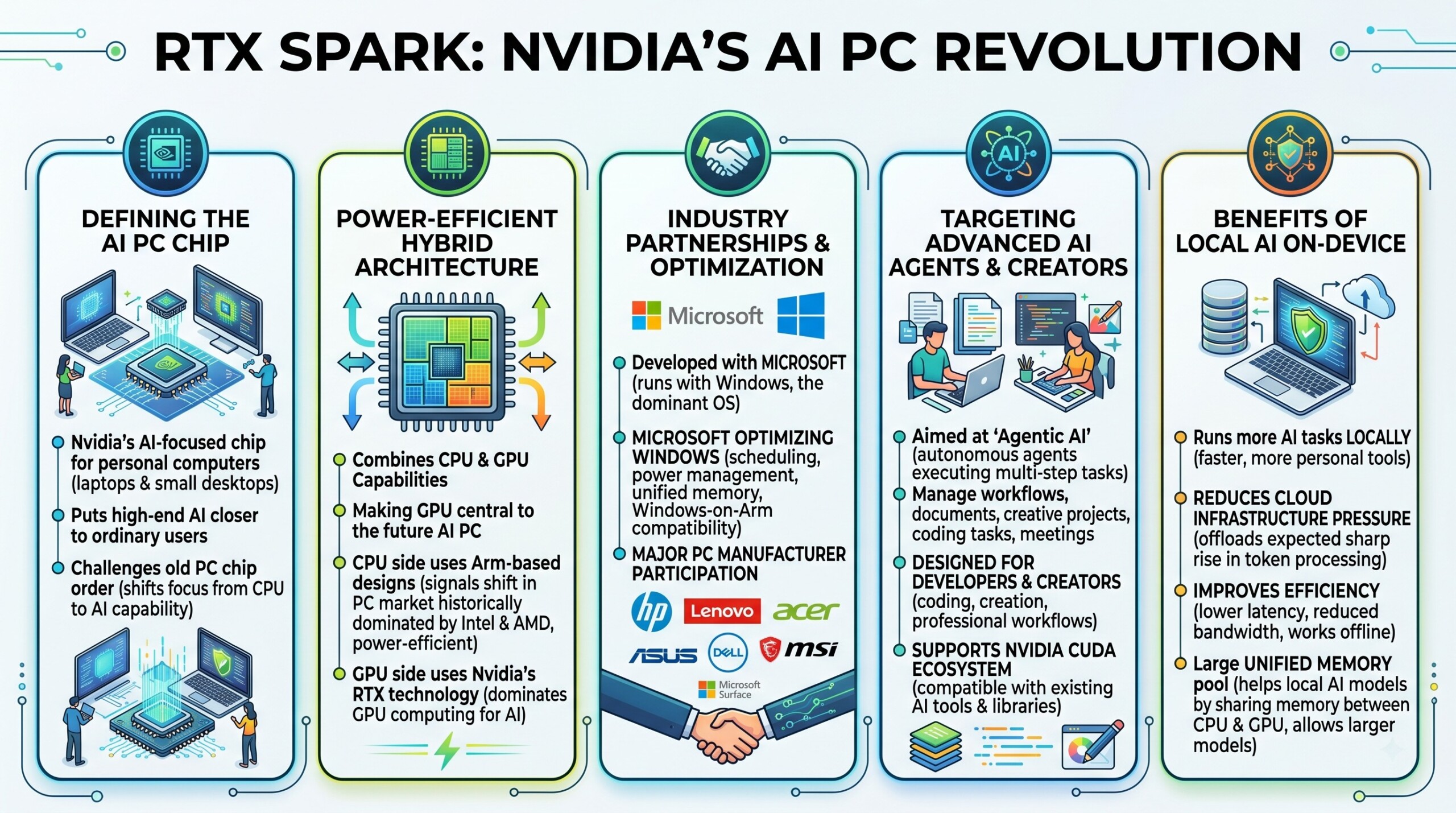
- The platform supports Nvidia’s CUDA ecosystem. This matters because many AI developers already use CUDA-based tools and libraries. Keeping compatibility with existing AI workflows could help developers adopt the platform faster.
- Some RTX Spark systems are expected to offer large unified memory. This helps local AI models because CPU and GPU can access a shared memory pool. Larger memory can allow more capable AI models to run directly on the device.
- Microsoft is optimising Windows for this architecture. This includes work on scheduling, power management, unified memory, and Windows-on-Arm compatibility. Without strong operating-system support, new AI hardware would be difficult for users and developers to benefit from.
- Major PC makers are joining the effort. Companies such as HP, Lenovo, Acer, Asus, Dell, MSI, and Microsoft Surface are connected to the RTX Spark rollout. Their participation suggests Nvidia wants this to become a mainstream PC category, not a niche experiment.
- Nvidia is challenging the old PC chip order. Intel and AMD still dominate PC CPUs, but Nvidia is trying to redefine the PC around AI acceleration rather than traditional CPU performance alone. If this strategy works, the most important laptop specification may shift from processor speed to AI capability.
Conclusion
Nvidia’s plan for your laptop is not just to make it faster. It wants to make it more intelligent. The company sees the PC moving from a machine where humans do most of the clicking, typing, and switching between apps, to a machine where AI agents do more of the work. That requires a new kind of hardware: powerful enough for local AI, efficient enough for laptops, and compatible with the software ecosystem people already use.
Success is not guaranteed. Intel and AMD have deep control over the PC CPU market, and users may not immediately understand why they need an AI-first laptop. Developers will also need time to adapt. But Nvidia has money, brand power, GPU leadership, a strong developer ecosystem, and Microsoft as a partner. If RTX Spark succeeds, the laptop may stop being just a personal computer. It may become a personal AI machine.