How latest AI models break into cyber-vulnerable systems
How latest AI models break into cyber-vulnerable systems
Introduction
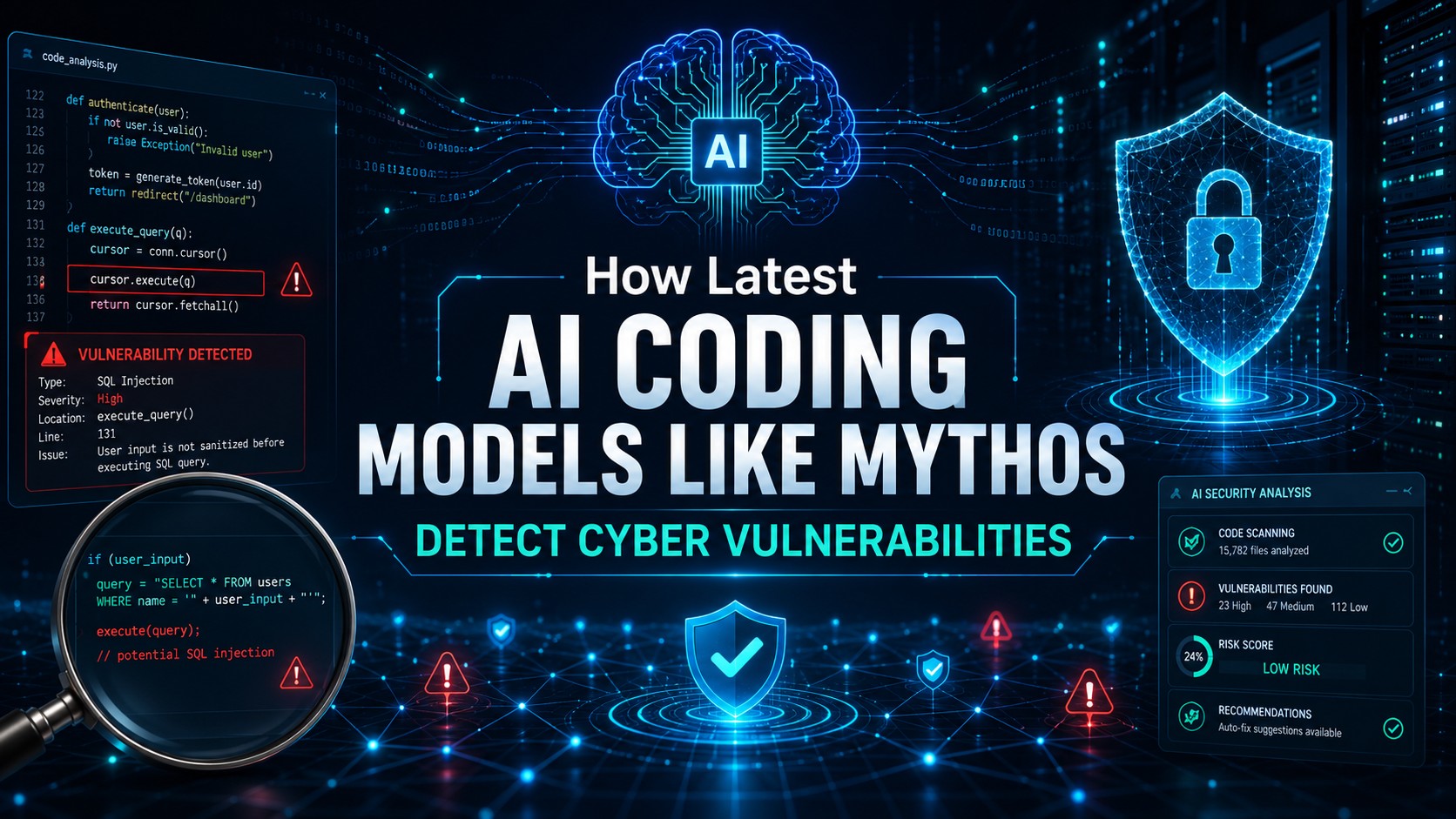
By mid-2026, AI coding models have moved beyond simple code completion. The newest systems—such as Anthropic’s Claude Mythos Preview, OpenAI’s Codex Security, Google’s CodeMender, GitHub’s Copilot Autofix, Snyk’s DeepCode AI, and Semgrep’s AI-assisted AppSec tools—are increasingly being used to detect, validate, prioritize and help patch security vulnerabilities. The shift is important: AI is no longer just writing software; it is beginning to inspect software like a security researcher.
The most dramatic example is Claude Mythos Preview, which Anthropic describes as a model with unusually strong cybersecurity capabilities. It has not been made generally available; instead, Anthropic launched Project Glasswing to give limited access to selected critical industry partners and open-source developers. The reason is dual-use risk: the same capability that helps defenders find flaws can also help attackers exploit them.

Let’s dive deep into it.
1. They understand whole-project context, not just isolated lines
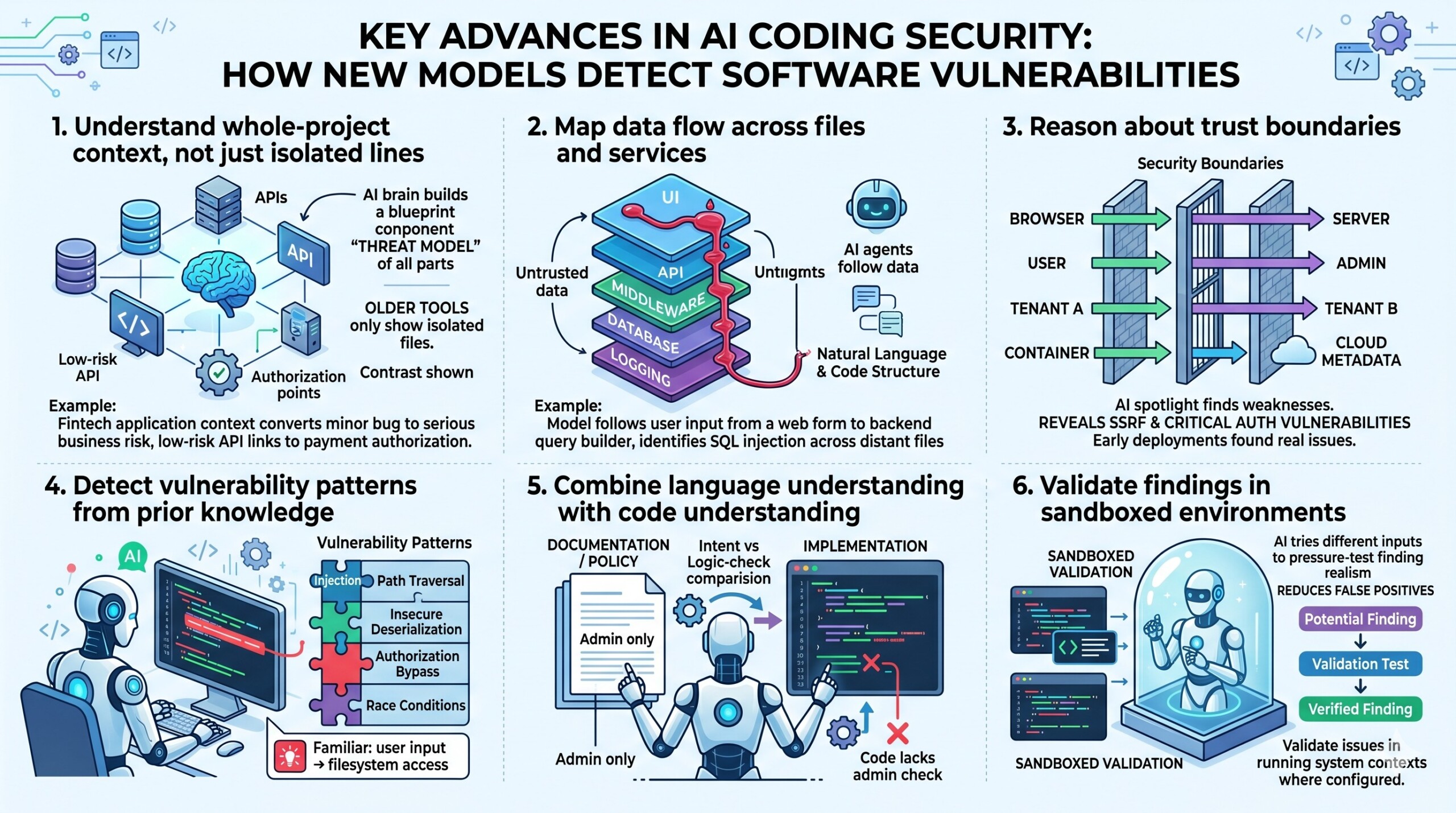
Older static tools often inspect a file or function in isolation. New AI coding models build a broader picture of the system: what the application does, which components trust each other, where data enters, where authentication happens, and where sensitive operations occur. OpenAI says Codex Security first builds a project-specific threat model before searching for vulnerabilities.
Example: In a fintech application, the model may notice that a “low-risk” API endpoint indirectly reaches a payment authorization function. That broader context can turn a minor-looking bug into a serious business-risk finding.
2. They map data flow across files and services
Modern vulnerabilities often appear when unsafe data travels across many layers: UI, API, middleware, database, queue, cloud function and logging pipeline. AI agents can trace these paths in natural language and code structure.
Example: A model may follow user input from a web form into a backend query builder and identify a possible SQL injection risk, even if the dangerous code is several files away from the input source.
3. They reason about trust boundaries
A major security skill is recognizing where trust changes: browser to server, user to admin, tenant to tenant, plugin to host, container to cloud metadata service. AI coding models can be prompted or configured to examine these boundaries explicitly.
Example: Codex Security reported finding a real SSRF issue and a critical cross-tenant authentication vulnerability during early deployments, showing how project-context reasoning can reveal bugs that are not just syntactic mistakes. An excellent collection of learning videos awaits you on our Youtube channel.
4. They detect vulnerability patterns from prior knowledge
Large coding models are trained on vast amounts of code and security-related text. They learn common weakness families: injection, path traversal, insecure deserialization, authorization bypass, unsafe cryptography, insecure defaults, race conditions and memory safety issues.
Example: If a developer writes file-download logic using a user-controlled path, the model may flag path traversal because it recognizes the familiar “user input → filesystem access” pattern.

5. They combine language understanding with code understanding
Security reviews depend not only on code but also on comments, documentation, configuration, README files, API contracts and deployment notes. AI models can read all of these together.
Example: Documentation may say “only admins can call this endpoint,” but the code may not enforce the admin check. An AI reviewer can compare the intention in documentation with the implementation.
6. They can validate findings in sandboxed environments
A major weakness of traditional security tools is false positives. Newer AI security agents increasingly try to validate whether a reported issue is real. OpenAI says Codex Security can pressure-test findings in sandboxed validation environments and, where configured, validate issues in the context of the running system.
Example: Instead of merely saying “possible injection,” the tool may test whether the suspected input path actually reaches the risky operation under realistic conditions. A constantly updated Whatsapp channel awaits your participation.
7. They prioritize by real-world impact
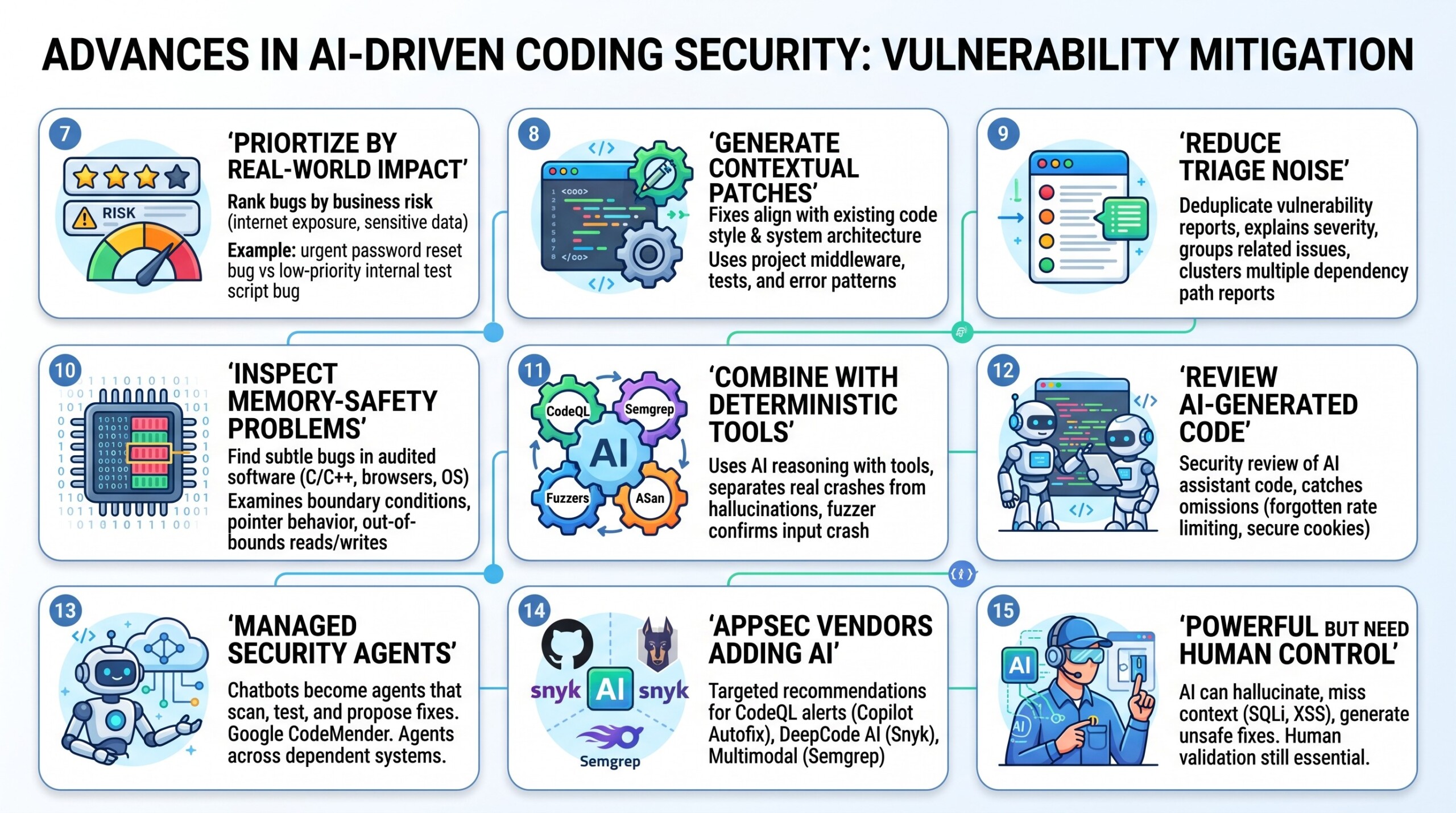
Not every bug matters equally. AI security tools can rank findings by business impact: internet exposure, authentication requirements, privilege level, data sensitivity, tenant isolation, exploitability and blast radius.
Example: A logging bug in an internal test script may be low priority. The same bug in a public password-reset flow may be urgent.
8. They generate patch suggestions with surrounding context
AI coding models can propose patches that fit the surrounding code style and architecture. OpenAI says Codex Security proposes fixes aligned with system intent and surrounding behavior, with the goal of improving security while minimizing regressions.
Example: For an authorization flaw, the model may not merely add a generic if admin check. It may reuse the project’s existing role-checking middleware, tests and error-handling patterns.
9. They help maintainers reduce triage noise
Open-source maintainers often suffer from low-quality vulnerability reports. AI tools can help by deduplicating reports, explaining severity, grouping related issues and drafting reproduction steps. Anthropic explicitly recommends using frontier models for first-round triage, deduplication, reproduction steps, patch proposals and pull-request security review.
Example: If 40 reports describe the same vulnerable dependency path, the AI can cluster them into one actionable remediation item. Excellent individualised mentoring programmes available.
10. They can inspect memory-safety problems
Mythos is notable because Anthropic says it found subtle memory-safety bugs in heavily audited systems, including operating systems, browsers and core software. The company says Mythos identified vulnerabilities that were old, subtle and difficult for traditional review to catch.
Example: In C or C++ code, an AI security model may examine boundary conditions, sentinel values, parser states or unsafe pointer behavior that can produce out-of-bounds reads or writes.
11. They can work with fuzzers, sanitizers and static analyzers
The strongest setups do not rely on the model alone. They combine AI reasoning with deterministic tools: CodeQL, Semgrep, fuzzers, AddressSanitizer, unit tests, dependency scanners and CI pipelines. Anthropic notes that memory-safety findings are easier to verify when tools like AddressSanitizer can separate real crashes from hallucinations.
Example: The model proposes suspicious parser inputs; a fuzzer or sanitizer confirms whether the input causes a real crash.
12. They can review AI-generated code for AI-generated bugs
As AI writes more code, security teams need AI to review it. Recent research on AI-generated code found CWE-mapped vulnerabilities across public repositories and noted that some weakness families appear in AI-attributed code. This does not mean AI code is always insecure, but it confirms the need for security review of AI-generated output.
Example: An AI assistant may generate a quick authentication flow but forget rate limiting, token rotation or secure cookie settings. A security-focused model can catch those omissions. Subscribe to our free AI newsletter now.
13. Vendors are turning models into managed security agents
The market is moving from “chatbot that comments on code” to “agent that scans, tests and proposes fixes.” Google announced CodeMender, an AI code security agent integrated into Agent Platform, designed to identify vulnerabilities, recommend fixes, securely test them and apply approved patches across dependent systems.
Example: In a cloud-native application, an agent may identify a vulnerable code path, update the code, adjust dependent configuration, run tests and submit a human-reviewable patch.
14. Existing AppSec vendors are adding AI layers
GitHub, Snyk and Semgrep are also adding AI to established security workflows. GitHub Copilot Autofix provides targeted recommendations for CodeQL code-scanning alerts. Snyk promotes DeepCode AI and Agent Fix for AI-assisted vulnerability review and remediation. Semgrep Multimodal adds AI-driven detection, triage and remediation to Semgrep’s platform.
Example: A pull request triggers a CodeQL alert for XSS; Copilot Autofix explains the issue and suggests a safer escaping pattern for developer review.
15. They are powerful but still need human control
AI coding models are not security authorities. They can hallucinate, miss context, overstate severity or generate unsafe fixes. Research on Copilot code review found that AI review can miss critical vulnerabilities such as SQL injection, XSS and insecure deserialization, while developer discussions continue to highlight concerns around data leakage, prompt injection and insecure code suggestions.
Example: A model may correctly identify a risky deserialization function but propose a patch that breaks backward compatibility. Human security engineers must still validate the risk, fix and operational impact. Upgrade your AI-readiness with our masterclass.
Conclusion
The latest AI coding models detect cyber vulnerabilities by combining broad code understanding, threat modeling, data-flow reasoning, pattern recognition, validation tools and patch generation. Models like Claude Mythos Preview show how far frontier systems have advanced; products like OpenAI Codex Security, Google CodeMender, GitHub Copilot Autofix, Snyk DeepCode AI and Semgrep Multimodal show how these capabilities are entering real developer workflows.
But the central lesson of 2026 is caution. These systems are dual-use. The same reasoning that helps find and fix vulnerabilities can also help discover and weaponize them. The safest future is not “AI replaces security teams,” but “AI gives defenders scale, speed and context – while humans retain judgment, accountability and control.”