China’s latest open-source LLMs
China’s latest open-source LLMs
Introduction
China has rapidly become one of the most important centers of open-source and open-weight large language model development. Companies such as Alibaba, DeepSeek, Baidu, Tencent, Moonshot AI, MiniMax, Z.ai, Meituan, and Xiaomi are releasing powerful models that compete not only within China but also on the global AI stage. These models are important because they give developers, researchers, startups, and enterprises more choices beyond closed proprietary systems. They also show China’s growing strength in areas such as reasoning, coding, multilingual AI, long-context processing, agentic workflows, and cost-efficient model deployment.
Let’s dive deep into it.
As of July 2026, here are 10 leading Chinese open-source / open-weight LLM models or model families worth tracking. “Top” here means a mix of capability, visibility, ecosystem adoption, and strategic importance, and not a single benchmark ranking.
- Qwen3 – Alibaba Cloud
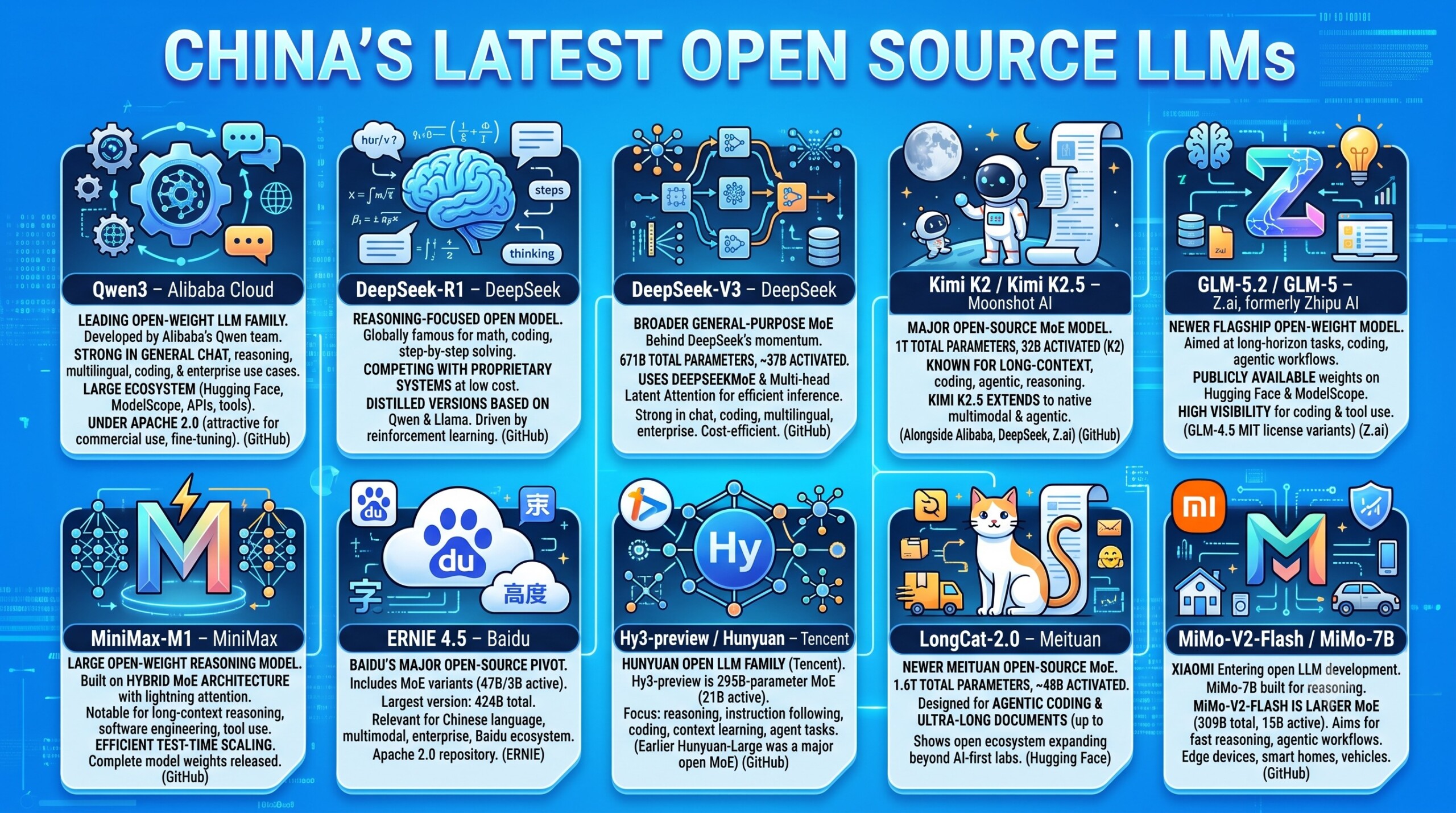
Qwen3 is one of China’s most important open-weight LLM families, developed by Alibaba’s Qwen team. It is strong across general chat, reasoning, multilingual work, coding, and enterprise use cases, and Alibaba has built a large ecosystem around Qwen through Hugging Face, ModelScope, APIs, and developer tooling. Qwen3 is especially important because its open-weight models are under Apache 2.0, making it attractive for commercial experimentation and fine-tuning. - DeepSeek-R1 – DeepSeek
DeepSeek-R1 became globally famous as a reasoning model focused on math, coding, and step-by-step problem solving. It showed that a Chinese open model could compete with top proprietary reasoning systems at much lower cost, and DeepSeek also released distilled versions based on Qwen and Llama for easier deployment. It is one of the best-known examples of reinforcement-learning-driven reasoning in open models. - DeepSeek-V3 – DeepSeek
DeepSeek-V3 is the broader general-purpose MoE model behind much of DeepSeek’s momentum. It has 671B total parameters with about 37B activated per token, using DeepSeekMoE and Multi-head Latent Attention for efficient inference. It is especially useful for general chat, coding, multilingual tasks, and enterprise deployment where strong capability and cost-efficiency matter. - Kimi K2 / Kimi K2.5 – Moonshot AI
Kimi K2 is Moonshot AI’s major open-source MoE model, with 1T total parameters and 32B activated parameters. It is known for strong long-context, coding, agentic, and reasoning performance. Kimi K2.5 extends the line toward native multimodal and agentic use, making Moonshot one of the most important Chinese open-model labs alongside Alibaba, DeepSeek, and Z.ai. - GLM-5.2 / GLM-5 – Z.ai, formerly Zhipu AI
GLM-5.2 is Z.ai’s newer flagship open-weight model aimed at long-horizon tasks, coding, and agentic workflows. Z.ai says the model weights are publicly available on Hugging Face and ModelScope, and the GLM line has become highly visible among developers looking for Chinese open models with strong coding and tool-use capabilities. GLM-4.5 was already important because Z.ai released base, reasoning, and FP8 versions under the MIT license. - MiniMax-M1 – MiniMax
MiniMax-M1 is a large open-weight reasoning model from MiniMax, built on a hybrid MoE architecture with lightning attention. It is notable for long-context reasoning, software engineering, tool use, and efficient test-time scaling. MiniMax also has newer M-series work, but M1 remains a landmark because MiniMax released complete model weights and positioned it as a serious open alternative for complex reasoning workloads. - ERNIE 4.5 – Baidu
ERNIE 4.5 marks Baidu’s major open-source pivot. The model family includes multiple variants, including MoE models with 47B and 3B active parameters, and the largest version has 424B total parameters. ERNIE is especially relevant for Chinese-language, multimodal, enterprise, and Baidu ecosystem use cases, and its Apache 2.0 GitHub repository makes it easier for developers to inspect and deploy. - Hy3-preview / Hunyuan – Tencent
Tencent’s Hunyuan family includes major open LLM releases, with Hy3-preview being a newer 295B-parameter MoE model with 21B active parameters. Tencent positions Hy3-preview around reasoning, instruction following, coding, context learning, and agent tasks. Earlier, Hunyuan-Large was also a major open-source MoE release with 389B total parameters and 52B active parameters, making Tencent a serious player in China’s open-model landscape. - LongCat-2.0 – Meituan
LongCat-2.0 is a newer Meituan open-source MoE model with 1.6T total parameters and about 48B activated per token. It is designed for agentic coding and ultra-long document handling, with Meituan highlighting support for up to 1M-token inputs. Because Meituan is not traditionally seen as a frontier AI lab, LongCat’s release shows how China’s open LLM ecosystem is expanding beyond the usual AI-first companies. - MiMo-V2-Flash / MiMo-7B – Xiaomi
Xiaomi’s MiMo line is important because it shows device and consumer-electronics companies entering open LLM development. MiMo-7B was built for reasoning and trained from scratch, while MiMo-V2-Flash is a larger MoE model with 309B total parameters and 15B active parameters, aimed at fast reasoning and agentic workflows. For edge devices, smart homes, vehicles, and Xiaomi’s broader hardware ecosystem, MiMo could become strategically important.
Conclusion
China’s open-source LLM ecosystem is no longer a secondary player; it is now one of the major forces shaping the future of artificial intelligence. Models such as Qwen, DeepSeek, Kimi, GLM, ERNIE, Hunyuan, MiniMax, LongCat, and MiMo demonstrate that advanced AI can be made more accessible, customizable, and affordable. For businesses and developers, these models open new opportunities to build AI applications without depending entirely on closed Western platforms.