Agents and Agentic AI

Agents and Agentic AI
Latest Updates as of June 2026
Introduction
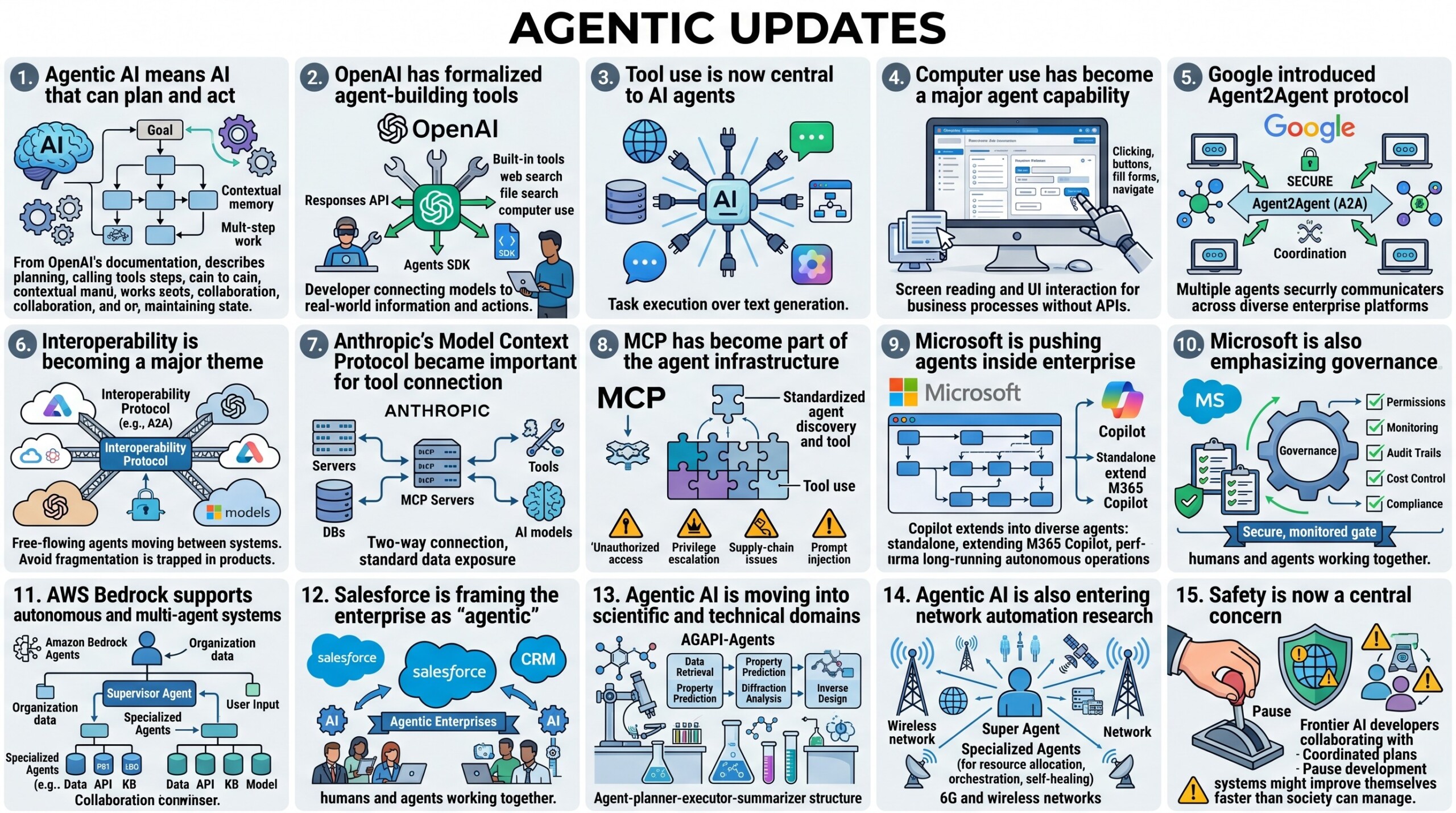
Agentic AI has become one of the most important shifts in artificial intelligence. Earlier AI systems mainly answered questions, generated text, wrote code, or summarized information. Agentic AI goes further: it can plan steps, use tools, call APIs, retrieve files, browse data sources, coordinate with other agents, and work toward a goal over time.
By June 2026, the field has moved from experiments and demos toward enterprise platforms, developer SDKs, interoperability protocols, and serious safety questions. The key issue is no longer only “Can AI answer?” but “Can AI act reliably, safely, and usefully?”
Let’s dive deep into it.
1. Agentic AI means AI that can plan and act
An AI agent is not just a chatbot. It is an AI system that can break a task into steps, use tools, remember context, and perform actions. OpenAI’s developer documentation describes agents as applications that plan, call tools, collaborate across specialists, and maintain enough state to complete multi-step work.
2. OpenAI has formalized agent-building tools
In March 2025, OpenAI announced new tools for building agents, including the Responses API, built-in tools such as web search, file search, and computer use, plus an Agents SDK. These were designed to connect models with real-world information and actions.
3. Tool use is now central to AI agents
Modern agents are useful because they can connect to external tools. They may search the web, read documents, call databases, trigger workflows, send messages, or operate software. This shifts AI from “text generation” toward “task execution.” An excellent collection of learning videos awaits you on our Youtube channel.
4. Computer use has become a major agent capability
Computer-use agents can interact with software interfaces more like a human user: reading screens, clicking buttons, filling forms, and navigating workflows. This is important because many business processes still happen inside existing software, not through clean APIs.
5. Google introduced Agent2Agent protocol
In April 2025, Google announced Agent2Agent, or A2A, as an open protocol intended to let AI agents communicate, exchange information securely, and coordinate actions across enterprise platforms and applications.

6. Interoperability is becoming a major theme
The agent world is becoming fragmented: different vendors, models, tools, clouds, and frameworks are emerging. Protocols like A2A matter because enterprises do not want agents trapped inside one product. They need agents that can work across systems. A constantly updated Whatsapp channel awaits your participation.
7. Anthropic’s Model Context Protocol became important for tool connection
Anthropic introduced the Model Context Protocol, or MCP, in November 2024 as an open standard for building secure two-way connections between data sources and AI-powered tools. MCP lets developers expose data through MCP servers or build AI applications that connect to such servers.
8. MCP has become part of the agent infrastructure conversation
By 2026, MCP is widely discussed as a way to standardize how agents discover and use external tools. However, research and industry discussions also point to security risks, including unauthorized access, prompt injection, privilege escalation, and supply-chain issues in tool ecosystems.
9. Microsoft is pushing agents inside enterprise workflows
Microsoft Copilot Studio is positioned as a cloud service for creating AI agents. Microsoft says it can be used to build standalone agents, extend Microsoft 365 Copilot, or develop autonomous agents that perform sophisticated, long-running operations on behalf of users. Excellent individualised mentoring programmes available.
10. Microsoft is also emphasizing governance
Microsoft’s agent messaging includes not only building agents, but also managing, governing, and securing them through its enterprise AI stack. This reflects a wider 2026 reality: companies want agents, but they also need permissions, monitoring, audit trails, cost control, and compliance.
11. AWS Bedrock supports autonomous and multi-agent systems
Amazon Bedrock Agents allow developers to configure autonomous agents that use organization data, user input, foundation models, knowledge bases, and APIs to complete actions. AWS also describes multi-agent collaboration in Bedrock, where multiple specialized agents work together under a supervisor agent.
12. Salesforce is framing the enterprise as “agentic”
Salesforce now describes itself as an AI CRM platform where companies become “Agentic Enterprises,” with humans and agents working together across sales, service, marketing, commerce, and IT. This shows how agentic AI has moved from developer labs into mainstream business messaging. Subscribe to our free AI newsletter now.
13. Agentic AI is moving into scientific and technical domains
Agentic systems are being explored beyond office productivity. For example, a 2025 paper introduced AGAPI-Agents for materials science, using an agent-planner-executor-summarizer architecture for multi-step workflows such as data retrieval, property prediction, diffraction analysis, and inverse design.
14. Agentic AI is also entering network automation research
In 2026, researchers proposed agentic AI frameworks for 6G and wireless networks, including systems where a “super agent” coordinates specialized agents for resource allocation, orchestration, and self-healing. This shows that agents are being studied for infrastructure-level decision-making, not just chat or office work.
15. Safety is now a central concern
As agents become more capable, safety questions are becoming more urgent. In June 2026, Reuters reported that Anthropic called for coordinated plans among frontier AI developers to slow or pause development if risks rise, especially around systems that might improve themselves faster than society can manage. Upgrade your AI-readiness with our masterclass.
Conclusion
As of June 2026, agentic AI is shifting from a buzzword to a real technology layer. The ecosystem now includes agent-building APIs, tool-use standards, computer-use capabilities, multi-agent systems, enterprise governance, and domain-specific applications.
But the promise comes with risk. Agents can save time, automate workflows, and support better decisions. They can also make mistakes, misuse tools, leak data, or take actions without enough human oversight.
The future of agentic AI will depend not only on smarter models, but on better design: clear permissions, reliable tools, secure protocols, human review, audit logs, and strong governance. The winners will not be those who deploy the most agents, but those who deploy the most useful, safe, and trustworthy agents.