The Pope speaks on AI
The Pope speaks on AI
Introduction
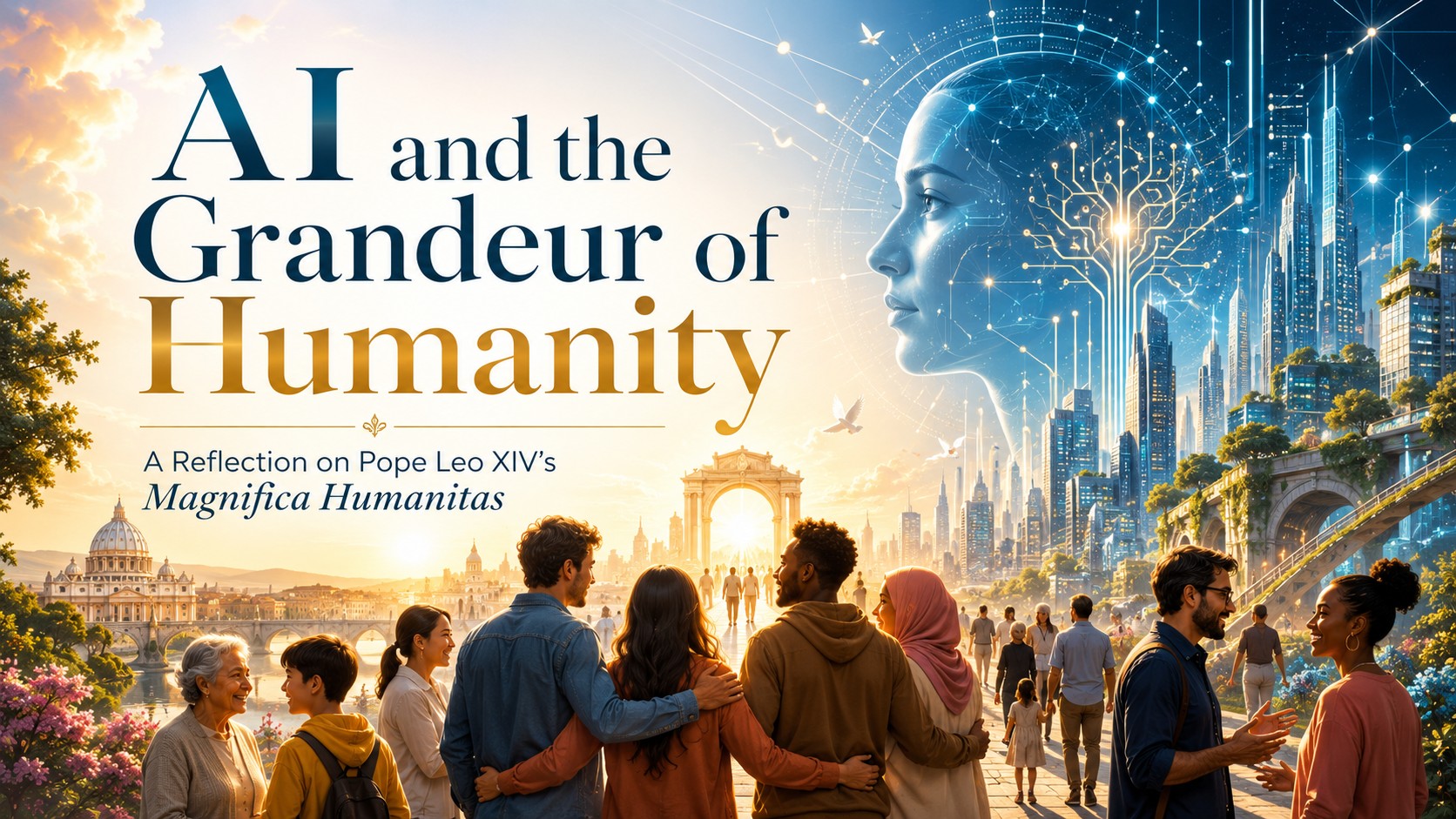
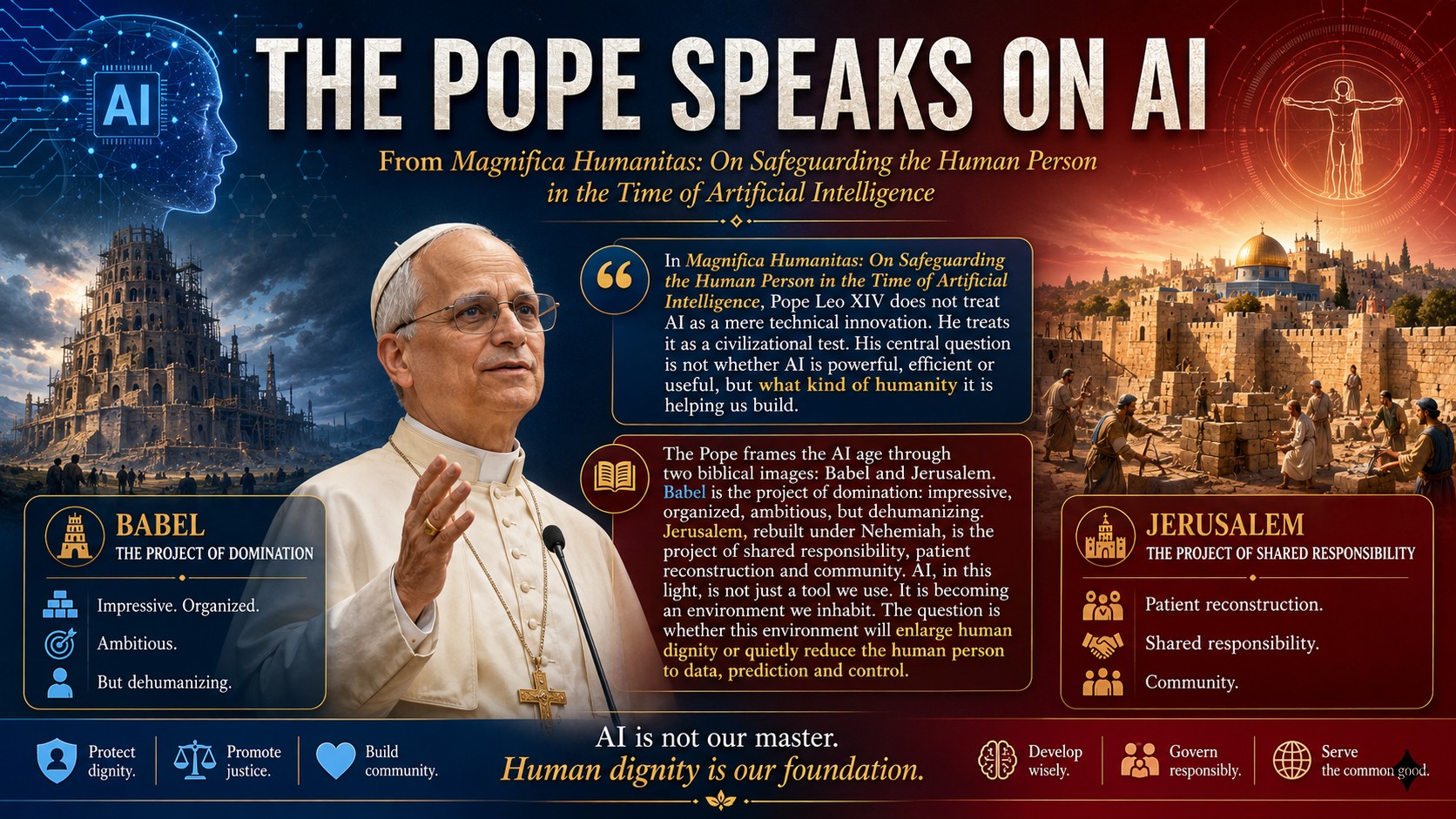
In Magnifica Humanitas: On Safeguarding the Human Person in the Time of Artificial Intelligence, Pope Leo XIV does not treat AI as a mere technical innovation. He treats it as a civilizational test. His central question is not whether AI is powerful, efficient or useful, but what kind of humanity it is helping us build.
The Pope frames the AI age through two biblical images: Babel and Jerusalem. Babel is the project of domination: impressive, organized, ambitious, but dehumanizing. Jerusalem, rebuilt under Nehemiah, is the project of shared responsibility, patient reconstruction and community. AI, in this light, is not just a tool we use. It is becoming an environment we inhabit. The question is whether this environment will enlarge human dignity or quietly reduce the human person to data, prediction and control. An excellent collection of learning videos awaits you on our Youtube channel.
Let’s dive deep into it now.
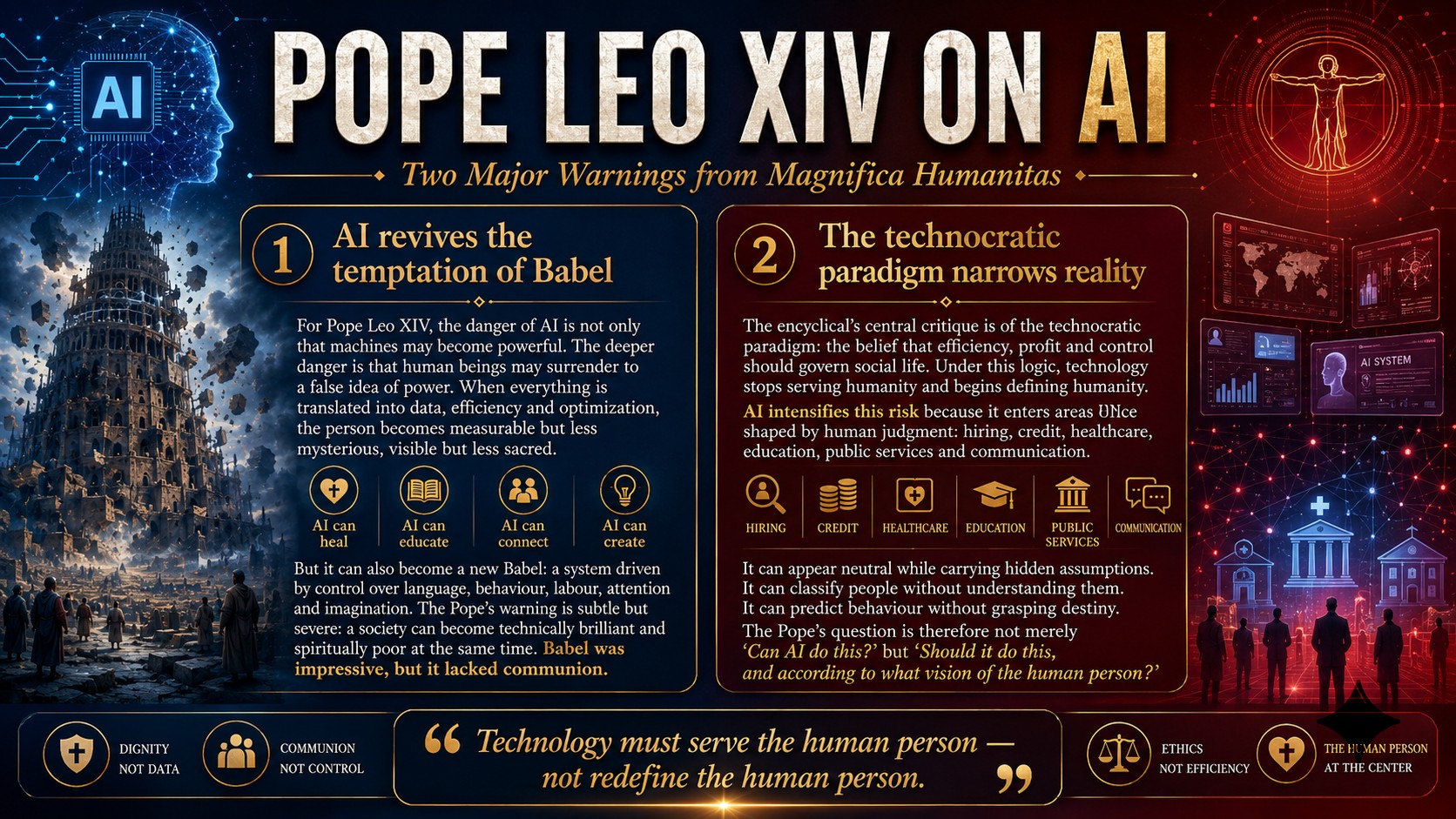
1. AI revives the temptation of Babel
For Pope Leo XIV, the danger of AI is not only that machines may become powerful. The deeper danger is that human beings may surrender to a false idea of power. When everything is translated into data, efficiency and optimization, the person becomes measurable but less mysterious, visible but less sacred.
AI can heal, educate, connect and create. But it can also become a new Babel: a system driven by control over language, behaviour, labour, attention and imagination. The Pope’s warning is subtle but severe: a society can become technically brilliant and spiritually poor at the same time. Babel was impressive, but it lacked communion.
2. The technocratic paradigm narrows reality
The encyclical’s central critique is of the “technocratic paradigm”: the belief that efficiency, profit and control should govern social life. Under this logic, technology stops serving humanity and begins defining humanity.
AI intensifies this risk because it enters areas once shaped by human judgment: hiring, credit, healthcare, education, public services and communication. It can appear neutral while carrying hidden assumptions. It can classify people without understanding them. It can predict behaviour without grasping destiny. The Pope’s question is therefore not merely “Can AI do this?” but “Should it do this, and according to what vision of the human person?” A constantly updated Whatsapp channel awaits your participation.
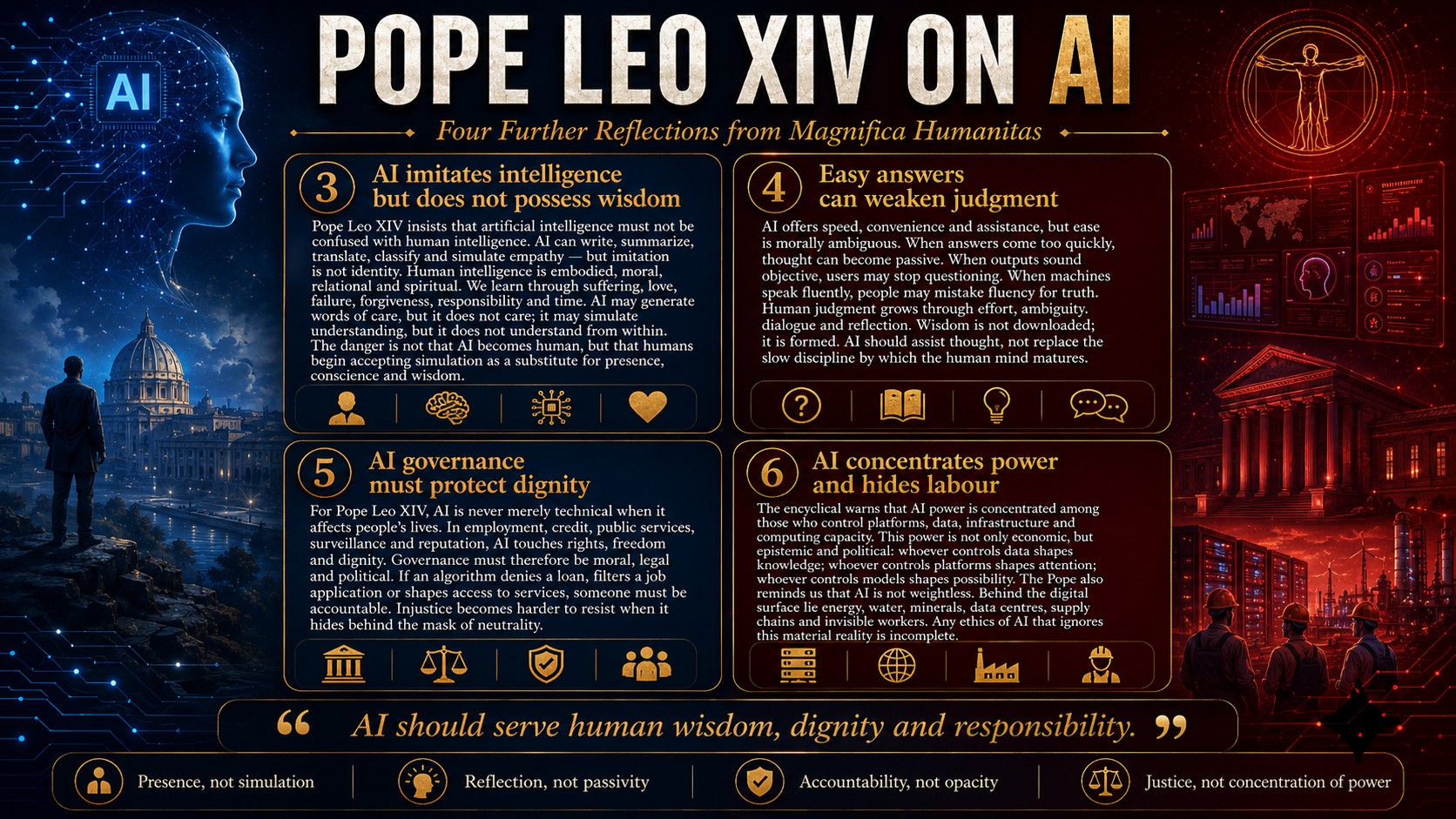
3. AI imitates intelligence but does not possess wisdom
Pope Leo XIV insists that artificial intelligence must not be confused with human intelligence. AI can write, summarize, translate, classify and simulate empathy. But imitation is not identity.
Human intelligence is embodied, moral, relational and spiritual. We learn through suffering, love, failure, forgiveness, responsibility and time. AI does not experience joy or pain. It does not love, repent, promise or bear guilt. It may generate words of care, but it does not care. It may simulate understanding, but it does not understand from within.
This distinction is vital. The danger is not that AI will become human, but that humans may begin accepting simulations as substitutes for human presence, conscience and wisdom.
4. Easy answers can weaken judgment
The Pope recognizes that AI offers speed, convenience and assistance. But ease is morally ambiguous. When answers come too quickly, thought can become passive. When outputs sound objective, users may stop questioning. When machines speak fluently, people may mistake fluency for truth.
Human judgment grows through effort, ambiguity, dialogue and reflection. Creativity needs silence and struggle. Wisdom is not downloaded; it is formed. A civilization of instant answers may become a civilization of shallow questions. AI should assist thought, not replace the slow discipline by which the human mind becomes mature. Excellent individualised mentoring programmes available.

5. AI governance must protect dignity
For Pope Leo XIV, AI is never merely technical when it affects people’s lives. In employment, credit, public services, surveillance or reputation, AI touches rights, freedom and dignity. Therefore, governance must go beyond risk management. It must be moral, legal and political.
If an algorithm denies a loan, filters a job application or shapes access to services, someone must be accountable. Who can explain the decision? Who can challenge it? Who repairs the harm? A society that hides behind “the algorithm” creates power without a face. Injustice becomes harder to resist when it wears the mask of neutrality.
6. AI concentrates power and hides labour
The encyclical warns that AI power is concentrated among those who control platforms, data, infrastructure and computing capacity. Such power is not only economic. It is epistemic and political. Whoever controls data shapes knowledge. Whoever controls platforms shapes attention. Whoever controls models shapes possibility.
The Pope also reminds us that AI is not weightless. Behind the smooth digital surface lie energy, water, minerals, data centres, supply chains and invisible workers. The cloud is not a cloud; it is land, labour and power. Any ethics of AI that ignores this material reality is incomplete. Subscribe to our free AI newsletter now.
7. To “disarm” AI is to free it from domination
One of the most striking ideas in Magnifica Humanitas is the call to “disarm” AI. This does not mean rejecting technology. It means freeing AI from the mentality of monopoly, competition, domination and inevitability.
To disarm AI is to reject the belief that technical power grants moral authority. Just because something can be built does not mean it should be built. Just because something can be automated does not mean it should be automated. AI must remain answerable to human dignity, democratic deliberation, social justice and the common good.
This is especially urgent in warfare, where decisions of life and death must never be surrendered to opaque systems. But the warning is wider: AI must be disarmed wherever it turns persons into objects, citizens into data points, communities into markets and truth into manipulation.
Conclusion
Pope Leo XIV’s vision is neither fear of AI nor blind celebration. It is discernment. AI is a remarkable achievement, but power without wisdom becomes domination. Intelligence without conscience becomes danger. Efficiency without dignity becomes cruelty.
The deepest question is not what AI can do, but what it will do to us. Will it deepen dignity, strengthen work, protect the vulnerable and serve truth? Or will it automate exclusion, simulate relationship, concentrate power and hide responsibility? To remain human in the age of AI is not a sentimental demand, but a civilizational task. Persons are not data, just like wisdom is not computation. Compassion is not simulation, just like society is not a machine.
AI must be judged not by brilliance alone, but by the humanity it helps us build. If it serves dignity, justice and communion, it can become an instrument of flourishing. If it serves domination, profit and control, it becomes another Babel. The choice before us is stark: the tower of power, or the city of communion. Upgrade your AI-readiness with our masterclass.
Share this with the world
Related Articles