Future belongs to people who can do what AI cannot
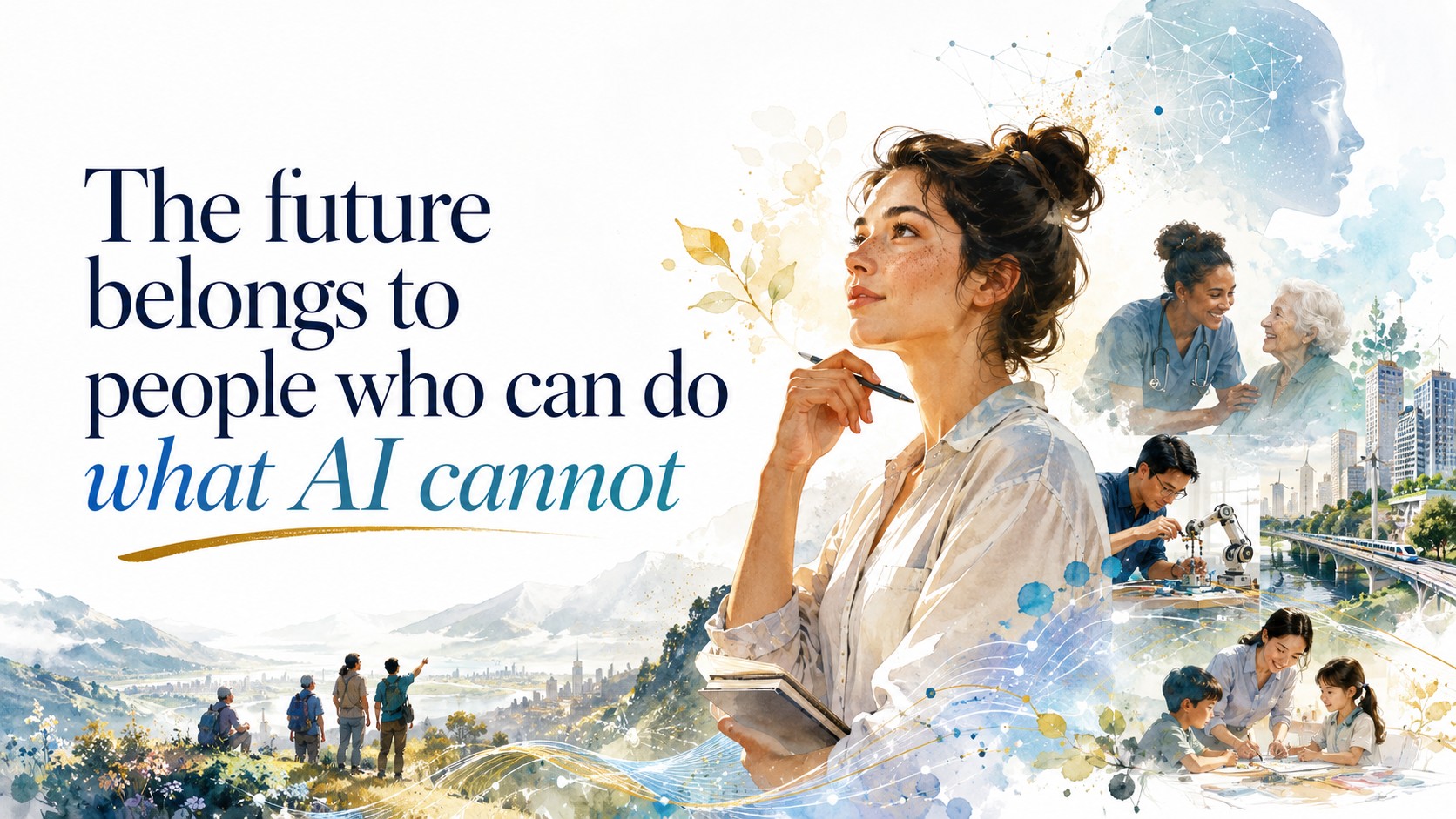
Future belongs to people who can do what AI cannot
Introduction
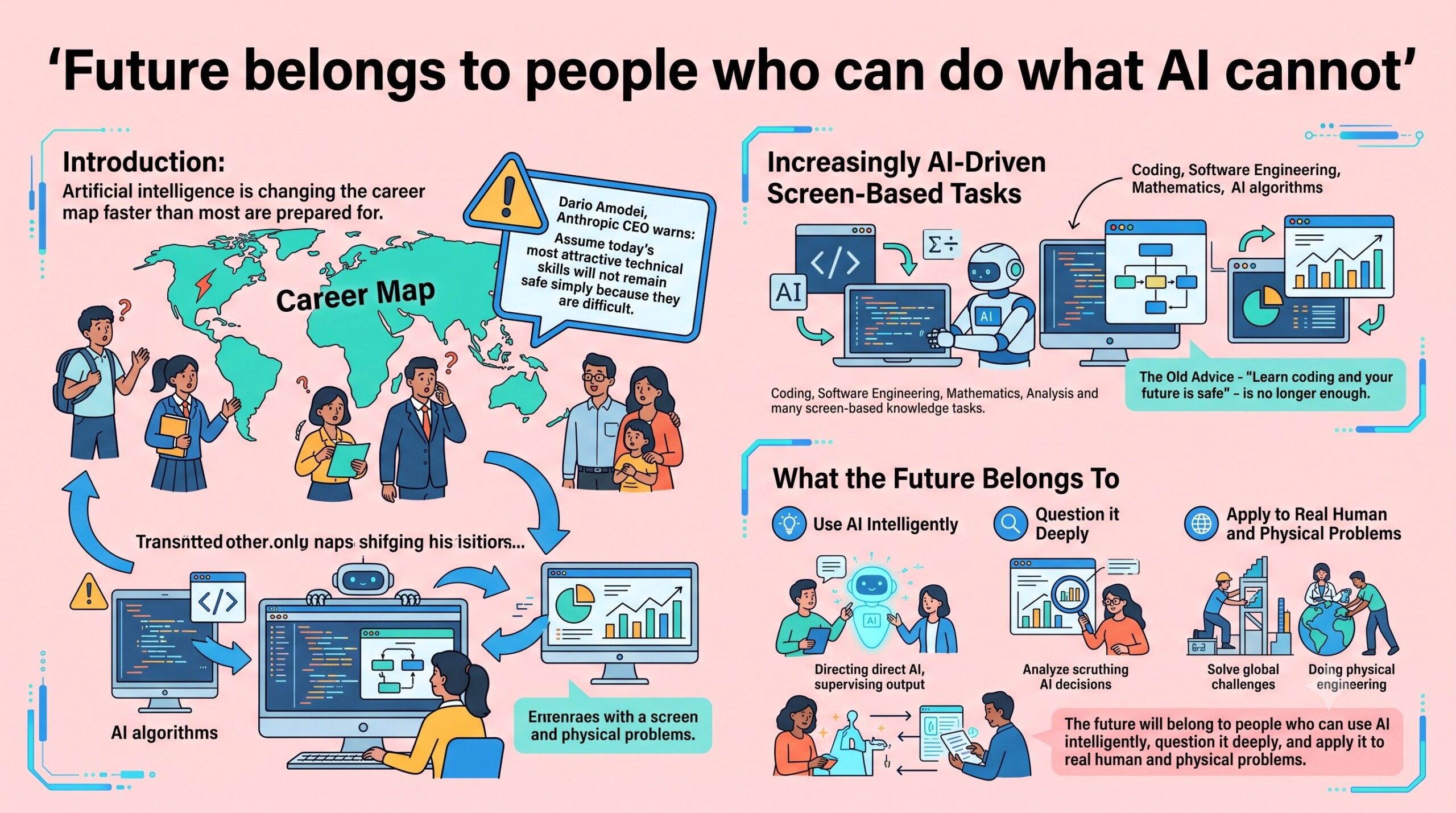
Artificial intelligence is changing the career map faster than most students, professionals, parents, colleges, and companies are prepared for. In a powerful warning, Anthropic CEO Dario Amodei argues that we should not assume today’s most attractive technical skills will remain safe simply because they are difficult.
Coding, software engineering, mathematics, analysis, and many screen-based knowledge tasks are becoming increasingly AI-driven. This does not mean every software engineer will disappear tomorrow. But it does mean that the old advice – “learn coding and your future is safe” – is no longer enough.
The future will not belong to people who merely collect skills that AI can copy. It will belong to people who can use AI intelligently, question it deeply, and apply it to real human and physical problems. An excellent collection of learning videos awaits you on our Youtube channel.
Let’s dive deep into it now.
1. AI attacks repeatable cognitive work first
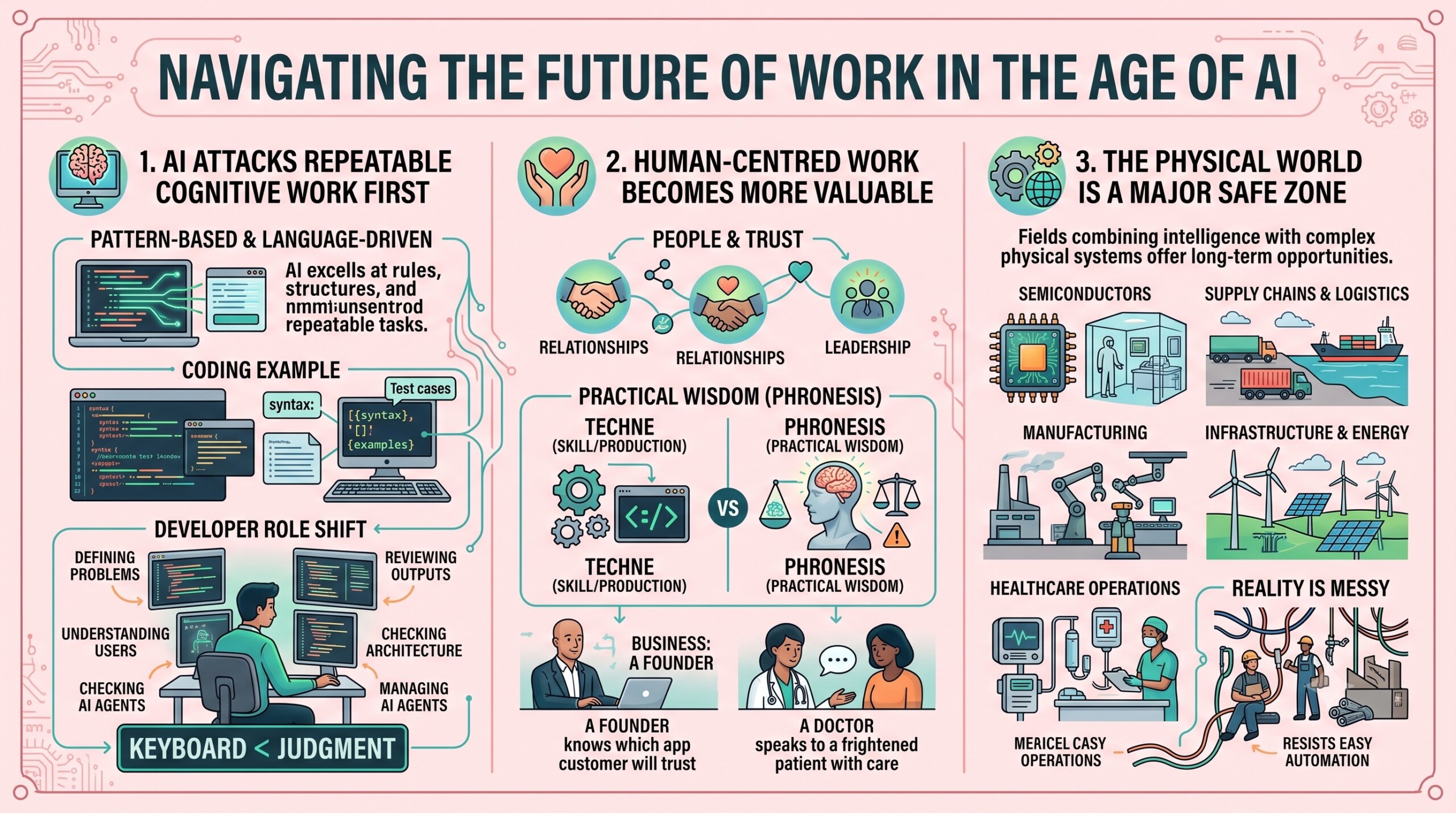
The most important idea is simple: AI is strongest at work that is repeatable, pattern-based, language-driven, and screen-based.
If a task happens mostly inside a computer, follows clear rules, uses code or language, and can be judged by visible outputs, AI will keep getting better at it. Coding is a perfect example. It has structure, syntax, documentation, examples, test cases, and huge amounts of training data available online.
That is why AI coding tools are improving so quickly. The future developer may not spend most of the day typing code line by line. Instead, the role may shift towards defining problems, reviewing outputs, understanding users, checking architecture, managing AI agents, and making sure the final system works in the real world.
The keyboard may become less important than judgment.
2. Human-centred work becomes more valuable
This is where the human advantage begins.
Work that involves people, trust, emotions, persuasion, demand, relationships, leadership, and judgment will become more valuable. These are often called “soft skills,” but that phrase is misleading. In the AI age, they may become the hardest skills.
A machine can create twenty versions of an app interface. But a human must understand which one a customer will trust. AI can generate a business plan. But a founder must know what people will actually pay for. AI can summarize a medical report. But a doctor must still speak to a frightened patient with care and responsibility.
This is the ancient distinction between techne and phronesis: technical skill and practical wisdom. AI may become extraordinary at technical production. But practical wisdom – knowing what matters, when to act, whom to trust, and what consequences may follow – remains deeply human. A constantly updated Whatsapp channel awaits your participation.
3. The physical world is a major safe zone
AI is strongest where everything is digital. But the world still runs on physical systems.
It runs on chips, factories, machines, logistics, hospitals, farms, ports, warehouses, energy systems, roads, devices, and people moving through real space. That is why fields such as semiconductors, supply chains, manufacturing, traditional engineering, robotics, infrastructure, energy, healthcare operations, and applied hardware may offer a better long-term runway.
These fields combine intelligence with reality.
AI can help design a chip, but someone must build the semiconductor ecosystem. AI can optimize a warehouse, but someone must understand goods, delays, workers, vendors, machines, and customers. AI can suggest a factory layout, but someone must know how real materials, costs, safety rules, and human habits interact.
The physical world resists easy automation because reality is messy.
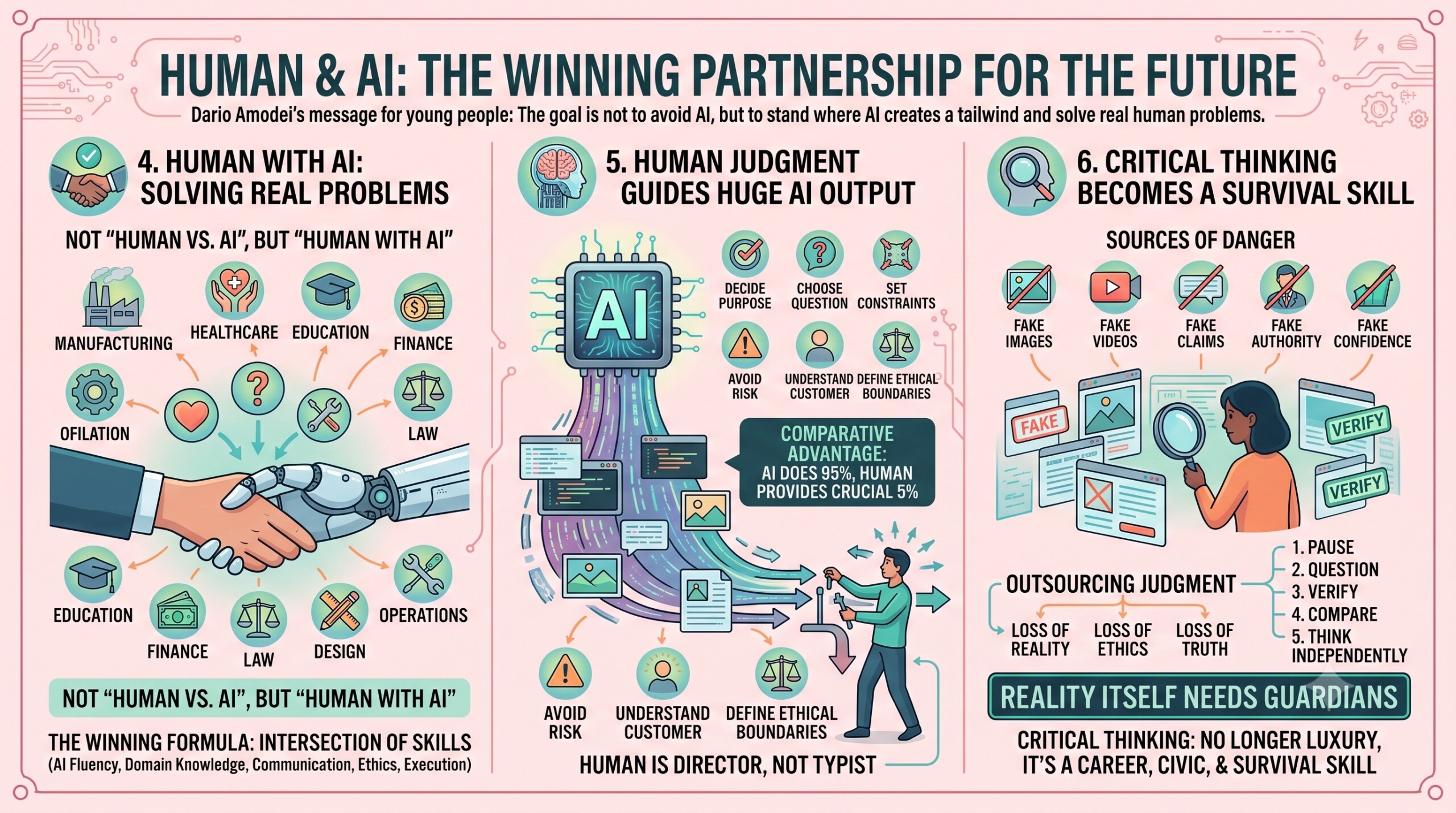
4. The winning formula is human plus AI
Dario Amodei’s message is especially important for young people in India. The goal should not be to avoid AI. The goal should be to stand where AI creates a tailwind.
A person who only learns routine coding may face pressure. But a person who understands AI plus customers, AI plus manufacturing, AI plus healthcare, AI plus education, AI plus finance, AI plus law, AI plus design, or AI plus operations may become far more valuable.
The winning formula is not “human versus AI.”
It is “human with AI, solving real human problems.”
This means students and professionals should not ask only, “What skill should I learn?” They should ask, “Where can this skill create value in the real world?” The answer will usually lie at the intersection of AI fluency, domain knowledge, communication, ethics, and execution. Excellent individualised mentoring programmes available.
5. Small human judgment can guide huge AI output
One of the most underrated ideas in this discussion is comparative advantage.
Even if AI does most of the work, the small human contribution can still matter enormously. If AI performs 95% of a task and the human contributes 5%, that 5% may guide the entire direction. It may decide what question to ask, what output to trust, what risk to avoid, what customer really wants, and what ethical line should not be crossed.
In such a world, humans may do less mechanical work but more judgment work. The human becomes less like a typist and more like a director.
This is a profound shift. The value of the human may not come from producing every sentence, every line of code, or every slide. It may come from deciding the purpose, constraints, meaning, and consequences of the work.
6. Critical thinking becomes a survival skill
AI will not only generate useful answers. It will also generate convincing nonsense.
It will create fake images, fake videos, fake claims, fake authority, fake confidence, and fake certainty. In such a world, the person who can pause, question, verify, compare, and think independently will have a major advantage.
The danger is not only that AI may take jobs. The deeper danger is that people may outsource their judgment to machines and slowly lose the ability to tell what is real, useful, ethical, or true.
Here the philosophical problem becomes almost esoteric: when the simulation becomes more fluent than the observer, reality itself starts needing guardians. The old question “What is true?” becomes harder when every falsehood can arrive beautifully formatted, emotionally intelligent, and perfectly confident.
That is why critical thinking is no longer an academic luxury. It is a career skill, a civic skill, a survival skill. Subscribe to our free AI newsletter now.
7. The safest career strategy is to become useful where AI meets reality
The central lesson is clear: the future will not reward people who merely collect skills that AI can copy. It will reward people who combine AI fluency with human understanding, physical-world awareness, domain knowledge, communication, ethics, and judgment.
Coding may still matter. But coding alone will not be enough. Degrees may still matter. But degrees alone will not be enough. Technical skill may still matter. But technical skill without context, human insight, and real-world application will become fragile.
The safest career strategy is to become useful in areas where intelligence must meet people, systems, institutions, and reality. That is where AI needs human direction. That is where complexity cannot be reduced to a prompt. That is where the future will create new winners.
Conclusion
Dario Amodei’s message is uncomfortable, but it is not hopeless. AI will disrupt many careers, especially those built around routine digital work. But it will also create huge opportunities for people who choose wisely.
The future belongs to those who can understand AI, use AI, question AI, and apply AI to real human and physical problems.
In the AI age, the smartest career advice may be this: do not become a task machine. Become the person who knows which tasks matter. Upgrade your AI-readiness with our masterclass.

Share this with the world
Related Articles