From co-creation to co-intelligence
From co-creation to co-intelligence
Introduction
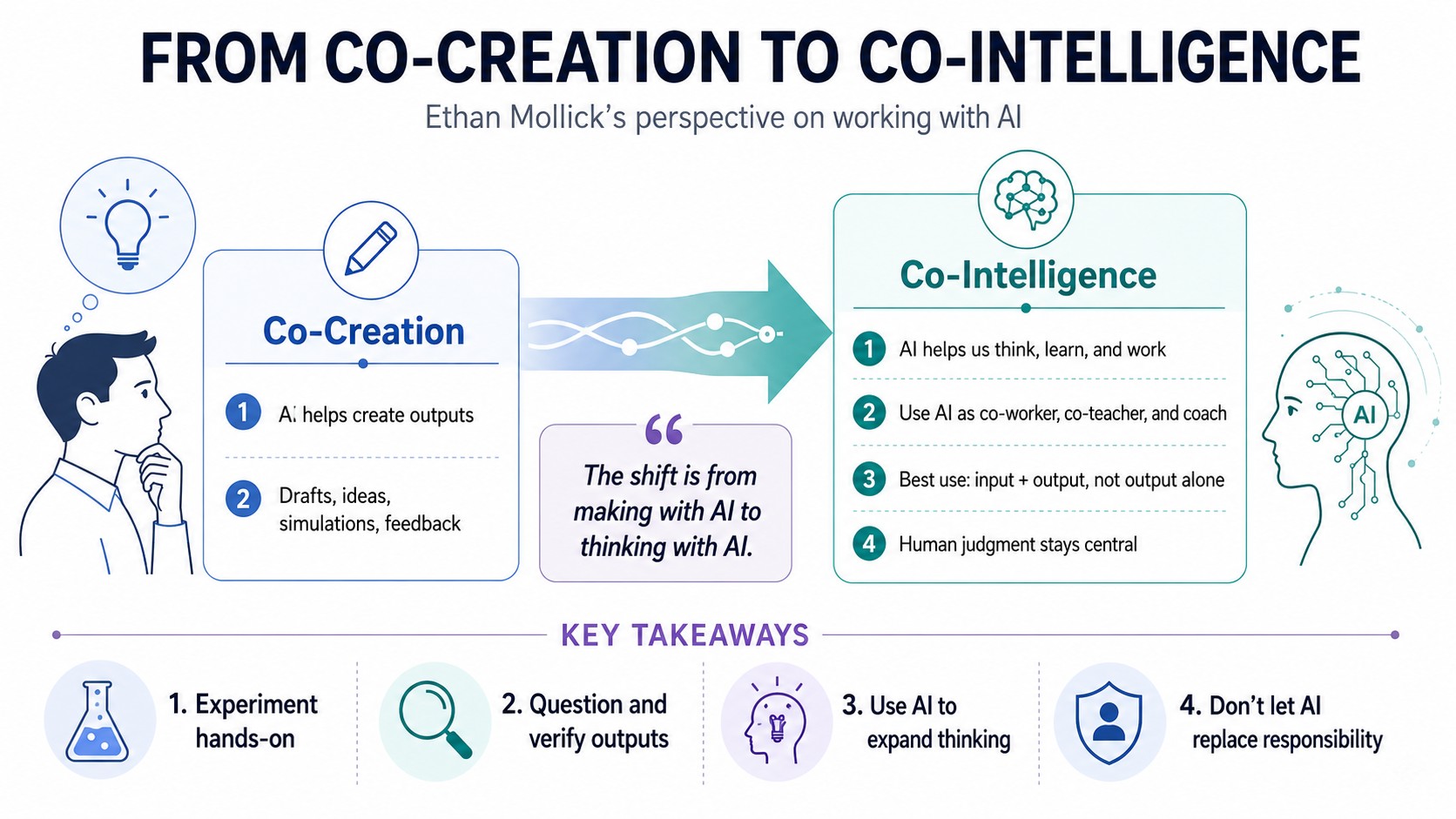
For the last few years, we have often described artificial intelligence as a tool for co-creation. The phrase was useful. It helped us see AI as a partner in producing things: a lesson plan, article, design, classroom simulation, business idea, code snippet, or strategy note. In this model, the human gives direction; AI helps with expression, variation, speed, and scale. But this frame is now incomplete.
Ethan Mollick’s idea of co-intelligence points to a wider shift. AI is no longer only helping us create outputs. It is beginning to participate in the process of thinking: challenging assumptions, generating alternatives, simulating perspectives, summarizing complexity, and helping us notice what we may have missed. Mollick’s One Useful Thing blog focuses on the implications of AI for work, education, and life, while his book Co-Intelligence is explicitly about living and working with AI. An excellent collection of learning videos awaits you on our Youtube channel.
This does not mean AI has wisdom, consciousness, or moral responsibility. It does not mean AI should replace human judgment. But it does mean the human mind is no longer working alone.
The question is no longer only: “What can AI make for us?” A deeper question is: “What happens to human thought when another kind of intelligence begins to think with us?”
Let’s dive deep into it now.
1. Co-creation was about output; co-intelligence is about thought
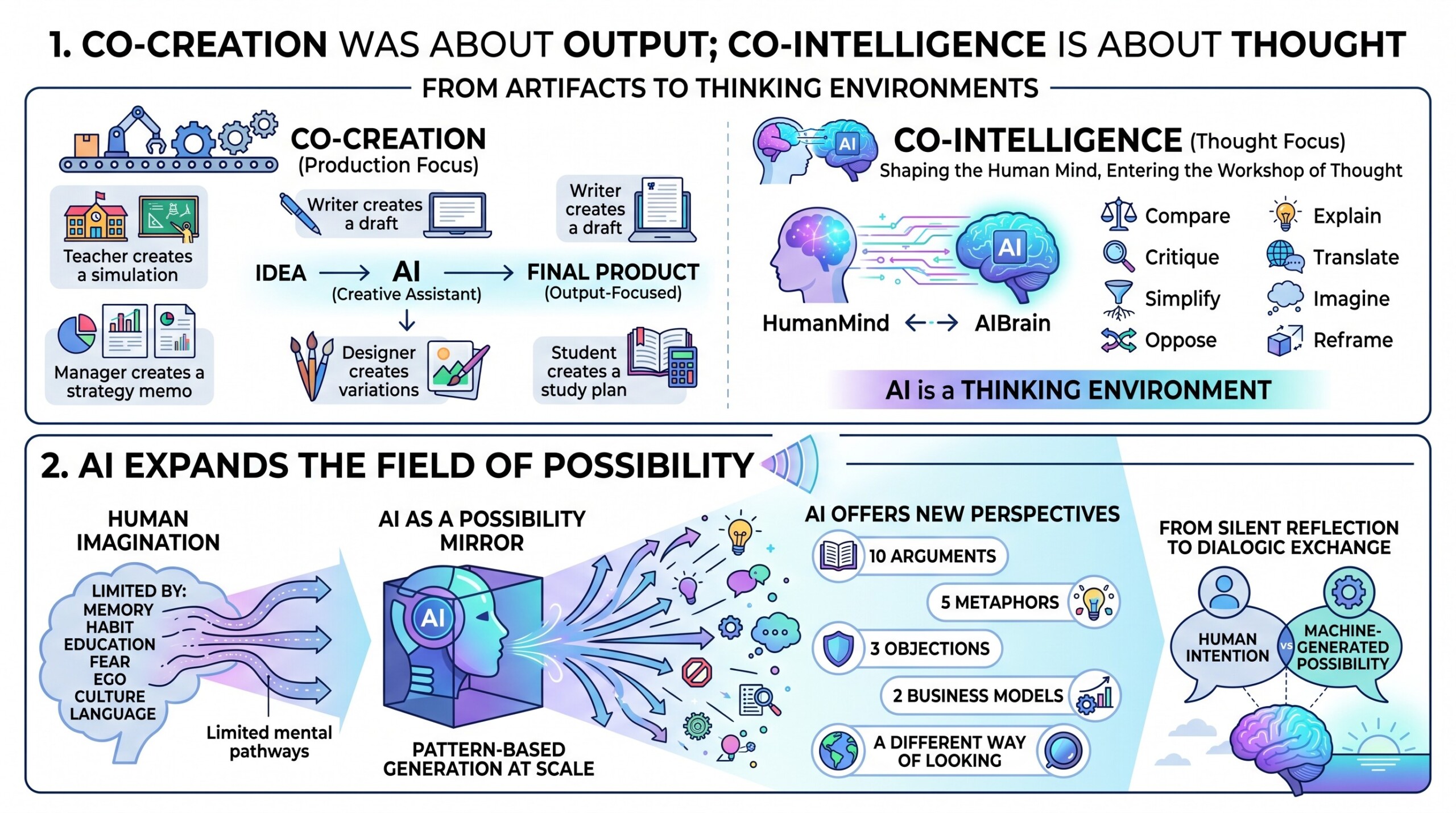
Co-creation focuses on production. A teacher creates a simulation with AI. A writer creates a draft. A manager creates a strategy memo. A designer creates variations. A student creates a study plan.
In co-creation, AI is a creative assistant. It helps move from idea to artifact. Co-intelligence goes deeper. It is not only about the artifact produced at the end. It is about the shaping of the human mind during the process.
When we work with AI, we do not merely ask it to write. We ask it to compare, critique, simplify, deepen, oppose, explain, translate, imagine, and reframe. In doing so, it enters the workshop of thought.
This is why co-intelligence is philosophically more serious than co-creation. It changes AI from a production tool into a thinking environment.
2. AI expands the field of possibility
Human imagination is powerful, but it is also limited. We are shaped by memory, habit, education, fear, ego, culture, and language. Often, we do not see the possibilities outside our familiar mental pathways.
AI can widen that possibility space. It can offer ten arguments, five metaphors, three objections, two business models, or a completely different way of looking at the same issue. Many suggestions may be ordinary. Some may be wrong. But some may open a door.
This is not magic or divine intelligence. It is pattern-based generation at scale. But from the human side, the effect can still be profound. The mind suddenly has a mirror that answers back.
Co-intelligence makes thinking more dialogic. Thought is no longer only silent reflection inside one mind. It becomes an exchange between human intention and machine-generated possibility. A constantly updated Whatsapp channel awaits your participation.
3. Co-intelligence requires humility
AI forces a new humility upon us.
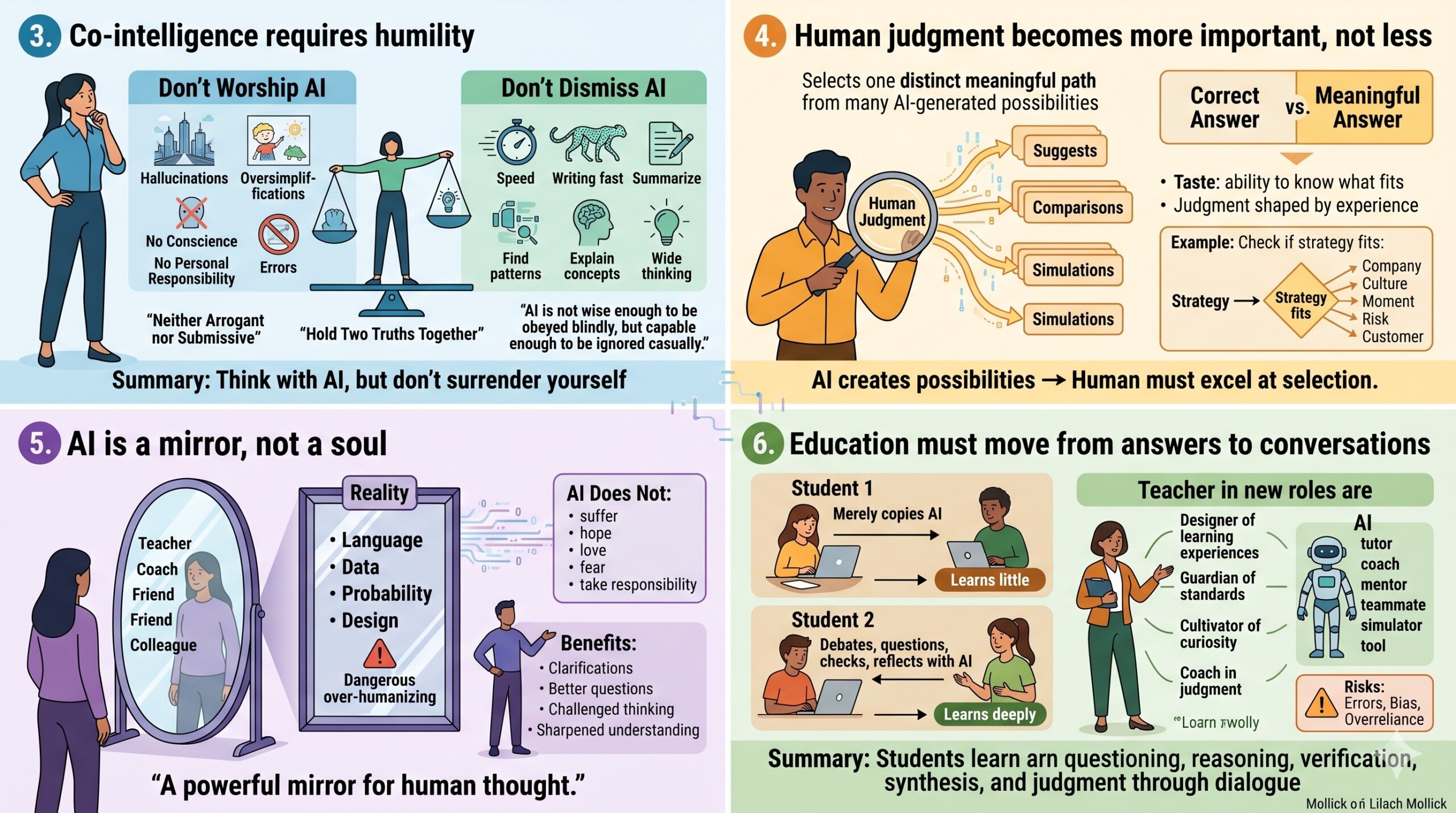
We must not worship it. AI can hallucinate, oversimplify, flatter, mislead, and confidently produce errors. It has no lived experience, no conscience, and no personal responsibility for consequences.
But we must not dismiss it either. AI can write fast, summarize well, generate options, find patterns, explain concepts, and expose gaps in our reasoning. It can help a beginner move faster and help an expert think wider.
So the human position becomes delicate. We must be neither arrogant nor submissive. We must be alert. Co-intelligence asks us to hold two truths together: AI is not wise enough to be obeyed blindly, but it is capable enough to be ignored casually.
The future belongs not to those who merely “use AI,” but to those who know how to think with it without surrendering themselves to it.
4. Human judgment becomes more important, not less
In any serious partnership with AI, judgment remains the central human responsibility.
AI can generate, suggest, compare, simulate, and summarize. But the human must still decide what is true, useful, ethical, beautiful, relevant, and worth doing.
This is where human taste matters. Taste is not only artistic preference. It is the ability to know what fits. It is judgment shaped by experience. It is the difference between a correct answer and a meaningful answer.
AI may produce a hundred lines. The human must know which line matters. AI may produce a strategy. The human must know whether it fits this company, this culture, this moment, this risk, and this customer.
Co-intelligence does not reduce the need for judgment. It increases it. When the machine produces more possibilities, the human must become better at selection. Excellent individualised mentoring programmes available.

5. AI is a mirror, not a soul
There is a temptation to humanize AI too much. Because it writes fluently, we may imagine that it understands as we understand. Because it responds politely, we may imagine that it cares. Because it can imitate wisdom, we may confuse imitation with inner life.
This is dangerous. AI is a mirror made of language, data, probability, and design. It reflects patterns from human civilization. It can sound like a teacher, coach, critic, friend, or colleague. But it does not suffer, hope, love, fear, or take responsibility.
And yet, even a mirror can change us. When we speak to AI, we often clarify ourselves. When we ask better questions, we discover what we actually want. When AI challenges us, we sharpen our thinking. When it gives a weak answer, we may understand the problem better.
AI is not a soul. But it can become a powerful mirror for human thought.
6. Education must move from answers to conversations
The older model of education often rewarded the correct answer. The AI age challenges that model. If machines can produce answers instantly, then the deeper value of education must shift toward questioning, reasoning, verification, synthesis, and judgment.
Mollick’s education work with Lilach Mollick has explored AI as tutor, coach, mentor, teammate, simulator, and tool – while also stressing risks such as errors, bias, and student overreliance. In a co-intelligent world, students must learn how to ask better questions, test assumptions, compare perspectives, identify weak reasoning, and improve their own thinking through dialogue with AI.
The teacher’s role also changes. A teacher is no longer only a provider of information. The teacher becomes a designer of learning experiences, a guardian of standards, a cultivator of curiosity, and a coach in judgment. A student who merely copies AI learns little. A student who debates with AI, questions it, improves it, checks it, and reflects on it may learn deeply. Subscribe to our free AI newsletter now.
7. Work will be redesigned around human-AI partnership
The most common fear is that AI will replace human work. In some tasks, it will. Routine writing, summarizing, coding, support, and analysis are already being transformed.
But the deeper story is not only replacement. It is reconfiguration. Work will increasingly be divided between what machines can generate and what humans must judge. AI may draft the document, but humans must define the purpose. AI may create options, but humans must understand context. AI may analyze data, but humans must decide what action is wise.
This means careers will change. Professionals will need to become better questioners, editors, verifiers, designers, integrators, and decision-makers. The worker of the future will not simply compete with AI. The worker of the future will orchestrate AI.
But orchestration requires maturity. If we allow AI to think for us, we become weaker. If we learn to think with AI, we may become stronger.
Conclusion
The journey from co-creation to co-intelligence is not just a change in terminology. It is a change in our relationship with machines.
Co-creation asked: “What can we make with AI?”
Co-intelligence asks: “What can we become when we think with AI?”
This is a philosophical shift. Every powerful technology changes not only what humans do, but what humans believe about themselves. The telescope changed our place in the universe. The printing press changed memory and authority. The internet changed access to knowledge. AI is now changing the experience of thought.
But the final responsibility remains human.
AI can help us create, but it cannot give us purpose. AI can help us think, but it cannot give us conscience. AI can help us decide, but it cannot carry moral responsibility. AI can imitate wisdom, but it cannot live a human life. Did that sound too poetic! Ha ha.
So the goal is not to surrender intelligence to the machine. The goal is to build a wiser partnership — one where AI expands possibilities, while humans deepen judgment, responsibility, and meaning.
The future will not be shaped by artificial intelligence alone. It seems it will be shaped by the quality of human intelligence that learns how to work with it. Upgrade your AI-readiness with our masterclass.
Share this with the world
Related Articles