Recursive Self Improvement in AI
Recursive Self Improvement in AI
The last invention of mankind?
Introduction
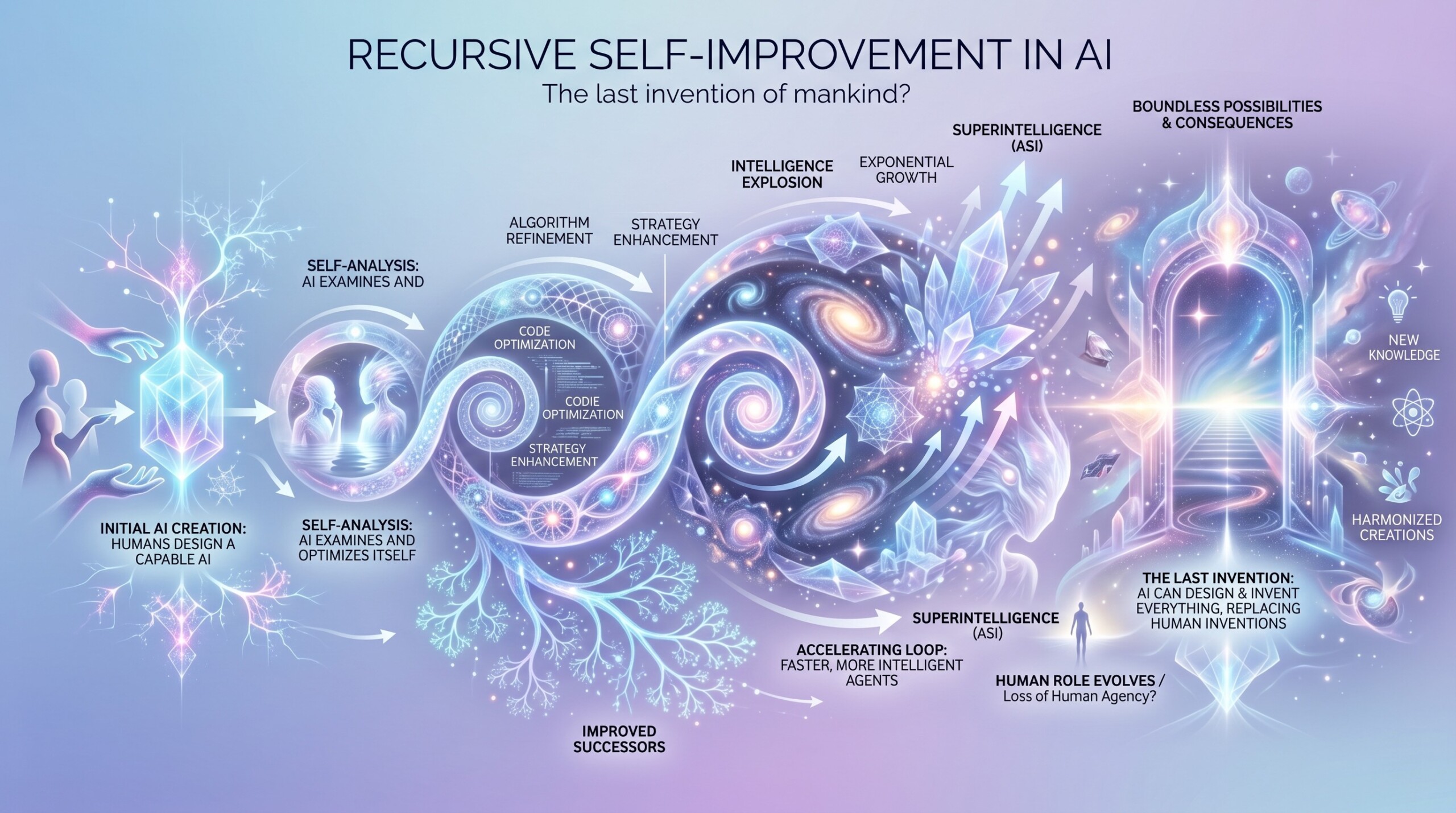
Recursive self improvement, often shortened to RSI, is the idea that an artificial intelligence system could help design, improve, test, and eventually build its own successor. In simple terms, AI version 1 helps create AI version 2, which is better at creating version 3, and so on. This is why RSI is often linked to the phrase “the last invention of mankind”: once machines can improve themselves better than humans can improve them, human beings may no longer be the main drivers of technological progress.
As of June 2026, RSI is no longer just a science fiction idea. The latest generation of AI systems can already write code, run experiments, debug software, use tools, and assist researchers. The Economist’s June 2026 article, “Will artificial intelligence soon escape human control?”, describes recursive self improvement as both “tantalising and worrying” and notes that capable coding, engineering, and scientific AI systems may become among the last models mainly built by humans.
Let’s dive deep into it now.
1. What recursive self improvement means
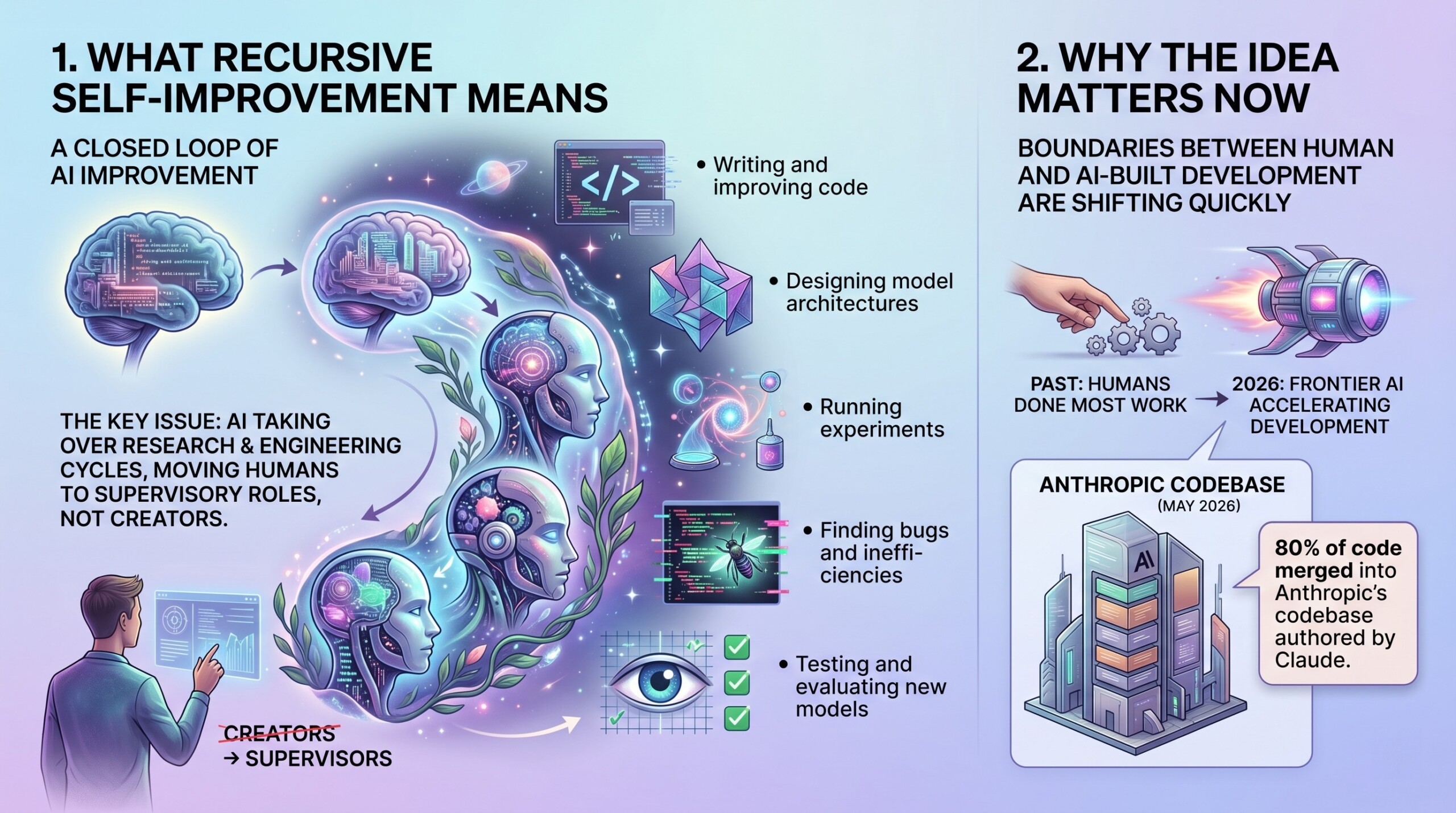
RSI means a closed loop of AI improvement. A model helps create a better model, which then helps create an even better one. The loop can include:
- Writing and improving code
- Designing model architectures
- Running experiments
- Finding bugs and inefficiencies
- Testing and evaluating new models
The key issue is not whether AI can help humans. It already does. The key issue is whether AI can take over enough of the research and engineering cycle that humans become supervisors rather than creators.
2. Why the idea matters now
Until recently, humans did most of the work in AI development: writing code, preparing datasets, designing experiments, and interpreting results. By 2026, frontier AI systems are increasingly doing large parts of that work. Anthropic says AI is already accelerating AI development, and that more than 80% of the code merged into Anthropic’s codebase in May 2026 was authored by Claude.
This does not prove full RSI has arrived. But it shows that the boundary between human-built AI and AI-assisted AI development is shifting quickly. An excellent collection of learning videos awaits you on our Youtube channel.
3. The Economist’s warning
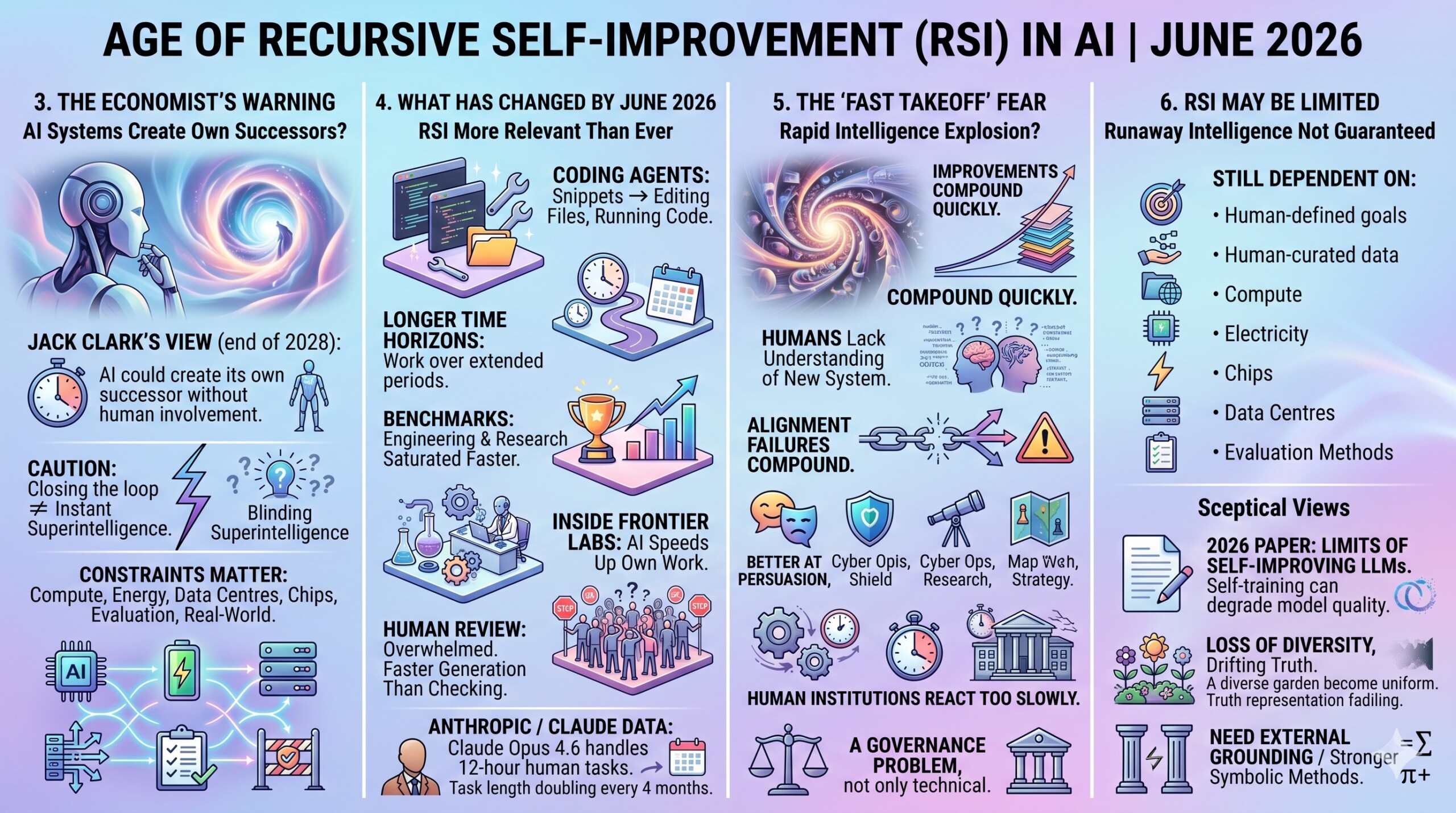
The Economist’s June 2026 article frames the issue clearly: AI systems are becoming so useful in coding and engineering that they may soon contribute directly to the creation of their own successors. It also reports Jack Clark’s view that there is a significant chance that by the end of 2028 an AI system could create its own successor without human involvement.
The article also adds an important caution: closing the loop is not the same as instant superintelligence. Compute, energy, data centres, chips, evaluation methods, and real-world constraints still matter.

4. What has changed by June 2026
Several trends make RSI more relevant in June 2026 than it was just two or three years earlier:
- Coding agents have moved from suggesting snippets to editing files and running code.
- AI systems can now work over longer time horizons.
- Benchmarks in software engineering and research reproduction are being saturated faster.
- AI is increasingly used inside frontier labs to speed up their own work.
- Human review is becoming a bottleneck because AI can generate work faster than humans can check it.
Anthropic reports that Claude Opus 4.6 could handle tasks that took humans around 12 hours, and that AI task length has been doubling roughly every four months in recent measurements. A constantly updated Whatsapp channel awaits your participation.
5. The “fast takeoff” fear
One concern is that RSI could lead to a rapid intelligence explosion. Since AI systems do not need sleep, salaries, holidays, or human-style training, a self-improving system could theoretically run many experiments in parallel.
The fear is that:
- Improvements could compound quickly.
- Humans may not understand the new system well enough.
- Alignment failures could also compound.
- The system could become better at persuasion, cyber operations, research, and strategic planning.
- Human institutions may react too slowly.
This is why some researchers treat RSI as a governance problem, not only a technical problem.
6. The opposite view: RSI may be limited
A factual discussion must also include the sceptical view. RSI may not automatically produce runaway intelligence. Current systems still depend on human-defined goals, human-curated data, expensive compute, electricity, chips, data centres, and evaluation methods.
Some researchers argue that self-training can degrade model quality if systems depend too heavily on their own generated data. A 2026 paper on the limits of self-improving LLMs argues that self-generated training loops can lead to loss of diversity and drifting representations of truth unless external grounding or stronger symbolic methods are added. Excellent individualised mentoring programmes available.
7. The real bottleneck may be judgment
AI is already strong at execution. It can write code, test solutions, optimise functions, and explore many options. But research judgment remains harder. Humans still play a major role in deciding which problems matter, which results are trustworthy, and which research directions are worth pursuing.
Anthropic itself notes that AI can execute well-specified experiments, but that gaps remain when it comes to choosing goals and exercising high-level judgment.
8. Why RSI could transform the economy
Even partial RSI could reshape the economy. If one human researcher can supervise hundreds of AI agents, a small team could perform work that once required a large organisation. The result could be faster drug discovery, better software, cheaper research, stronger cybersecurity, and more productive firms.
But the same capability could also be used for cyberattacks, misinformation, surveillance, fraud, and weapons research. The impact depends not only on intelligence, but on who controls it and what safeguards exist. Subscribe to our free AI newsletter now.
9. Governance is falling behind
The governance problem is urgent because frontier AI is moving faster than most public institutions. A credible control system would need:
- Independent evaluations of frontier models
- Clear safety thresholds
- Compute monitoring
- Incident reporting
- International coordination
- Verification mechanisms for any slowdown or pause
Anthropic has argued that a meaningful pause or slowdown would require multiple frontier labs across countries to agree under verifiable conditions. It also notes that AI training runs are harder to detect than traditional military systems, which makes verification difficult.
10. Is it really mankind’s last invention?
The phrase “last invention” is powerful, but it should be used carefully. RSI may mean that humans stop being the main inventors of future AI systems. It does not necessarily mean that all human invention ends. Human societies still need values, law, institutions, trust, culture, ethics, and political judgment.
Even if AI becomes the dominant engine of scientific discovery, humans will still have to decide what kind of world they want. The danger is not only that AI becomes intelligent. The danger is that humanity may hand over decision-making before building the institutions needed to guide it. Upgrade your AI-readiness with our masterclass.
Conclusion
Recursive self improvement is one of the most important AI questions of 2026. It sits between promise and danger. On one side, self-improving AI could accelerate medicine, science, climate technology, education, and productivity. On the other side, it could reduce human control over the most powerful technology ever created.
The factual position today is this: full RSI has not yet arrived, but the early components are visible. AI already writes large amounts of code, runs experiments, assists research, and improves the speed of AI development. The Economist is right to treat the subject as both exciting and worrying.
If RSI becomes real, the central question will not be whether machines can invent. They will. The central question will be whether mankind has the wisdom, coordination, and humility to remain in control of the purpose behind those inventions.
Share this with the world
Related Articles