Alibaba goes document to video now

Alibaba goes document to video now
Introduction
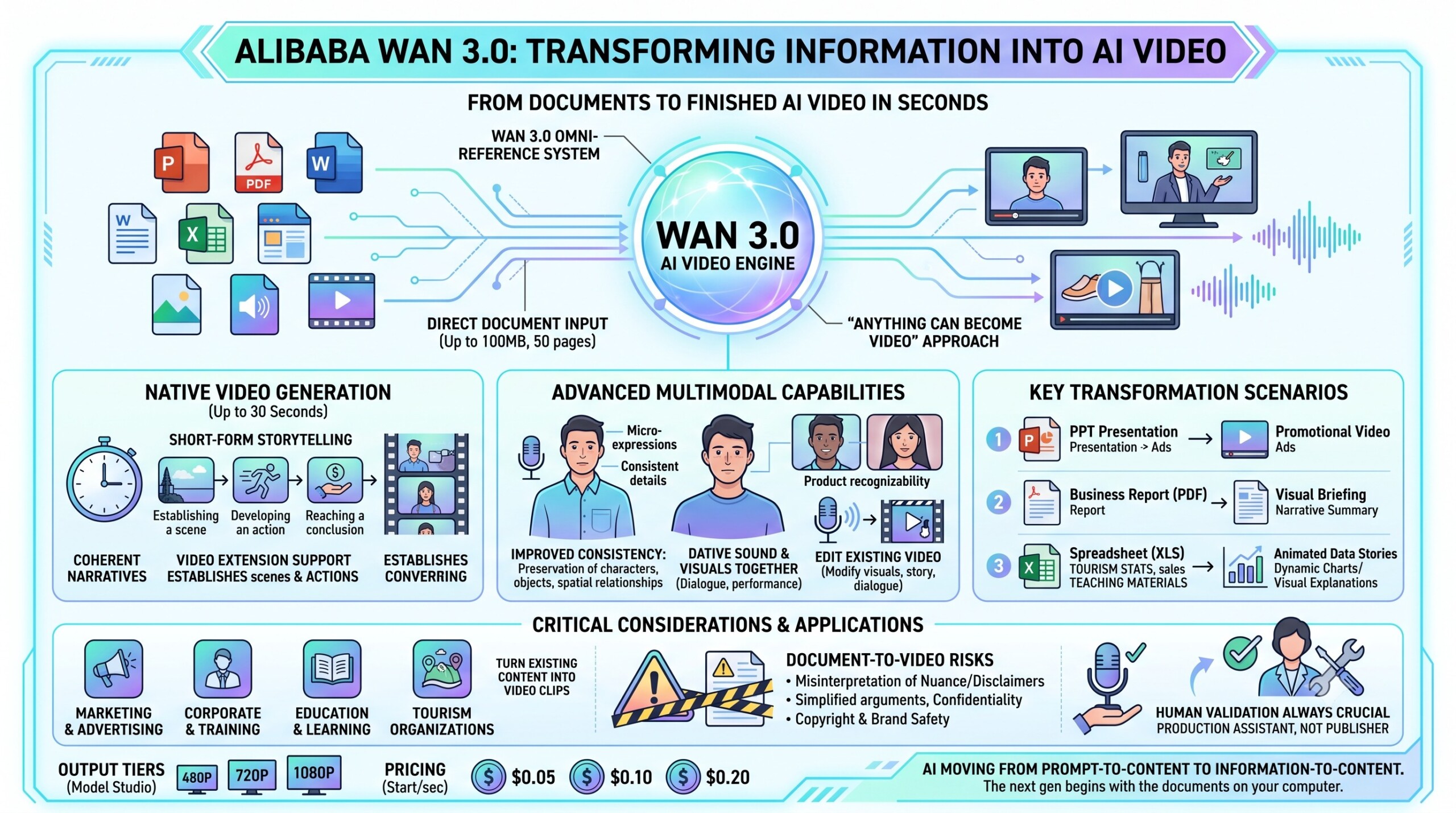
Generative video is moving beyond the familiar idea of typing a prompt and waiting for a short cinematic clip. Alibaba Cloud’s Wan 3.0, officially launched on 24 August 2026 after entering public beta earlier in August, represents an important step in this transition. The model can generate videos of up to 30 seconds while accepting not only text, images, audio and existing video, but also documents and web content as creative references.
The most interesting capability is what Alibaba calls an “anything can become video” approach. A PowerPoint presentation can become a promotional film, a PDF report can become a narrated briefing, spreadsheet information can be visualised dynamically, and training material can potentially become short educational video content. Instead of asking the user to translate every source document into a detailed cinematic prompt manually, Wan 3.0 can use the source material itself as part of the creative context.
This makes Wan 3.0 relevant not only to filmmakers and AI enthusiasts, but also to teachers, marketers, businesses, consultants, tourism organisations, training teams, media companies and creators who already possess large amounts of useful information but need a faster way to convert it into visual communication.
Let’s dive deep into it.
1. Wan 3.0 is Alibaba’s latest-generation AI video model
Wan 3.0 is the newest major generation in Alibaba Cloud’s Wan family of generative video models. It follows the Wan 2.x series and substantially broadens the model from specialised video-generation modes towards a more unified multimodal creation system. Alibaba describes the model as capable of combining characters, scenes, camera directions, dialogue, sound and reference materials within one creative workflow.
2. It can generate up to 30 seconds natively
One of the most visible improvements is video duration. Wan 3.0 supports native video generation of up to 30 seconds in a single generation, giving creators more room to establish a scene, develop an action and reach a conclusion. Alibaba positions this as a move from isolated AI clips towards short-form storytelling. Video extension can also be used to continue a sequence beyond the initial generation.
Thirty seconds may still sound short compared with conventional filmmaking, but it is significant for generative video. A coherent 30-second advertisement, training segment, product demonstration or social video can contain several times more narrative information than the very short clips associated with earlier AI video systems.
3. Documents can now become video inputs
The standout feature is direct document input. Wan 3.0 can accept formats including DOC, XLS, PPT, PDF, TXT, Markdown, Apple Keynote, Pages and Numbers. Alibaba says a request can use one document or link of up to 100 MB and up to 50 pages.
This changes the workflow significantly. Previously, a user might read a 20-page report, extract the important ideas, write a script, prepare visual descriptions and then feed those descriptions into a video generator. Wan 3.0 can use the document itself as an information source while the accompanying prompt tells the model what kind of video to create. An excellent collection of learning videos awaits you on our Youtube channel.
4. A PowerPoint can become a promotional video
Consider a company that already has a presentation describing its product, customers, features and brand identity. Instead of creating a video campaign from zero, that presentation can become the starting material.
Alibaba demonstrates this concept with document-to-commercial workflows. A user can provide the source presentation and specify the desired style, audience and narrative direction. Wan 3.0 can then interpret the material and turn its ideas into a short audiovisual story. For small businesses and marketing teams, this could significantly shorten the journey from internal presentation to customer-facing content.


5. Reports can become video briefings
Business reports, research notes and analytical documents are often valuable but difficult to consume quickly. Wan 3.0 introduces the possibility of transforming them into visual summaries.
A quarterly business report, for example, could become a 30-second executive briefing containing selected numbers, narration, graphics and visual storytelling. The source document provides the information, while the prompt can specify whether the output should feel corporate, educational, dramatic or conversational. This does not remove the need to verify the final output. Any AI-generated interpretation of business information should still be reviewed for factual accuracy and appropriate emphasis.
6. Spreadsheets can become animated data stories
Spreadsheet support is particularly interesting because it moves AI video beyond purely visual source material.
Alibaba says spreadsheet information can be converted into dynamic charts and visual explanations. A tourism organisation could potentially upload visitor statistics and create a short visual briefing about changing destination demand. A sales team could convert regional performance data into an animated update. A teacher could use numerical information to produce a visual explanation rather than showing students a static table.
This begins to connect generative video with data storytelling. A constantly updated Whatsapp channel awaits your participation.
7. Text, image, audio and video references can work together
Document support is only part of the model. Wan 3.0 is designed as an omni-reference system capable of accepting multiple forms of creative input.
A creator might provide photographs of a character, an image of a product, a reference environment, an audio sample and written instructions describing the story. The model can use these references together rather than forcing the creator to work through completely separate generation tools.
This matters because professional creative work rarely starts from text alone. Brands already possess logos, products, photographs, videos, documents, voice material and visual guidelines. AI becomes more useful when it can work with those existing assets.
8. Reference consistency has been improved
A persistent weakness of generative video has been consistency. A person’s face may change between shots, a product may acquire different details, a room may suddenly change shape, or clothing may alter during movement.
Alibaba says Wan 3.0 places greater emphasis on preserving characters, objects, spatial relationships and visual style across generated content. It also highlights more lifelike and diverse human faces and improved micro-expressions. Better consistency is especially important for advertising because a product must remain recognisable throughout the video.
9. Audio and visuals can be generated together
Wan 3.0 is positioned as an audiovisual generation model rather than a silent-video generator that necessarily requires a separate sound-production stage.
Alibaba highlights native sound as part of the model’s storytelling capability, allowing dialogue, performance and visual sequences to be conceived together. This can simplify production workflows for social videos, advertisements and short narrative content. However, Alibaba also acknowledges that audio texture continues to improve, so professional productions may still require dedicated sound editing or voice work. Excellent individualised mentoring programmes available.
10. Existing video can also be edited
Wan 3.0 is not limited to generating videos from nothing. The model includes video-editing capabilities that allow creators to modify elements such as visuals, story direction and dialogue without necessarily recreating an entire production manually.
This reflects a broader change in generative AI. The most useful creative systems are increasingly becoming editing environments rather than one-click generators. A creator may generate an initial version, identify a weak scene, change the instruction and refine the result iteratively. This is much closer to an actual creative workflow.
11. The model supports up to 1080P output
Wan 3.0 currently offers 480P, 720P and 1080P generation tiers through Alibaba Cloud Model Studio. There is no official 4K output tier in the current product information.
The 480P option may be appropriate for experimentation and rapid iteration, while 720P provides a middle ground between cost and quality. The 1080P tier is intended for higher-quality final outputs.
This tiered system also allows creators to test a concept cheaply before spending more on the final generation.
12. Pricing starts at five cents per generated second
Alibaba Cloud lists Wan 3.0 pricing at approximately $0.05 per second for 480P, $0.10 per second for 720P and $0.20 per second for 1080P.
That means a complete 30-second generation is approximately $1.50 at 480P, $3 at 720P and $6 at 1080P before considering repeated attempts or other workflow costs. This pricing model makes sophisticated video generation accessible, but users should remember that creative production usually requires several generations before the preferred result is achieved. Subscribe to our free AI newsletter now.
13. Education and corporate training could be major applications
Document-to-video generation may prove particularly useful in education and enterprise learning.
Training departments already possess thousands of presentations, manuals, SOPs, onboarding documents and compliance materials. Converting these manually into engaging videos is expensive and slow. Wan 3.0 creates the possibility of taking existing material and rapidly producing short educational videos, revision clips, explainers or micro-learning modules. A teacher might convert a lesson presentation into a visual explanation, while a corporation could transform parts of an onboarding manual into short training videos.
Human instructional design remains essential because automatically creating a video does not guarantee that the learning experience is pedagogically effective.
14. Marketing and advertising could change dramatically
The model is particularly well suited to brands because organisations already possess the source material required for video creation.
A product catalogue can become a campaign concept. A brand document can become a promotional video. A tourism itinerary can become a destination film. A restaurant menu and photographs could form the basis for social-media content. A property brochure could become a real-estate video.
Alibaba itself highlights filmmaking, advertising, social content, creative design and cultural tourism among the scenarios for Wan 3.0. The biggest change may therefore not be that AI creates entirely imaginary movies. It may be that ordinary organisations can transform existing business material into video far more easily.
15. Document-to-video also creates new risks
The capability should not be confused with perfect automated filmmaking.
Documents frequently contain nuanced information, legal disclaimers, detailed statistics and contextual qualifications. An AI system may select the wrong point, oversimplify an argument or produce a visual interpretation that was never intended by the author.
Alibaba also notes that areas including audio quality and on-screen text rendering still have room for improvement. Copyright, confidential documents, personal information and brand safety also become important. Uploading a document to an AI video service should never happen simply because the technology allows it. Organisations need to consider whether they have the right to process the material, whether confidential information is involved and whether the generated video accurately represents the source.
For serious business, education, journalism or policy applications, Wan 3.0 should therefore be treated as a powerful production assistant rather than an unquestioned publisher. Upgrade your AI-readiness with our masterclass.
Conclusion
Alibaba Wan 3.0 matters because it expands the definition of AI video generation. The input no longer has to be merely a sentence describing an imaginary scene. It can be a presentation, PDF, spreadsheet, webpage, photograph, audio recording, existing video or combination of creative references.
That seemingly small change could have large consequences. Organisations are already surrounded by information but frequently struggle to convert that information into formats people actually watch. Presentations remain unread, reports remain buried, training manuals remain underused and product information remains trapped in static documents. Document-to-video AI creates a new bridge between stored information and visual communication.
Wan 3.0 also points towards a broader future for generative media. AI systems are moving from prompt-to-content towards information-to-content. Instead of asking people to recreate their knowledge inside a prompt, the model increasingly reads the materials they already use and helps transform them into another medium.
The next generation of AI video may not begin with a camera or even a prompt. It may begin with the PowerPoint, PDF, spreadsheet or report already sitting on your computer.