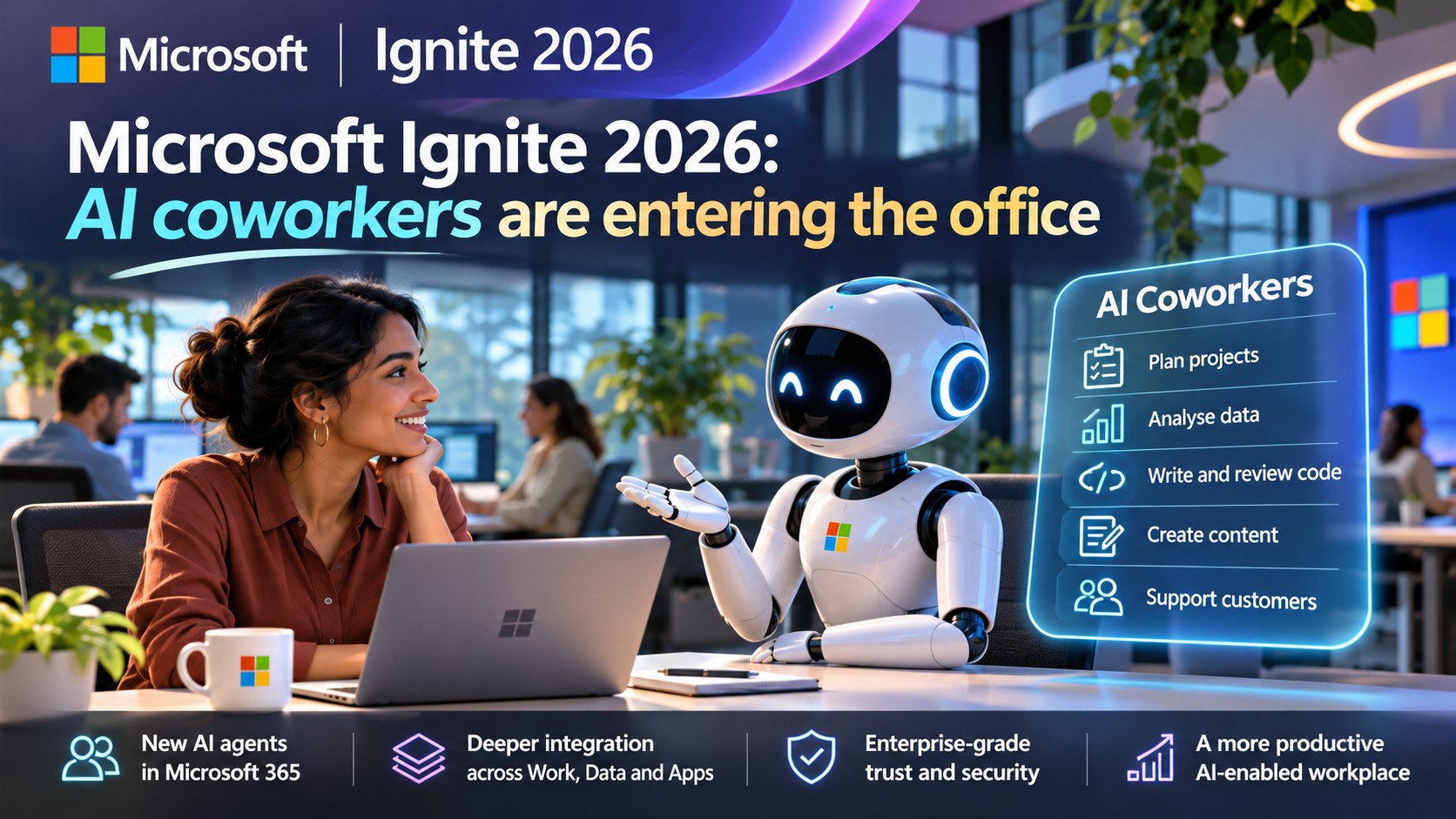
Microsoft Ignite 2026: AI coworkers are entering the office
Microsoft Ignite 2026: AI coworkers are entering the office
Introduction
For several decades, Microsoft has supplied businesses with software for preparing documents, managing spreadsheets, communicating with colleagues and organising information. These applications have become familiar components of professional life across industries. Artificial intelligence is now encouraging Microsoft to reconsider how many of these activities can be performed.
At Microsoft Ignite 2026, held from 17 to 20 November in San Francisco and online, the company presented an extensive range of developments involving Copilot, AI agents, specialised models, enterprise information systems and cybersecurity. The announcements reveal Microsoft’s ambition to integrate artificial intelligence into the daily operations of businesses. Here are twenty developments that could influence professional life during 2027.
Let’s dive deep into it!
1. Copilot becomes a broader working environment
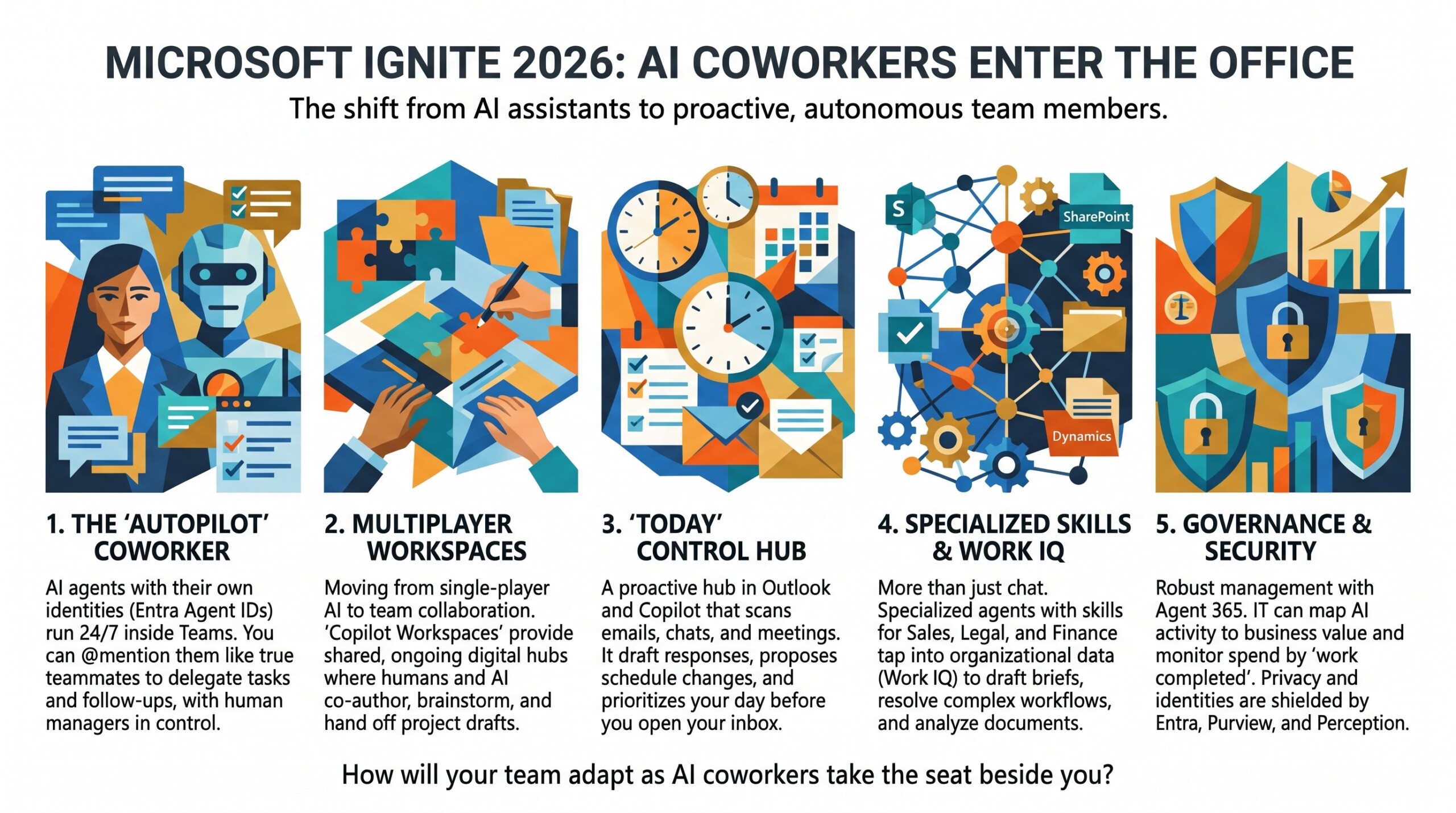
Microsoft is bringing conversational assistance, collaborative work, programming and agent-driven activities into a more unified Copilot experience. Employees could increasingly use a common environment for assignments ranging from answering simple questions to preparing substantial professional work products.
2. Copilot Cowork supports extended assignments
Copilot Cowork is designed to assist with professional assignments involving multiple steps, documents and information sources. An employee could use such capabilities to assemble material for a departmental review, subject to the available permissions and the need to verify the completed work.
3. Autopilot introduces ongoing AI activity
Microsoft presented Autopilot as a persistent agent capable of supporting recurring assignments and continuing work without requiring instructions at every stage. Organisations adopting it will need to establish clear boundaries concerning permitted actions, exceptional circumstances and human intervention.
4. Copilot Workspaces brings teams and AI together
Copilot Workspaces provides a shared environment in which employees and AI agents can collaborate around common projects and information. This approach could make AI-assisted teamwork more coordinated while reducing dependence on isolated individual conversations.
5. Copilot Code helps employees create applications
Microsoft announced Copilot Code, which allows users to describe dashboards, trackers and applications in ordinary language. It is being introduced through a staged rollout, potentially making selected software creation activities accessible to professionals without extensive programming experience.
6. Work IQ connects AI with workplace information
Work IQ helps Copilot draw upon relevant relationships among employees, documents, communications, meetings and projects. This organisational context can make AI assistance more relevant to particular business situations, provided that the underlying information is accurate and appropriately accessible.
7. Microsoft IQ helps organisations develop their own intelligence
Microsoft IQ is an enterprise platform intended to organise and reuse the knowledge required by business applications and AI agents. Organisations with fragmented records may need to improve their information management before they can take full advantage of such capabilities.
8. New connectors expand access to business information
Microsoft announced additional connectors that can help AI systems interact with information from a wider range of business services. Administrators will need to determine which connections are valuable and establish suitable permissions for accessing company information.
9. Copilot becomes more specialised for professional roles
Microsoft is developing additional capabilities for professionals working in sales, finance, legal services and customer support. These applications could provide more relevant assistance by incorporating the terminology, information requirements and workflows associated with particular occupations.
10. Salesforce and Dynamics 365 become more closely integrated
Microsoft announced new business application integrations, including Salesforce in Copilot, which entered preview. Sales professionals could use these capabilities to bring customer information into familiar workplace applications, subject to organisational configuration and product availability.

11. Microsoft Decision 1.1 becomes generally available
Microsoft announced the general availability of Decision 1.1, a specialised model for structured decision-making activities such as classification, routing and prioritisation. Businesses could use it to process routine requests, although important decisions should remain subject to appropriate evaluation and supervision.
12. Microsoft introduces MAI Code 2
MAI Code 2 is a model designed for demanding software development assignments, including debugging and making coordinated changes across multiple files. Microsoft announced its availability in GitHub Copilot and Foundry, giving development teams another option for AI-assisted programming.
13. Code 2 Flash targets rapid programming assignments
Code 2 Flash is intended for activities such as explaining existing code, implementing smaller changes and carrying out routine fixes. Having models designed for different levels of task complexity could help software teams manage processing costs and development time.
14. Foundry expands its selection of AI models
Microsoft announced that GPT-6.2 was coming to Foundry, alongside plans to introduce additional models from Meta. A wider selection enables developers to evaluate different AI systems according to their applications, technical requirements and commercial circumstances.
15. Microsoft advances its own model ecosystem
Alongside partnerships with external AI developers, Microsoft is expanding its MAI family of specialised models. It also announced MAI Licensed Weights for selected customers, potentially giving eligible organisations greater flexibility in how they deploy and manage AI capabilities.
16. Agent 365 helps organisations supervise AI agents
Agent 365 provides management, identity and security capabilities for AI agents operating within organisations. As businesses introduce more automated processes, administrators will increasingly need dependable information about which agents exist, what they can access and how they are operating.
17. Agent 365 Business Analytics examines AI expenditure
Microsoft announced Agent 365 Business Analytics, available through its Frontier programme, to help organisations connect AI usage and expenditure with business outcomes. Meaningful evaluation will require managers to examine actual improvements in work quality, operational performance and resource consumption.
18. Microsoft Perception strengthens cybersecurity
Microsoft announced the general availability of Perception, a security system coordinating specialised AI agents across vulnerability assessment, detection and remediation activities. Such capabilities could support cybersecurity professionals, although consequential changes to business systems still require appropriate operational controls.
19. Microsoft launches its AI Transparency Initiative
The initiative includes expanded collaboration with the US National Institute of Standards and Technology and efforts to develop approaches for independently examining AI activities. Its long-term significance will depend on whether effective transparency and security standards achieve widespread adoption across the technology industry.
20. Azure Cobalt 200 strengthens computing infrastructure
Microsoft announced the general availability of Azure Cobalt 200 virtual machines, based on its own Arm-based processor technology. AI agents perform many activities outside the underlying model, including operating software and processing files, making general-purpose computing infrastructure an important part of AI performance.
Conclusion
Microsoft Ignite 2026 provides a fascinating view of how professional software could evolve during 2027. The company’s announcements extend across collaborative work, specialised models, automated processes, organisational intelligence and cybersecurity. Businesses should evaluate these technologies through manageable experiments, examining actual availability, implementation costs, operational requirements and measurable improvements before adopting them more extensively.