What McKinsey found about AI in companies
What McKinsey found about AI in companies
Introduction
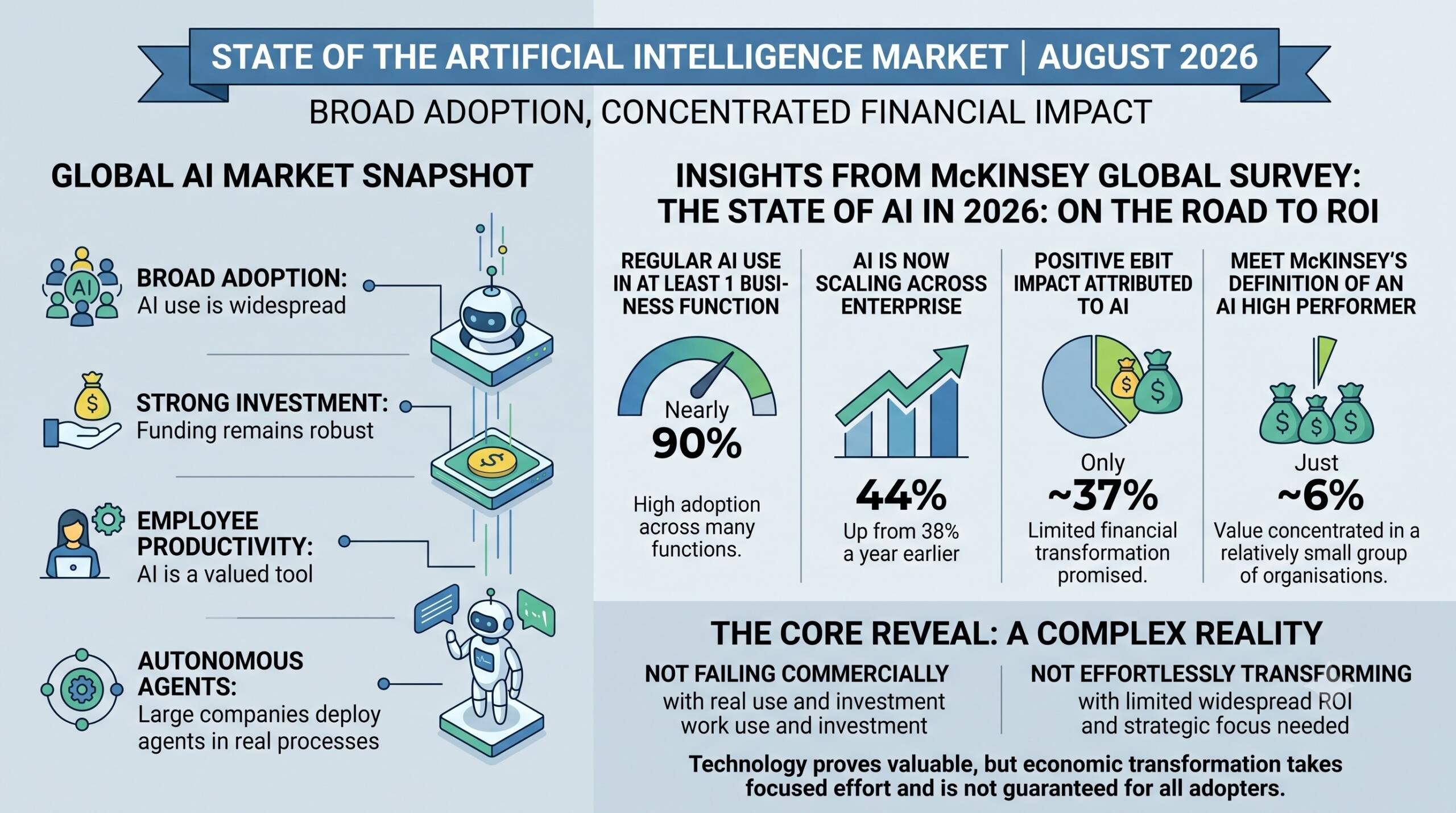
The artificial intelligence market in August 2026 presents an unusual economic picture. Adoption is broad, investment remains strong, employees increasingly experience AI as a useful productivity technology, and large companies are beginning to deploy autonomous agents across real business processes. Yet the financial transformation promised by several years of extraordinary AI investment remains concentrated in a relatively small group of organisations.
McKinsey’s latest global survey, The state of AI in 2026: On the road to ROI, provides one of the clearest snapshots of this transition. Nearly nine in ten respondents report regular AI use in at least one business function, while 44% say AI is now scaling across their enterprises, up from 38% a year earlier. At the same time, only 37% attribute any positive EBIT impact to AI, and only about 6% meet McKinsey’s definition of an AI high performer.
That combination is more revealing than either the optimistic or pessimistic interpretation of AI. The technology is neither failing commercially nor effortlessly transforming every company that adopts it.
Let’s dive deep into it now.
1. AI moved from an adoption market to a scaling market
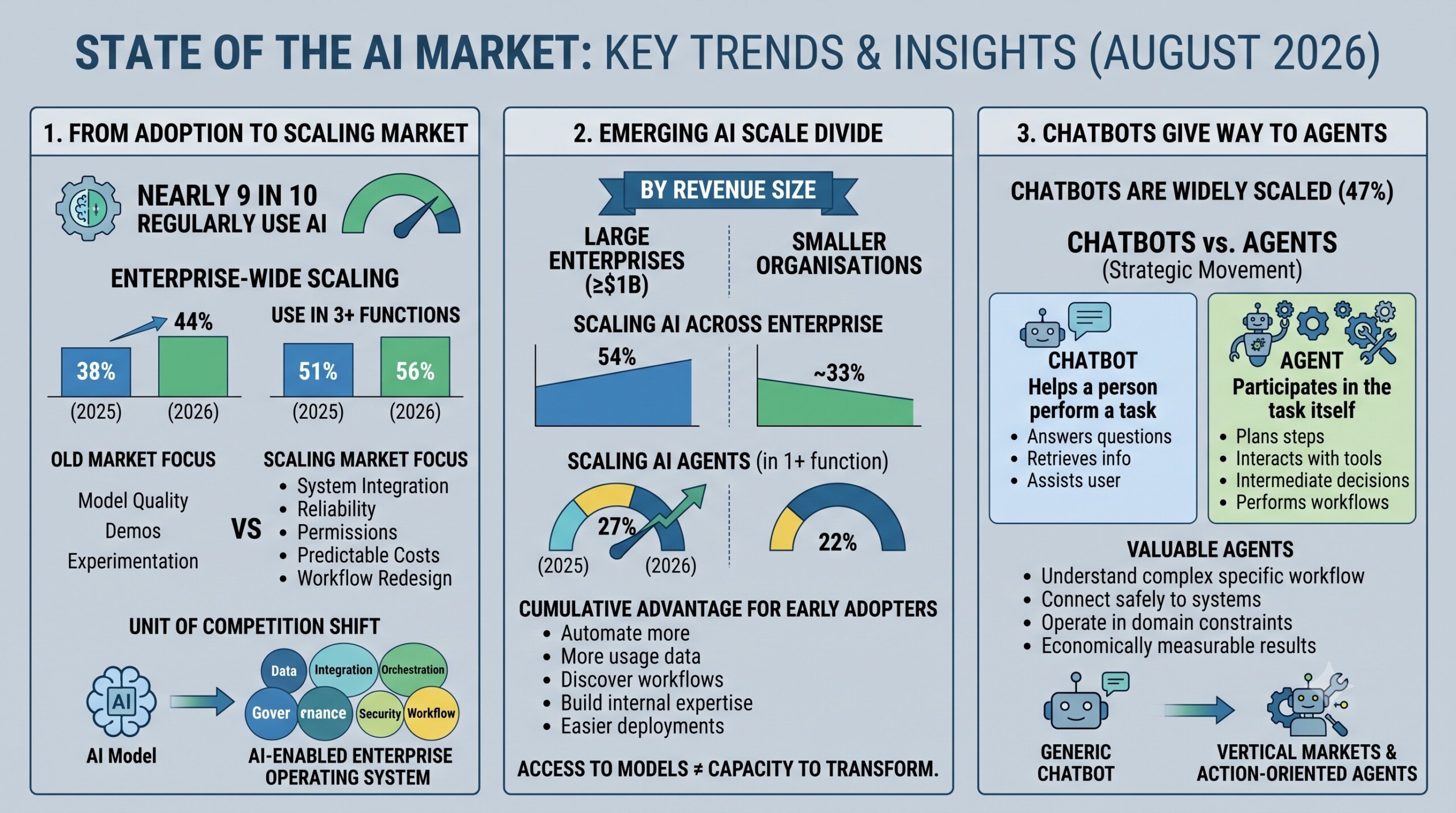
The first important signal is that the central question is no longer whether businesses will use AI. McKinsey reports that nearly nine in ten respondents say their organisations regularly use AI in at least one business function. More significantly, the proportion reporting enterprise-wide scaling increased from 38% in 2025 to 44% in 2026, while the share using AI in three or more functions rose from 51% to 56%.
This changes the economics of the AI market. During the first generative-AI phase, vendors could compete primarily on model quality, impressive demonstrations, experimentation and access. A scaling market asks different questions: Can the technology connect to enterprise systems? Can it operate reliably thousands or millions of times? Can permissions be controlled? Can outputs be measured? Can costs remain predictable? Can employees reorganise their work around it?
The unit of competition is therefore gradually shifting from the AI model to the AI-enabled operating system of the enterprise. Models remain essential, but sustainable commercial value increasingly depends on everything built around them: data, integration, orchestration, evaluation, governance, security and redesigned workflows. An excellent collection of learning videos awaits you on our Youtube channel.
2. AI scale divide emerging between large and smaller companies
McKinsey’s data suggests that AI may reinforce differences between companies before it democratises them. Among organisations with annual revenue of at least $1 billion, 54% report scaling AI across the enterprise. Among smaller organisations, only about one-third report the same level of scaling.
The divergence becomes sharper when agents are considered. The proportion of respondents from large enterprises reporting that they are scaling AI agents in at least one function increased from 27% to 40% in a single year. Among smaller organisations, the comparable share remained essentially flat at 22%. This matters because the competitive advantage of AI may become cumulative. A large organisation that deploys AI earlier can automate more processes, generate more usage data, discover more effective workflows, build internal AI expertise and learn how to govern increasingly autonomous systems. Each improvement can make the next deployment easier.
Smaller businesses still benefit from rapidly declining technology barriers and powerful ready-made AI services. But McKinsey’s results indicate that having access to the same model does not mean having the same capacity to transform an organisation around that model.
3. Market moving from chatbots towards agents
Chatbots remain the most widely scaled AI tool in McKinsey’s survey, with 47% of respondents saying their organisations are scaling them across the enterprise. But the more strategically important movement is occurring further along the automation spectrum. About one in five respondents reports enterprise scaling of AI agents, with a similar proportion scaling software coding agents.
A chatbot mainly helps a person perform a task. An agent can increasingly participate in the task itself by planning steps, interacting with tools, retrieving information, making intermediate decisions and carrying out parts of a workflow. That distinction has substantial economic implications.
This suggests that the agent market will probably become increasingly vertical rather than remaining a single generic category. The commercially valuable agent is unlikely to be merely the one that can reason impressively in a demonstration. It will be the one that understands a particular workflow, connects safely to relevant systems, operates within domain constraints and produces an economically measurable result. A constantly updated Whatsapp channel awaits your participation.
4. Coding agents beginning to challenge the traditional software market
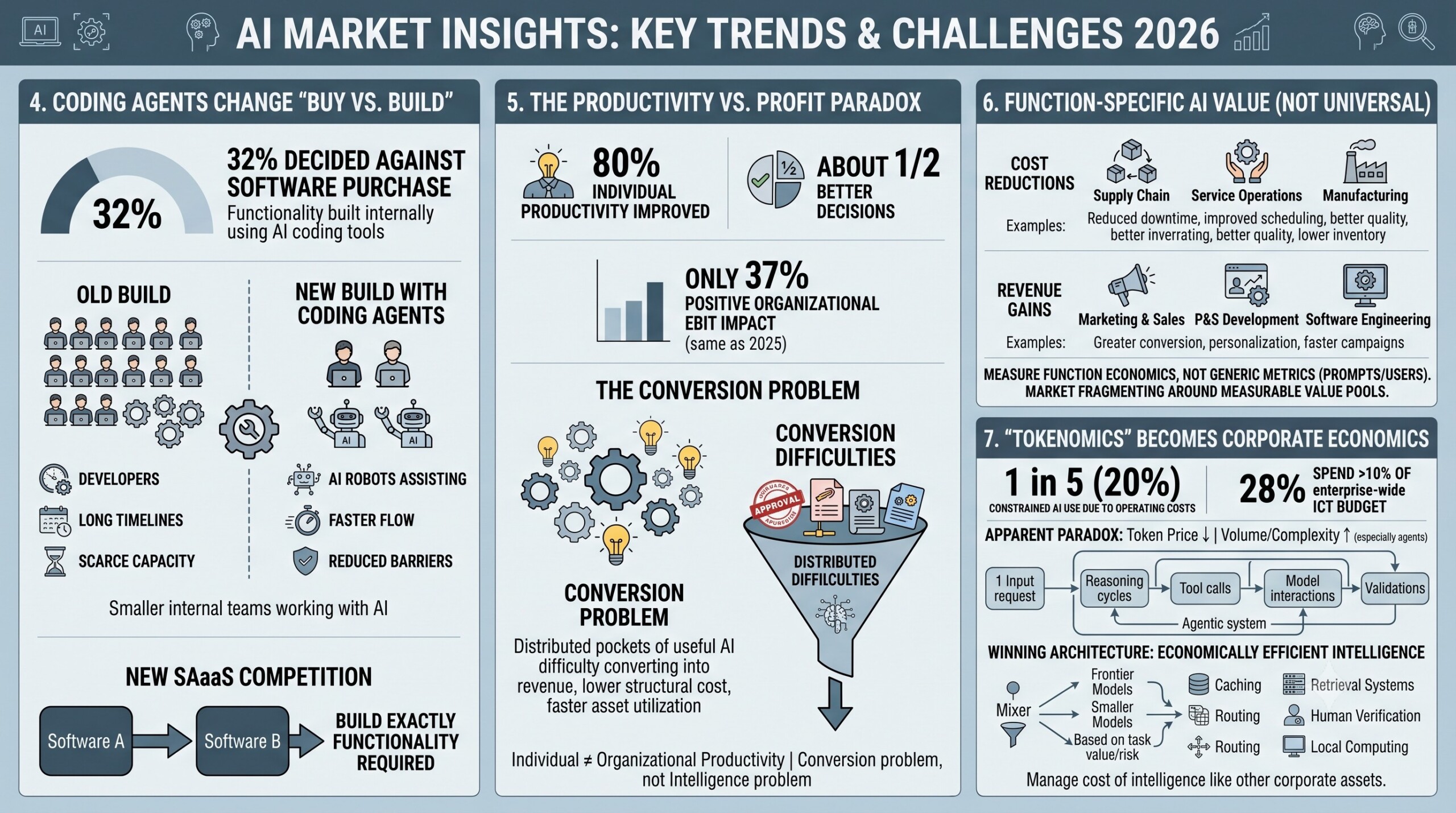
Perhaps the most strategically disruptive finding in the report concerns software purchasing. McKinsey found that 32% of respondents say their organisations have decided against purchasing at least one software product or feature because the required functionality could instead be built internally using AI coding tools.
This does not imply the end of enterprise software. Companies will continue buying products when reliability, security, maintenance, integration, compliance, network effects or specialised functionality make external software economically superior. But the threshold for deciding whether software deserves to be purchased may be changing.
Historically, an organisation comparing “buy” with “build” had to account for scarce developer capacity, long development cycles and substantial maintenance costs. Coding agents can reduce some of those barriers. A feature that previously required a dedicated development project may increasingly be created by a smaller internal team working with AI.
For the software-as-a-service market, this creates a new form of competition: the alternative to buying Software A may no longer be Software B. It may be building exactly the functionality required. SaaS companies may therefore need to defend pricing not only through features, but through trust, data advantages, workflow depth, integration, reliability and the continuing cost of ownership.
5. Central paradox of 2026 AI market: Productivity sans profit
McKinsey reports one of the clearest contrasts in the entire study: 80% of respondents say AI has improved their individual productivity, and about half say it helps them make better decisions. Yet only 37% say AI has contributed positively to their organisation’s EBIT, essentially unchanged from 2025.
This is not necessarily contradictory. Individual productivity and organisational productivity are different economic concepts. If an employee prepares a report in thirty minutes instead of three hours, the time saving is real. But unless the organisation changes what happens to those saved hours, the financial result may be negligible.
The same problem appears when AI accelerates one stage of a process while approvals, legacy systems, hand-offs, policies or customer interactions remain unchanged. Local efficiency can rise dramatically while the total economic throughput of the system barely moves.
The August 2026 AI market can therefore be understood as suffering from a conversion problem rather than an intelligence problem. Companies increasingly possess useful artificial intelligence. Their difficulty is converting distributed pockets of intelligence into revenue, lower structural cost, faster asset utilisation, better decisions or entirely new business models. Excellent individualised mentoring programmes available.
6. AI value becoming function-specific not universal
Another important message from the report is that AI does not create financial value through the same mechanism everywhere. Respondents most frequently report cost reductions in supply-chain management, service operations and manufacturing. Revenue gains are more commonly associated with marketing and sales, product and service development, and software engineering.
This distinction should influence how the AI market is evaluated. A manufacturing AI system should not necessarily be judged by the same economic measure as an AI sales system. In manufacturing, the relevant value might come from reduced downtime, improved scheduling, better quality control or lower inventory. In marketing, it might come from greater conversion, personalisation or faster campaign development.
The implication is that generic measures such as number of prompts, number of active users or licences deployed become progressively less useful as organisations mature. What matters is whether AI changes the economics of the business function in which it operates.
The AI market is therefore likely to fragment around measurable value pools. Vendors able to demonstrate a direct relationship between their systems and business outcomes may command a stronger position than those selling intelligence primarily as a general-purpose capability.


7. “Tokenomics” becoming part of corporate economics
For several years, falling model prices encouraged an assumption that AI intelligence would become so inexpensive that usage cost would eventually become almost irrelevant. McKinsey’s 2026 findings complicate that assumption. One in five respondents says AI-related operating costs, including token costs, have already caused their organisations to constrain AI use.
The apparent paradox is important. The price of an individual token or inference can decline while the organisation’s total AI bill continues to rise because the volume and complexity of AI activity rise even faster. Agentic systems intensify this effect because one user request can trigger repeated reasoning cycles, searches, tool calls, validations and model interactions.
Twenty-eight percent of respondents say their organisations already spend more than 10% of their enterprise-wide information and communication technology budget on AI technologies. AI is therefore becoming significant enough that CFOs, CIOs and business leaders must think about the cost of intelligence in much the same way they manage cloud infrastructure, labour or software portfolios.
This creates another competitive frontier for the AI industry: economically efficient intelligence. The winning architecture will not always use the largest or most capable model for every task. Companies may increasingly combine frontier models, smaller models, caching, retrieval systems, routing, human verification and local computing according to the economic value and risk of the task. Subscribe to our free AI newsletter now.
Conclusion
The strongest interpretation of the AI market in August 2026 is neither that AI is an unquestioned economic revolution nor that the promised revolution has failed. The evidence suggests something more interesting: technological capability has advanced faster than organisational capability.
AI is already widely used, agentic systems are moving into real workflows, coding agents are altering software economics, corporate investment remains strong and employees overwhelmingly report productivity benefits. Yet enterprise-level returns remain concentrated because organisations are still learning how to convert artificial intelligence into redesigned businesses.
That gap between capability and conversion may define the next stage of the market. As models improve and access becomes increasingly common, competitive advantage is likely to move towards organisations that can combine AI with proprietary knowledge, economical computing, strong data, redesigned workflows, disciplined measurement, risk management and decisive leadership.
Share this with the world
Related Articles