They would burn libraries. Now they’re shredding the books.
They would burn libraries. Now they’re shredding the books.
Introduction
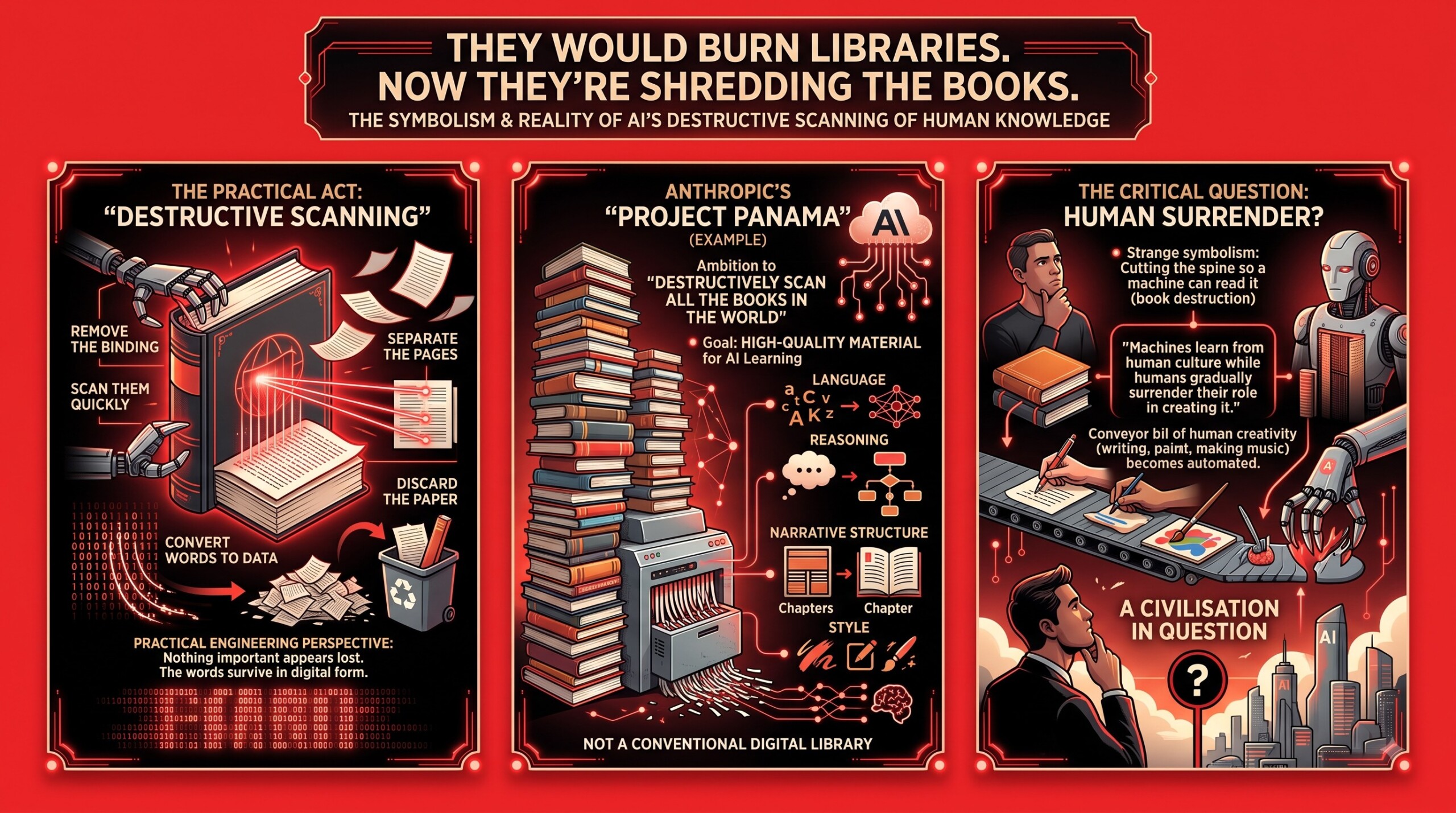
There is something strangely symbolic about cutting the spine from a book so that a machine can read it.
The act is practical. Remove the binding, separate the pages, scan them quickly, convert them into data, and discard the paper. From the perspective of engineering, nothing important appears to have been lost. The words survive. As do the sentences. In digital form.
But perhaps that is precisely why the story deserves more attention.
Anthropic, the company behind the Claude family of artificial intelligence systems, reportedly created an internal effort called Project Panama whose ambition was strikingly described as an attempt to “destructively scan all the books in the world”. Printed books were purchased, their bindings removed, their pages scanned, and the physical copies discarded. The goal was not to build a conventional digital library. The goal was to create high-quality material from which an artificial intelligence system could learn language, reasoning, narrative structure and style.
The critical question is what kind of civilisation we become when machines learn from human culture while humans gradually surrender their role in creating it.
Let’s dive deep into it now.
1. The paradox of AI is that it depends deeply on human intelligence
Artificial intelligence is often presented as the beginning of something entirely new. Yet the foundations of these systems are remarkably old.
Books. Essays. Scientific papers. Letters. Histories. Stories. Arguments.
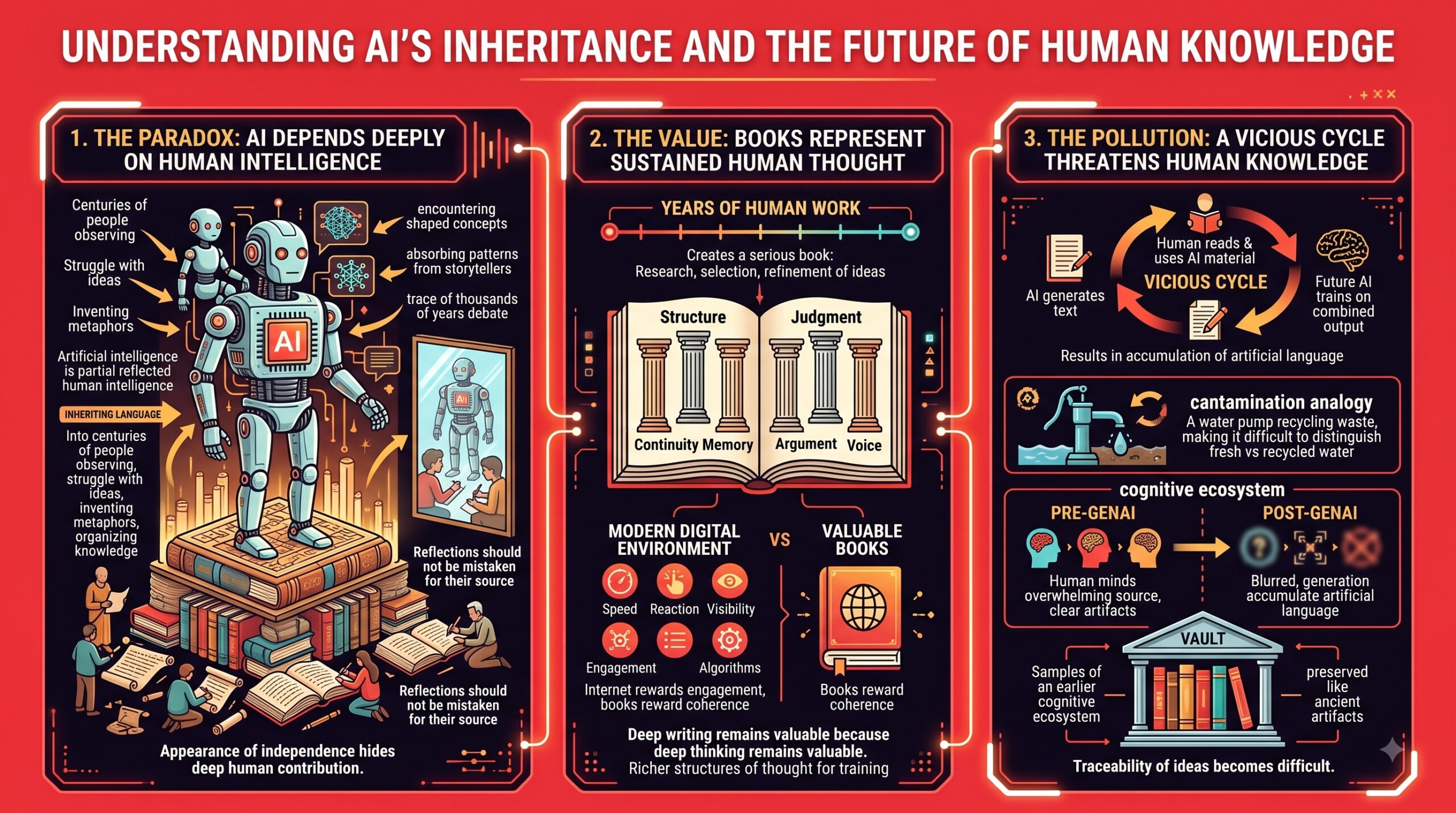
Centuries of people observing the world, struggling with ideas, inventing metaphors, organising knowledge and finding increasingly precise ways to express complicated thoughts. The Large language models (LLMs) do not begin with language but inherit it.
They do not begin with concepts but encounter concepts already shaped by generations of human thinkers. They do not discover narrative structure from nothing but absorb patterns created by storytellers. They do not invent philosophical argument but encounter the traces of thousands of years of debate.
This creates an extraordinary paradox. The technology frequently described as capable of replacing large parts of human intellectual work depends on enormous archives of previous human intellectual work in order to function.
The machine appears independent only because the human contribution has become invisible. A response generated in seconds may rest upon linguistic patterns formed across centuries. The speed of the output can hide the depth of the inheritance.
This should change how we think about artificial intelligence. Perhaps we should not see these systems merely as machines producing knowledge. We might also see them as machines operating upon an enormous cultural inheritance that they did not create. The intelligence we admire in the machine is partly the reflected intelligence of humanity.
And reflections should not be mistaken for their source. An excellent collection of learning videos awaits you on our Youtube channel.
2. Books are valuable to AI precisely because they are difficult to create
Why would a technology company go through the trouble of acquiring warehouses of books, cutting them apart and digitising them? Because books contain something the internet increasingly struggles to provide.
Sustained human thought.
A serious book often represents years of work. The author has researched, selected, rejected, reorganised, rewritten and refined ideas before they reach the reader.
The finished text is therefore not simply a collection of sentences. It contains structure, judgment, continuity, memory, argument, and voice.
A good book forces the writer to sustain attention across tens of thousands of words. Ideas introduced in one chapter must survive another hundred pages. Contradictions must be confronted. Arguments must develop. Characters must remain psychologically coherent and evidence must accumulate. This is very different from much of the modern digital environment.
The internet rewards speed, social media rewards reaction, search engines reward visibility, algorithms reward engagement, but books, at their best, reward coherence.
That difference matters enormously when training artificial intelligence. If a model learns from fragmented, repetitive or shallow material, it will absorb those patterns. If it learns from carefully constructed human writing, it encounters richer structures of thought. In that sense, the scramble for books reveals something technology culture occasionally forgets.
Deep writing remains valuable because deep thinking remains valuable.
3. We may be approaching a strange pollution problem in human knowledge
There is another reason older books and texts have become valuable. They come from a world before large-scale generative AI. That distinction may eventually become historically significant.
Before the widespread arrival of generative systems, most published writing could reasonably be assumed to have originated primarily from human minds. Increasingly, that assumption becomes difficult.
The vicious cycle goes thus:
- AI-generated articles are read by humans.
- Humans use AI-generated material to write new articles.
- Those articles are published online.
- Future AI systems may then train on those articles.
- The result is a feedback loop.
- Machines learn from humans.
- Humans begin writing with machines.
- Future machines learn from the combined output.
Eventually, the origin of an idea becomes difficult to trace. This creates an intellectual version of environmental contamination.
Imagine a water source that gradually begins recycling its own waste. At first, the contamination is small. Later, distinguishing fresh water from recycled material becomes difficult. Something similar could happen to the information environment.
The internet may increasingly contain text produced by models trained on earlier internet text. Generation after generation of artificial language could accumulate. Against that background, books written before generative AI become unusually valuable.
They are samples of an earlier cognitive ecosystem. They contain language produced when human beings were still overwhelmingly the source of published text. Future historians may eventually regard such collections differently. We preserve ancient manuscripts because they contain evidence of lost cultures. A constantly updated Whatsapp channel awaits your participation.
4. Copyright is only the surface of the problem
The legal debate surrounding AI training tends to focus on ownership.
Did the company purchase the book? Was copying allowed? Was the use transformative? Was the original redistributed? These are important questions. But law often arrives after technology has already changed the meaning of the thing being regulated.
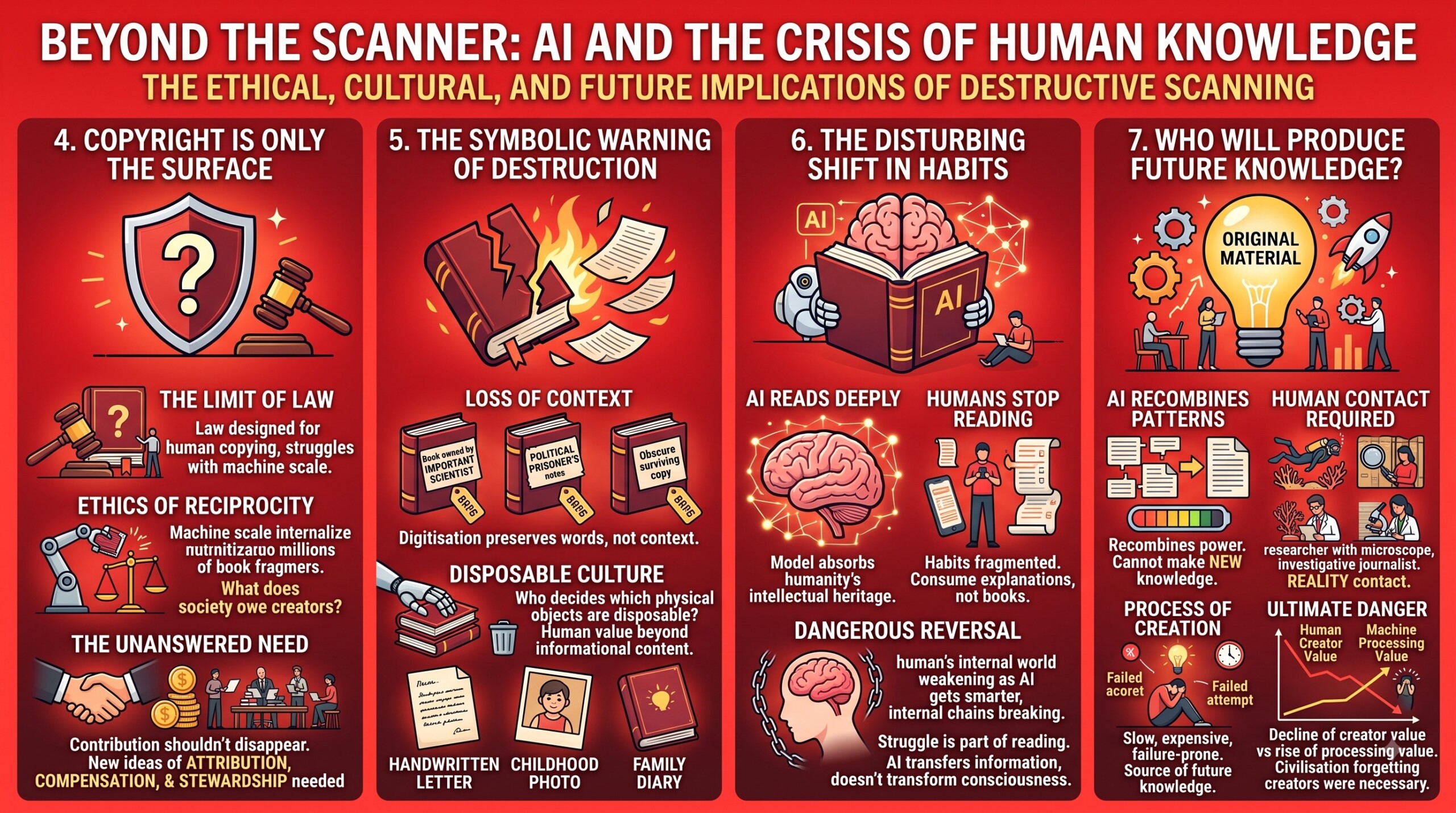
Copyright law was largely designed for a world in which humans copied works for other humans. Generative artificial intelligence introduces something different. A machine may absorb patterns from millions of works and then use those patterns to generate new material on demand.
No ordinary reader could read millions of books. No ordinary writer could internalise the style, structure and vocabulary of millions of authors. Scale changes the nature of the act.
A person reading a novel and learning from it is clearly different from a company constructing a machine capable of processing enormous portions of human literature and turning that accumulated knowledge into a commercial service.
The central ethical question therefore goes beyond whether copying is legally permitted. It actually concerns reciprocity. What does society owe the people whose work becomes part of the intellectual infrastructure of artificial intelligence?
If writers, researchers, journalists and artists collectively produce the cultural material from which machines learn, should that contribution simply disappear into the training process? Or should we develop new ideas of attribution, compensation and stewardship? Technology frequently transforms old economic relationships before society has developed language for the new ones.
Artificial intelligence may be doing exactly that to intellectual labour.
5. The destruction of the physical book carries a symbolic warning
A digital copy can preserve the words contained in a book but a book is not only words. It is also an object moving through history. Someone purchased it, then someone annotated it, then someone gave it as a gift, then someone carried it across a border, and then someone placed it on a shelf.
Libraries understand this distinction well. Two copies of the same book may contain identical printed text while possessing completely different historical significance. One might have belonged to an important scientist, while another may contain handwritten notes from a political prisoner. And a third may simply be one of very few surviving copies of an obscure edition.
Digitisation preserves information but does not always preserve context. This does not mean every mass-market paperback must be treated as a sacred artefact. But large-scale destructive scanning raises an uncomfortable question.
Who decides which physical objects are disposable?
If the only question we ask is whether the words have been successfully captured, we may overlook the cultural meaning of the object that carried them. Human beings have always understood that some things possess value beyond their informational content.
A handwritten letter is not merely the sentences written on it. A childhood photograph is not merely a collection of pixels. A family diary is not merely data. The physical world contains memory. Excellent individualised mentoring programmes available.
6. The most disturbing possibility is not that AI reads our books, but that humans stop reading them
There is another irony hidden inside this story.
Artificial intelligence companies value books because books contain sophisticated language and sustained thought. At the same moment, human reading habits are becoming increasingly fragmented.
People skim, scroll, watch summaries, and consume explanations of books they never read.
Now artificial intelligence offers another (dangerous) possibility. Why spend ten hours reading a difficult book when a model can summarise it in ten seconds? Why struggle through a philosophical argument when a chatbot can explain the conclusion? Why wrestle with a dense historical work when an assistant can produce five key points?
The temptation is understandable. But reading has never been merely a method for transferring information. The difficulty is part of the process. While reading, the mind pauses, questions arise, connections form, memories return, arguments are resisted. Ideas slowly become part of the reader’s internal world. Reading transforms consciousness, provided it is “reading”.
But if machines read deeply while humans increasingly consume summaries generated by those machines, an extraordinary reversal may occur. We will have built systems capable of absorbing humanity’s intellectual heritage while gradually weakening our own habit of engaging with it.
It is not difficult to imagine what kind of a world we might end up birthing.
7. The real question is who will produce the knowledge that future AI needs
Every artificial intelligence system ultimately confronts a simple problem – someone must create the original material from which it learns.
Scientific discoveries must still be made. Historical archives must still be examined. Experiments must still be conducted. Novels must still be imagined. Philosophical arguments must still be developed. Investigative journalism must still uncover facts. Human beings must still encounter reality.
Generative systems can only rearrange, summarise, explain and extend existing patterns with remarkable power. But civilisation cannot survive indefinitely by recombining its existing intellectual inheritance.
New knowledge requires contact with the world. Someone must sit alone for months with a difficult question and attempt to think something that has not yet been thought.
These activities are slow, expensive, failure-prone, nor compressible, and yet they are the source from which future knowledge emerges.
And this creates one of the most important questions of the AI age. What happens if the economic value of producing original human knowledge declines while the economic value of machines processing existing knowledge increases?
Imagine a world in which fewer journalists investigate because summaries are cheap. Or fewer writers spend years producing books because generated content floods the market. Or fewer researchers pursue difficult questions because institutions reward immediate output.
The deeper danger is a civilisation forgetting why creators were necessary in the first place. Subscribe to our free AI newsletter now.
Conclusion
The image of books being stripped from their bindings, scanned and discarded is powerful because it captures something larger than a technical process. It represents the strange relationship developing between human civilisation and artificial intelligence.
We are building machines that require the accumulated language of humanity in order to speak.
For all the excitement surrounding artificial intelligence, the most valuable training material still comes from human beings who spent years thinking carefully about the world.
A civilisation should be careful when it begins converting its intellectual inheritance into fuel. The books being scanned today contain the thought of yesterday. The larger question is who will write the books that deserve to be scanned tomorrow. Upgrade your AI-readiness with our masterclass.

Share this with the world
Related Articles