
Is DeepSeek building its own chips now?

Is DeepSeek building its own chips now?
Introduction
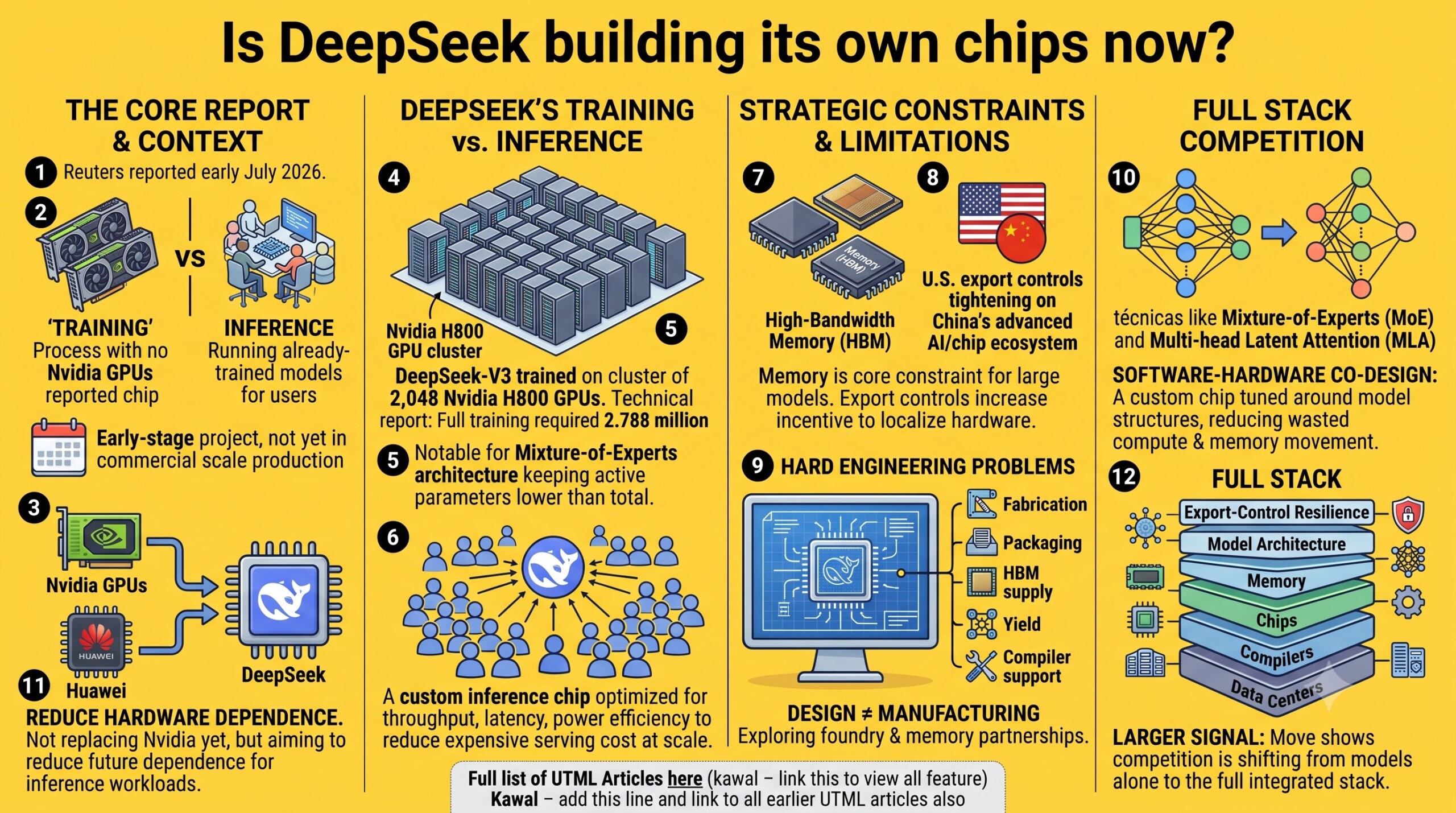
DeepSeek, the Chinese AI startup, is reportedly developing its own AI chip. The important technical detail is that the chip is described as an inference chip, not a training chip. That means it would be aimed at running already-trained AI models for users, rather than training frontier models from scratch. Reuters reported this on July 7, 2026, citing people familiar with the matter, so the correct wording is “reportedly developing,” not “has already built and deployed.”
Let’s dive deep into it.
- This is about inference.
Inference is the phase where a trained model generates answers, code, summaries, or reasoning outputs for users. Reuters says DeepSeek’s chip effort is aimed at inference, not training. - It is not yet a proven production chip.
There is no public evidence yet that DeepSeek has a completed chip running at large commercial scale. The reported project is still early-stage. - The goal is hardware independence.
A DeepSeek-designed chip could reduce dependence on Nvidia GPUs and even on domestic alternatives such as Huawei chips. That is the strategic reason behind the move. - Training still used Nvidia hardware.
DeepSeek-V3 was not trained on a DeepSeek chip. Its technical report says the model was trained on a cluster of 2,048 Nvidia H800 GPUs. - DeepSeek-V3 was already hardware-efficient.
The DeepSeek-V3 report says full training required 2.788 million H800 GPU-hours, a notable figure because the model used a large Mixture-of-Experts architecture while keeping active parameters per token much lower than total parameters. - The chip would likely target serving cost.
Inference becomes expensive when millions of users query a model repeatedly. A custom inference chip can be optimized for throughput, latency, memory bandwidth, and power efficiency. - Memory is a core constraint.
Large models are not limited only by raw compute. They also need fast movement of weights and activations. High-bandwidth memory is critical for AI training and inference at scale, and it is now part of U.S. export-control focus. - Export controls are a direct backdrop.
The U.S. has tightened controls on advanced semiconductors, semiconductor equipment, software tools, and HBM linked to China’s advanced AI and chip ecosystem. This increases the incentive for Chinese AI firms to localize hardware. - Design is not the same as manufacturing.
DeepSeek can design an AI accelerator, but fabrication, packaging, HBM supply, yield, and compiler support are separate hard problems. Reuters says the company is exploring foundry and memory partnerships. - Software-hardware co-design is the real prize.
DeepSeek’s models already use techniques such as Mixture-of-Experts and Multi-head Latent Attention. A custom chip could be tuned around such model structures, reducing wasted compute and memory movement. - It does not replace Nvidia yet.
The accurate position is not “DeepSeek has defeated Nvidia.” It is: DeepSeek is reportedly trying to reduce future dependence on Nvidia for inference workloads. - The larger signal is strategic.
DeepSeek’s move shows that frontier AI competition is shifting from models alone to the full stack: model architecture, chips, memory, compilers, data centers, and export-control resilience.
Conclusion
In conclusion, DeepSeek’s reported chip effort should be seen as a strategic move toward AI-stack control, not as proof that it has already replaced Nvidia or solved China’s chip constraints. The technically accurate picture is narrower but important: DeepSeek is reportedly working on an inference-focused AI accelerator, while its major published model training has still depended on Nvidia H800 GPUs. If successful, such a chip could help DeepSeek lower serving costs, improve hardware-model optimization, and reduce exposure to export controls. But the real test will be manufacturing scale, memory access, software tooling, and sustained production performance – not the announcement or existence of a design effort alone.