The Thinking Debt – Is AI making humans intellectually lazy
The Thinking Debt – Is AI making humans intellectually lazy
Introduction
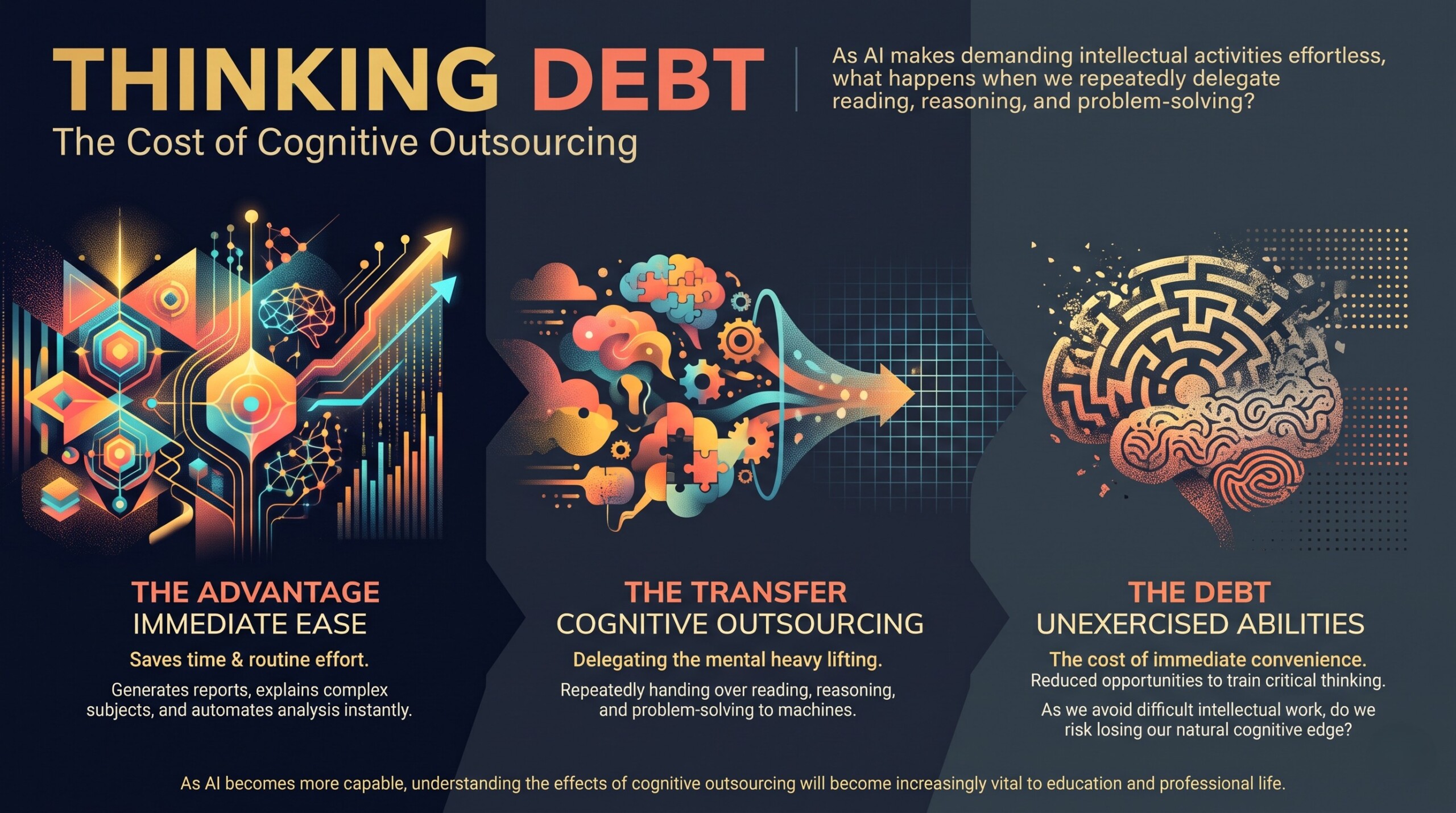
Artificial intelligence has made demanding intellectual activities easier than at any previous time. Students can obtain explanations of complicated subjects, professionals can generate reports, and managers can request detailed analyses without completing every stage themselves. These capabilities provide genuine advantages by reducing routine effort and making knowledge more accessible. However, they also raise questions about what happens when people repeatedly delegate reading, reasoning and problem-solving to machines.
The expression ‘thinking debt’ describes a possible consequence of excessive dependence on external cognitive assistance. When someone routinely avoids difficult intellectual work, the immediate convenience may come at the cost of reduced opportunities to practise important abilities. Existing research has identified associations between confidence in AI and reduced critical-thinking effort during certain tasks, although it has not established that AI causes permanent intellectual decline. As AI becomes more capable during 2027, understanding the effects of cognitive outsourcing will become increasingly relevant to education and professional life.
Let’s dive deep into it.
1. Cognitive outsourcing is becoming an everyday habit
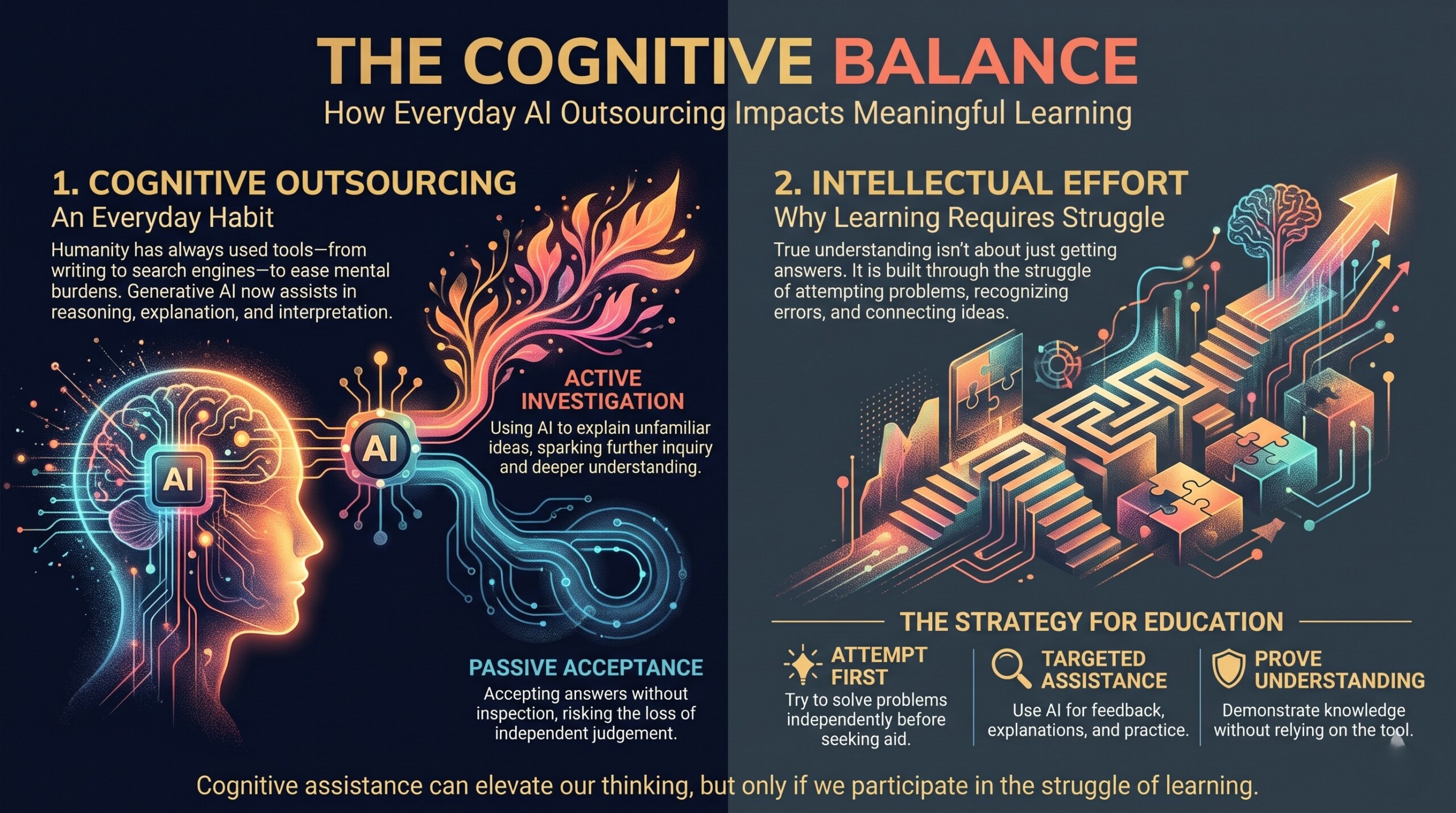
Human beings have always used tools to reduce mental effort. Writing allows us to preserve information, calculators make arithmetic easier, and search engines provide access to knowledge without requiring us to memorise enormous amounts of material. Generative AI extends this process by helping with activities that previously required substantial reasoning, explanation and interpretation.
The consequences depend on how the assistance is used. A person who asks AI to explain unfamiliar information may develop a better understanding of the subject, particularly when the explanation encourages further investigation. Someone who repeatedly accepts complete answers without examining them may miss opportunities to develop the knowledge and judgement required for independent work.
2. Learning requires meaningful intellectual effort
Education involves more than receiving correct answers. Students develop understanding by attempting problems, recognising mistakes, comparing possible solutions and connecting new information with existing knowledge. These activities can be demanding, but they are important components of acquiring durable skills.
AI can support learning through explanations, feedback and practice questions. Difficulties arise when students use it to complete assignments without participating meaningfully in the underlying reasoning. Teachers can encourage more productive behaviour by asking learners to attempt problems independently, use AI for targeted assistance and demonstrate their understanding without relying on the tool.
3. Confidence in AI can reduce critical engagement
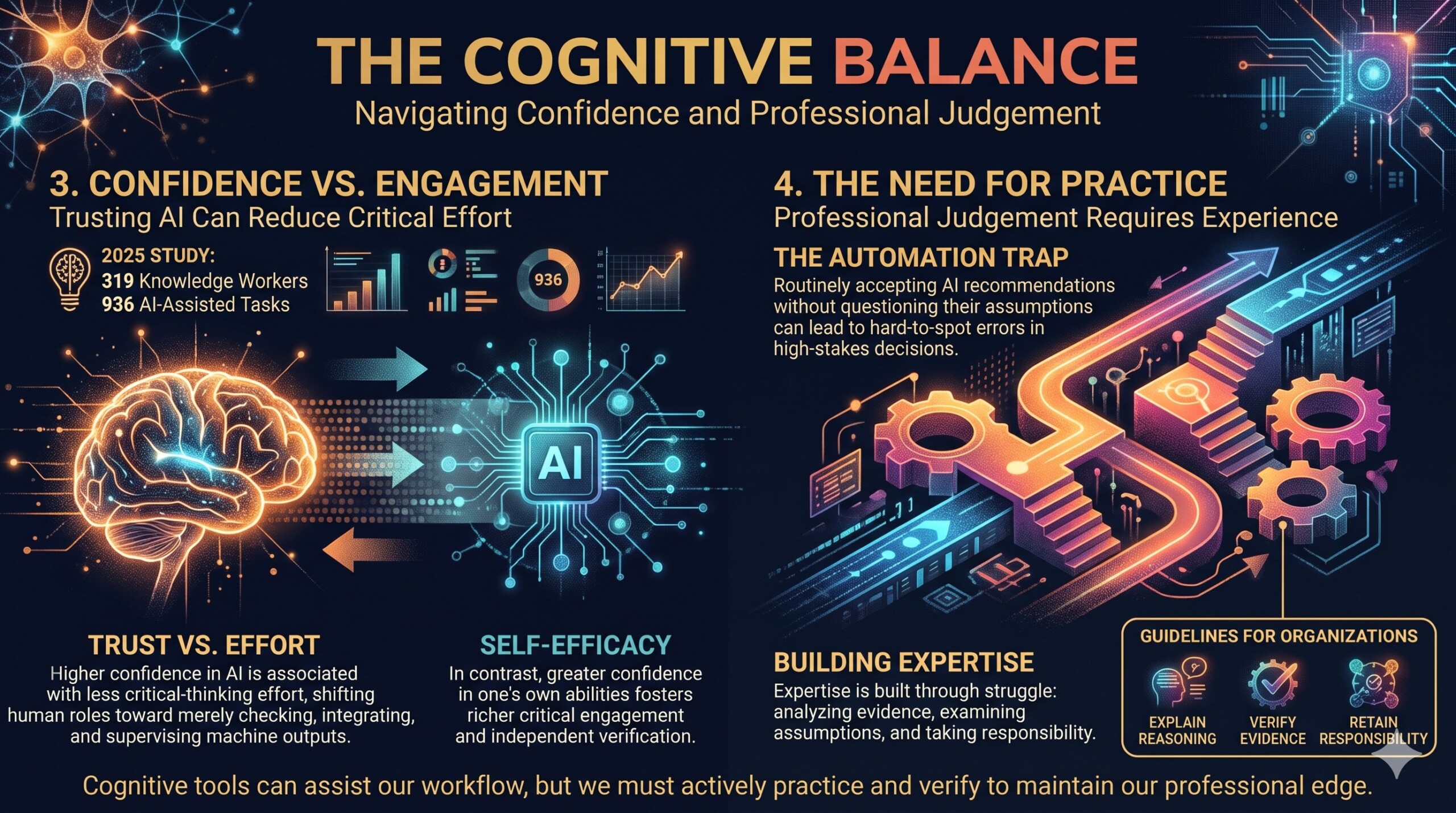
A 2025 Microsoft Research study surveyed 319 knowledge workers and examined 936 examples of AI-assisted professional tasks. The researchers found that greater confidence in AI was associated with less reported critical-thinking effort, while greater confidence in one’s own abilities was associated with more critical engagement. They also observed that AI shifted some critical-thinking activities towards checking information, integrating outputs and supervising completed work.
These findings require careful interpretation because the study relied on self-reported experiences and observational analysis. It did not establish that using AI inevitably reduces intelligence or causes lasting damage to cognitive abilities. Nevertheless, the relationship between trust in automation and independent verification deserves attention, especially as AI becomes involved in increasingly consequential activities.
4. Professional judgement depends on continued practice
Professional expertise develops through experience, analysis and responsibility for decisions. A financial analyst learns to interpret business performance, a doctor evaluates clinical evidence, and a teacher assesses whether students understand difficult concepts. AI can assist these activities by organising information and identifying possible explanations.
Problems may arise when professionals routinely accept AI recommendations without examining their assumptions. The danger is especially significant when errors are difficult to recognise or decisions have important consequences. Organisations should encourage employees to explain their reasoning, verify relevant evidence and retain responsibility for decisions supported by AI.
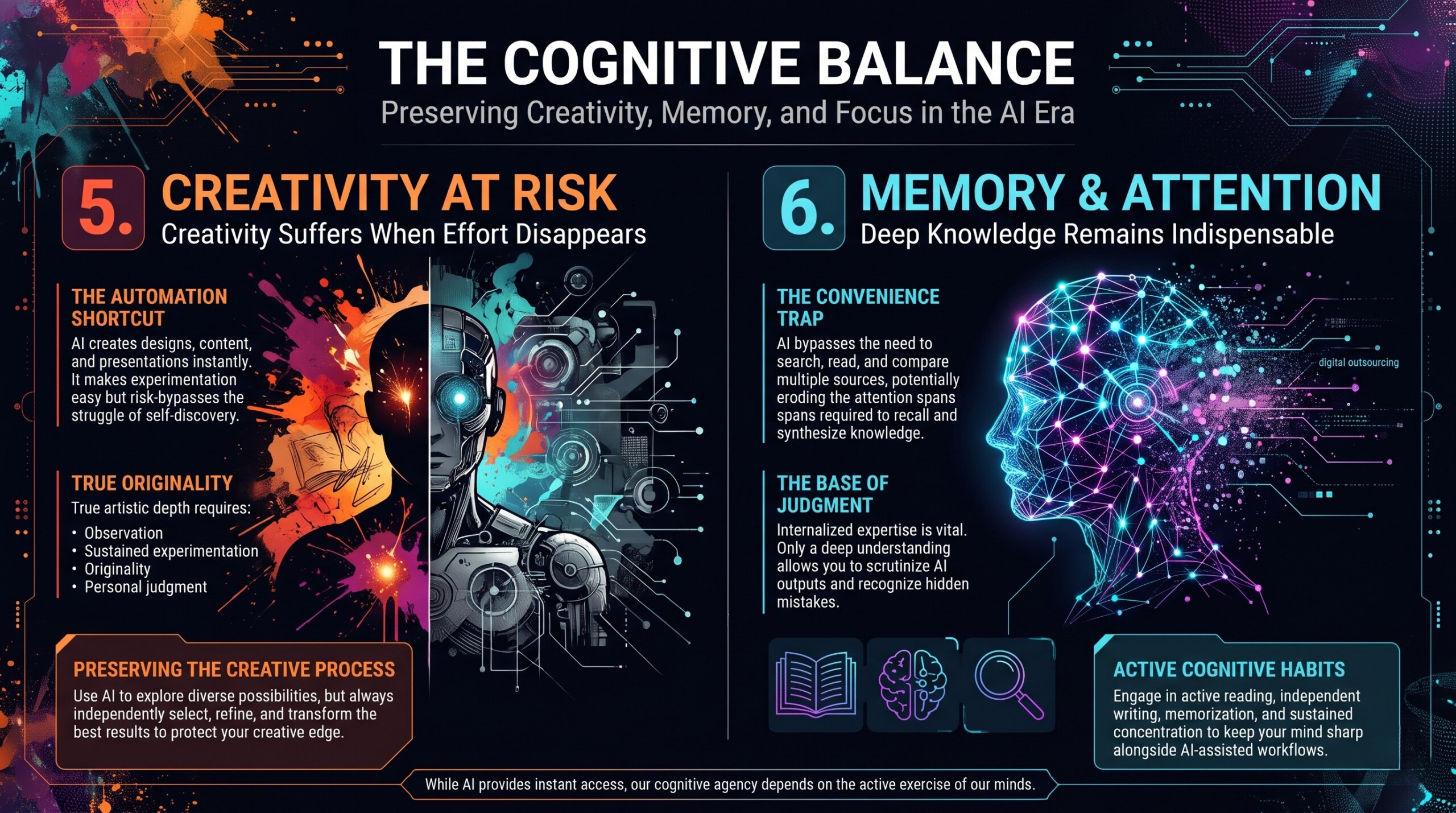
5. Creativity can suffer when effort disappears
Modern AI tools can generate written content, designs, presentations, images and business ideas almost instantly. These capabilities make experimentation easier and help people explore possibilities beyond their existing technical skills. Creative professionals may benefit from comparing alternatives and developing ideas more quickly.
However, creative ability also involves observation, sustained experimentation, originality and the development of personal judgement. Someone who accepts the first generated result may produce content without developing the skills required to recognise an excellent idea. Using AI to explore possibilities while independently selecting and refining the best results can help preserve the intellectual work involved in creativity.

6. Memory and attention remain valuable abilities
Easy access to digital information has changed how people remember and retrieve knowledge. AI adds another layer by producing explanations directly, reducing the need to search, read and compare multiple sources. This convenience can help users obtain information efficiently, especially when dealing with unfamiliar subjects.
Yet substantial knowledge remains valuable because it supports interpretation, judgement and the recognition of mistakes. People who understand a subject deeply can evaluate AI-generated information more effectively than those who depend entirely on the system for explanations. Reading, writing, memorisation where appropriate and sustained concentration can remain useful practices alongside AI-assisted work.
7. Maintaining intellectual independence in 2027
A practical approach is to preserve deliberate opportunities for independent reasoning. Students can attempt problems before requesting hints, professionals can prepare initial arguments before comparing them with AI suggestions, and researchers can examine original evidence before accepting automated summaries. These habits help users benefit from AI while continuing to exercise their own intellectual abilities.
Schools and employers can reinforce this approach by evaluating the process of thinking alongside the finished result. Learners may be asked to defend conclusions, explain calculations, identify uncertainty or complete selected tasks independently. Such practices encourage the development of judgement and expertise within an increasingly automated working environment.
Conclusion
Artificial intelligence offers powerful opportunities to improve learning, productivity and access to knowledge, but those benefits require thoughtful use. Current research raises legitimate concerns about excessive cognitive outsourcing while leaving important questions about long-term effects unresolved. The central educational challenge is to preserve opportunities for meaningful reasoning, concentration and independent judgement. As 2027 approaches, intellectual independence may become especially valuable in a world where sophisticated answers are increasingly easy to obtain.
Share this with the world
Related Articles