The teacher’s dilemma: How much thinking should children delegate to AI?
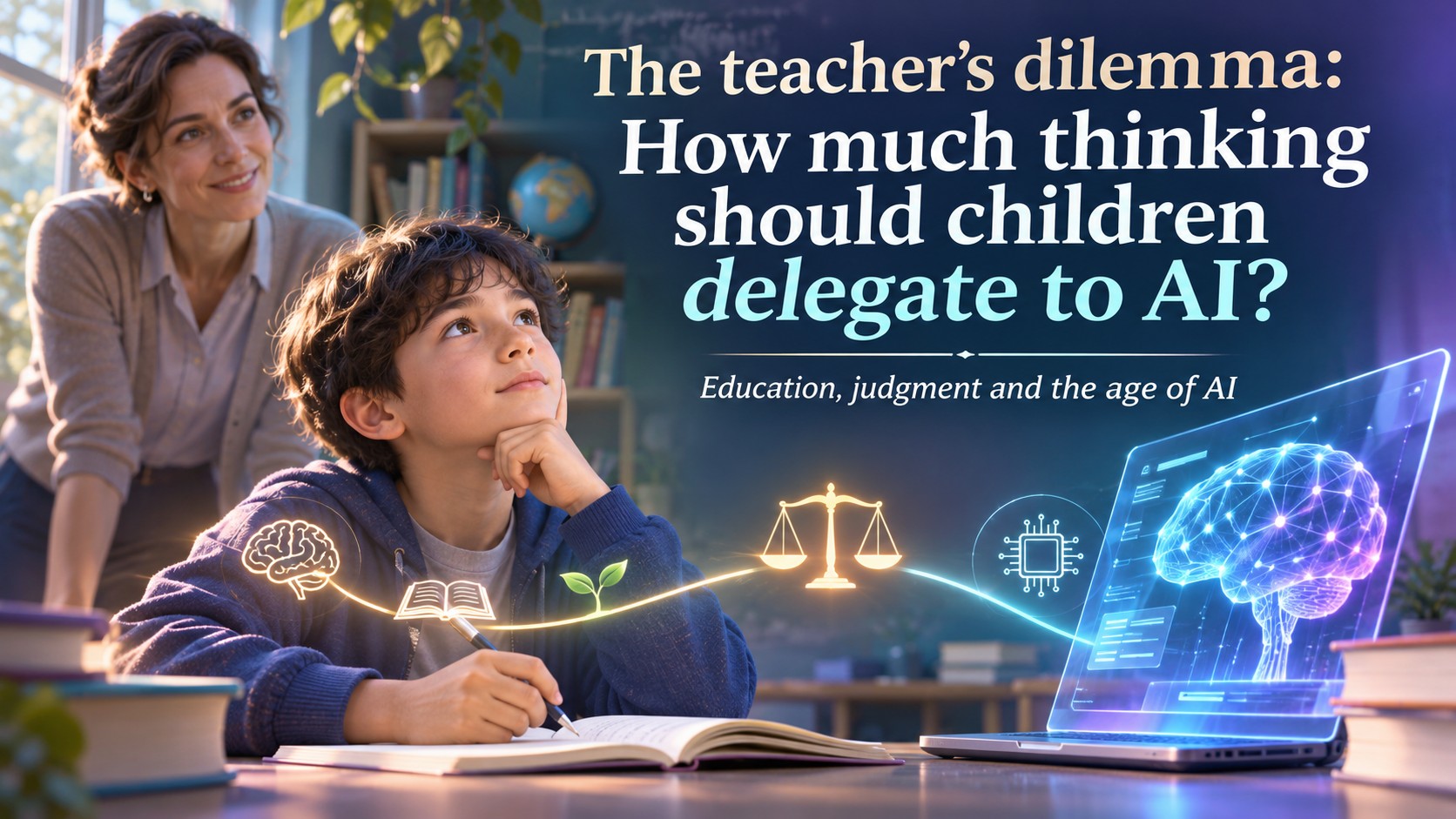
The teacher’s dilemma: How much thinking should children delegate to AI?
Introduction
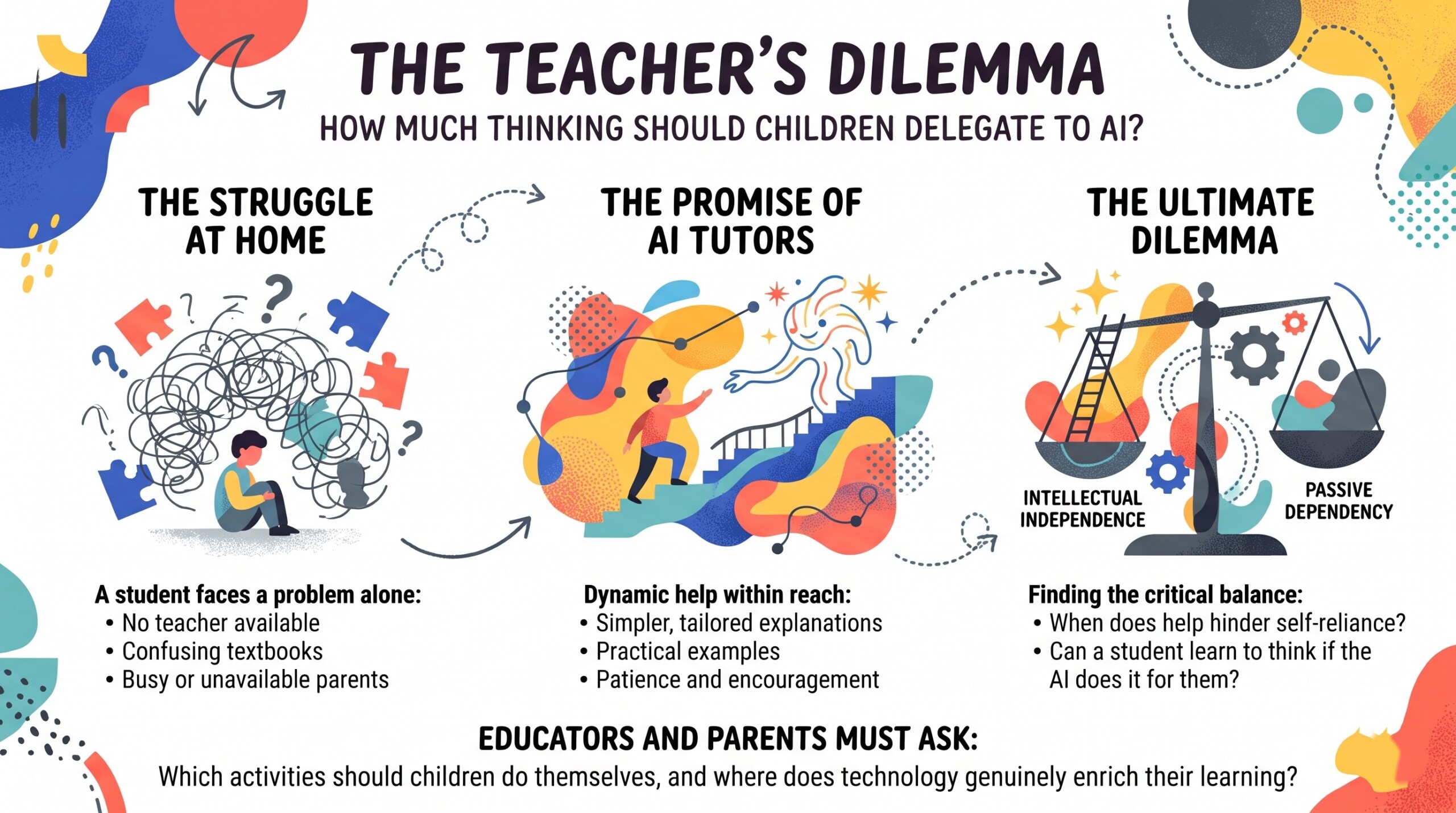
Imagine a child struggling with a mathematics problem at home. The teacher is unavailable, the textbook explanation seems confusing and the parents may lack the time or knowledge to help. An appropriately designed AI tutor could offer a simpler explanation, present a related example and provide encouragement until the child begins to understand the concept.
Such assistance could make education more accessible to millions of children. However, it introduces a fascinating dilemma for teachers and parents concerning the relationship between receiving help and developing intellectual independence. As artificial intelligence enters classrooms and homes, educators must consider which activities children should perform themselves and where technological assistance can genuinely enrich their learning.
Let’s dive deep into it!
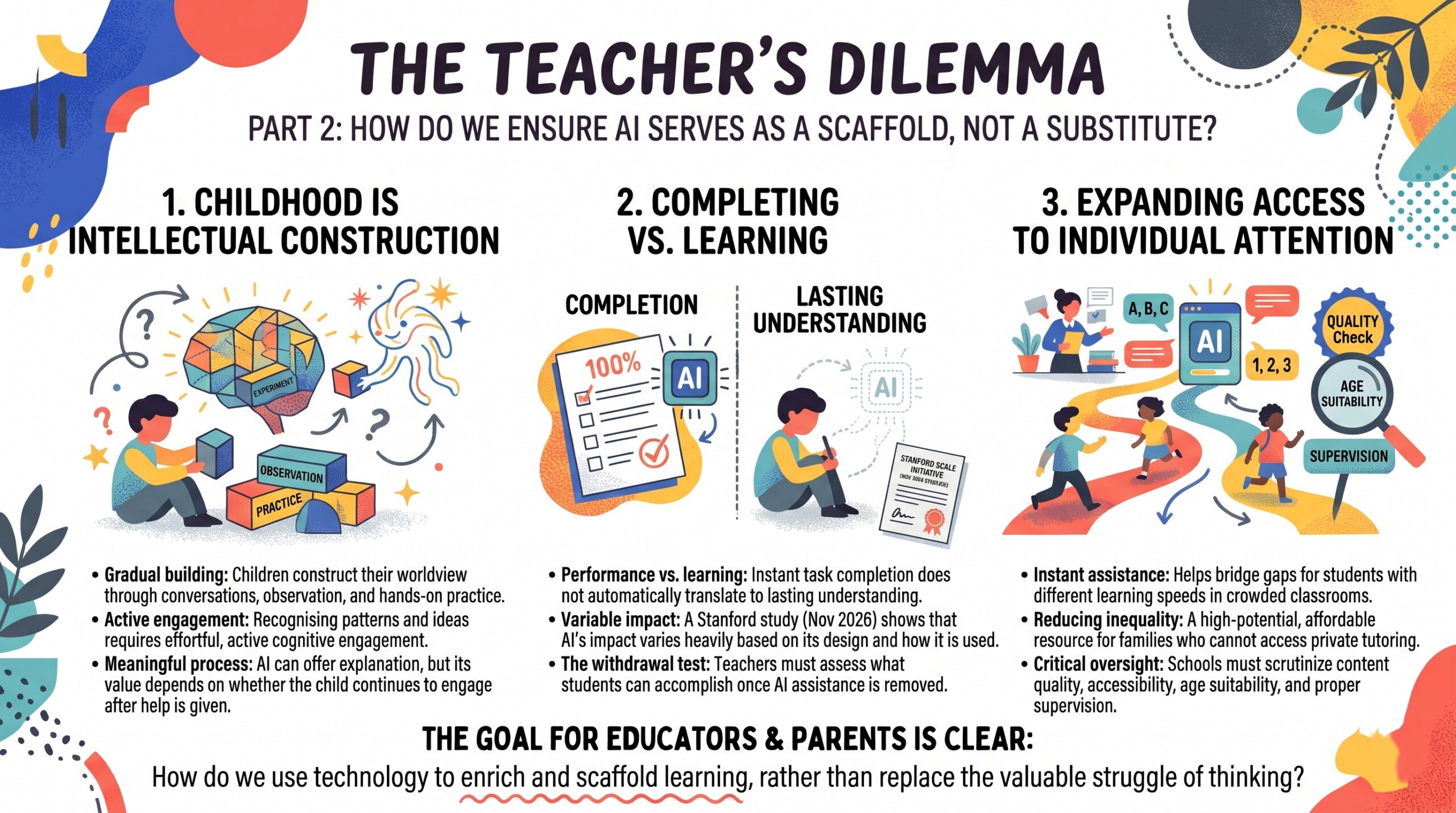
1. Childhood is a period of intellectual construction
Children gradually construct their understanding of the world through conversations, observation, experimentation and practice. Learning to recognise patterns, understand language and connect unfamiliar ideas with previous knowledge requires active engagement. Teachers carefully design activities that help these abilities develop over time.
AI tutoring can participate in this process by offering explanations and responding to individual learning needs. Its educational value will depend on whether children engage meaningfully with the subject after receiving assistance. A completed worksheet may reveal very little about what a child has actually understood.
2. Completing an assignment and learning are different achievements
Research increasingly distinguishes between immediate improvements in student performance and lasting improvements in understanding. A November 2026 evidence review from Stanford’s SCALE Initiative examined studies of AI in education and found that learning outcomes varied according to the design of the technology and its educational application.
These findings suggest that schools should examine what students can accomplish after AI assistance is withdrawn. For instance, a learner who successfully completes a mathematics assignment with an AI tutor could subsequently attempt a similar problem independently. Such exercises help teachers understand whether the original assistance contributed to lasting learning.
3. AI can expand access to individual attention
A classroom may contain children with widely different levels of preparation, confidence and learning speed. Even an excellent teacher cannot always provide an immediate individual explanation to every learner who encounters difficulty. AI tutoring offers the possibility of additional assistance beyond the limited time available during ordinary classroom activities.
This opportunity is particularly relevant in countries where private tutoring is unaffordable for many families. A carefully designed system could provide supplementary explanations in familiar languages and at suitable levels of difficulty. Schools must nevertheless examine accessibility, content quality, age suitability and the availability of appropriate supervision before adopting such tools.
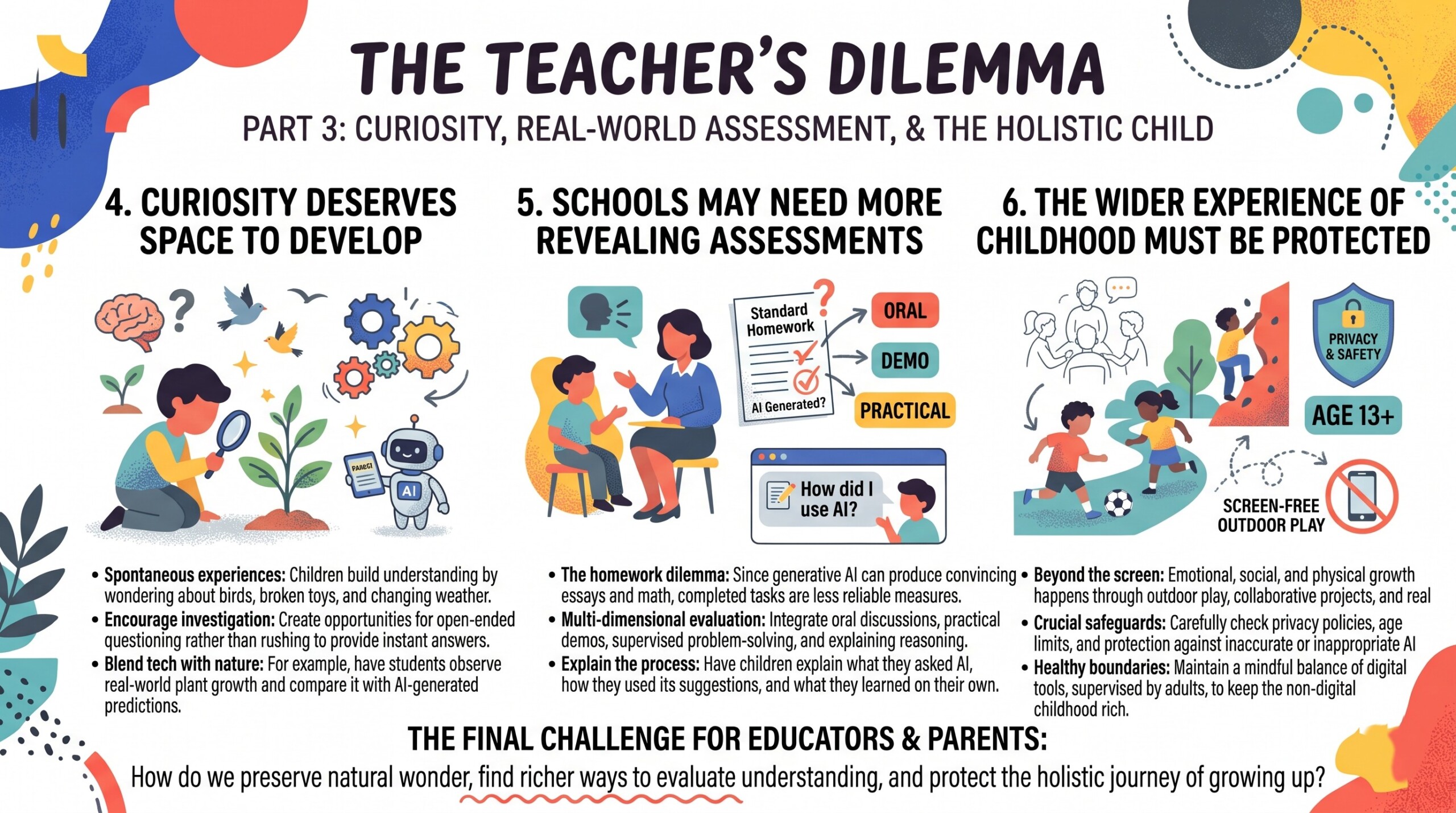
4. Curiosity deserves space to develop
Children often encounter questions through spontaneous experiences, such as watching birds, examining a broken toy or observing changing weather. Their attempts to explain these experiences can lead towards increasingly sophisticated understanding. Educators can encourage this curiosity by creating opportunities for investigation rather than immediately providing every possible explanation.
AI could help children explore questions through guided conversations and simple experiments. A teacher might ask students to observe the growth of a plant, record their findings and compare them with an AI-generated prediction. The resulting discussion connects digital assistance with direct experience of the natural world.
5. Schools may need more revealing assessments
Traditional homework assignments often provide teachers with evidence of students’ understanding. Generative AI can now produce convincing essays, mathematical solutions and science explanations, making the completed assignment a less dependable measure when the amount of assistance is unknown.
Teachers could supplement existing assessments with oral discussions, supervised problem-solving, practical demonstrations and explanations of reasoning. Children might also be invited to describe what they asked an AI system, how they used its suggestions and which ideas they discovered independently. These approaches can provide a richer picture of learning while encouraging responsible technology use.

6. The wider experience of childhood must be protected
Education encompasses friendships, social interaction, physical activity, imagination and emotional development. Children acquire important capabilities through collaborative projects, disagreements, outdoor experiences and relationships with adults. These experiences provide forms of development that extend beyond the academic assistance offered by digital systems.
Parents and schools should also examine the age restrictions, privacy arrangements and safeguards of any AI service used by children. Younger learners may have difficulty recognising inaccurate advice or inappropriate content. Age-appropriate tools, adult involvement and a healthy balance of digital and non-digital activities deserve careful consideration.
7. A practical classroom experiment for 2027
Teachers could divide selected assignments into three stages: independent exploration, guided assistance and independent application. Students would initially attempt a problem themselves, receive a suitable hint or explanation from an approved AI tutor, and subsequently attempt a related problem without assistance. This approach gives educators opportunities to observe both immediate progress and subsequent understanding.
The method could be adapted for mathematics, language learning, science and other subjects. Older students might compare AI-generated explanations, identify weaknesses and design their own investigations. The appropriate degree of assistance would depend on the learner’s age, prior knowledge and the educational purpose of each activity.
Conclusion
Artificial intelligence offers schools an opportunity to expand access to educational assistance while reconsidering familiar methods of teaching and assessment. Its most valuable applications may emerge when teachers deliberately design activities that support understanding, curiosity and independent intellectual development. Children growing up during the AI revolution deserve both the benefits of extraordinary new technologies and the deeply human experience of discovering what their own minds can achieve.
Share this with the world
Related Articles